文档文本内容
Unit 6 Topic2 小结
一.重点单词。
1. literature n. 文学
2. classic adj. 最优秀的;经典的
3. in one's view 在某人看来
4. overcome v. 克服;解决
5. statement n. 说法;陈述
6. literary adj. 文学的
7. society n. 社团,协会;社会
8. moving adj. 感人的,动人的
9. poetry n. 诗集;诗歌
10. poet n. 诗人
11. playwright n. 剧作家
12. drama n. 戏剧
13. scene n. 场面,片段
14. kiss n. & v. 吻,亲吻
15. masterpiece n. 代表作,杰作
16. district n. 地区;区域
17. unlike prep. 不像;与……不同
adj. 不同的,不像的
18. rainbow n. 虹,彩虹
19. inspiration n. 灵感;妙计
20. eventually adv. 最后,终于
21. golden adj. 金(黄)色的
22. monk n. 僧侣;修道士
23. narrator n. 叙述者;旁白员
24. husband n. 丈夫
25. precious adj. 宝贵的;珍稀的
26. possession n. 个人财产;拥有
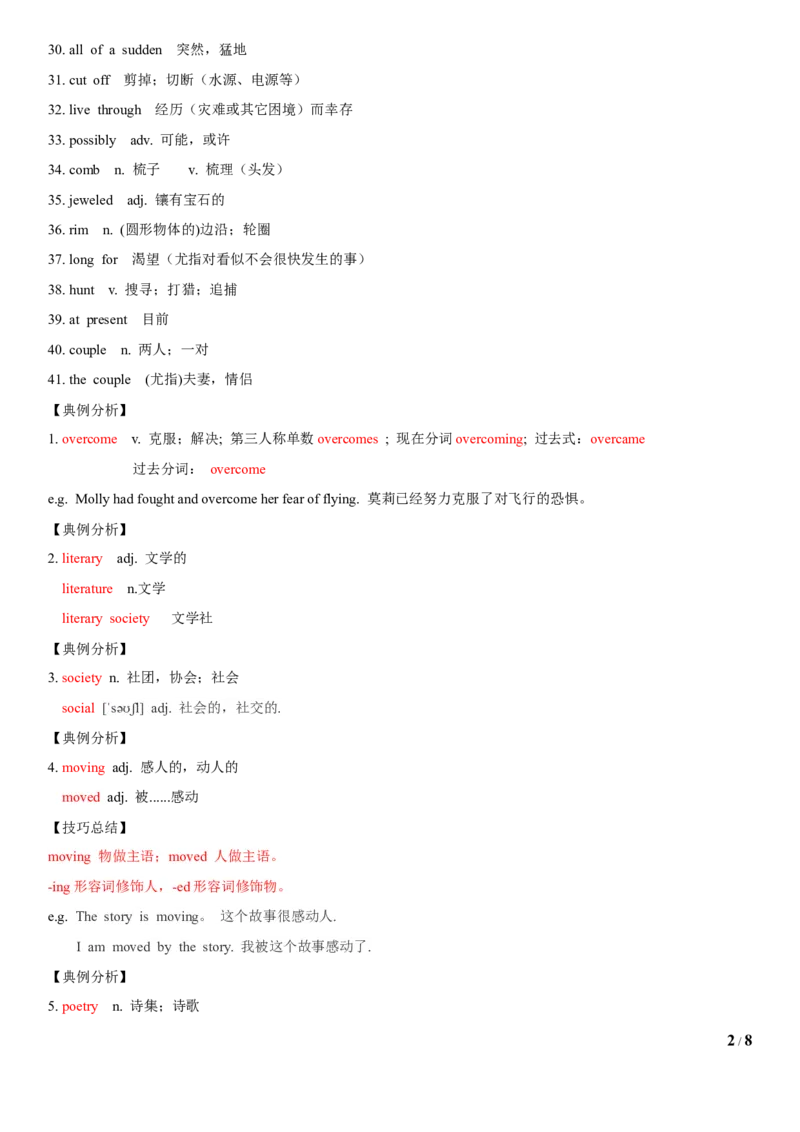
27. wealth n. 财产,财富
28. chain n. 链子;一系列;连锁商店
29. sudden adj. 突然的,忽然的
1 / 830. all of a sudden 突然,猛地
31. cut off 剪掉;切断(水源、电源等)
32. live through 经历(灾难或其它困境)而幸存
33. possibly adv. 可能,或许
34. comb n. 梳子 v. 梳理(头发)
35. jeweled adj. 镶有宝石的
36. rim n. (圆形物体的)边沿;轮圈
37. long for 渴望(尤指对看似不会很快发生的事)
38. hunt v. 搜寻;打猎;追捕
39. at present 目前
40. couple n. 两人;一对
41. the couple (尤指)夫妻,情侣
【典例分析】
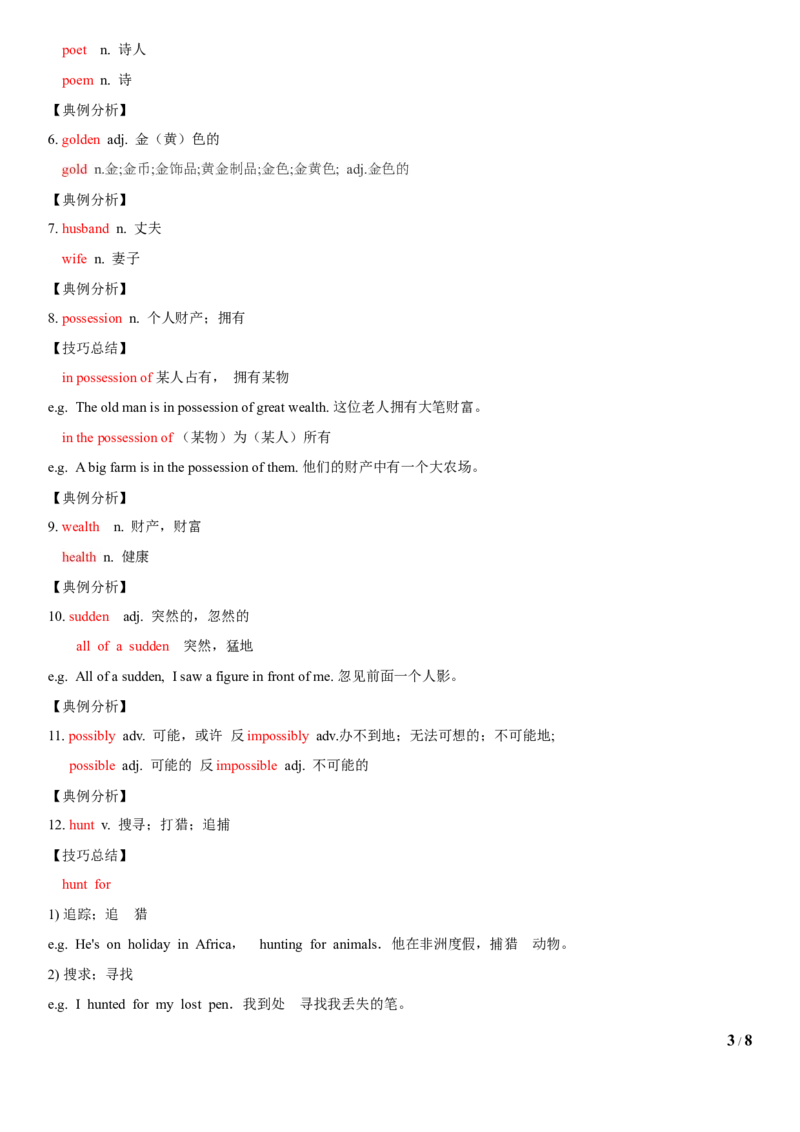
1. overcome v. 克服;解决; 第三人称单数overcomes ; 现在分词overcoming; 过去式:overcame
过去分词: overcome
e.g. Molly had fought and overcome her fear of flying. 莫莉已经努力克服了对飞行的恐惧。
【典例分析】
2. literary adj. 文学的
literature n.文学
literary society 文学社
【典例分析】
3. society n. 社团,协会;社会
social [ˈsəʊʃl] adj. 社会的,社交的.
【典例分析】
4. moving adj. 感人的,动人的
moved adj. 被......感动
【技巧总结】
moving 物做主语;moved 人做主语。
-ing形容词修饰人,-ed形容词修饰物。
e.g. The story is moving。 这个故事很感动人.
I am moved by the story. 我被这个故事感动了.
【典例分析】
5. poetry n. 诗集;诗歌
2 / 8poet n. 诗人
poem n. 诗
【典例分析】
6. golden adj. 金(黄)色的
gold n.金;金币;金饰品;黄金制品;金色;金黄色; adj.金色的
【典例分析】
7. husband n. 丈夫
wife n. 妻子
【典例分析】
8. possession n. 个人财产;拥有
【技巧总结】
in possession of 某人占有, 拥有某物
e.g. The old man is in possession of great wealth. 这位老人拥有大笔财富。
in the possession of (某物)为(某人)所有
e.g. A big farm is in the possession of them. 他们的财产中有一个大农场。
【典例分析】
9. wealth n. 财产,财富
health n. 健康
【典例分析】
10. sudden adj. 突然的,忽然的
all of a sudden 突然,猛地
e.g. All of a sudden, I saw a figure in front of me. 忽见前面一个人影。
【典例分析】
11. possibly adv. 可能,或许 反impossibly adv.办不到地;无法可想的;不可能地;
possible adj. 可能的 反impossible adj. 不可能的
【典例分析】
12. hunt v. 搜寻;打猎;追捕
【技巧总结】
hunt for
1) 追踪;追 猎
e.g. He's on holiday in Africa, hunting for animals.他在非洲度假,捕猎 动物。
2) 搜求;寻找
e.g. I hunted for my lost pen.我到处 寻找我丢失的笔。
3 / 8They hunted high and low for the missing will.他们到处寻找那份 失踪的遗嘱。
二.重点短语。
1. the best way to do sth. 做某事的最好方法
2. defeat their enemies 打败他们的敌人
3. in order to 为了
4. in fact = as a matter of fact 实际上
5. in my view 在我看来;我认为
6. without the help of... = without one’s help 如果没有…的帮助
7. be full of = be filled with 充满,装满
8. Chinese literature 中国文学作品
9. one of .……中之一
10. the four classic novels 四大名著
11. like……better=prefer 更喜欢
12. neither……nor 既不……也不……
13. without the help of 没有……的帮助
14. be considered to be… 被认为是…
15. △a lot of poetry 很多诗
16. be regarded as… 被视为…
17. be known/famous for 因…而著名
18. in one’s lifetime 在某人一生中
19. the dark side of human nature 人性的黑暗面
20. grow up 长大
21. △go for long walks in the mountains 在山里长时间地散步
22. △take boat rides 乘船
23. △have a strong imagination 想象力很丰富
24. graduate from… 从…毕业
25. each time 每次
26. from an early age 从小
27. be interested in… 对…感兴趣
28. be set free 被…释放
29. fight against... 与…作斗争
30. to feel better 为了觉得好一点
31. return to 返回
4 / 832. be different from 与 ..... 不同
33. feel sad 感觉难过
34. buy sth for sb= buy sb sth 为某人买某物
35. in fact 事实上,实际上
36. have sth done 使某人,某物被...
37. all of a sudden 突然
38. cut off 切断
39. live through 度过,经受过
40. long for 渴望
41. put away 收好
42. at present 目前
【典例分析】
1. in order to 为了
e.g. He gets up very early in order to get up early.
【典例分析】
2. in one’s view 在某人看来,常放在句首,后面引出某人的看法。
e.g. In his view(在他看来),we should go there by train.
【典例分析】
3. neither……nor…… 两者都不/ 即不……也不……,
后面的谓语动词就近原则。
e.g. Neither he nor I am from China.
Neither I nor he is from China.他和我都不是来自中国。
【技巧总结】
1) both…and… 两者都,谓语多用复数
e.g. Both he and I like English.他和我都喜欢英语
2) not only…but also… 不仅....而且/either…or… 要么...要么/neither…nor… 即不……也不……,后谓语由后一个主
语确定,即就近原则。
e.g. Not only I but also he likes English.不仅我而且他也喜欢英语。
Either you or I am right. 要么是你对,要么是我对。
Neither my dad nor my mom is at home.我爸爸和我妈妈都不在家。
【典例分析】
4. be considered to be…… 被认为是……
e.g. He is considered to be one of the best romantic poets in China.
5 / 8他被认为是中国最好的浪漫主义诗人之一。
【典例分析】
5. be interested in sth.对某事感兴趣 ’
e.g. He is interested in the film。他对这部电影感兴趣。
be interested in doing sth. 对做某事感兴趣
e.g. He is interested in playing football. 他对踢足球感兴趣
【典例分析】
6. grow up 长大 过去式 grew up
e.g. He grew up in China. 他在中国长大.
【典例分析】
7. have sth done 使某人,某物被...
e.g. He has his hair cut off. 他剪了头发.
【典例分析】
8. live through 意为“度过,经历过”
e.g. His father has lived through the two world wars.他的父亲经历了两次世界大战。
【典例分析】
9. cut off 切除,切断
e.g. Our phone's been cut off. 我们的电话被切断了。
【典例分析】
10. long for 渴望,羡慕;憧憬
e.g. Senior citizens long for a more predictable and secure future.老年人渴望有一个更稳定、更可预见的未来。
【典例分析】
11. put...away 把…收好; 宾语为it,them时,必须放中间.
e.g. He finished putting the milk away and turned around 她把牛奶收好后转过身来。
三.重难点详解
1.He is a hero in the novel called Journey to the West, which is one of the four classic novels of Chinese literature.
which is one of the four classic novels of Chinese literature为非限制性定语从句,用来修饰先行词Journey to the West.
2. I think he is the bravest character I,ve ever known.
I’ve ever known 是定语从句,省略了关系代词that, 修饰先行词character.
当先行词被形容词的最高级或序数词修饰时,关系代词只能用that.,当that 在从句中做宾语时,可以省略。
3. helpful意为“有用的,有益的”。
be helpful to sb. 对某人有用/有益。
e.g. The booklet should be very helpful to parents of disabled children.
6 / 8这本小册子对于残疾儿童的父母会很有用。
4. In fact, it was Sandy and Pigsy who helped the Monkey King win every battle.
实际上,是沙僧和猪八戒帮助孙悟空赢得了每次战斗。
It is+强调部分+who+其他成分,是强调句型。 除谓语动词不能强调外,其他成分都可强调。强调人时可以将who 换
为that。
e.g. It is I that help you.是我帮助你的。
5. The passage I read about him said that he was as great as the British poet William Shakespeare.
我读过的那篇关于他的文章说到他和英国诗人威廉. 莎士比亚一样伟大。
as + adj + as…… 和…… 一样……
as big as 和…… 一样大
as beautiful as…… 和……一样漂亮。
6. I do understand. 我很理解。
do 用在动词原形之前,表强调。
7. Isn’t it lovely, Jim? 难道它不可爱吗?
这是一个否定疑问句,意为“难道不……?”,通常由be / 助动词/情态动词的否定形式放在句子的开头。回答要据
实做答,事实的确如此就回答“Yes”;事实不是那样,就回答“No”。
e.g.— Aren’t you a doctor?
— Yes, I am. (不,我是医生。)
—No, I’m not. (是,我不是医生。)
8. both...and... 两者都......, 既......又...... 连接并列成分
(连接主语时,谓语动词用复数)
e.g. Both she and her sister are good at English.
9. but 表转折,不能与although/though连用。
e.g. I failed again,but I won't give up.
10. so表因果,不能与but连用。
e.g. The dress was very expensive, so I didn't buy it.
11. as well as 1.和......一样好,2.也,又。
(as well as连接两个主语时,遵循就远原则)
e.g. He speaks English as well as his teacher.
Your parents provide you with food as well as clothes.
He as well as his students has been to the park.
7 / 88 / 8