Unit 5 China and the World
Topic 2 He is really the pride of China.
(满分100分,时间80分钟)
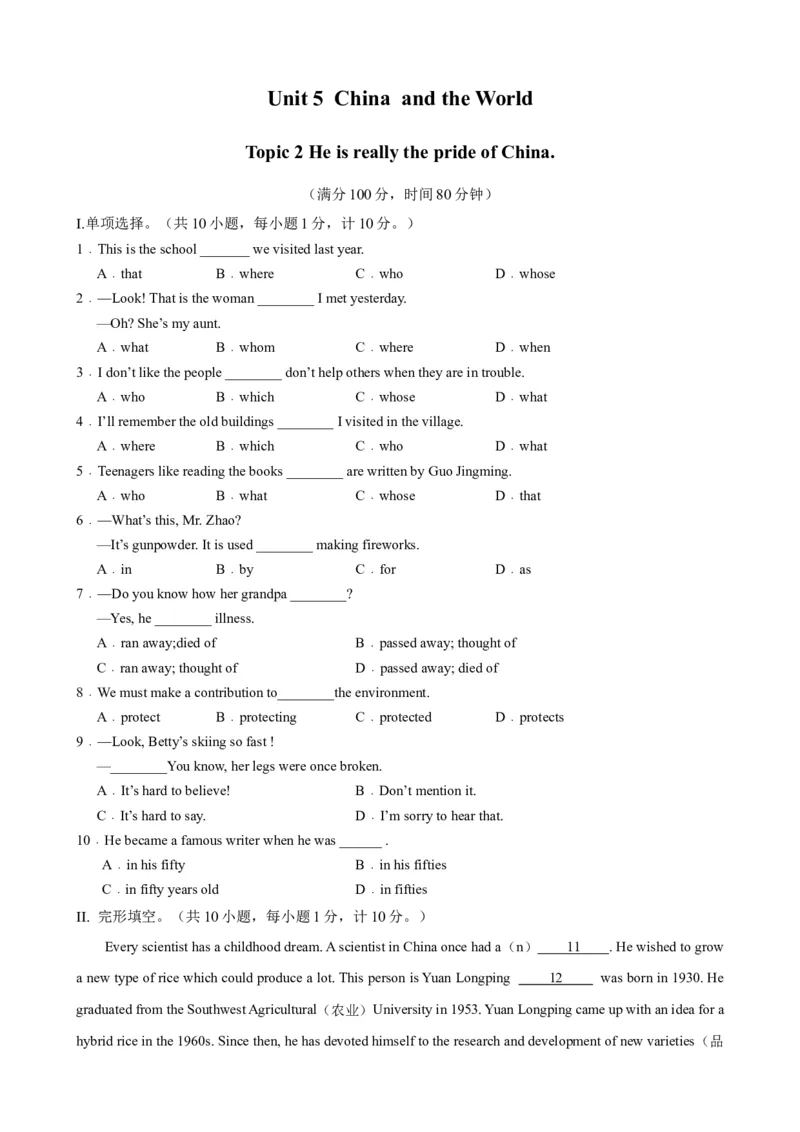
I.单项选择。(共10小题,每小题1分,计10分。)
1.This is the school _______ we visited last year.
A.that B.where C.who D.whose
2.—Look! That is the woman ________ I met yesterday.
—Oh? She’s my aunt.
A.what B.whom C.where D.when
3.I don’t like the people ________ don’t help others when they are in trouble.
A.who B.which C.whose D.what
4.I’ll remember the old buildings ________ I visited in the village.
A.where B.which C.who D.what
5.Teenagers like reading the books ________ are written by Guo Jingming.
A.who B.what C.whose D.that
6.—What’s this, Mr. Zhao?
—It’s gunpowder. It is used ________ making fireworks.
A.in B.by C.for D.as
7.—Do you know how her grandpa ________?
—Yes, he ________ illness.
A.ran away;died of B.passed away; thought of
C.ran away; thought of D.passed away; died of
8.We must make a contribution to________the environment.
A.protect B.protecting C.protected D.protects
9.—Look, Betty’s skiing so fast !
—________You know, her legs were once broken.
A.It’s hard to believe! B.Don’t mention it.
C.It’s hard to say. D.I’m sorry to hear that.
10.He became a famous writer when he was ______ .
A.in his fifty B.in his fifties
C.in fifty years old D.in fifties
II. 完形填空。(共10小题,每小题1分,计10分。)
Every scientist has a childhood dream. A scientist in China once had a(n) 11 . He wished to grow
a new type of rice which could produce a lot. This person is Yuan Longping 12 was born in 1930. He
graduated from the Southwest Agricultural(农业)University in 1953. Yuan Longping came up with an idea for a
hybrid rice in the 1960s. Since then, he has devoted himself to the research and development of new varieties(品种).
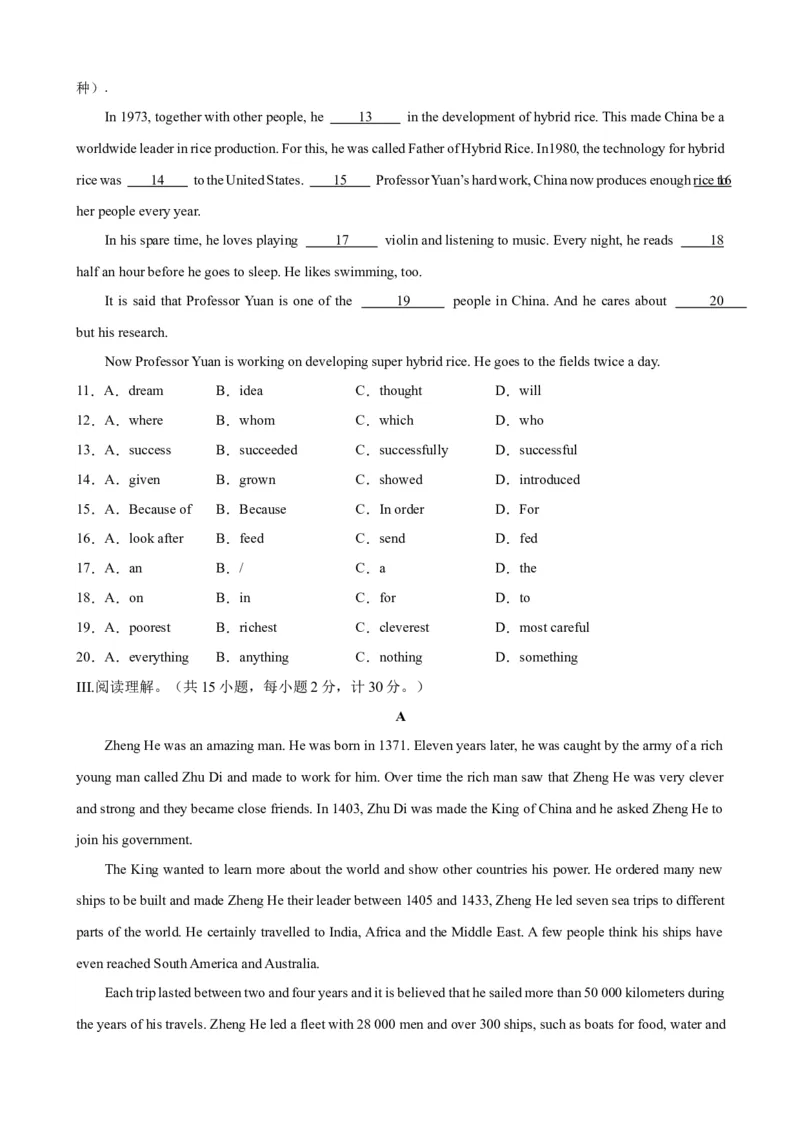
In 1973, together with other people, he 13 in the development of hybrid rice. This made China be a
worldwide leader in rice production. For this, he was called Father of Hybrid Rice. In1980, the technology for hybrid
rice was 14 to the United States. 15 Professor Yuan’s hard work, China now produces enough r i c e t1o6
her people every year.
In his spare time, he loves playing 17 violin and listening to music. Every night, he reads 18
half an hour before he goes to sleep. He likes swimming, too.
It is said that Professor Yuan is one of the 19 people in China. And he cares about 20
but his research.
Now Professor Yuan is working on developing super hybrid rice. He goes to the fields twice a day.
11.A.dream B.idea C.thought D.will
12.A.where B.whom C.which D.who
13.A.success B.succeeded C.successfully D.successful
14.A.given B.grown C.showed D.introduced
15.A.Because of B.Because C.In order D.For
16.A.look after B.feed C.send D.fed
17.A.an B./ C.a D.the
18.A.on B.in C.for D.to
19.A.poorest B.richest C.cleverest D.most careful
20.A.everything B.anything C.nothing D.something
III.阅读理解。(共15小题,每小题2分,计30分。)
A
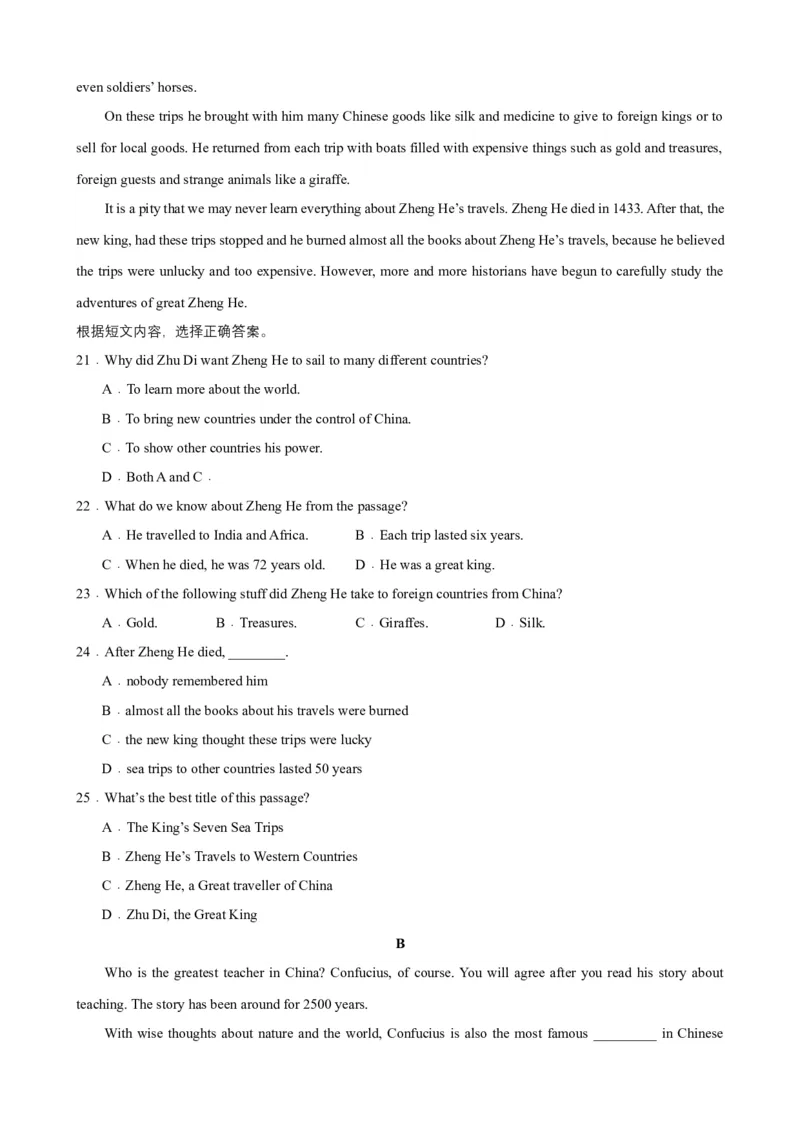
Zheng He was an amazing man. He was born in 1371. Eleven years later, he was caught by the army of a rich
young man called Zhu Di and made to work for him. Over time the rich man saw that Zheng He was very clever
and strong and they became close friends. In 1403, Zhu Di was made the King of China and he asked Zheng He to
join his government.
The King wanted to learn more about the world and show other countries his power. He ordered many new
ships to be built and made Zheng He their leader between 1405 and 1433, Zheng He led seven sea trips to different
parts of the world. He certainly travelled to India, Africa and the Middle East. A few people think his ships have
even reached South America and Australia.
Each trip lasted between two and four years and it is believed that he sailed more than 50 000 kilometers during
the years of his travels. Zheng He led a fleet with 28 000 men and over 300 ships, such as boats for food, water andeven soldiers’ horses.
On these trips he brought with him many Chinese goods like silk and medicine to give to foreign kings or to
sell for local goods. He returned from each trip with boats filled with expensive things such as gold and treasures,
foreign guests and strange animals like a giraffe.
It is a pity that we may never learn everything about Zheng He’s travels. Zheng He died in 1433. After that, the
new king, had these trips stopped and he burned almost all the books about Zheng He’s travels, because he believed
the trips were unlucky and too expensive. However, more and more historians have begun to carefully study the
adventures of great Zheng He.
根据短文内容,选择正确答案。
21.Why did Zhu Di want Zheng He to sail to many different countries?
A.To learn more about the world.
B.To bring new countries under the control of China.
C.To show other countries his power.
D.Both A and C.
22.What do we know about Zheng He from the passage?
A.He travelled to India and Africa. B.Each trip lasted six years.
C.When he died, he was 72 years old. D.He was a great king.
23.Which of the following stuff did Zheng He take to foreign countries from China?
A.Gold. B.Treasures. C.Giraffes. D.Silk.
24.After Zheng He died, ________.
A.nobody remembered him
B.almost all the books about his travels were burned
C.the new king thought these trips were lucky
D.sea trips to other countries lasted 50 years
25.What’s the best title of this passage?
A.The King’s Seven Sea Trips
B.Zheng He’s Travels to Western Countries
C.Zheng He, a Great traveller of China
D.Zhu Di, the Great King
B
Who is the greatest teacher in China? Confucius, of course. You will agree after you read his story about
teaching. The story has been around for 2500 years.
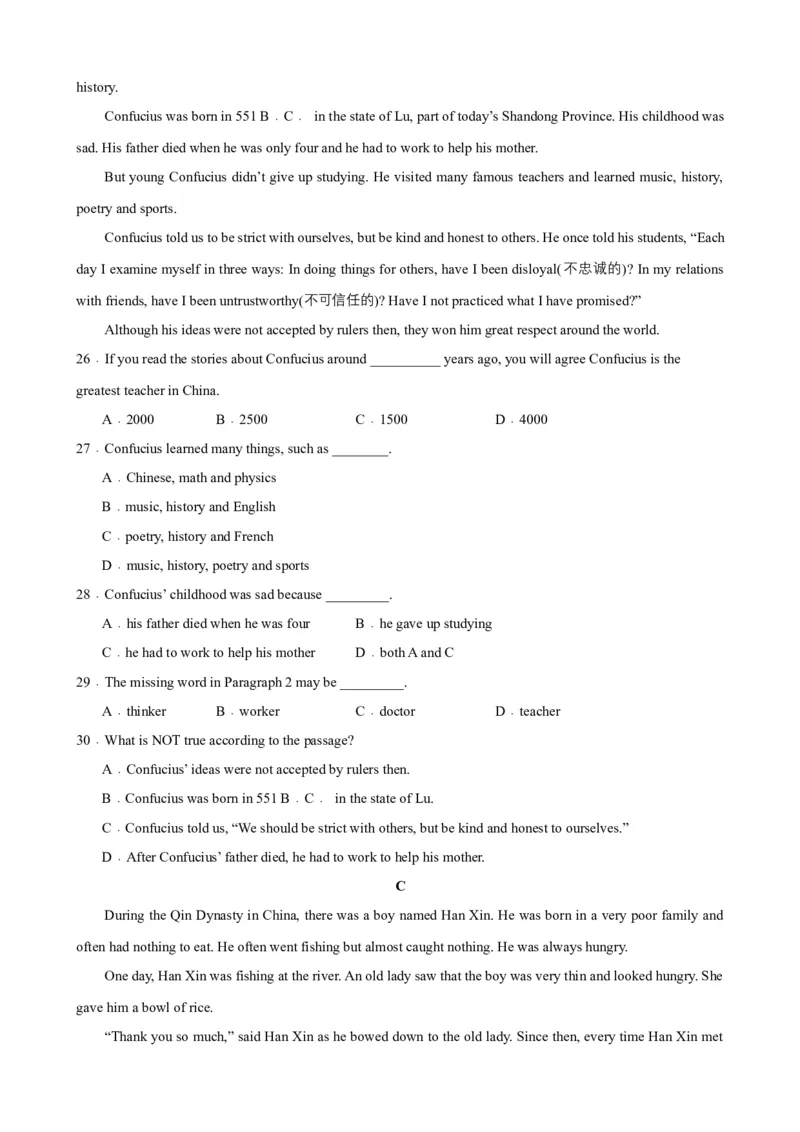
With wise thoughts about nature and the world, Confucius is also the most famous _________ in Chinesehistory.
Confucius was born in 551 B.C. in the state of Lu, part of today’s Shandong Province. His childhood was
sad. His father died when he was only four and he had to work to help his mother.
But young Confucius didn’t give up studying. He visited many famous teachers and learned music, history,
poetry and sports.
Confucius told us to be strict with ourselves, but be kind and honest to others. He once told his students, “Each
day I examine myself in three ways: In doing things for others, have I been disloyal(不忠诚的)? In my relations
with friends, have I been untrustworthy(不可信任的)? Have I not practiced what I have promised?”
Although his ideas were not accepted by rulers then, they won him great respect around the world.
26.If you read the stories about Confucius around __________ years ago, you will agree Confucius is the
greatest teacher in China.
A.2000 B.2500 C.1500 D.4000
27.Confucius learned many things, such as ________.
A.Chinese, math and physics
B.music, history and English
C.poetry, history and French
D.music, history, poetry and sports
28.Confucius’ childhood was sad because _________.
A.his father died when he was four B.he gave up studying
C.he had to work to help his mother D.both A and C
29.The missing word in Paragraph 2 may be _________.
A.thinker B.worker C.doctor D.teacher
30.What is NOT true according to the passage?
A.Confucius’ ideas were not accepted by rulers then.
B.Confucius was born in 551 B.C. in the state of Lu.
C.Confucius told us, “We should be strict with others, but be kind and honest to ourselves.”
D.After Confucius’ father died, he had to work to help his mother.
C
During the Qin Dynasty in China, there was a boy named Han Xin. He was born in a very poor family and
often had nothing to eat. He often went fishing but almost caught nothing. He was always hungry.
One day, Han Xin was fishing at the river. An old lady saw that the boy was very thin and looked hungry. She
gave him a bowl of rice.
“Thank you so much,” said Han Xin as he bowed down to the old lady. Since then, every time Han Xin metthe old lady at the river, he never went hungry. Han Xin was very thankful to the old lady. “I will find a way to pay
you back someday,” he said.
“Why do you promise so much when you have nothing?” she said. “I give you rice because I feel sorry that
you don’t have anything to eat. I don’t expect you to repay me. If you are a real man, you will find a way to support
yourself.”
When Han Xin grew up, he became brave and kind. He joined the army and then became a general. And later
he became the “King of Qi” and the “King of Chu” in the Han Dynasty. He did many good things and helped many
people.
Han Xin never forgot the old lady. He went back to the village and took her to his palace. Han Xin bowed down
to her and gave her a bowl filled with gold.
“I promised I would pay you back someday,” he said.
The old lady refused. “Thank you for the gold,” she said. “You have already paid me back by becoming a
strong and kind man.”
The Chinese idiom “one rice, thousand gold” (一饭恩,千金酬) comes from this story. It tells us that we
should always give a hand to others without expecting anything in return, and we should also forever remember the
help from someone else.
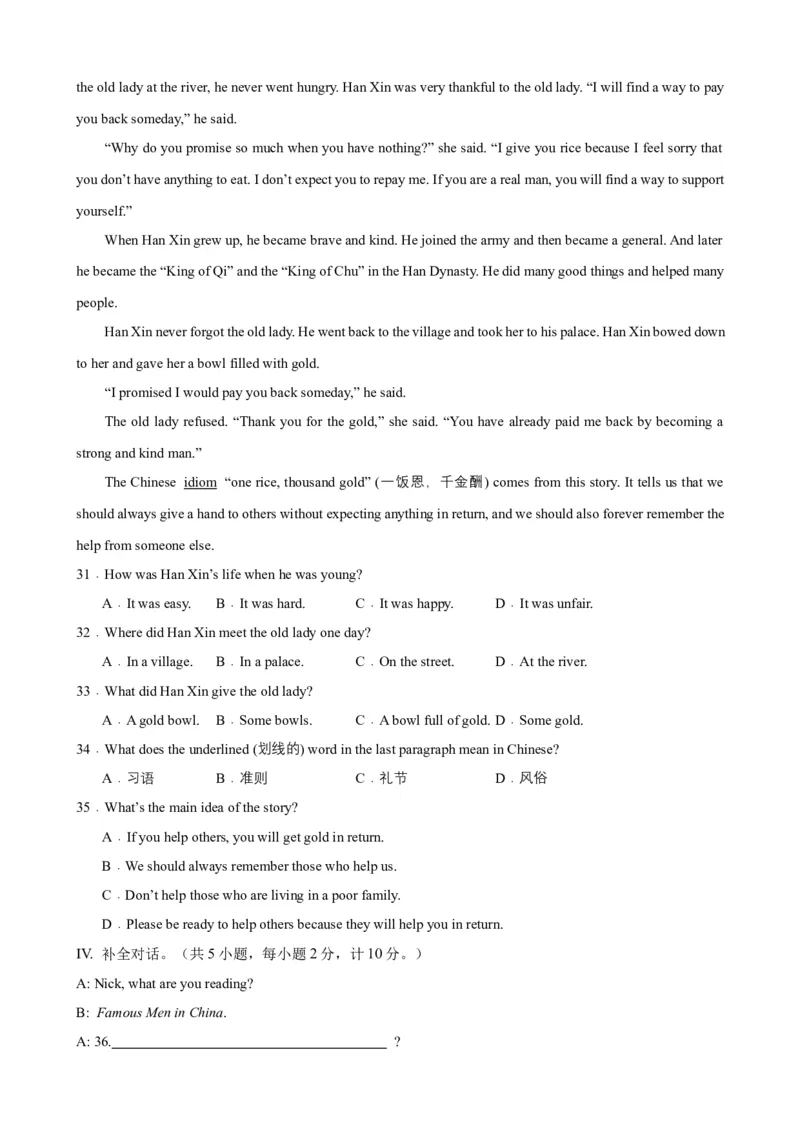
31.How was Han Xin’s life when he was young?
A.It was easy. B.It was hard. C.It was happy. D.It was unfair.
32.Where did Han Xin meet the old lady one day?
A.In a village. B.In a palace. C.On the street. D.At the river.
33.What did Han Xin give the old lady?
A.A gold bowl. B.Some bowls. C.A bowl full of gold. D.Some gold.
34.What does the underlined (划线的) word in the last paragraph mean in Chinese?
A.习语 B.准则 C.礼节 D.风俗
35.What’s the main idea of the story?
A.If you help others, you will get gold in return.
B.We should always remember those who help us.
C.Don’t help those who are living in a poor family.
D.Please be ready to help others because they will help you in return.
IV. 补全对话。(共5小题,每小题2分,计10分。)
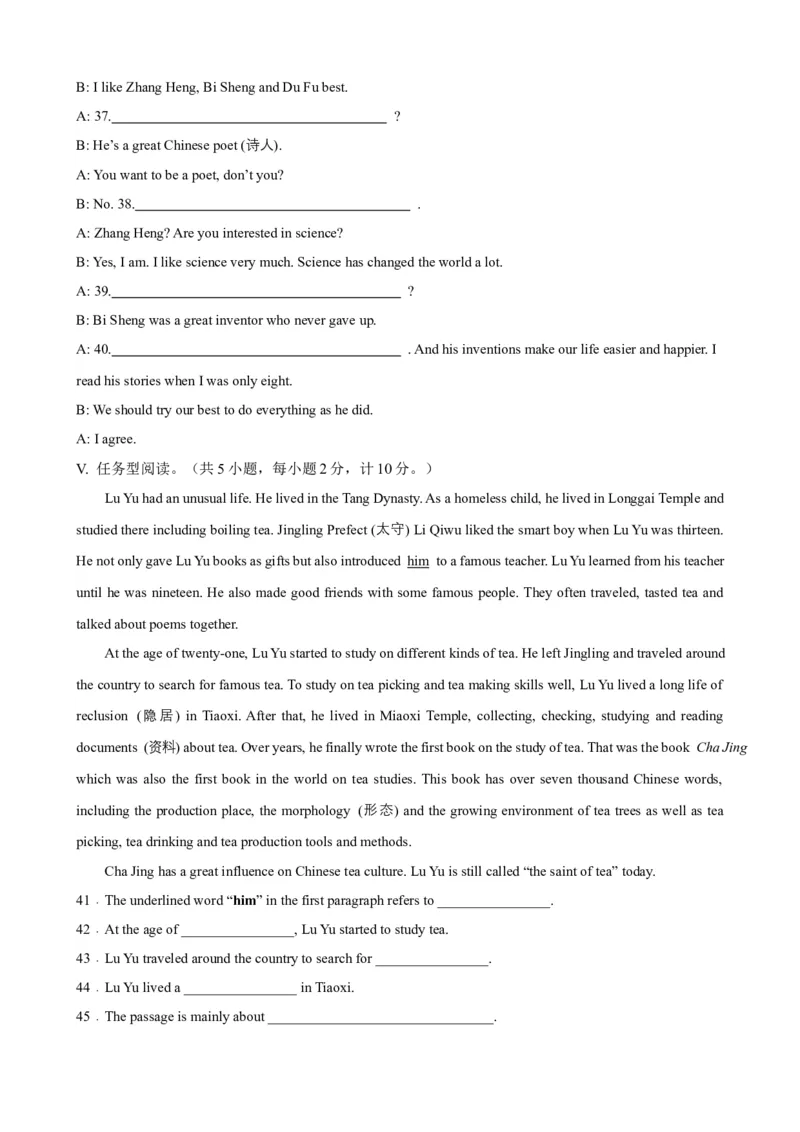
A: Nick, what are you reading?
B: Famous Men in China.
A: 36. ?B: I like Zhang Heng, Bi Sheng and Du Fu best.
A: 37. ?
B: He’s a great Chinese poet (诗人).
A: You want to be a poet, don’t you?
B: No. 38. .
A: Zhang Heng? Are you interested in science?
B: Yes, I am. I like science very much. Science has changed the world a lot.
A: 39. ?
B: Bi Sheng was a great inventor who never gave up.
A: 40. . And his inventions make our life easier and happier. I
read his stories when I was only eight.
B: We should try our best to do everything as he did.
A: I agree.
V. 任务型阅读。(共5小题,每小题2分,计10分。)
Lu Yu had an unusual life. He lived in the Tang Dynasty. As a homeless child, he lived in Longgai Temple and
studied there including boiling tea. Jingling Prefect (太守) Li Qiwu liked the smart boy when Lu Yu was thirteen.
He not only gave Lu Yu books as gifts but also introduced him to a famous teacher. Lu Yu learned from his teacher
until he was nineteen. He also made good friends with some famous people. They often traveled, tasted tea and
talked about poems together.
At the age of twenty-one, Lu Yu started to study on different kinds of tea. He left Jingling and traveled around
the country to search for famous tea. To study on tea picking and tea making skills well, Lu Yu lived a long life of
reclusion (隐居) in Tiaoxi. After that, he lived in Miaoxi Temple, collecting, checking, studying and reading
documents (资料) about tea. Over years, he finally wrote the first book on the study of tea. That was the book Cha Jing
which was also the first book in the world on tea studies. This book has over seven thousand Chinese words,
including the production place, the morphology (形态) and the growing environment of tea trees as well as tea
picking, tea drinking and tea production tools and methods.
Cha Jing has a great influence on Chinese tea culture. Lu Yu is still called “the saint of tea” today.
41.The underlined word “him” in the first paragraph refers to ________________.
42.At the age of ________________, Lu Yu started to study tea.
43.Lu Yu traveled around the country to search for ________________.
44.Lu Yu lived a ________________ in Tiaoxi.
45.The passage is mainly about ________________________________.V. 短文填空。(共10小题,每小题1分,计10分。)
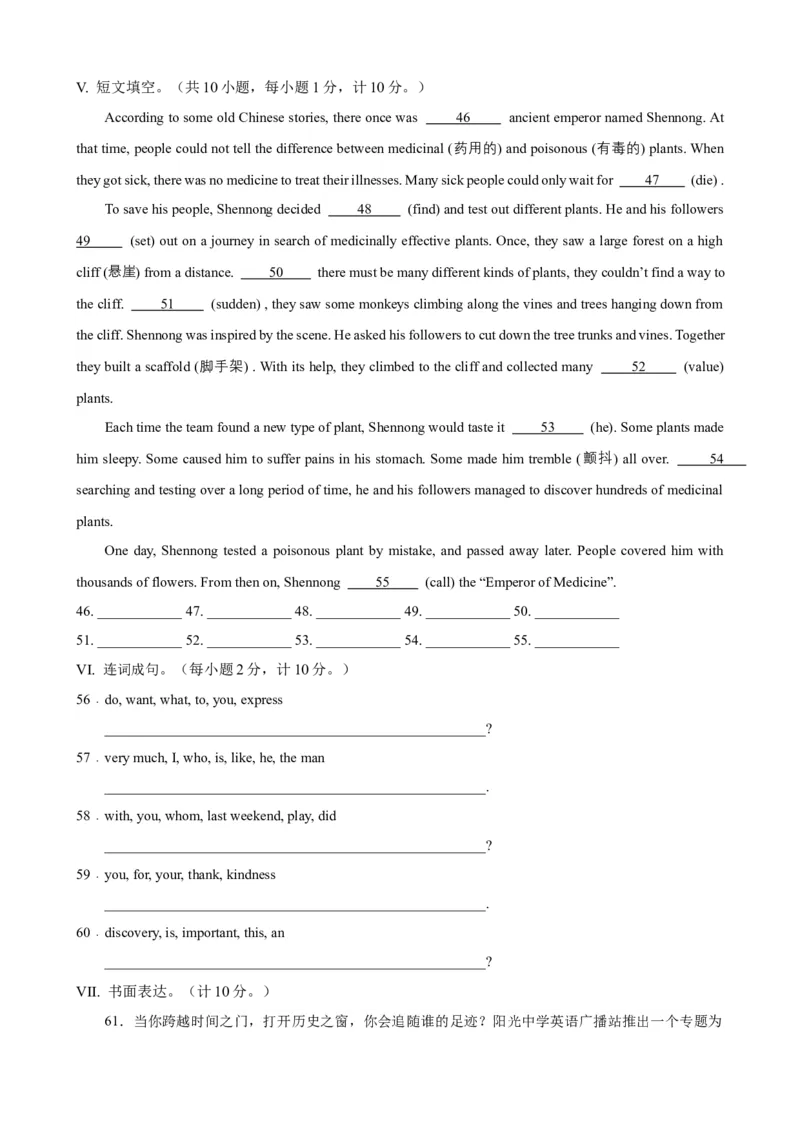
According to some old Chinese stories, there once was 46 ancient emperor named Shennong. At
that time, people could not tell the difference between medicinal (药用的) and poisonous (有毒的) plants. When
they got sick, there was no medicine to treat their illnesses. Many sick people could only wait for 47 (die) .
To save his people, Shennong decided 48 (find) and test out different plants. He and his followers
49 (set) out on a journey in search of medicinally effective plants. Once, they saw a large forest on a high
cliff (悬崖) from a distance. 50 there must be many different kinds of plants, they couldn’t find a way to
the cliff. 51 (sudden) , they saw some monkeys climbing along the vines and trees hanging down from
the cliff. Shennong was inspired by the scene. He asked his followers to cut down the tree trunks and vines. Together
they built a scaffold (脚手架) . With its help, they climbed to the cliff and collected many 52 (value)
plants.
Each time the team found a new type of plant, Shennong would taste it 53 (he). Some plants made
him sleepy. Some caused him to suffer pains in his stomach. Some made him tremble (颤抖) all over. 54
searching and testing over a long period of time, he and his followers managed to discover hundreds of medicinal
plants.
One day, Shennong tested a poisonous plant by mistake, and passed away later. People covered him with
thousands of flowers. From then on, Shennong 55 (call) the “Emperor of Medicine”.
46. ____________ 47. ____________ 48. ____________ 49. ____________ 50. ____________
51. ____________ 52. ____________ 53. ____________ 54. ____________ 55. ____________
VI. 连词成句。(每小题2分,计10分。)
56.do, want, what, to, you, express
______________________________________________________?
57.very much, I, who, is, like, he, the man
______________________________________________________.
58.with, you, whom, last weekend, play, did
______________________________________________________?
59.you, for, your, thank, kindness
______________________________________________________.
60.discovery, is, important, this, an
______________________________________________________?
VII. 书面表达。(计10分。)
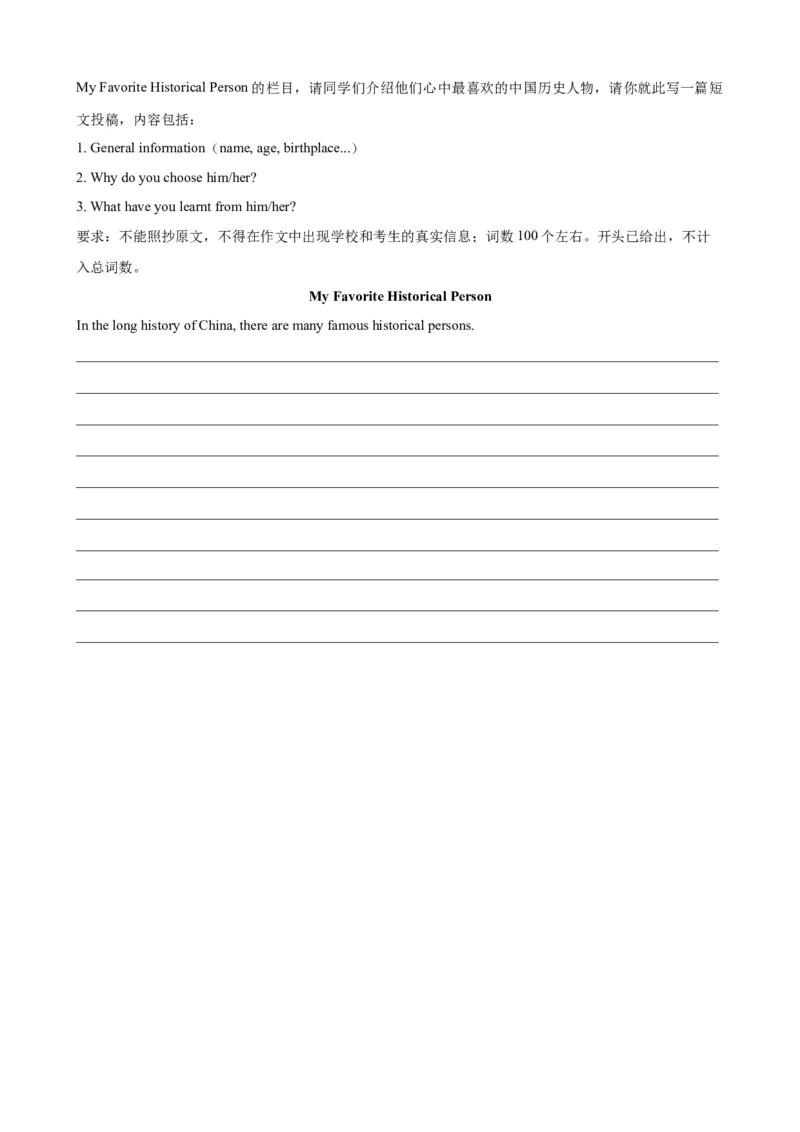
61.当你跨越时间之门,打开历史之窗,你会追随谁的足迹?阳光中学英语广播站推出一个专题为My Favorite Historical Person的栏目,请同学们介绍他们心中最喜欢的中国历史人物,请你就此写一篇短
文投稿,内容包括:
1. General information(name, age, birthplace...)
2. Why do you choose him/her?
3. What have you learnt from him/her?
要求:不能照抄原文,不得在作文中出现学校和考生的真实信息;词数100个左右。开头已给出,不计
入总词数。
My Favorite Historical Person
In the long history of China, there are many famous historical persons.
___________________________________________________________________________________________
___________________________________________________________________________________________
___________________________________________________________________________________________
___________________________________________________________________________________________
___________________________________________________________________________________________
___________________________________________________________________________________________
___________________________________________________________________________________________
___________________________________________________________________________________________
___________________________________________________________________________________________
___________________________________________________________________________________________参考答案
1.A
【详解】句意:这就是我们去年参观的学校。
考查定语从句。that指代人或物,在定语从句中作主语、宾语或表语;where在定语从句中作状语;
who指人,在定语从句作主语、宾语;whose在定语从句中作定语。根据“This is the school ... we
visited last year.”可知,本句为定语从句,先行词the school为下文定语从句的逻辑宾语,指物,用引
导词that。故选A。
2.B
【详解】句意:——看!那就是我昨天遇到的那个女人。——哦?她是我姑姑。
考查定语从句。空格处引导定语从句,从句修饰先行词 the woman,关系词在从句中作宾语。故选
B。
3.A
【详解】句意:我不喜欢那些在别人有困难时不帮助别人的人。
考查定语从句。who谁;which哪一个;whose谁的;what什么。根据“I don’t like the people ... don’t
help others when they are in trouble.”可知,该句是含有定语从句的复合句,先行词“the people”指人,
关系代词应用who。故选A。
4.B
【详解】句意:我将会记得我在农村参观的那些老建筑。
考查定语从句关系词。根据“I visited in the village.”可知是修饰前面的the old buildings的,故本句是
一个定语从句;the old buildings为先行词是物,关系代词应用that或which。故选B。
5.D
【详解】试题分析:句意:青少年喜欢读郭敬明写的书。who先行词是人; what 不能引导定语从句
whose 先行词是人或物,作定语; that先行词是人或物。此句先行词books表示物,关系代词该用
that,所以选D。
6.C
【详解】句意:——这是什么,赵先生?——是火药。它是用来制作烟花的。
考查介词词义辨析。in在……里;by常置于表示被动的动词后,表示使为者;for为了;as作为。根
据空后“making fireworks”可知,空处应是for;be used for…,被用作……。故选C。
7.D
【详解】句意:——你知道她爷爷是怎么去世的吗? ——知道,他是因病去世的。
考查动词短语。ran away逃跑;passed away去世;thought of考虑,关心;died of死于……。结合选项中的动词短语的搭配可知,“爷爷去世的方式”对应“因病去世”才是符合逻辑的对话,所以第
一空应填passed away,第二空应填died of。故选D。
8.B
【详解】句意:我们必须对保护环境做出贡献。
考查短语介词的用法。根据固定用法“make a contribution to doing sth.”为做某事作出贡献。故选B。
9.A
【详解】句意:——看,贝蒂滑雪太快了!——很难相信!你知道,她的腿曾经断过。
考查情景交际。It’s hard to believe!很难相信;Don’t mention it.别提了;It’s hard to say.很难说;I’m sorry
to hear that.听到这个消息我很难过。根据前句“Betty’s skiing so fast !”和后句“her legs were once
broken.”的情景可知,空处应是表示惊讶,应用“很难相信”。故选A。
10.B
【详解】句意:他五十多岁时成了一名著名的作家。
考查数词的用法。在英语中,“in one’s +整十的基数词的复数”表示的是在这个整“十”范围内的人
的岁数或年代。结合选项,故选B。
11.A 12.D 13.B 14.D 15.A 16.B 17.D 18.C 19.D
20.C
【分析】本文是一篇记叙文,介绍了中国杂交水稻之父——袁隆平。他发展的杂交水稻技术,极大
地提高了粮食产量,他一心只做研究,是中国最伟大的人物之一。
11.句意:中国的一位科学家曾经有一个梦想。
dream梦想;idea主意;thought想法;will意志。根据“Every scientist has a childhood dream.”及“He
wished to grow a new type of rice which could produce a lot.”可知,每位科学家都有梦想,此处引出袁
隆平教授的梦想——生产新型水稻。故选A。
12.句意:这个人叫袁隆平,生于1930年。
where先行词指地点;whom先行词指人,在从句中作宾语;which先行词指物;who先行词指人,
在从句中作主语、宾语。根据“This person is Yuan Longping…was born in 1930.”可知,本句是定语从
句,先行词“Yuan Longping”指人,且从句中缺少主语,故用who引导定语从句。故选D。
13.句意:1973年,他和其他人一起成功地研制出了杂交水稻。
success成功,名词;succeeded成功,动词;successfully成功地,副词;successful成功的,形容词。
根据“he…in the development of hybrid rice”可知,句中缺少谓语,故用succeeded;succeed in“在某方
面成功”。故选B。14.句意:1980年,杂交水稻技术被引进美国。
given给;grown种植;showed展示;introduced引进。根据“the technology for hybrid rice was…to the
United States”可知,杂交水稻技术被引进美国。故选D。
15.句意:因为袁教授的辛勤工作,中国现在每年生产足够的大米来喂养她的人民。
Because of因为,由于,后接名词、动名词或名词短语;Because因为,后接句子;In order按顺序;
For为了。根据“…Professor Yuan’s hard work”可知,因为袁隆平的辛勤工作,中国……;空格后是名
词短语,故用because of。故选A。
16.句意:因为袁教授的辛勤工作,中国现在每年生产足够的大米来喂养她的人民。
look after照顾;feed喂养;send发送;fed喂养,过去式。根据“China now produces enough rice to…
her people every year.”可知,中国生产水稻来喂养人民;此处是动词不定式作状语,to后应跟动词原
形。故选B。
17.句意:在他的业余时间,他喜欢拉小提琴和听音乐。
an不定冠词,表泛指,用于元音音素开头的单词前;/零冠词;a不定冠词,表泛指,用于辅音音素
开头的单词前;the定冠词。violin“小提琴”表乐器,其前应加定冠词the;play the violin“拉小提琴”
故选D。
18.句意:每天晚上,他在睡觉前读半小时书。
on后接具体的某一天;in后接年、月、季节等;for后接一段时间;to常与from连用,表范围。
“half an hour”表一段时间,其前应加介词for。故选C。
19.句意:据说袁教授是中国最细心的人之一。
poorest最贫穷的;richest最富有的;cleverest最聪明的;most careful最细心的。根据“Now Professor
Yuan is working on developing super hybrid rice. He goes to the fields twice a day.”可知,此处介绍袁隆平
教授在工作上的认真、细心。故选D。
20.句意:他除了他的研究之外什么也不关心。
everything一切事情;anything任何事情;nothing没什么事情;something一些事情。根据“he cares
about…but his research”可知,袁隆平教授除了研究之外,什么也不关心;nothing but“除了……什么也
不,只有”。故选C。
21.D 22.A 23.D 24.B 25.C
【分析】本文是一篇说明文。介绍了历史人物郑和。皇帝朱棣想要更多地了解世界,向其他国家展
示他的力量,于是下令建造许多新的船只,并让郑和成为他们的领袖。1405年至1433年期间,郑和
七次率领海上旅行前往世界各地。他带去了许多中国商品,如丝绸和药品,以赠予外国国王,或卖
了再买当地的商品。郑和于1433年去世。在那之后,新国王停止了这些旅行,并烧毁了几乎所有关于郑和旅行的书。
21.细节理解题。根据文中“The King wanted to learn more about the world and show other countries his
power.”可知,朱棣要郑和航行到许多不同的国家是因为朱棣想了解世界各地,也想展示他的力量。
故选D。
22.细节理解题。根据文中“He certainly travelled to India, Africa and the Middle East.”可知,郑和去
了印度、非洲和中东。故选A。
23.细节理解题。根据文中“On these trips he brought with him many Chinese goods like silk and medicine
to give to foreign kings or to sell for local goods.”可知,郑和从中国带到国外的东西有丝绸。故选D。
24.细节理解题。根据文中“Zheng He died in 1433. After that, the new king, had these trips stopped and
he burned almost all the books about Zheng He’s travels,”可知,郑和死后,几乎所有关于他旅行的书都
被烧毁了。故选B。
25.最佳标题。短文介绍了历史人物郑和,1405年至1433年期间,郑和七次率领海上旅行前往世界
各地,是中国伟大的旅行家。故文章的最佳标题应是“郑和,中国伟大的旅行家”。故选C。
26.B 27.D 28.D 29.A 30.C
【分析】本文是一篇记叙文,介绍了我国著名思想家孔子的生平及其伟大思想。
26.细节理解题。根据原文“The story has been around for 2500 years”可知,关于孔子的故事发生在
2500年前左右。故选B。
27.细节理解题。根据原文“He visited many famous teachers and learned music, history, poetry and
sports”可知,孔子学习的课程有音乐、历史、诗歌、体育。故选D。
28.细节理解题。根据原文“His childhood was sad. His father died when he was only four and he had to
work to help his mother”可知,孔子的童年是不幸的,因为他的父亲去世得早,他必须帮母亲干活。故
选D。
29.词句猜测题。根据原文“With wise thoughts about nature and the world”可知,孔子以其思想而闻名
世界,故此处应填意为“思想家”的名词。故选A。
30.细节理解题。根据原文“Confucius told us to be strict with ourselves, but be kind and honest to
others”可知,孔子教导人们要严于律己,宽以待人。C选项“宽于律己,严于待人”说法错误,故选
C。
31.B 32.D 33.C 34.A 35.B
【导语】本文主要讲述了韩信的“一饭恩,千金酬”的故事。
31.细节理解题。根据“He was born in a very poor family and often had nothing to eat. He often wentfishing but almost caught nothing. He was always hungry.”可知,韩信出身贫寒,经常挨饿,小时候的生
活很艰难。故选B。
32.细节理解题。根据“One day, Han Xin was fishing at the river. An old lady saw that the boy was very
thin and looked hungry. She gave him a bowl of rice.”可知,韩信是在河边遇到的老妇人。故选D。
33.细节理解题。根据“Han Xin bowed down to her and gave her a bowl filled with gold.”可知,韩信给
了老妇人一个装满黄金的碗。故选C。
34.词句猜测题。根据“The Chinese idiom ‘one rice, thousand gold’ comes from this story.”可知,此处
说的是“一饭恩,千金酬”这个习语的来历,idiom是“习语”的意思。故选A。
35.主旨大意题。根据“The Chinese idiom ‘one rice, thousand gold’ comes from this story. It tells us that
we should always give a hand to others without expecting anything in return, and we should also forever
remember the help from someone else.”可知,这篇短文告诉我们要不求回报的帮助别人,更要永远记住
那些帮助过我们的人。故选B。
36.Who/ Whom do you like best among them 37.What does Du Fu do 38.I want to be a scientist
like Zhang Heng 39.What do you know about Bi Sheng/ What do you think of Bi Sheng/ How do you
like Bi Sheng 40.You’re right/So he was/I agree with you
【导语】本文是A和B两个人的对话。对话从B正在读的书谈起,然后谈论了中国的一些历史名人。
36.根据“Famous Men in China.”和“I like Zhang Heng, Bi Sheng and Du Fu best.”可知此处应是问在
这些中国名人中对方最喜欢谁,故填Who/ Whom do you like best among them。
37.根据“He’s a great Chinese poet”可知此处应是问杜甫是做什么的,故填What does Du Fu do。
38.根据“You want to be a poet, don’t you?”和“Zhang Heng? Are you interested in science?”可知此处
应是说自己并不想成为诗人,而是想成为张衡那样的科学家,故填 I want to be a scientist like Zhang
Heng。
39.根据“Bi Sheng was a great inventor who never gave up.”可知此处应是问关于毕昇的情况或是评价,
故填What do you know about Bi Sheng/ What do you think of Bi Sheng/ How do you like Bi Sheng。
40.根据“Bi Sheng was a great inventor who never gave up.”和“And his inventions make our life easier
and happier.”可知此处应是对对方观点的肯定,故填You’re right/So he was/I agree with you。
41.Lu Yu 42.twenty-one 43.famous tea 44.long life of reclusion 45.Lu Yu and his
Cha Jing
【导语】本文主要介绍了陆羽一生从事茶的研究,最终完成了世界上第一部茶叶专著——《茶经》。
41.根据“He not only gave Lu Yu books as gifts but also introduced him to a famous teacher. ”可知,他不仅把书作为礼物送给陆羽,而且把他介绍给一位著名的老师。所以him指的是陆羽,故填Lu Yu。
42.根据“At the age of twenty-one, Lu Yu started to study on different kinds of tea.”可知,二十一岁时,
陆开始研究不同种类的茶。故填twenty-one。
43.根据“He left Jingling and traveled around the country to search for famous tea.”可知,陆羽走遍全国
寻找名茶。故填famous tea。
44.根据“Lu Yu lived a long life of reclusion (隐居) in Tiaoxi. ”可知,陆羽在苕溪过了很长的隐居生活。
故填long life of reclusion。
45.根据全文可知,本文主要介绍了陆羽一生从事茶的研究,最终完成了世界上第一部茶叶专著
——《茶经》。故填Lu Yu and his Cha Jing。
46.an 47.death 48.to find 49.set 50.Although/Though 51.Suddenly 52.
valuable 53.himself 54.After/By 55.was called/has been called
【导语】本文主要介绍了神农尝百草的故事。
46.句意:根据一些古老的中国故事,曾经有一位名叫神农的古代皇帝。此处泛指“一个古代皇
帝”,ancient以元音音素开头,用不定冠词an。故填an。
47.句意:许多病人只能等待死亡。此处缺少介词的宾语,用名词death“死亡”。故填death。
48.句意:为了拯救他的人民,神农决定寻找并试验不同的植物。decide to do sth.“决定做某事”。故
填to find。
49.句意:他和他的追随者开始了寻找药用植物的旅程。set out“出发”,本文时态为一般过去时,
动词用过去式。故填set。
50.句意:尽管肯定有很多不同种类的植物,但他们找不到通往悬崖的路。前后两句是让步关系,
用although/though引导让步状语从句。故填Although/Though。
51.句意:突然,他们看到一些猴子沿着悬崖上垂下来的藤蔓和树木攀爬。此处修饰整个句子用副
词suddenly“突然”。故填Suddenly。
52.句意:在它的帮助下,他们爬上了悬崖,采集了许多珍贵的植物。修饰名词 plants用形容词
valuable“珍贵的”。故填valuable。
53.句意:每次团队发现一种新的植物,神农都会亲自品尝。根据“Shennong would taste it...”可知是
他会亲自尝试,用反身代词himself。故填himself。
54.句意:经过长时间的搜索和测试,他和他的追随者成功地发现了数百种药用植物。根据
“searching and testing over a long period of time”可知是经过长时间的搜索和测试之后,after“在……之
后”;也可说是通过长时间的搜索和测试,by“通过”。故填After/By。55.句意:从此,神农被称为“药祖”。主语和谓语 call之间是被动关系,根据“From then on”可知
此处可用一般过去时的被动语态 was/were done,主语是单数,be动词用was;也可用现在完成时
have/has been done,助动词用has。故填was called/has been called。
56.What do you want to express
【详解】根据所给词及标点可知,此句为特殊疑问句。what为特殊疑问词,后跟助动词do;you为
主语;want“想要”,为谓语动词;to express“表达”,动词不定式作宾语。故填What do you want to
express“你想表达什么”。
57.He is the man who I like very much
【详解】根据所给标点可知,应用陈述句的形式,分析所给单词,he作主语,首字母需大写;is作
系动词;the man作表语;who引导定语从句,位于先行词the man之后;I作从句主语;like作从句
的谓语动词;very much作程度副词,位于句末。故答案为He is the man who I like very much“他是我
非常喜欢的人”。
58.Whom did you play with last weekend
【详解】根据所给单词和标点可知,本句问特殊疑问句,特殊疑问词 whom放于句首,首字母大写,
后跟一般疑问句,did放于主语you之前,play with作谓语,last weekend作时间状语,放于句末。故
填Whom did you play with last weekend“你上周末和谁一起玩”。
59.Thank you for your kindness
【详解】根据所给标点可知应用陈述句形式,分析所给单词,Thank you for因……而感谢,your
kindness作宾语。故答案为:Thank you for your kindness“谢谢你的好意”。
60.Is this an important discovery
【详解】句意:这是一个重要发现吗?根据标点符号判断,句子是以 Is开头的一般疑问句,an
important discovery一个重大发现,结合句意,答案为Is this an important discovery。
61.范文:
My Favorite Historical Person
In the long history of China, there are many famous historical persons. A great number of historical figures
have made great contributions to the society and some of them really impressed themselves on our memory.
As for me, my favorite historical person is Zhuge Liang, a famous politician with great achievement in literature
in the Three Kingdoms period. His intelligence is acknowledged by the Chinese. He helped Liu Bei to get over
the emergencies and successfully established Shu. Moreover, various articles written by him have been passed
on until now, impressing me with his loyalty and huge amount of knowledge. Therefore, I regard loyalty as the
most valuable quality and always keep on learning to be a knowledgeable person. At the same time, I also learn
his wisdom to help more people.There used to be a lot of people who had outstanding thoughts and great achievements. They are our most
precious wealth. We should learn from them.