Unit 6 Entertainment and Friendship
Topic 1 I would rather watch sports shows than those ones.
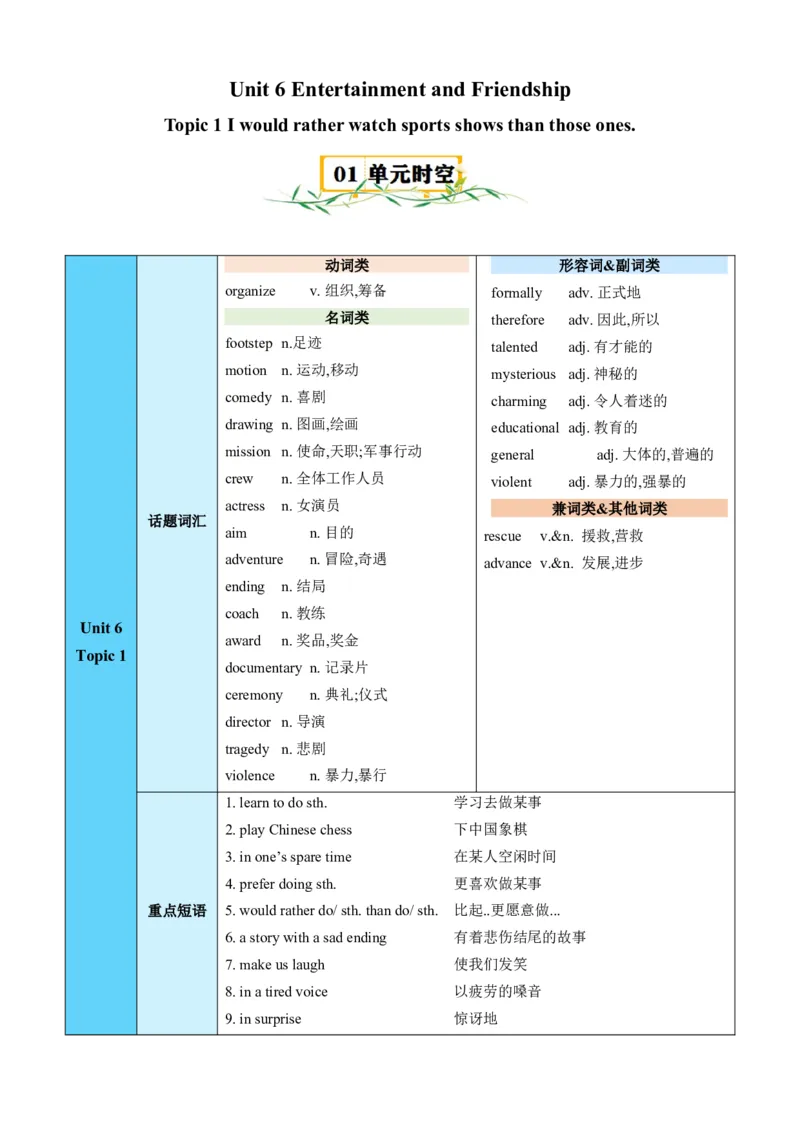
动词类 形容词&副词类
organize v. 组织,筹备 formally adv. 正式地
名词类 therefore adv. 因此,所以
footstep n.足迹 talented adj. 有才能的
motion n. 运动,移动 mysterious adj. 神秘的
comedy n. 喜剧 charming adj. 令人着迷的
drawing n. 图画,绘画 educational adj. 教育的
mission n. 使命,天职;军事行动 general adj. 大体的,普遍的
crew n. 全体工作人员 violent adj. 暴力的,强暴的
actress n. 女演员 兼词类&其他词类
话题词汇
aim n. 目的 rescue v.&n. 援救,营救
adventure n. 冒险,奇遇 advance v.&n. 发展,进步
ending n. 结局
coach n. 教练
Unit 6
award n. 奖品,奖金
Topic 1
documentary n. 记录片
ceremony n. 典礼;仪式
director n. 导演
tragedy n. 悲剧
violence n. 暴力,暴行
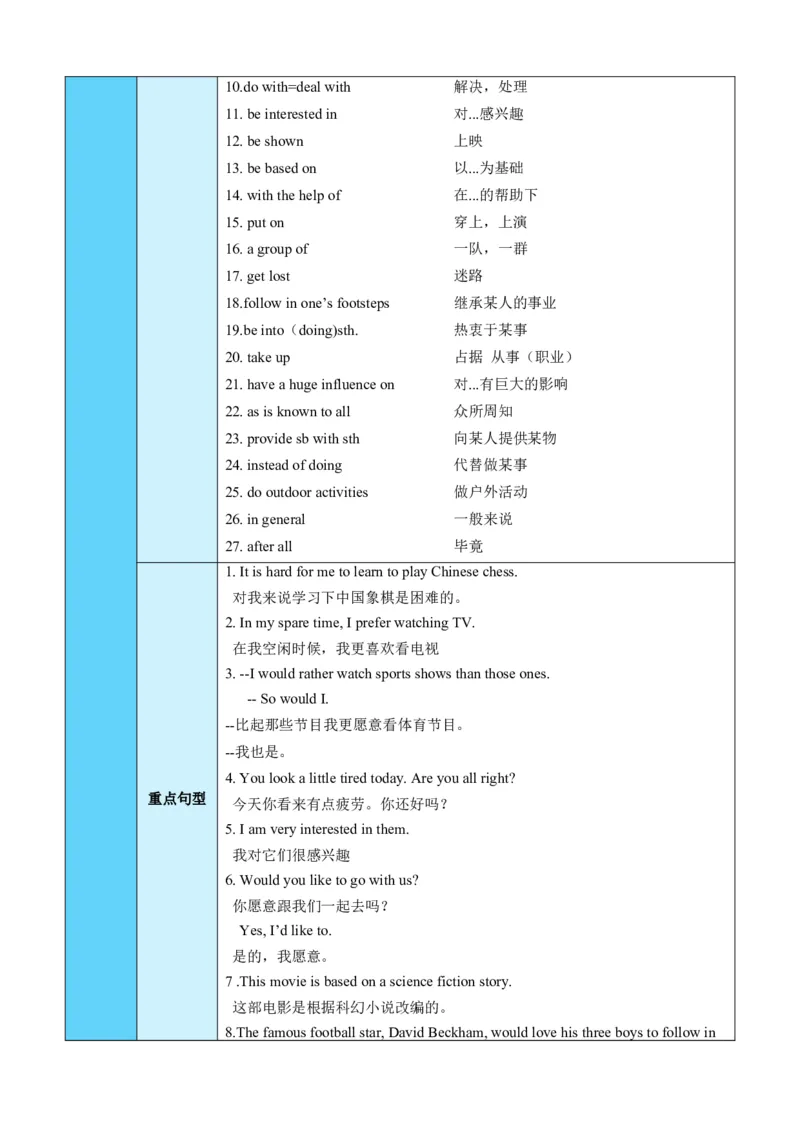
1. learn to do sth. 学习去做某事
2. play Chinese chess 下中国象棋
3. in one’s spare time 在某人空闲时间
4. prefer doing sth. 更喜欢做某事
重点短语 5. would rather do/ sth. than do/ sth. 比起..更愿意做...
6. a story with a sad ending 有着悲伤结尾的故事
7. make us laugh 使我们发笑
8. in a tired voice 以疲劳的嗓音
9. in surprise 惊讶地10.do with=deal with 解决,处理
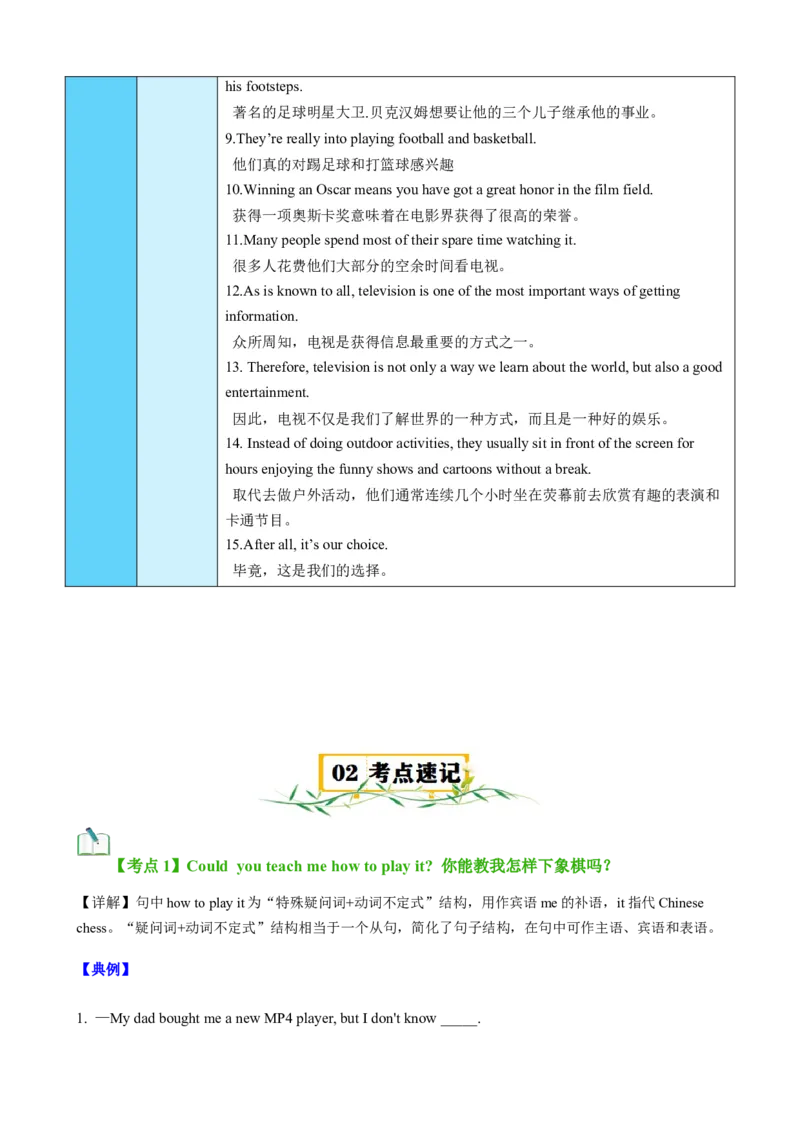
11. be interested in 对...感兴趣
12. be shown 上映
13. be based on 以...为基础
14. with the help of 在...的帮助下
15. put on 穿上,上演
16. a group of 一队,一群
17. get lost 迷路
18.follow in one’s footsteps 继承某人的事业
19.be into(doing)sth. 热衷于某事
20. take up 占据 从事(职业)
21. have a huge influence on 对...有巨大的影响
22. as is known to all 众所周知
23. provide sb with sth 向某人提供某物
24. instead of doing 代替做某事
25. do outdoor activities 做户外活动
26. in general 一般来说
27. after all 毕竟
1. It is hard for me to learn to play Chinese chess.
对我来说学习下中国象棋是困难的。
2. In my spare time, I prefer watching TV.
在我空闲时候,我更喜欢看电视
3. --I would rather watch sports shows than those ones.
-- So would I.
--比起那些节目我更愿意看体育节目。
--我也是。
4. You look a little tired today. Are you all right?
重点句型
今天你看来有点疲劳。你还好吗?
5. I am very interested in them.
我对它们很感兴趣
6. Would you like to go with us?
你愿意跟我们一起去吗?
Yes, I’d like to.
是的,我愿意。
7 .This movie is based on a science fiction story.
这部电影是根据科幻小说改编的。
8.The famous football star, David Beckham, would love his three boys to follow inhis footsteps.
著名的足球明星大卫.贝克汉姆想要让他的三个儿子继承他的事业。
9.They’re really into playing football and basketball.
他们真的对踢足球和打篮球感兴趣
10.Winning an Oscar means you have got a great honor in the film field.
获得一项奥斯卡奖意味着在电影界获得了很高的荣誉。
11.Many people spend most of their spare time watching it.
很多人花费他们大部分的空余时间看电视。
12.As is known to all, television is one of the most important ways of getting
information.
众所周知,电视是获得信息最重要的方式之一。
13. Therefore, television is not only a way we learn about the world, but also a good
entertainment.
因此,电视不仅是我们了解世界的一种方式,而且是一种好的娱乐。
14. Instead of doing outdoor activities, they usually sit in front of the screen for
hours enjoying the funny shows and cartoons without a break.
取代去做户外活动,他们通常连续几个小时坐在荧幕前去欣赏有趣的表演和
卡通节目。
15.After all, it’s our choice.
毕竟,这是我们的选择。
【考点1】Could you teach me how to play it? 你能教我怎样下象棋吗?
【详解】句中how to play it为“特殊疑问词+动词不定式”结构,用作宾语me的补语,it指代Chinese
chess。“疑问词+动词不定式”结构相当于一个从句,简化了句子结构,在句中可作主语、宾语和表语。
【典例】
1. —My dad bought me a new MP4 player, but I don't know _____.— Let's read the instructions.
A.
what to use B. which to use C. how to use it D. when to use it
【参考答案】 C
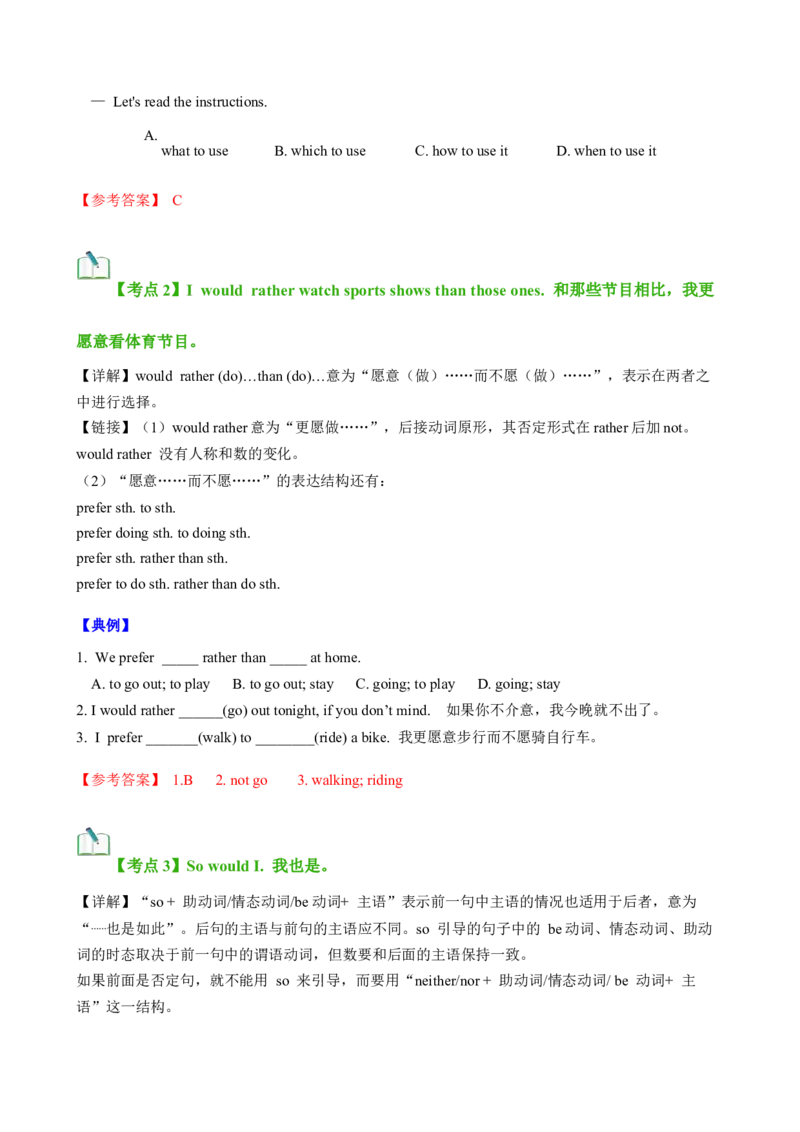
【考点2】I would rather watch sports shows than those ones. 和那些节目相比,我更
愿意看体育节目。
【详解】would rather (do)…than (do)…意为“愿意(做)……而不愿(做)……”,表示在两者之
中进行选择。
【链接】(1)would rather意为“更愿做……”,后接动词原形,其否定形式在rather后加not。
would rather 没有人称和数的变化。
(2)“愿意……而不愿……”的表达结构还有:
prefer sth. to sth.
prefer doing sth. to doing sth.
prefer sth. rather than sth.
prefer to do sth. rather than do sth.
【典例】
1. We prefer _____ rather than _____ at home.
A. to go out; to play B. to go out; stay C. going; to play D. going; stay
2. I would rather ______(go) out tonight, if you don’t mind. 如果你不介意,我今晚就不出了。
3. I prefer _______(walk) to ________(ride) a bike. 我更愿意步行而不愿骑自行车。
【参考答案】 1.B 2. not go 3. walking; riding
【考点3】So would I. 我也是。
【详解】“so + 助动词/情态动词/be动词+ 主语”表示前一句中主语的情况也适用于后者,意为
“⋯⋯也是如此”。后句的主语与前句的主语应不同。so 引导的句子中的 be动词、情态动词、助动
词的时态取决于前一句中的谓语动词,但数要和后面的主语保持一致。
如果前面是否定句,就不能用 so 来引导,而要用“neither/nor + 助动词/情态动词/ be 动词+ 主
语”这一结构。【典例】
1. —John works very hard. 约翰工作很努力。
—_____________. 的确如此。
2. Jack wasn't late for school. _______________.
杰克上学没迟到。汤姆也没有迟到。
【参考答案】 1. So he does. 2. Neither/Nor was Tom.
【考点4】Jane Eyre continued her teaching in someone else's home. 简· 爱继续在别人
家教书。
【详解】continue sth./doing sth. 意为“继续做先前做的事情”;continue to do sth. 意为“(做完一件
事)继续做另一件事”。
【典例】
1. After he finished reading a novel, he continued _________(play) games with his friends.
他读完小说后跟朋友们继续玩游戏。
2. After a rest, he continues his ___________(read).
【参考答案】1. to play 2. reading
【考点5】You look a little tired today. 你今天看起来有点疲倦。
【详解】 (1) look 意为“看起来,看上去”,是连系动词,连系动词后跟形容词。
(2)a little 意为“一点,有点”。常放在形容词前表程度。如:
【典例】
1. Mike is a little ________(tall) than Tom. 迈克比汤姆高一点。
【参考答案】1. taller
【考点6】This movie is based on a science fiction story.这部电影是根据一部科幻小说改
编的。【详解】be based on 意为“根据······;取材于······;以⋯⋯为基础”。
【链接】base on 意为“以······为依据”。
【典例】
1. The scientist's idea ____________ scientific experiments. 这位科学家的看法是建立在科学实验的基础上的。
2. We shall always _______ our opinion _______ facts. 我们的意见都要以事实为依据。
【参考答案】1. was based on 2. base; on
【考点7】A group of aliens visit the earth and one of them, E. T., gets lost and is left on
this planet. 几个外星人到访地球,其中一个名为E. T.的外星人迷路了,便留在了地球上。
【详解】(1)a group of 意为“一群,几个”。如:
When I passed by the river, I saw a group of children swimming in the river. 我路过河边时看见一群小孩
正在河里游泳。
(2) get lost 意为“迷路”,和 be lost 同义。如:
If you get lost outside, you needn't be nervous.如果在野外迷了路,你不必慌张。
(3) is left 是一般现在时的被动语态,意为“被留下”。如:
The baby is left in the basket when her mother goes shopping. 那个婴儿的妈妈在购物时,把她留在了筐里。
【典例】
1. The little monkey __________ but he can find his way home.
2. When I open the door, there is nothing in the room but a watch __________.
【参考答案】1. gets lost 2. is left
【考点8】It’ll be shown in the National Theatre from Aug. 26th to 30th. 这部影
片将于8月26日至 30日在国家大剧院上映。
【详解】(1)这是一个一般将来时被动语态的结构。一般将来时的被动语态结构为“will + be +及物
动词过去分词”。如:Lily will be sent to China as an exchange student.莉莉将作为一名交换生被
送到中国。
(2) from Aug. 26th to 30th 意为“从8月26日到30日”。在时间表达方面,表示从哪一天到哪一
天,可以用“from...to...”。 如:We'll live in this big farm from Monday to Friday.从周一到周五我们将住在这个大农场里。
【典例】
1. All kinds of clothes __________ (show) in the center of exhibition.
【参考答案】1. gets lost 2. is left
【考点9】Instead of doing outdoor activities, they usually sit in front of the
screen for hours enjoying the funny shows and cartoons without a break. 电视也能使
人懒惰。他们不去做户外运动,而是通常坐在屏幕前好几个小时欣赏有趣的节目和卡通节目
而不休息。
【详解】(1) instead of 意为“代替,而不是”。如:Take a shower instead of a bath. 淋浴吧,别用浴
缸了。
(2) in front of 意为“在……前面”;in the front of 意为“在……前部(在一定范围内)”。如:
There is a car in front of the building. 在建筑物的前面有一辆车。
There is a big desk in the front of the classroom, it's for the teachers. 教室的前面有一张大桌子,是
老师用的。
【典例】
1. ______ doing outdoor activities, they usually watch TV at home for most of the time.
A. Because of B. Instead C. Instead of D. Refers to
【参考答案】C
【考点】时态学习中的“三看三辨”【点拨】(1)看状语,辨运用
【误】He has seen the movie yesterday.
【正】He saw the movie yesterday.
【解析】现在完成时不可与单纯表示过去的时间状语连用。
【误】He just received a letter from his brother.
【正】He has just received a letter from his brother.
【解析】当动词与 already, yet, just, ever, never,before等副词连用,表示过去某一动作对现在有影响时
要用现在完成时。
(2)看动词,辨形态
【误】He has hanged the lamp on the wall.
【正】He has hung the lamp on the wall.
【解析】部分动词含有两种形意不同的过去式与过去分词,要特别注意确定词义,选择正确形式。
如:
hang—hung—hung(悬挂)
hang—hanged—hanged(绞死)
(3)看句型,辨呼应
【误】If my mother will come tomorrow, I will be very glad.
【正】If my mother comes tomorrow, I will be very glad.
【解析】呼应是时态运用的一个重要方面。在时间、条件等状语从句中,主句用将来时或情态动词,
从句用一般现在时代替一般将来时。
【误】They didn't tell me whether he is going to Nanjing the next day.
【正】They didn't tell me whether he was going to Nanjing the next day.
【解析】主句的谓语动词为过去时态,宾语从句的谓语动词也常用相应的表过去的四种时态之一。
【典例】
一、单项选择
1.—I haven’t seen you for a long time, Mr Wu.
—Yes. I ________ as a volunteer in Xinjiang for three years. I came back the other day.
A.have worked B.was working C.will work D.worked
2.—How much do you know about the Olympics in Paris in 2024?
—Well, the newspapers and websites _________ much about them up till now.A.were not covered B.haven’t been covered
C.haven’t covered D.will not cover
3.When summer came, many old people ________ sitting under the trees and talking with each other.
A.are used to B.got used to C.used to D.use to
4.—We ________ to Hong Kong, Tony.
—What a cool plan! I love the city.
A.didn’t travel B.traveled C.won’t travel D.will travel
5.—What should parents do to face their children’s success?
—I think children will act better if they _______ in correct ways.
A.praises B.will praise C.are praised D.have praised
6.Lewis Carroll was an English writer. By the time of his death, one of his works, Alice ________ the most
popular children’s book in England.
A.become B.had become C.has become
7.Amy loves pink. She has a pink room. She often wears pink clothes. She has pink dolls. She even paints her
fingernails (手指甲) pink. All her school things are pink too. The story mainly tells us ________.
A.Amy likes to paint fingernails
B.Amy’s favourite colour is pink
C.Amy loves her pink dolls best
D.Amy is a top student at school
8.—Look! Tom with her mum ________ a New Year present list.
—He has a big family and it’s always exciting to choose presents for everyone.
A.make B.makes C.is making D.are making
9.When I got up, my parents had already gone out and they hadn’t ________ me a note.
A.given B.leave C.shown D.left
10.Different kinds of tea ________ different water temperatures, brewing times and processes. What about
________ to a teahouse in Chibi to taste its brick tea?
A.requires; coming B.require; come C.requires; come D.require; coming
【参考答案】
1.D【详解】句意:——吴先生,我好久没见到你了。——对,我在新疆做了三年志愿者。几天前我回
来了。
考查动词时态。have worked现在完成时;was working过去进行时;will work一般将来时;worked
动词work的过去式/过去分词。根据“for three years”和“I came back the other day.”可知,吴先生去
新疆做了三年的志愿者,前几天回来了,事情为过去一段时间内发生的且现在已经结束,时态为一
般过去时,谓语动词用过去式,worked为动词过去式。故选D。
2.C
【详解】句意:——你对2024年巴黎奥运会了解多少?——嗯,到目前为止报纸和网站还没有报道
很多关于奥运会的消息。
考查现在完成时。根据“till now”可知,应用现在完成时,且主语和“cover报道”之间是主动关系,
故用主动语态。故选C。
3.B
【详解】句意:当夏天来临时,许多老人习惯坐在树下互相交谈。
考查动词短语。be used to doing sth.习惯做某事;get used to doing sth.习惯做某事;used to do sth.过去
常做某事;use sth. to do sth.使用某物做某事。“When summer came”是一般过去时,根据主从句时态
一致的原则,可知此处是过去式,所以排除A和D;“sitting…and talking”是动名词,排除C。故选
B。
4.D
【详解】句意:——托尼,我们要去香港。——多么酷的计划!我爱这座城市。
考查动词时态。根据答语“What a cool plan! I love the city.”可知,此处为肯定句;此处表示计划要做
的事情,所以应用一般将来时。故选D。
5.C
【详解】句意:——面对孩子的成功,父母应该做什么?——我认为如果用正确的方法表扬孩子,
他们会表现得更好。
考查一般现在时的被动语态。根据“children will act better if they...in correct ways“可知,句子是含有
if引导的条件状语从句的主从复合句,时态遵循”主将从现“,此时从句用一般现在时;句中的they
指代“children”,其与动词praise“表扬”之间是逻辑上的动宾关系,所以此处应用一般现在时的被动
语态,谓语结构是am/is/are done,are praised符合语境。故选C。
6.B
【详解】句意:刘易斯·卡罗尔是一位英国作家。到他去世时,他的一部作品《爱丽丝》已经成为英
国最受欢迎的儿童读物。
考查动词的时态。根据“By the time of his death, one of his works, Alice...the most popular children’s
book in England.”可知“变得受欢迎”的动作发生在“去世”之前,故此处表示过去的过去,用过去
完成时had done。故选B。
7.B
【详解】句意:Amy喜欢粉红色。她有一个粉红色的房间。她常常穿粉红色的衣服。她有粉红色的洋娃娃。她甚至把手指甲涂成粉红色。她的所有学习用品也都是粉红色的。这个故事告诉我们Amy
最喜欢的颜色是粉红色。
考查主旨大意。根据题干可知,Amy的房间、衣服、玩具、所有的学习用品都是粉红色的,说明她
喜欢的颜色是粉红色。故选B。
8.C
【详解】句意:——看!汤姆和他的妈妈正在制作一个新年礼物清单。——他有一个大家庭。为每
个人挑选礼物总是很令人兴奋的。
考查时态和语法一致。根据“Look!”可知,汤姆和妈妈应是正在制作一个新年礼物清单,时态为现
在进行时,现在进行时的结构为:主语+am/is/are+动词-ing形式,排除A、B;另外,根据“Tom
with her mum”,with表示“和”,连接两个并列主语时,谓语动词的数与离它最远的主语保持一致,
故应用is。排除D。故选C。
9.D
【详解】句意:当我起床时,我的父母已经出去了,他们没有给我留下一张纸条。
考查动词辨析。given给;leave离开/留下,原形;shown展示;left离开/留下,过去分词。此空前用
的hadn’t,可知时态为过去完成时,结构had+动词过去分词,leave“离开,留下”的过去分词为
left。故选D。
10.D
【详解】句意:不同种类的茶需要不同的水温、冲泡时间和工艺。来赤壁的茶馆尝尝那里的砖茶怎
么样?
考查动词用法。第一句的主语是“Different kinds of tea”,kind表示“种类”,此处是复数形式,本句是一般
现在时,require用原形;What about doing sth.表示“做某事……”,此处用coming。故选D。