专题 01 Unit1 Animal Friends Section A
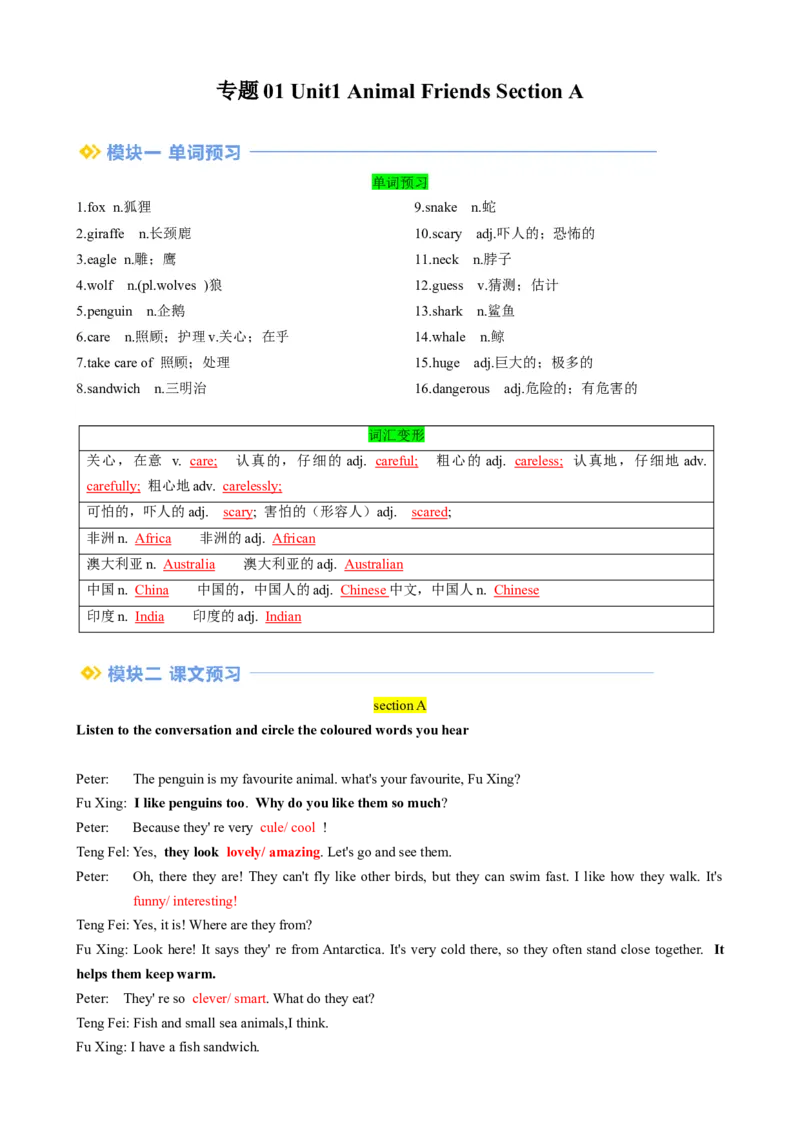
单词预习
1.fox n.狐狸 9.snake n.蛇
2.giraffe n.长颈鹿 10.scary adj.吓人的;恐怖的
3.eagle n.雕;鹰 11.neck n.脖子
4.wolf n.(pl.wolves )狼 12.guess v.猜测;估计
5.penguin n.企鹅 13.shark n.鲨鱼
6.care n.照顾;护理v.关心;在乎 14.whale n.鲸
7.take care of 照顾;处理 15.huge adj.巨大的;极多的
8.sandwich n.三明治 16.dangerous adj.危险的;有危害的
词汇变形
关心,在意 v. care; 认真的,仔细的 adj. careful; 粗心的 adj. careless; 认真地,仔细地 adv.
carefully; 粗心地adv. carelessly;
可怕的,吓人的adj. scary; 害怕的(形容人)adj. scared;
非洲n. Africa 非洲的adj. African
澳大利亚n. Australia 澳大利亚的adj. Australian
中国n. China 中国的,中国人的adj. Chinese 中文,中国人n. Chinese
印度n. India 印度的adj. Indian
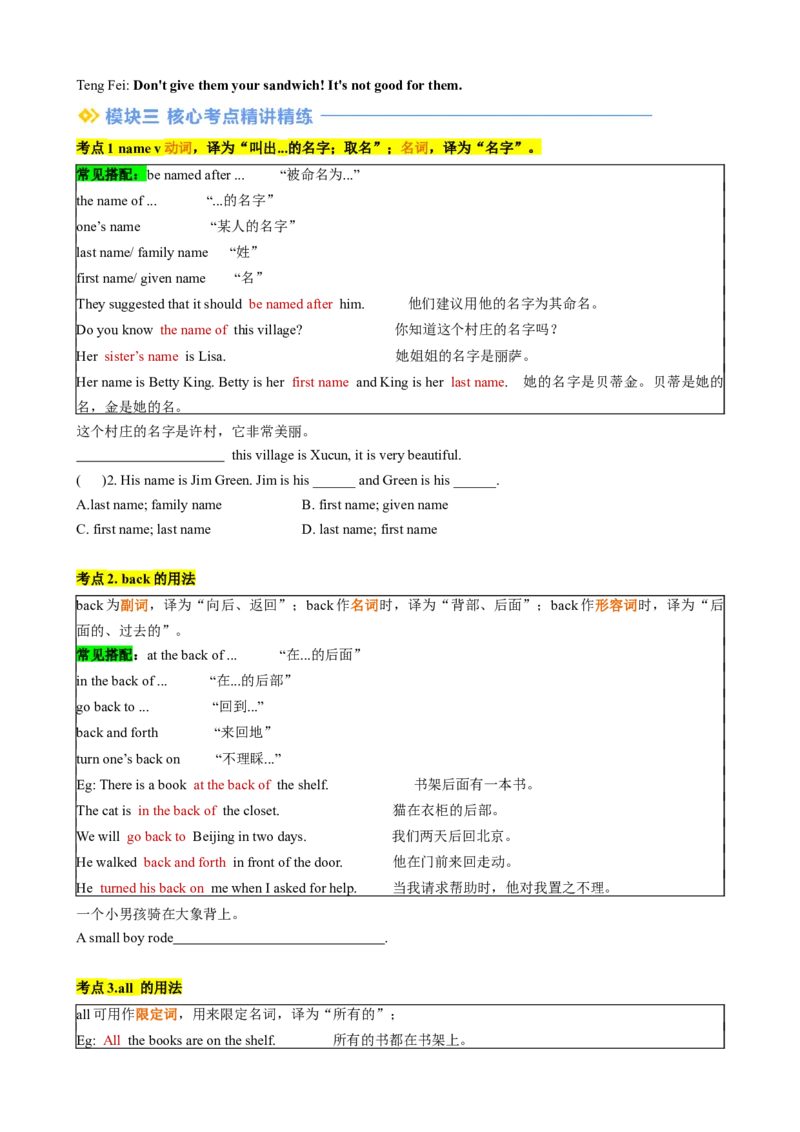
section A
Listen to the conversation and circle the coloured words you hear
Peter: The penguin is my favourite animal. what's your favourite, Fu Xing?
Fu Xing: I like penguins too. Why do you like them so much?
Peter: Because they' re very cule/ cool !
Teng Fel: Yes, they look lovely/ amazing. Let's go and see them.
Peter: Oh, there they are! They can't fly like other birds, but they can swim fast. I like how they walk. It's
funny/ interesting!
Teng Fei: Yes, it is! Where are they from?
Fu Xing: Look here! It says they' re from Antarctica. It's very cold there, so they often stand close together. It
helps them keep warm.
Peter: They' re so clever/ smart. What do they eat?
Teng Fei: Fish and small sea animals,I think.
Fu Xing: I have a fish sandwich.Teng Fei:Don't give them your sandwich! It's not good for them.
考点1 name v动词,译为“叫出...的名字;取名”;名词,译为“名字”。
常见搭配:be named after ... “被命名为...”
the name of ... “...的名字”
one’s name “某人的名字”
last name/ family name “姓”
first name/ given name “名”
They suggested that it should be named after him. 他们建议用他的名字为其命名。
Do you know the name of this village? 你知道这个村庄的名字吗?
Her sister’s name is Lisa. 她姐姐的名字是丽萨。
Her name is Betty King. Betty is her first name and King is her last name. 她的名字是贝蒂金。贝蒂是她的
名,金是她的名。
这个村庄的名字是许村,它非常美丽。
this village is Xucun, it is very beautiful.
( )2. His name is Jim Green. Jim is his ______ and Green is his ______.
A.last name; family name B. first name; given name
C. first name; last name D. last name; first name
考点2. back的用法
back为副词,译为“向后、返回”;back作名词时,译为“背部、后面”;back作形容词时,译为“后
面的、过去的”。
常见搭配:at the back of ... “在...的后面”
in the back of ... “在...的后部”
go back to ... “回到...”
back and forth “来回地”
turn one’s back on “不理睬...”
Eg: There is a book at the back of the shelf. 书架后面有一本书。
The cat is in the back of the closet. 猫在衣柜的后部。
We will go back to Beijing in two days. 我们两天后回北京。
He walked back and forth in front of the door. 他在门前来回走动。
He turned his back on me when I asked for help. 当我请求帮助时,他对我置之不理。
一个小男孩骑在大象背上。
A small boy rode .
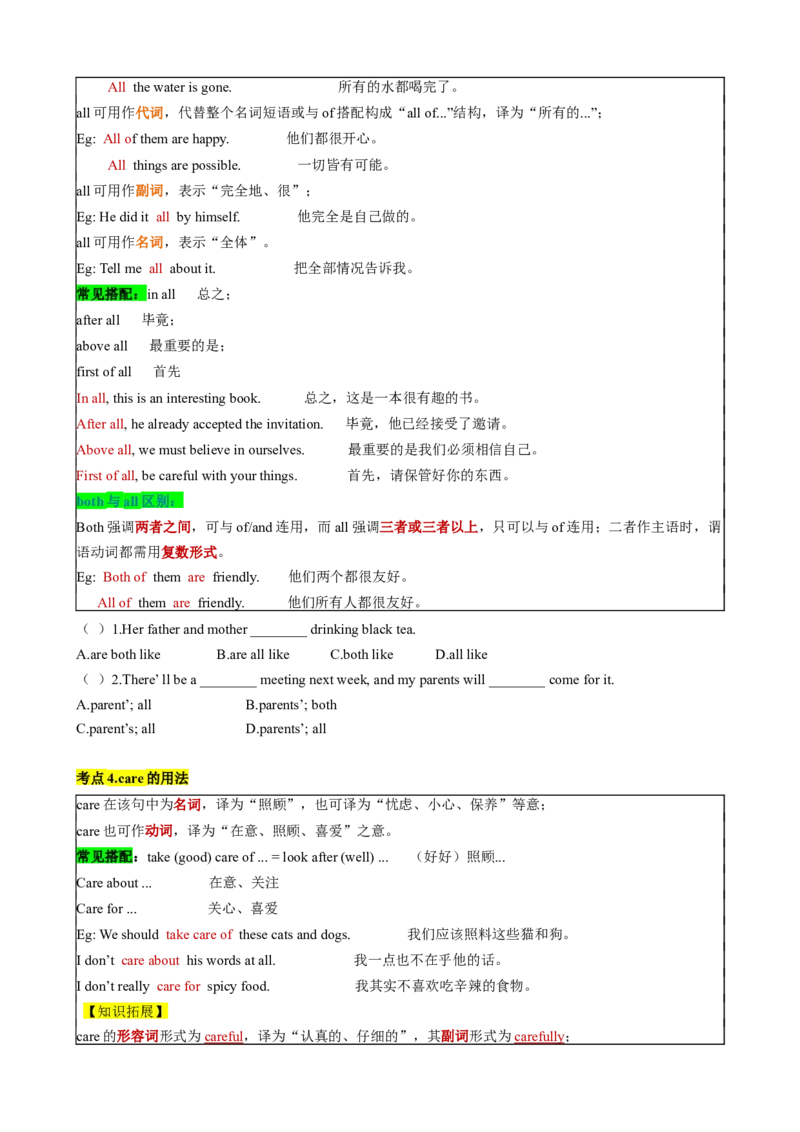
考点3.all 的用法
all可用作限定词,用来限定名词,译为“所有的”;
Eg: All the books are on the shelf. 所有的书都在书架上。All the water is gone. 所有的水都喝完了。
all可用作代词,代替整个名词短语或与of搭配构成“all of...”结构,译为“所有的...”;
Eg: All of them are happy. 他们都很开心。
All things are possible. 一切皆有可能。
all可用作副词,表示“完全地、很”;
Eg: He did it all by himself. 他完全是自己做的。
all可用作名词,表示“全体”。
Eg: Tell me all about it. 把全部情况告诉我。
常见搭配:in all 总之;
after all 毕竟;
above all 最重要的是;
first of all 首先
In all, this is an interesting book. 总之,这是一本很有趣的书。
After all, he already accepted the invitation. 毕竟,他已经接受了邀请。
Above all, we must believe in ourselves. 最重要的是我们必须相信自己。
First of all, be careful with your things. 首先,请保管好你的东西。
both与all区别:
Both强调两者之间,可与of/and连用,而all强调三者或三者以上,只可以与of连用;二者作主语时,谓
语动词都需用复数形式。
Eg: Both of them are friendly. 他们两个都很友好。
All of them are friendly. 他们所有人都很友好。
( )1.Her father and mother ________ drinking black tea.
A.are both like B.are all like C.both like D.all like
( )2.There’ ll be a ________ meeting next week, and my parents will ________ come for it.
A.parent’; all B.parents’; both
C.parent’s; all D.parents’; all
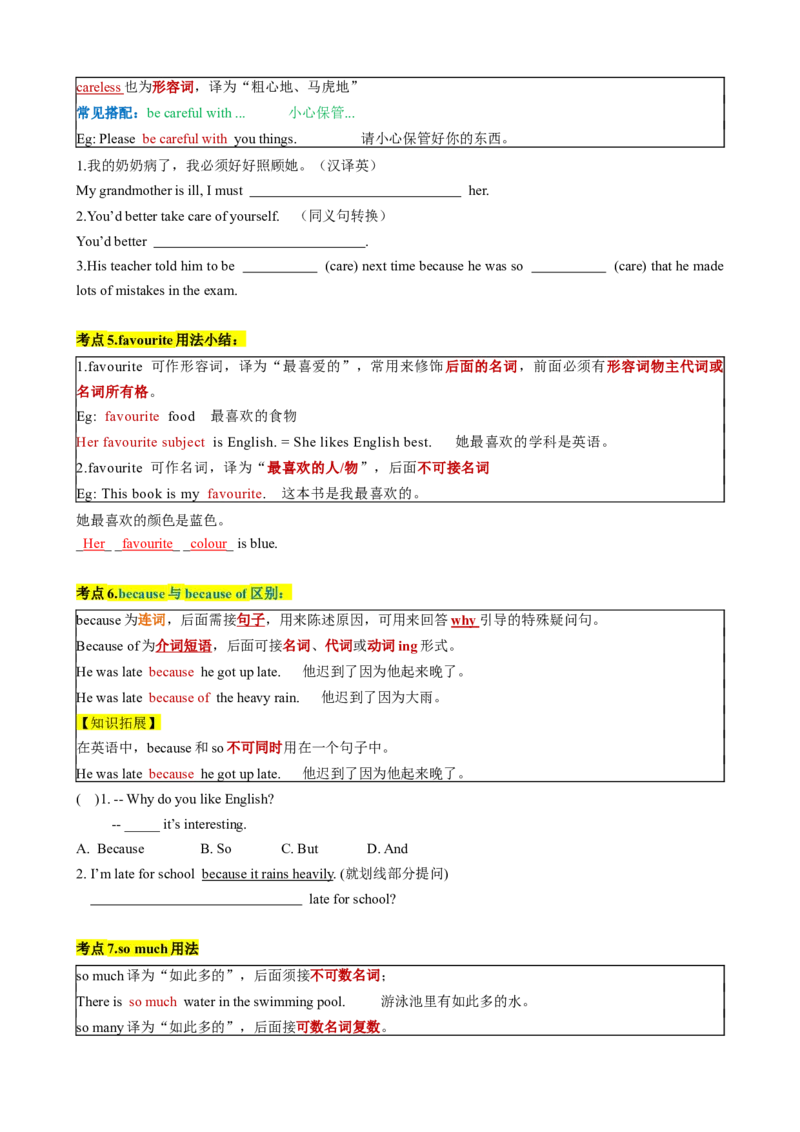
考点4.care的用法
care在该句中为名词,译为“照顾”,也可译为“忧虑、小心、保养”等意;
care也可作动词,译为“在意、照顾、喜爱”之意。
常见搭配:take (good) care of ... = look after (well) ... (好好)照顾...
Care about ... 在意、关注
Care for ... 关心、喜爱
Eg: We should take care of these cats and dogs. 我们应该照料这些猫和狗。
I don’t care about his words at all. 我一点也不在乎他的话。
I don’t really care for spicy food. 我其实不喜欢吃辛辣的食物。
【知识拓展】
care的形容词形式为careful,译为“认真的、仔细的”,其副词形式为carefully;careless 也为形容词,译为“粗心地、马虎地”
常见搭配:be careful with ... 小心保管...
Eg: Please be careful with you things. 请小心保管好你的东西。
1.我的奶奶病了,我必须好好照顾她。(汉译英)
My grandmother is ill, I must her.
2.You’d better take care of yourself. (同义句转换)
You’d better .
3.His teacher told him to be (care) next time because he was so (care) that he made
lots of mistakes in the exam.
考点5.favourite用法小结:
1.favourite 可作形容词,译为“最喜爱的”,常用来修饰后面的名词,前面必须有形容词物主代词或
名词所有格。
Eg: favourite food 最喜欢的食物
Her favourite subject is English. = She likes English best. 她最喜欢的学科是英语。
2.favourite 可作名词,译为“最喜欢的人/物”,后面不可接名词
Eg: This book is my favourite. 这本书是我最喜欢的。
她最喜欢的颜色是蓝色。
_Her_ _favourite_ _colour_ is blue.
考点6.because与because of区别:
because为连词,后面需接句子,用来陈述原因,可用来回答why 引导的特殊疑问句。
Because of为介词短语,后面可接名词、代词或动词ing形式。
He was late because he got up late. 他迟到了因为他起来晚了。
He was late because of the heavy rain. 他迟到了因为大雨。
【知识拓展】
在英语中,because和so不可同时用在一个句子中。
He was late because he got up late. 他迟到了因为他起来晚了。
( )1. -- Why do you like English?
-- _____ it’s interesting.
A. Because B. So C. But D. And
2. I’m late for school because it rains heavily. (就划线部分提问)
late for school?
考点7.so much用法
so much译为“如此多的”,后面须接不可数名词;
There is so much water in the swimming pool. 游泳池里有如此多的水。
so many译为“如此多的”,后面接可数名词复数。There are so many books in her room. 她的屋子里有如此多的书。
( )1. There are _______ animals in the zoo. Which one do you like?
A. so many B. so much C. such many D. such much
考点8.other, the other, others, the others与another区别:
other “其他的;另外的”常作限定词使用,后面可以接名词
the other “两者中的另一个”为特指,常用结构为one..., the other... “一个...;另一个”
others 用于已知的一些人或物中,出去某些后余下的人或物中的一部分。译为“其他”为泛指,常用
结构为some..., others... “一些...,另一些...”。Others = other + 可数名词复数
the others用于指一定范围内出去一个或一部分后,余下的全部人或物。译为“其余的;其余全部”为特
指,我们常用the others = the other + 可数名词复数
another “另一个;再一个”为泛指,三者或三者以上中的另一个
I can’t see you now -- some other time, maybe. 我现在不能见你 -- 也许别的时候吧。
I have two brothers, one is a doctor, the other is a teacher.我有两个哥哥,一个是医生,另一个是老师。
Some people came by car, others came on foot. 一些人开车来,另一些人走路来。
Can you give me another chance? 你能再给我一次机会吗?
( )1. Two apples are not enough. Can I have _____ one?
A. other B. the other C. others D. another
( )2. There are lots of students on the playground, some are playing football. Some are playing basketball, ____
are playing volleyball.
A. other B. the other C. others D. another
考点9.be from = come from “从…来;来自…”
常用来询问某人来自哪个地方或国籍。
be动词是系动词,come是实义动词,两者否定形式疑问形式不同。
①--Where are you from? = Where do you come from? 你来自哪里?
--I am from China. = I come from China. 我来自中国。
②--Where is he from? = Where does he come from? 他来自哪里?
--He is from China. = He comes from China. 他来自中国。
【知识拓展】
from为介词,译为“(表示时间)从...开始”或“(表示两地距离)离”
固定搭配:from ... to... “从...到...”
It is two kilometers from my home to my school. 从我的家到学校两公里。
We go to school from Monday to Friday. 我们从周一到周五上学。
( )1. -- Where ____ you from?
-- Lucy _____ from the USA, I ____ from China.
A.are; come; am B. are; come; is C. are; comes; is D. are; comes; am
考点10.help用法小结:
help sb. (to) do sth. = help sb. with sth. 译为“帮助某人做某事”Please help me (to) learn English. = Please help me with my English. 请帮我学英语。
with the help of... 译为“在...的帮助下”
I improve my English with the help of my English teacher. 在我英语老师的帮助下提高了我的英语。
( )1. Can you help me ______ some housework?
A. doing B. do C. to doing D. with doing
2. 在现代化设备的帮助下,我们能够了解更多信息。
modern equipment, we can learn about more information.
考点11.keep (动词) “保持;保留;持续;使...保持某种状态;饲养”
常见搭配:keep + 形容词 “保持...”
keep sb./sth. + 形容词 “使某人/某物保持某种状态”
keep doing sth. “一直做某事”
Please keep calm. 请保持冷静。
Please keep the room clean. 请保持房间干净。
Mr. Wang keeps working day and night. 王先生没日没夜的工作。
( )1. Please keep _____ hard, you must get good grades.
A. study B. studying C. to study D. to studying
考点12.be good for ... “对... 有益”
反义词为: be bad for “对...有害”
Vegetables are good for your health. 蔬菜对你健康有益。
【知识拓展】 good常见搭配:
be good at... = do well in... 擅长;在某方面做得出色
I am good at English. = I do well in English. 我擅长英语。
注意:at与in 为介词,故后接动词时,需要用动名词ing形式。
I am good at swimming. 我擅长游泳。
be good to... 对...友好
Our teacher is good to us. 我们的老师对我们很友好。
be good with 译为“善于应付...;和...相处的好”,be动词要随着主语发生变化。
She is good with the old. 她和老人相处的好。
( )1. Milk is good _____ our health.
A. with B. at C. for D. to
( )2. Too much chocolate ______ your teeth.
A.is good for B. is bad for C. is good at D. is good to
3. The girl is good at (speak) English.
考点13.询问“某人外貌”
常用“What do/does + sb. + look like?”的结构询问。
-- What does your sister look like? 你姐姐长什么样?-- She has big eyes. 她长着大眼睛。【知识拓展】
句式“What + be动词 + sth. /sb. like?”译为“某物/人是什么样的?”,该句式在询问某人时常常是询问
人的性格、品质等。
注意:此句中的like为介词,译为“像”
-- What’s your room like? 你的学校是什么样的?-- It's small and nice. 它小且漂亮。
-- What’s your sister like? 你姐姐怎么样?-- She is very friendly. 她很友好。
( ) 1. -- What’s the weather ______ today? -- It’s sunny.
A. like B. look like C. likes D. be like
( )2. -- What does Betty ______?-- She is tall and thin.
A. looks like B. look like C. like D. be like
( )3. -- What ____your teacher ____?-- She is very friendly.
A. is; like B. does; like C. does; look like D. is; look like
考点14.Why don’t you 你为什么不
Why don’t you后常常接动词原形,也可以缩写成why not;我们常常用该句型来给他人提出建议。
Why don’t you go there by bus? = Why not go there by bus? 你为什么不坐公交去那呢?
【知识拓展】 常见提建议句式
1.How/What about + 动词ing “……怎么样?”
How about joining a swimming club? 加入游泳俱乐部怎么样?
2.It’s a good idea to do sth “做某事是个好主意”
It’s a good idea to get up early. 早起是个好主意。
3.Let’s + V原 “让我们……吧。”
Let’s go out to take a walk. 让我们出去散步吧。
( )1. What about _______ English movie?
A.watch B. watching C. to watch D. to watching
( )2. Why don’t you _______ to school by bus?
A.go B. going C. to go D. to going
考点15. interesting.有趣.
interesting为形容词,译为“有趣的”,常常用来修饰物,在句中可作定语和表语。
interested 为形容词,译为 “感兴趣的”用来修饰人; Interest 为名词,译为“兴趣”。
常见搭配:take an interest in doing sth. = be interested in doing sth. 对做某事有兴趣
She is interested in reading books. = She takes an interest in reading books. 她对读书感兴趣。
( )1. This subject is so _______ that all of us is _______ in it.
A.interesting; interesting B. interesting; interested
C. interested; interesting D. interested; interested
一.特殊疑问句What’s your favourite animal? It’s the monkey.
Where are penguins from? They’re from Antarctica.
Why do you like penguins so much? Because they’re very cute!
Why don’t you like snakes? Because they’re really scary.
特殊疑问句是以特殊疑问词开头的、对某一具体问题进行提问的问句。回答特殊疑问句不能用
yes或no。特殊疑问句读时一般用降调。本单元主要复习what、where、why引导的特殊疑问句。
1. why引导的特殊疑问句常对“原因”进行提问, 一般用because 来回答。
—Why do you like the book? 你为什么喜欢这本书?—Because it is interesting. 因为它有趣。
—Why does your brother want to take a walk?你弟弟为什么想去散步?
—Because he wants to relax after a long day.因为他想在漫长的一天后放松一下。
2. what引导的特殊疑问句常对“姓名、物品、职业、事件等”进行提问。
—What’s your name? 你叫什么名字?—My name is Lily. 我叫莉莉。
—What are those on the table? 桌上那些是什么东西?—They’re my textbooks. 它们是我的课本。
3. where引导的特殊疑问句常对“地点”进行提问。
—Where is my schoolbag? 我的书包在哪里?—Under the tree. 在树下。
其他常见的特殊疑问词(组)及其用法:
4.常见的特殊疑问词(组)
特 殊 疑 问 询问对象 含义 例句
词(组)
what 事物 什么 What's your name?你叫什么名字?
what color 颜色 什么颜色 What color is your car?你的车是什么颜色的?
where 地点 在哪里 Where's my schoolbag?我的书包在哪里?
why 原因 为什么 Why do you like fruit?你为什么喜欢水果?
when 时间 什么时候 When is your birthday?你的生日在什么时候?
how 方式、程度 怎样;如何 How did you solve the problem?你是怎样解决这个问题
的?
who 人 谁 Who's she?她是谁?
how much 价钱 多少(钱) How much is this Jacket?这件夹克多少钱?
how old 年龄 多大年纪 How old is your grandma?你奶奶多大年纪?
口决助记
what用法真广泛,要问“什么”它当先,
姓名职业和颜色,what time问时间。
“什么时候”常用when,how主要问“怎样”。
where用来问地点,why问“原因”记心间。
一.单项填空
1.—______ do you usually go school,Mary?—By bike.
A.When B.How C.Where D.Why
2.—______is your brother?
—He's twenty.
A.How old B.How much C.What D.Who
3.—______does she live?
—She lives in the same neighborhood as me.
A.What B.Where C.Which
4.—______is the black T-shirt?
—It's 58 yuan.
A.What B.How much C.How many D.What color
5.—______students are there in your class?
—Fifty.
A.How many B.How much C.How long D.How far
二.用方框中所给疑问词的适当形式填空
what,when,how,why,who
6.—______does Jenny like geography?
—Because she thinks it's interesting.
7.—______is your day, Lucy?
—It s OK.
8.—______is Alice's favorite color?
—Red.
9.—______is the woman in red?
—My mother.
10.—______do you go to bed?
—At about 11:00.
二.对画线部分提问
11.He likes English because it's interesting.
he like English?
12.Her favorite food is the hot dog.
her favorite food?
13.Her computer is on the desk.
is her computer?
14.My grandpa is 75 years old.
is your grandpa?
15.She has an art lesson at 11:00 on Tuesday.
does she an art lesson?二.形容词
一、基本用法
1.形容词的功能:一做“定语”,二做“表语”。
This is a new bag.(new做定语)这是一个新包。
This bag is new.(new做表语)这个包是新的。
2.形容词用于修饰名词或置于代词one,ones前面,表示人或事物的特征等。
I want some large ones.我想要些大的。
3.形容词常和be动词或连系动词(look/feel/sound等)连用做表语,构成“系表”结构,即“主语+系动
词+表语”。
Mrs.Gao looks young.高老师看起来很年轻。
二、特殊用法
1.形容词做定语一般放在被修饰词之前,但在修饰 something,anything,nothing等不定代词时,要放在
这些词之后。
I have something important to do.我有些重要的事要做。
2.“the+形容词”表示一类人或物,做主语时谓语用复数。
We should help the old.我们应该帮助老人。
3.形容词前面可以加too,very,a little来修饰,表示程度。
He is too lazy.他太懒了。
单项填空
1.—______do you like Wolf WarriorsⅡ?—because it's exciting.
A.Why B.What C.How
2.—______does she live?—She lives in the same neighborhood as me.
A.What B.Where C.Which
3.Can anyone suggest(建议)______to go for lunch?
A.why B.what C.who D.where
4.It is raining outside.Why not______ an umbrella?
A.to take B.take C.taking
5.—We can invite Nick and Paul to Shanghai Disneyland with us.
—______I'll give them a call right now.
A.Why not? B.What for? C.Of course not. D.Not at all.
6.—Would you like______to eat?
—Yes,please.
A.anything delicious B.delicious anything C.something delicious
7.Frenchmen are outgoing(外向的).It is______ to make friends with them.
A.easy B.proud C.polite D.important
8.—Let's go on a picnic this weekend,OK?—That sounds______.
A.great B.well C.hardly D.terribly
9.—______do you speak English so well?
—Because I practice it with my partner every day.A.Why B.When C.Who D.What
10.—Bob,it's getting cold outside.______take a jacket?
—All right,Mum.
A.Why do you B.Why not C.Why did you D.Why don't
三.名词
一、基本用法
英语中,名词分为可数名词和不可数名词。不可数名词没有复数形式,可数名词在表示多个人或物时用
复数形式。
可数名词的复数形式一般是在词尾添加-s或-es构成,其构成规则如下:
(1)一般情况下,直接在词尾加-s,map→maps
(2)以s,x,sh,ch结尾的名词,直接在词尾加-es。
bus→buses,box→boxes,dish→dishes,watch→watches
(3)以“辅音字母+y”结尾的名词,变y为i,再加-es。family→families。strawberry-strawberries
元音字母+y结尾的名词,直接在后加-s. boy-boys, toy-toys
(4)以f,fe结尾的名词,变f或fe为v,再加-es。thief→thieves。knife→knives
(5)以o结尾的名词,口诀“黑人吃土豆,英雄吃番茄”。加-es
negro-negroes; potato→potatoes;hero-heroes;tomato→tomatoes;
其余加-s,photo→photos;piano-pianos
不规则变化:少数名词不规则,男女脚牙鹅孩子+老鼠
man-men woman-women foot-feet tooth-teeth goose-geese child-children mouse-mice
单复同形 :中日人民爱吃鱼鹿羊
Chinese-Chinese Japanese-Japanese fish-fish deer-deer sheep-sheep
一.用所给词的适当形式填空
1. These are my (brother).They are in No.11 Middle School.
2. —Are (that)your parents?
—Yes, they are.
3. —Who's that?(电话中)
— (these)is Jack speaking.
4. Here are three (photo)of my family.
They are beautiful.
5. Those are my (friend). They are friendly to me.
一.根据句意和图片提示写出所缺的单词
1.—What's your favorite animal?
—My favorite animal is the .2.Let's go and see the over there. It is a little scary.
3.Look at the . It is smart and it can work for people.
4.—Where does the come from?
—It comes from South Africa.
5.Look at the over there. It is very tall and beautiful.
二.单项选择
6.—Let's go to the zoo on Sunday.
— .
A.Good idea B.Excuse me
C.Thank you D.You're welcome
7.—Do you like lions?
—No, I think they are scary.)
A.kinds of B.many C.kind of
8.—Why do you like pandas?
— they are cute.
A.Because B.for C.But D./
9.—I'm making a plan with ChatGPT.
—Wow, how it is!
A.terrible B.scary
C.smart D.boring
10.—I enjoy myself reading on this and sunny afternoon.
—It sounds relaxing.
A.lazy B.terrible C.healthy D.busy
三.根据汉语意思完成句子,每空一词
11.——张桂梅是谁?她来自哪里?
——她是一位校长,来自牡丹江。
—Who is Zhang Guimei? is she ?
—She is a headmaster and is from Mudanjiang.
12.这位老人在长凳上睡觉,我们去帮助他吧。
The old man on the bench; go and help him.
13.动物园里有各种各样的动物。
There are animals in the zoo.
14.在周末我的弟弟可以睡一整天。
My brother can on weekends.15.——你为什么不喜欢狮子?
——因为它们有点儿吓人。
— like lions?
— they are kind of scary.
四.按要求完成句子
16.Mike never goes to the zoo on foot. (改为同义句) Mike never the zoo.
17.The lions are from Africa.(对画线部分提问)
the lions ?
18.Let's see the pandas first.(改为同义句)
seeing the pandas first?
19.These elephants are from Thailand. (变为同义句)
These elephants Thailand.
20.I like cats. They are interesting.(将两句合并为一句)
五.短文填空
请用适当的词完成下面的短文,每个空只能填写一个形式正确、意义相符的单词。
There are many 2 1 of animals. We can see some of them 2 2 the zoo.
Pandas come from China.They are cute, so children like them very much. People always watch 23 eat
bamboo in some short videos(视频). Giraffes come from Africa. They are tall and interesting. They need big
houses. Lions are from the same place as the giraffes. They are exciting(令人兴奋的) 24 scary. Animals are
our friends,so we need to be 2 5 to them.
能力提高
一
Many young girls want to become models(模特).They see models in magazines. 1 They want to be
tall and thin and look amazingly beautiful. For these girls, looks are everything. However ,according to Cameron
Russell, looks aren't everything. 2
Recently, Russell gave a talk on a famous TV show. She shared her ideas about looks. modeling photos, and
being a model. 3 Russell took her first modeling photo at 16.Butin the photo she didn't look like herself
in real life. A group of people made her look like an adult(成年的)woman. 4 All models look
different from their real selves(自己)in modeling photos. Because of that, people have an unhealthy idea about
beauty.
Many people also don't take Russell and other models seriously(认真地). 5 However, Russell
went to Columbia University and finished university with two degrees(学位).So, as you can see from Russelt's
example, looks aren't everything.
A. It is common among them.
B. And they want to be like them.
C. their look means everything
D. She knows it because she is a model.
E. For them, models only have good looks.F. Many of girls want to be a model
G. Some of them were really surprising.
二
Xavier Bouget is eighty years old. He has a 1 friend—a white pigeon
(鸽子).They've been friends with each other for two years.
Two years ago, Xavier was walking home 2 he saw a small white pigeon
fall to the ground. A cat was trying to catch(捕捉) her. At first, Xavier didn't
want to 3 her. When he got home, he told his wife about the pigeon. His
wife asked him why he didn't pick her up. So, he went back to 4 the small pigeon. Xavier came home
with the pigeon in his hand, not 5 that she would soon become his best friend.
“For a month and a half, I fed her 6 a syringe(注射器)five times a day," says Xavier.
Now. in 2021, the pigeon 7 Xavier everywhere. She sits on his shoulder(肩膀) or on his head when
he goes for a bike ride. She comes in through the window when he goes inside the 8 .She really enjoys
being with Xavier.
Their story is 9 and many people come to ask Xavier,“How have you domesticated(驯化)the
pigeon?”
Xavier says he has 10 tried domesticating his best friend. She's always been free to come and go.
It's trust(信任),nothing more.
1.A. special B. friendly C. lovely D. clever
2.A. why B. when C. which D. where
3.A. discover B. make C. save D. bring
4.A. start B. talk C. buy D. get
5. A. saying B. knowing C. paying D. flying
6. A. on B. into C. with D. about
7.A. helps B. remembers C. forge D. follows
8. A. house B. town C. farm D. zoo
9. A. lucky B. boring C. popular D. hard
10. A. never B. sometimes C. everyday D. often
三
Jon Matson is a postman. He 1 (like)the fresh air and making friends.
He has made friends with many of his customers and enjoys 2 (talk) to
them when he is working.
However, when COVID-19 began, Jon's life and work changed a lot. He still saw
his customers, but he had to talk 3 them from far way. He was feeling far
less happy than before.
What could he do to cheer both himself and others up? Jon 4 (look) some
costumes(戏服) in his house. He asked his manager 5 he could wear them
to work. He wanted to try to send 6 (smile) to people.The manager agreed. And people did smile 7 (happy)when they saw Jon in his costume. The next
day, he dressed up as a Trojan soldier and everyone loved it. Some would even wait by 3 (they)
windows and doors in order to see him. From then on, Jon decided to wear his funny costumes every day.
"So many people are happy and look forward to seeing my costume,” said 9 postman. "I think I
love my job 10 (much) than ever now!"
Jon and his costumes were written in One Hundred Reasons to Hope,a book launched( 上市)on
September16.2021.Children across the world may read about him and be encouraged.