Unit 3 Could you please clean your room?
Section A(2a-2d)
1.语言能力:学会礼貌地表达请求和许可。
2.文化意识:教育学生爱劳动、爱父母,学会帮父母分担家务。
Teaching
3.思维品质:能根据语篇推断人物的心理、行为动机等,推断信息之间简单的
Aims
逻辑关系。
4.学习能力:能运用知识迁移策略使用目标语言结构委婉地提出请求或征求别
人的许可。
Teaching 使用目标语言结构委婉地提出请求或征求别人的许可。
Difficulties
Teaching multimedia courseware or other realia that the T needs for teaching
Aids
Teaching Procedures Tips
Step 1 Presentation & Practice
Pre-listening
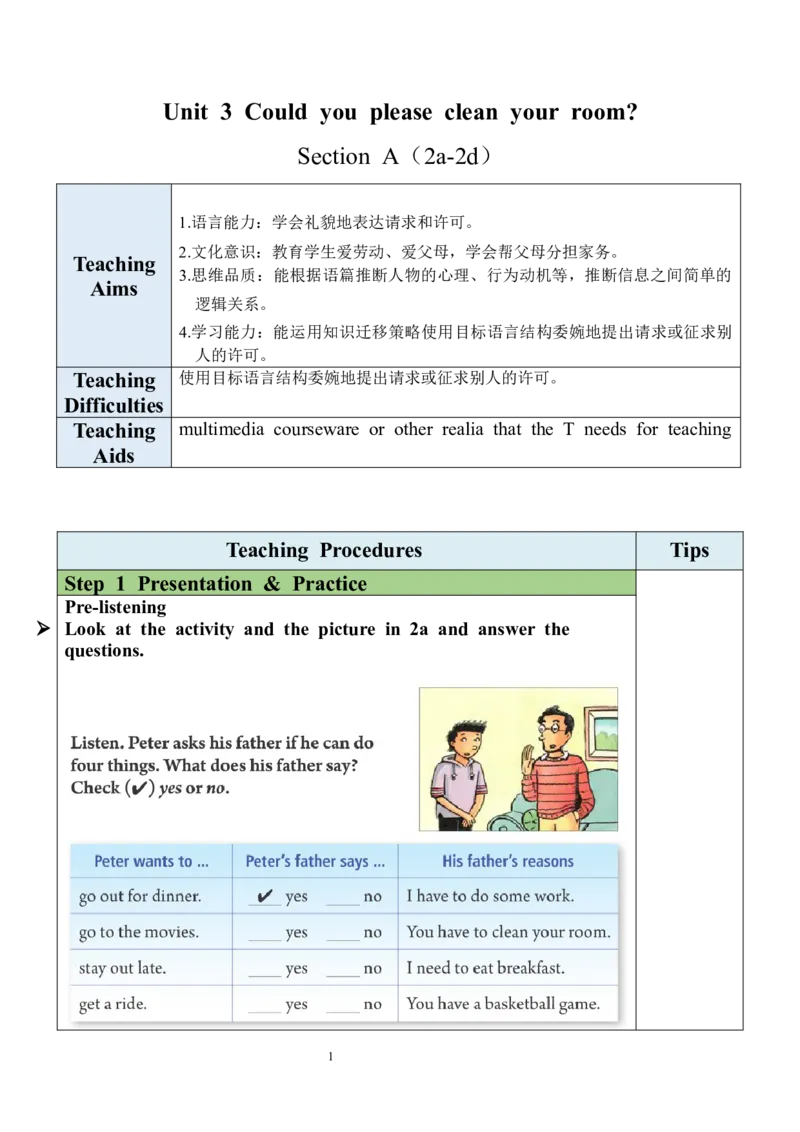
Look at the activity and the picture in 2a and answer the
questions.
11. What's the boy's name?
2. Who's the man in the picture? How do you know?
3. Where are they when they are talking? Why do you say so?
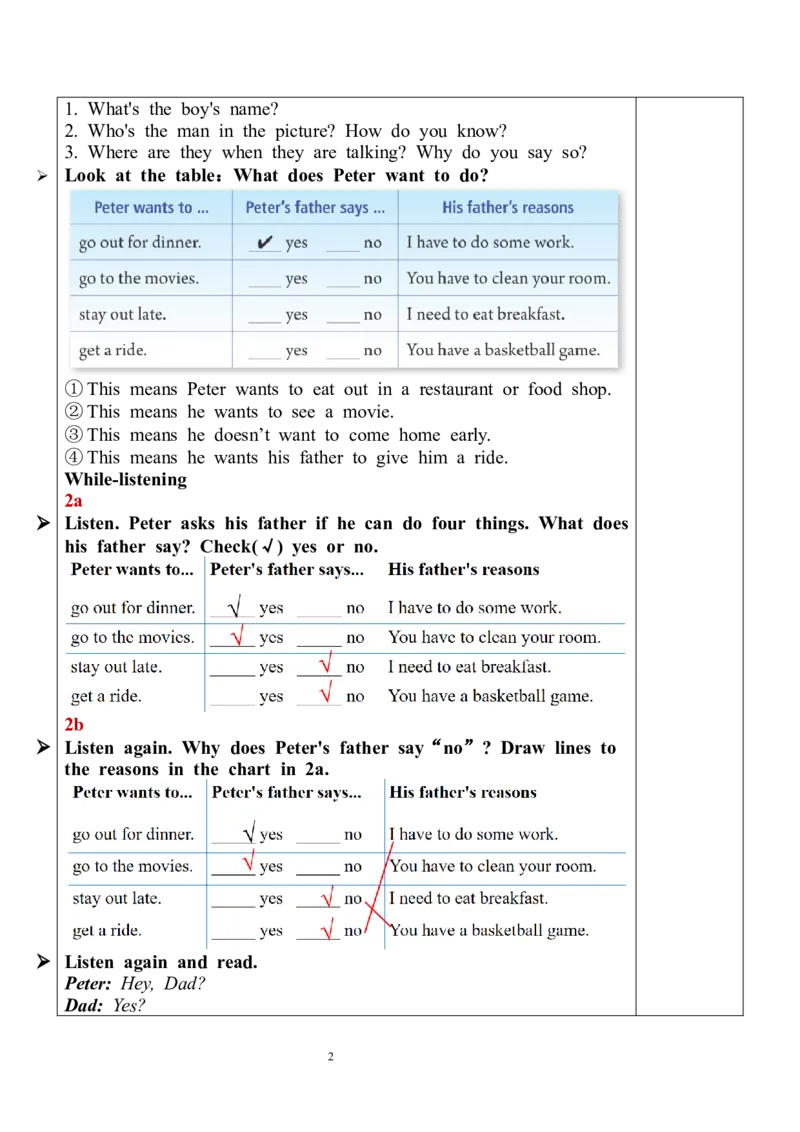
Look at the table:What does Peter want to do?
①This means Peter wants to eat out in a restaurant or food shop.
②This means he wants to see a movie.
③This means he doesn’t want to come home early.
④This means he wants his father to give him a ride.
While-listening
2a
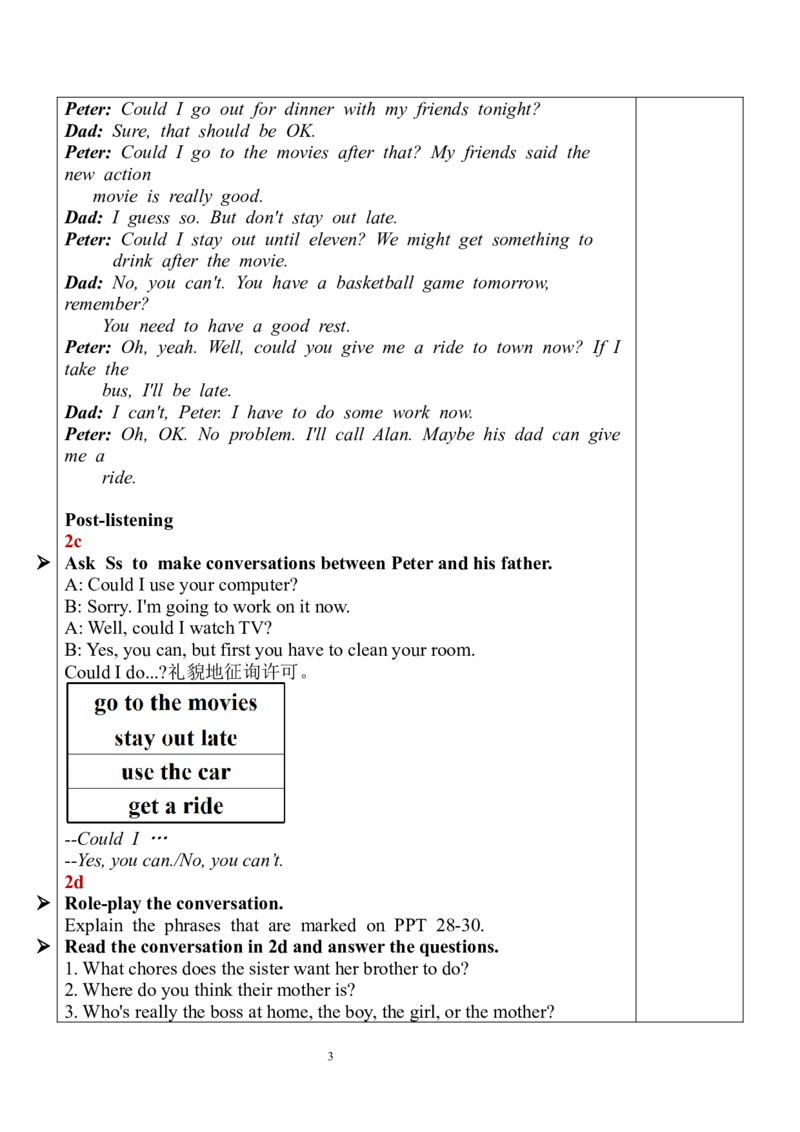
Listen. Peter asks his father if he can do four things. What does
his father say? Check(√) yes or no.
2b
Listen again. Why does Peter's father say“no”? Draw lines to
the reasons in the chart in 2a.
Listen again and read.
Peter: Hey, Dad?
Dad: Yes?
2Peter: Could I go out for dinner with my friends tonight?
Dad: Sure, that should be OK.
Peter: Could I go to the movies after that? My friends said the
new action
movie is really good.
Dad: I guess so. But don't stay out late.
Peter: Could I stay out until eleven? We might get something to
drink after the movie.
Dad: No, you can't. You have a basketball game tomorrow,
remember?
You need to have a good rest.
Peter: Oh, yeah. Well, could you give me a ride to town now? If I
take the
bus, I'll be late.
Dad: I can't, Peter. I have to do some work now.
Peter: Oh, OK. No problem. I'll call Alan. Maybe his dad can give
me a
ride.
Post-listening
2c
Ask Ss to make conversations between Peter and his father.
A: Could I use your computer?
B: Sorry. I'm going to work on it now.
A: Well, could I watch TV?
B: Yes, you can, but first you have to clean your room.
Could I do...?礼貌地征询许可。
--Could I …
--Yes, you can./No, you can’t.
2d
Role-play the conversation.
Explain the phrases that are marked on PPT 28-30.
Read the conversation in 2d and answer the questions.
1. What chores does the sister want her brother to do?
2. Where do you think their mother is?
3. Who's really the boss at home, the boy, the girl, or the mother?
3Answer:1.She wants her brother to take out the rubbish, fold the clothes
and do the dishes.
2.I think their mother is in a supermarket.
3.The mother.
Fill in the blanks.
Sister:Tony, could you please a few things?
Brother: Could I finish watching this show?
Sister:No. I think two hours of TV is for you!
Brother: Fine. What do you want me to do?
Sister: Could you the rubbish, fold the clothes and do the
dishes?
Brother: So much?
Sister:Yes, because will be back from shopping any
minute now. And she be happy if she sees this mess.
Brother: But the house is pretty clean and tidy!
Sister:Yes, well, it's clean, it's not “mother clean”!
Answer:help out with at least enough take out Mom
won't already but
Ask Ss to watch the video and try to repeat!
Step 2 Language points learning
1. Could I at least finish watching this show?
1)Could I do sth.? 意为“我可以做……吗”,表示想要征得对方允
许。
e.g. ---Could I go to the movies?
---Yes, you can./No,you can't.
注意:答语一般不用could
同义句:May I do sth.?
e.g.---May I use your computer? ---Go ahead.
2) finish doing sth. 完成做某事。
I finished writing the English composition.
【巧学妙记】 常接动词-ing作宾语的词(短语)
喜欢(enjoy)错过(miss)别介意(mind),
完成(finish)愉快(have fun)勤练习(practice),
4忙得(be busy)禁不住(can't help)想放弃(give up)。
注意:介词后一般接动词-ing形式。
What about watching TV?
2. And she won't be happy if she sees this mess.
mess n. 杂乱;不整洁
make a mess 搞得一团糟(表示动作)
be in a mess 杂乱不堪;陷入困境(表示状态)
What a mess! 多么凌乱啊!
—Don't make a mess on the balcony, Betty.
—Sorry, I won't.
All the rooms are in a mess.
【拓展延伸】
mess还可作动词,意为“使不整洁;弄脏;弄乱” 。
mess up 搞砸;弄糟
messy adj. 凌乱的;杂乱的
I've put the books away. Please don't mess them up again.
3. I think two hours of TV is enough for you!
此处,two hours of TV 虽为复数,但却表达一种整体的观念。英语语
法规定,当时间、长度、距离或其他可数名词表示一个完整的整体
概念作主语时,其后的谓语动词用其单数形式。
e.g. Two months is quite a long time.
两个月是挺长的一段时间。
e.g. Thirty students is not a big number for a class.
30人对一个班来说算不上是大数目。
4. any minute now 一种常见的口语表达法,相当于“随时;马上;
5在任何时刻”的意思,表示事情有可能在极短的时间内发生或眼下
就要发生。minute还可以用second, moment, time等词替换。
e.g. Don’t worry. He will come here any minute now.别担心, 他会马上
来这儿。
The guests are arriving any time now but we’re still not ready.客人即刻就
到,但我们还没有准备好。
We’re expecting them any moment now.我们期待他们随时到来。
Step 5 Summary & Homework
Summary
Ask Ss to do the exercises on PPT P24-26.
Homework
Preview the passage on Page 19.
Preview the new words and phrases.
Do the exercises in students’ book.
In this period, there are more new words and expressions. The T
should provide more practice in listening and speaking and encourage
Teaching
Ss to be more involved. In the reading part, Ss can experience more
Reflection
practice in using the target language in natural speech. In this part,
the T should teach Ss a reading strategy— the SQ4R(survey,
questions,read, record,recite, review).
6