文档文本内容
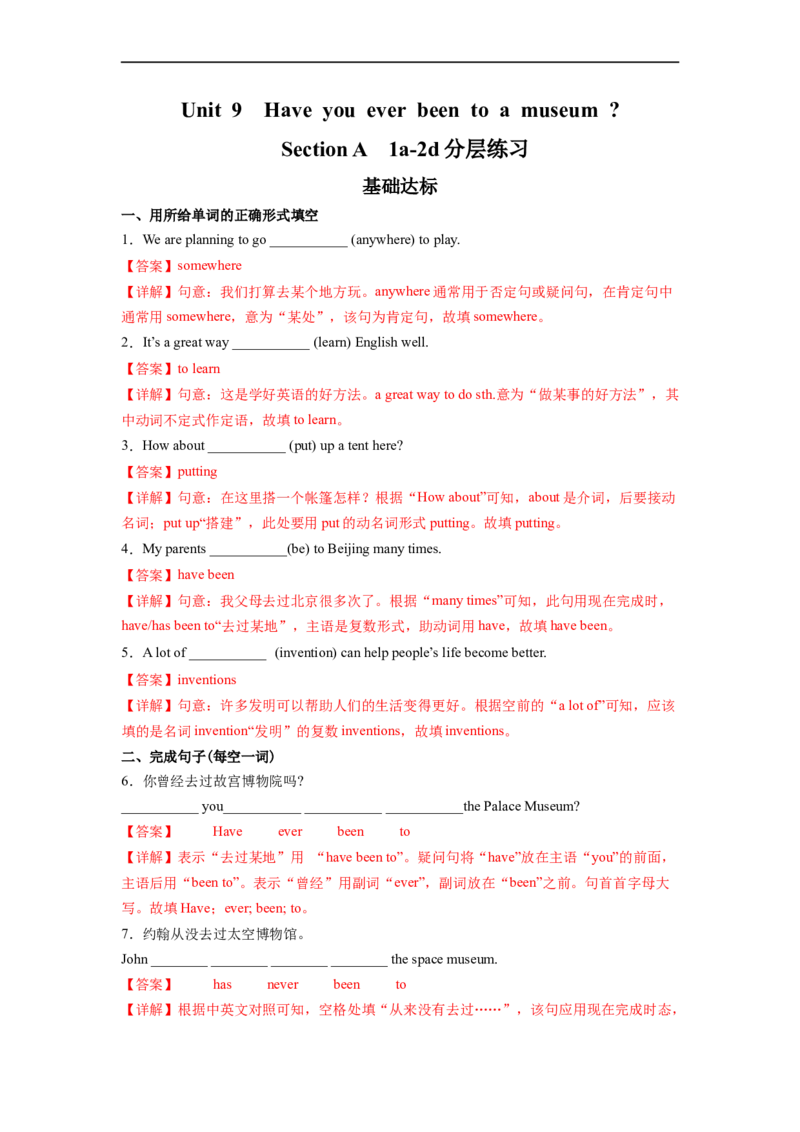
Unit 9 Have you ever been to a museum ?
Section A 1a-2d 分层练习
基础达标
一、用所给单词的正确形式填空
1.We are planning to go ___________ (anywhere) to play.
【答案】somewhere
【详解】句意:我们打算去某个地方玩。anywhere通常用于否定句或疑问句,在肯定句中
通常用somewhere,意为“某处”,该句为肯定句,故填somewhere。
2.It’s a great way ___________ (learn) English well.
【答案】to learn
【详解】句意:这是学好英语的好方法。a great way to do sth.意为“做某事的好方法”,其
中动词不定式作定语,故填to learn。
3.How about ___________ (put) up a tent here?
【答案】putting
【详解】句意:在这里搭一个帐篷怎样?根据“How about”可知,about是介词,后要接动
名词;put up“搭建”,此处要用put的动名词形式putting。故填putting。
4.My parents ___________(be) to Beijing many times.
【答案】have been
【详解】句意:我父母去过北京很多次了。根据“many times”可知,此句用现在完成时,
have/has been to“去过某地”,主语是复数形式,助动词用have,故填have been。
5.A lot of ___________ (invention) can help people’s life become better.
【答案】inventions
【详解】句意:许多发明可以帮助人们的生活变得更好。根据空前的“a lot of”可知,应该
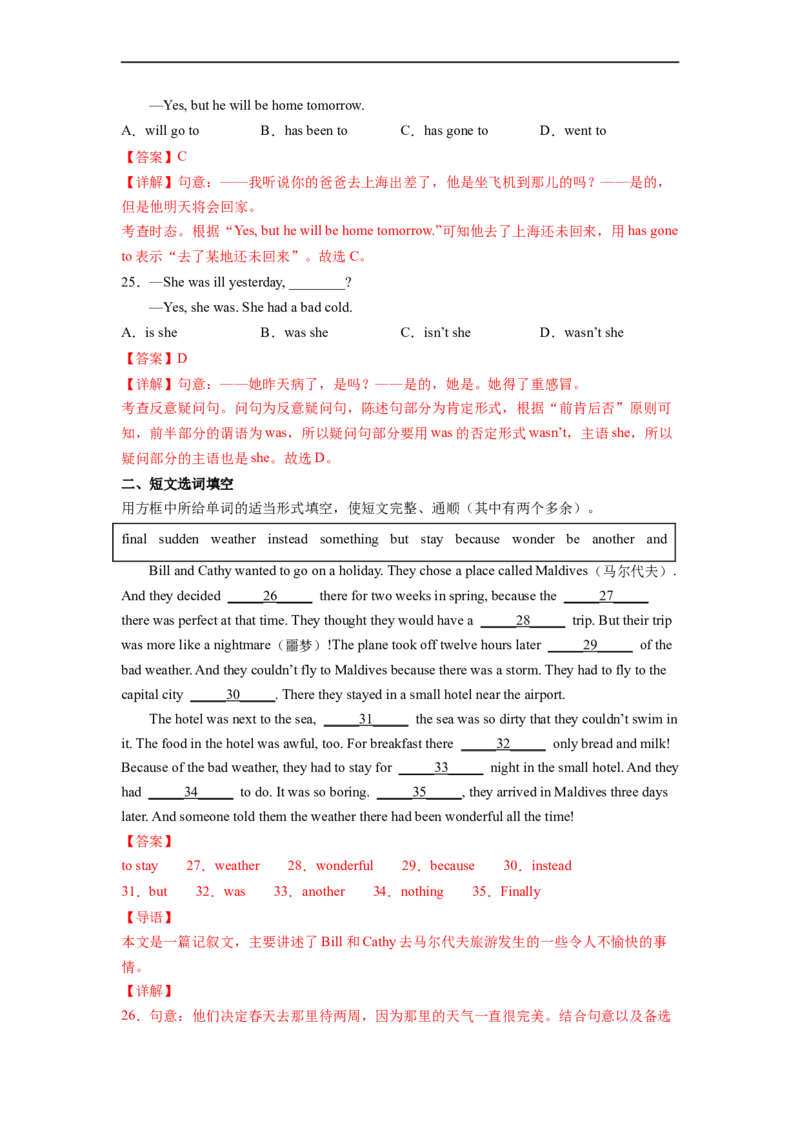
填的是名词invention“发明”的复数inventions,故填inventions。
二、完成句子(每空一词)
6.你曾经去过故宫博物院吗?
___________ you___________ ___________ ___________the Palace Museum?
【答案】 Have ever been to
【详解】表示“去过某地”用 “have been to”。疑问句将“have”放在主语“you”的前面,
主语后用“been to”。表示“曾经”用副词“ever”,副词放在“been”之前。句首首字母大
写。故填Have;ever; been; to。
7.约翰从没去过太空博物馆。
John ________ ________ ________ ________ the space museum.
【答案】 has never been to
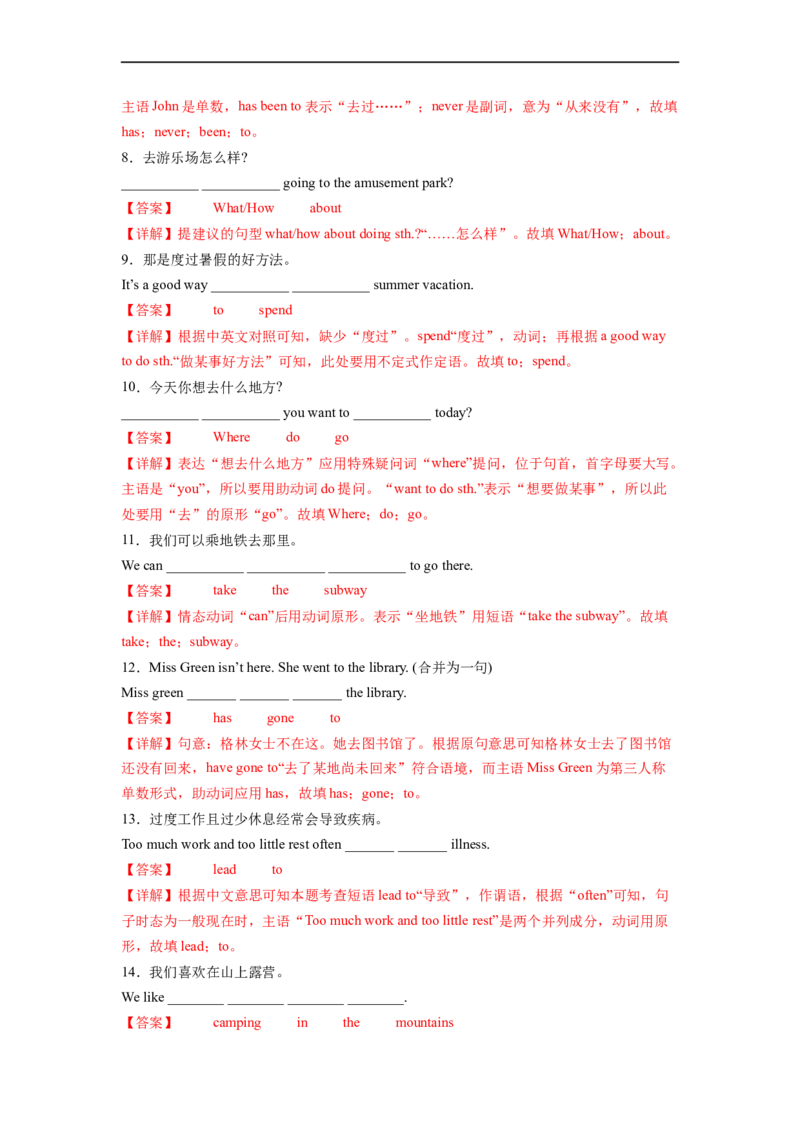
【详解】根据中英文对照可知,空格处填“从来没有去过……”,该句应用现在完成时态,主语John是单数,has been to表示“去过……”;never是副词,意为“从来没有”,故填
has;never;been;to。
8.去游乐场怎么样?
___________ ___________ going to the amusement park?
【答案】 What/How about
【详解】提建议的句型what/how about doing sth.?“……怎么样”。故填What/How;about。
9.那是度过暑假的好方法。
It’s a good way ___________ ___________ summer vacation.
【答案】 to spend
【详解】根据中英文对照可知,缺少“度过”。spend“度过”,动词;再根据a good way
to do sth.“做某事好方法”可知,此处要用不定式作定语。故填to;spend。
10.今天你想去什么地方?
___________ ___________ you want to ___________ today?
【答案】 Where do go
【详解】表达“想去什么地方”应用特殊疑问词“where”提问,位于句首,首字母要大写。
主语是“you”,所以要用助动词do提问。“want to do sth.”表示“想要做某事”,所以此
处要用“去”的原形“go”。故填Where;do;go。
11.我们可以乘地铁去那里。
We can ___________ ___________ ___________ to go there.
【答案】 take the subway
【详解】情态动词“can”后用动词原形。表示“坐地铁”用短语“take the subway”。故填
take;the;subway。
12.Miss Green isn’t here. She went to the library. (合并为一句)
Miss green _______ _______ _______ the library.
【答案】 has gone to
【详解】句意:格林女士不在这。她去图书馆了。根据原句意思可知格林女士去了图书馆
还没有回来,have gone to“去了某地尚未回来”符合语境,而主语Miss Green为第三人称
单数形式,助动词应用has,故填has;gone;to。
13.过度工作且过少休息经常会导致疾病。
Too much work and too little rest often _______ _______ illness.
【答案】 lead to
【详解】根据中文意思可知本题考查短语lead to“导致”,作谓语,根据“often”可知,句
子时态为一般现在时,主语“Too much work and too little rest”是两个并列成分,动词用原
形,故填lead;to。
14.我们喜欢在山上露营。
We like ________ ________ ________ ________.
【答案】 camping in the mountains【详解】根据汉语提示和“We like ...”可知,空格处缺“露营”和“在山上”。like doing
sth.喜欢做某事,故第一空填“camp露营”的动名词形式“camping”;“在山上”的英文
表达是“in the mountains”。故填camping;in;the;mountains。
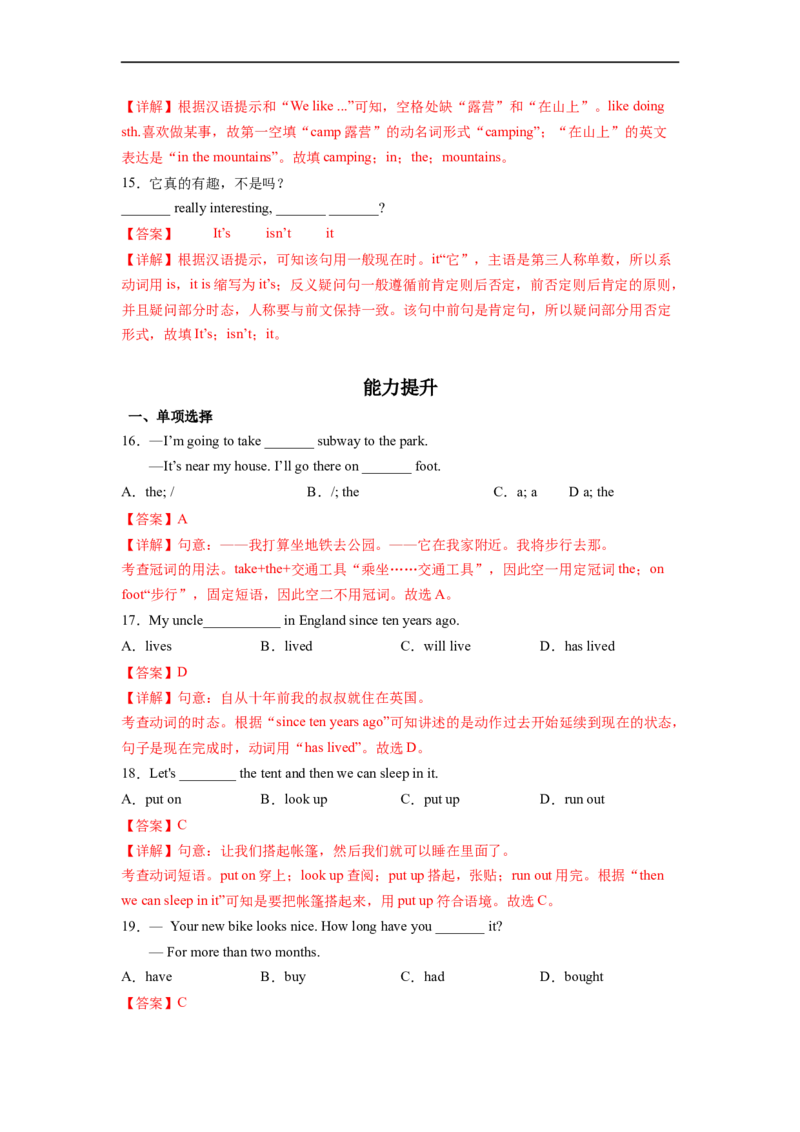
15.它真的有趣,不是吗?
_______ really interesting, _______ _______?
【答案】 It’s isn’t it
【详解】根据汉语提示,可知该句用一般现在时。it“它”,主语是第三人称单数,所以系
动词用is,it is缩写为it’s;反义疑问句一般遵循前肯定则后否定,前否定则后肯定的原则,
并且疑问部分时态,人称要与前文保持一致。该句中前句是肯定句,所以疑问部分用否定
形式,故填It’s;isn’t;it。
能力提升
一、单项选择
16.—I’m going to take _______ subway to the park.
—It’s near my house. I’ll go there on _______ foot.
A.the; / B./; the C.a; a D a; the
【答案】A
【详解】句意:——我打算坐地铁去公园。——它在我家附近。我将步行去那。
考查冠词的用法。take+the+交通工具“乘坐……交通工具”,因此空一用定冠词the;on
foot“步行”,固定短语,因此空二不用冠词。故选A。
17.My uncle___________ in England since ten years ago.
A.lives B.lived C.will live D.has lived
【答案】D
【详解】句意:自从十年前我的叔叔就住在英国。
考查动词的时态。根据“since ten years ago”可知讲述的是动作过去开始延续到现在的状态,
句子是现在完成时,动词用“has lived”。故选D。
18.Let's ________ the tent and then we can sleep in it.
A.put on B.look up C.put up D.run out
【答案】C
【详解】句意:让我们搭起帐篷,然后我们就可以睡在里面了。
考查动词短语。put on穿上;look up查阅;put up搭起,张贴;run out用完。根据“then
we can sleep in it”可知是要把帐篷搭起来,用put up符合语境。故选C。
19.— Your new bike looks nice. How long have you _______ it?
— For more than two months.
A.have B.buy C.had D.bought
【答案】C【详解】句意:——你的新自行车看起来不错。你拥有它多久了?——超过两个月。
考查延续性动词和非延续性动词。根据答语“For more than two months.”可知,此处的动词
要用延续性动词,排除B、D选项,分析句子结构可知,问句使用现在完成时,其结构为:
主语+have/has+动词的过去分词+宾语(或者其他)。故选C。
20.— _______ you _______ your silk scarf yet?
— No. I think I have to buy a new one today.
A.Did; find B.Have; found C.Are; finding D.Had; found
【答案】B
【详解】句意:——你已经找到你的丝巾了吗?——不。我想今天我不得不买一条新的了。
考查现在完成时。根据“yet”可知句子时态应为现在完成时,其谓语结构为“have/
has+done”,故选B。
21.Judy ___ the Sahara for a research on deserts and she will go to the Nile tomorrow from
there.
A.has been to B.has been C.has gone to D.has gone
【答案】C
【详解】句意:朱迪去了撒哈拉沙漠进行沙漠研究,明天她将从那里去尼罗河。
考查现在完成时。has been to去过已回;has gone to去了未回。根据“she will go to the Nile
tomorrow from there.”可知朱迪去了撒哈拉沙漠,没有回来,排除AB;再根据空后有宾语
可知应用has gone to。故选C。
22.—I don’t like smoking.
—_______
A.Neither he is. B.Neither is he. C.Neither he does. D.Neither does he.
【答案】D
【详解】句意:——我不喜欢抽烟。——他也不喜欢。
考查倒装句。根据“I don’t like smoking .”和选项可知,此处表示“他也不喜欢”。用结构
“Neither+助动词/be/情态动词+主语;主语he为第三人称单数,like为实义动词,句子用
一般现在时,因此助动词用does。故选D。
23.The telephone was ________ by Alexander Graham Bell in 1876. It is a great ________.
A.invented;invention B.invention;invent
C.invent;invented D.invented;invent
【答案】A
【详解】句意:电话是亚历山大·格雷厄姆·贝尔在1876年发明的。它是一项伟大的发明。
考查一般过去时被动语态和名词。invented发明,invent的过去式或过去分词;invention发
明,名词;invent发明,动词原形。主语The telephone与动词invent存在逻辑上的被动关
系,根据“in 1876”可知句子采用一般过去时的被动语态,其结构为:was / were+过去分词,
动词invent的过去分词为invented。不定冠词a后接单数名词。故选A。
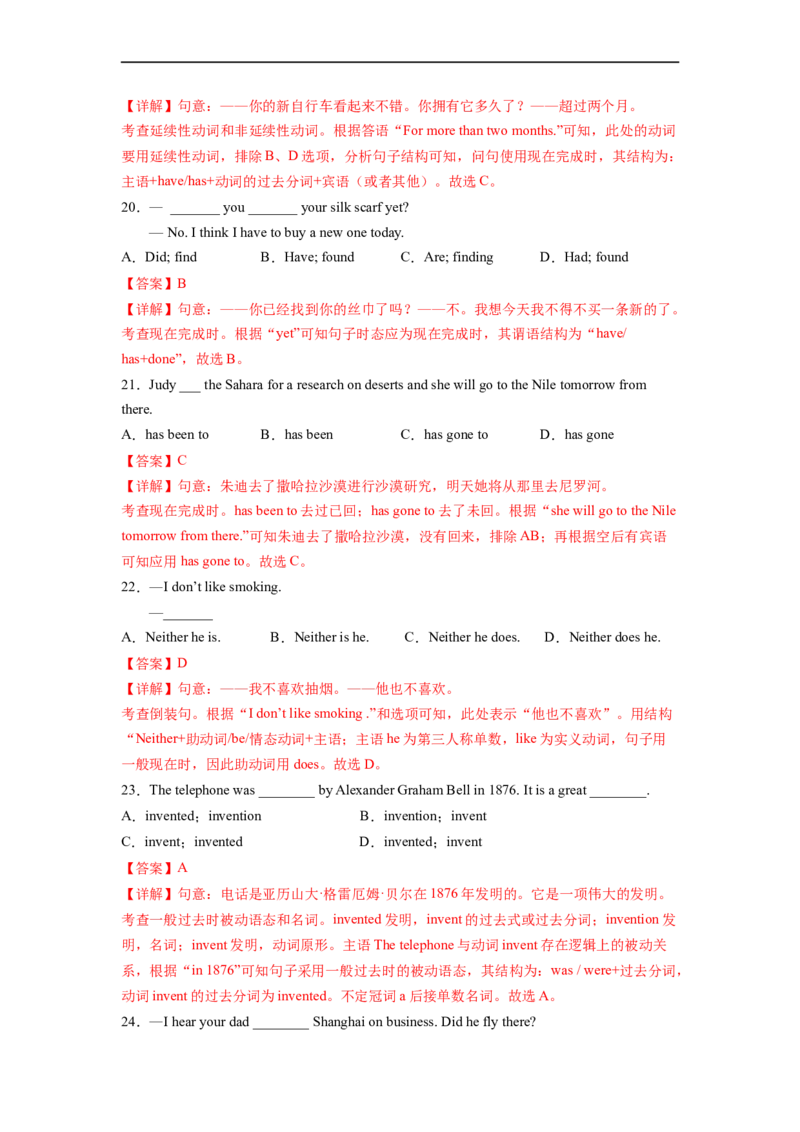
24.—I hear your dad ________ Shanghai on business. Did he fly there?—Yes, but he will be home tomorrow.
A.will go to B.has been to C.has gone to D.went to
【答案】C
【详解】句意:——我听说你的爸爸去上海出差了,他是坐飞机到那儿的吗?——是的,
但是他明天将会回家。
考查时态。根据“Yes, but he will be home tomorrow.”可知他去了上海还未回来,用has gone
to表示“去了某地还未回来”。故选C。
25.—She was ill yesterday, ________?
—Yes, she was. She had a bad cold.
A.is she B.was she C.isn’t she D.wasn’t she
【答案】D
【详解】句意:——她昨天病了,是吗?——是的,她是。她得了重感冒。
考查反意疑问句。问句为反意疑问句,陈述句部分为肯定形式,根据“前肯后否”原则可
知,前半部分的谓语为was,所以疑问句部分要用was的否定形式wasn’t,主语she,所以
疑问部分的主语也是she。故选D。
二、短文选词填空
用方框中所给单词的适当形式填空,使短文完整、通顺(其中有两个多余)。
final sudden weather instead something but stay because wonder be another and
Bill and Cathy wanted to go on a holiday. They chose a place called Maldives(马尔代夫).
And they decided _____26_____ there for two weeks in spring, because the _____27_____
there was perfect at that time. They thought they would have a _____28_____ trip. But their trip
was more like a nightmare(噩梦)!The plane took off twelve hours later _____29_____ of the
bad weather. And they couldn’t fly to Maldives because there was a storm. They had to fly to the
capital city _____30_____. There they stayed in a small hotel near the airport.
The hotel was next to the sea, _____31_____ the sea was so dirty that they couldn’t swim in
it. The food in the hotel was awful, too. For breakfast there _____32_____ only bread and milk!
Because of the bad weather, they had to stay for _____33_____ night in the small hotel. And they
had _____34_____ to do. It was so boring. _____35_____, they arrived in Maldives three days
later. And someone told them the weather there had been wonderful all the time!
【答案】
to stay 27.weather 28.wonderful 29.because 30.instead
31.but 32.was 33.another 34.nothing 35.Finally
【导语】
本文是一篇记叙文,主要讲述了Bill和Cathy去马尔代夫旅游发生的一些令人不愉快的事
情。
【详解】
26.句意:他们决定春天去那里待两周,因为那里的天气一直很完美。结合句意以及备选词汇可知,“stay待;停留”符合语境。空前decide后接不定式,即decide to do sth“决定
做某事”。故填to stay。
27.句意:他们决定春天去那里待两周,因为那里的天气一直很完美。结合句意以及备选
词汇可知,“weather天气”符合语境。故填weather。
28.句意:他们以为他们会有一个很棒的旅行。此处需要一个形容词作定语修饰名词
trip,结合句意以及备选词汇可知,wonder的形容词“wonderful很棒的;精彩的”符合语
境。故填wonderful。
29.句意:由于糟糕的天气,飞机2个小时后才起飞。根据句意可知,此处考查短语
“because of因为;由于”。故填because。
30.句意:他们不得不飞到首都。本句句子结构完整,考虑使用副词。结合句意以及备选
词汇,“instead代替;相反”符合语境。故填instead。
31.句意:酒店就在海边上,但是海水太脏,他们不能去游泳。根据句意可知,此处为表
转折的并列句,结合备选词汇,“but但是”符合语境。故填but。
32.句意:早餐只有牛奶和面包。此处考查there be句型,缺少be动词,结合整篇文章来
看,这是过去发生的事情,要用过去式;且there be句型中be动词单复数取决于后面最近
的名词,空后是不可数名词bread,所以was符合语境。故填was。
33.句意:由于糟糕的天气,他们不得不在这个小酒店里多待一晚。结合句意以及备选词
汇,“another又一;再一”符合语境。故填another。
34.句意:他们没有事情可做。根据下文“It was so boring.”可知他们没什么事情做,结合
句意以及备选词汇,something的否形式“nothing没有什么”符合语境。故填nothing。
35.句意:最终,他们在三天后到达马尔代夫。句子结构完整,考虑使用副词。结合句意
以及备选词汇,final的副词形式“finally最终;最后”符合语境,注意句首字母大写。故
填Finally。
拓展训练
完形填空(2021秋·浙江宁波·八年级校考期末)
阅读短文,掌握其大意,然后从每题所给的A、B、C、D四个选项中选出最佳选项。
When I was 12 years old, I worked as a newspaper delivery boy. An old lady who was my
customer gave me an important ____1____ that I would never forget.
____2____ a winter afternoon, a friend and I were playing a game—throwing stones onto
the roof (屋顶) of a house. ____3____, a stone dropped (掉落) from my hand as I let it go. It
headed straight toward a window instead of the roof. When hearing the sound of the ____4____
glass, we knew we were in trouble (麻烦). We ran away as fast as we could. However, a few days
later, I started to feel ____5____ for this. The window’s owner, the old lady, still greeted (打招
呼) me with a smile each day ____6____ I gave her the newspaper. But I was no longer able to
____7____ comfortable when I saw her. I decided that I would ____8____ my newspaper
delivery money. Three weeks later, I had seven dollars. I put the ____9____ in an envelope witha note. I explained that I was sorry for breaking her window and ____10____ that the seven
dollars would cover (代替) the cost of repairing (修理) it. I got a(n) ____11____ smile from her.
She thanked me for the newspaper and gave me a bag of cookies she made ____12____. I
thanked her and began to ____13____ the cookies as I continued (继续) my work.
After eating several cookies, I found a(n) ____14____ and took it out of the bag. When I
opened the envelope, I was surprised. Inside were seven dollars and a short note. It ____15____,
“I’m proud of you (我为你骄傲), boy!”
1.A.mind B.result C.lesson D.joke
2.A.On B.In C.At D.From
3.A.Deeply B.Hardly C.Unluckily D.Happily
4.A.dangerous B.broken C.fantastic D.bored
5.A.angry B.thankful C.afraid D.sorry
6.A.how B.why C.when D.until
7.A.review B.feel C.decide D.fill
8.A.make B.save C.borrow D.lend
9.A.money B.picture C.ticket D.newspaper
10.A.asked B.hoped C.wanted D.minded
11.A.upset B.famous C.necessary D.warm
12.A.herself B.himself C.myself D.themselves
13.A.meet B.laugh C.eat D.sell
14.A.note B.diary C.envelope D.cookie
15.A.spoke B.said C.spelt D.told
【答案】
1.C 2.A 3.C 4.B 5.D 6.C 7.B 8.B 9.A 10.
B 11.D 12.A 13.C 14.C 15.B
【导语】
本文作者讲述了自己做错事后主动承认错误并获得原谅的经历。
【详解】
1.句意:一位老太太是我的顾客,她给了我一个我永远不会忘记的重要教训。
mind思想;result结果;lesson课,教训;joke玩笑。根据后文故事情节可知,老太太给我
上了一课,give sb a lesson“给某人经验/教训”。故选C。
2.句意:一个冬天的下午,我和一个朋友在玩游戏,把石头扔到屋顶上。
On在(具体某一天或某一天的上午/下午);In在(年/月/季节);At在(几点);From
从。根据“a winter afternoon”可知,是具体某一天的下午。故选A。
3.句意:不幸的是,当我放开一块石头时,它从我手中掉了下来。
Deeply深深地;Hardly几乎不;Unluckily不幸地;Happily快乐地。根据“It headed
straight towards a window”可知,石头砸到了窗户,是不好的事情发生了。故选C。4.句意:当听到碎玻璃的声音时,我们知道自己有麻烦了。
dangerous危险的;broken破损的;fantastic极好的;bored无聊的。根据“I was sorry for
breaking her window”可知,是破损玻璃的声音。故选B。
5.句意:然而,几天后,我开始为此感到抱歉。
angry生气的;thankful感激的;afraid害怕的;sorry抱歉的。根据“We ran away as fast as
we could. However…”可知,我做错事后跑掉了,但为此感到抱歉。故选D。
6.句意:窗户的主人,那位老太太,每天我给她报纸时,仍然微笑着迎接我。
how怎样;why为什么;when当……时;until直到。根据“greeted me with a smile each
day…I gave her the newspaper”可知, 表示我给她送报纸时,用when引导时间状语从句。
故选C。
7.句意:但当我看到她时,我感觉不再舒服了。
review复习;feel感觉;decide决定;fill填满。根据“…comfortable when I saw her.”可知,
因为自己做错了事后跑掉了,所以感觉不舒服。故选B。
8.句意:我下定决心,我会省下送报的钱。
make做;save节省;borrow借来;lend借出。根据“my newspaper delivery money”和
“Three weeks later, I had seven dollars.”可知,是省下来一些钱。故选B。
9.句意:我把钱放在一个信封里,里面有一张便条。
money钱;picture图片;ticket票;newspaper报纸。根据“hoped the seven dollars would
cover the cost”可知,是把钱放进信封里。故选A。
10.句意:我向她解释说,我很抱歉打碎了她的窗户,希望这7美元足以支付修理窗户的
费用。
asked询问;hoped希望;wanted想要;minded介意。根据“the seven dollars would
cover(代替) the cost of repairing(修理) it”可知,希望这些钱能够支付修理窗户的费用。故选
B。
11.句意:我收到了她热情的微笑。
upset难过的;famous著名的;necessary必要的;warm温暖的。根据“received the…smile
from her”及“She thanked me for the newspaper”可知,是收到温暖的笑容。故选D。
12.句意:她感谢我的报纸,给了我一包她自己做的饼干。
herself她自己;himself他自己;myself我自己;themselves他们自己。主语是“she”,用
herself指代主语本身。故选A。
13.句意:我向她道谢,一边继续工作一边吃饼干。
meet遇见;laugh大笑;eat吃;sell卖。根据“gave me a pack of cookies”可知,我吃了她给
的饼干。故选C。
14.句意:吃了几块饼干后,我发现了一个信封,我把它从袋子里拿出来。
note便条;diary日记;envelope信封;cookie饼干。根据“When I opened the envelope”可
知,是发现了一个信封。故选C。15.句意:它说,“孩子,我以为你傲!”
spoke说,强调说的动作;said说,强调说的内容;spelt拼写;told告诉。根据“a short
note”及“I’m proud of you”可知,此处指这个纸条上写的内容,应填said。故选B。