第十一套 选择性必修第一册 Units 1~2
(120分钟 150分)
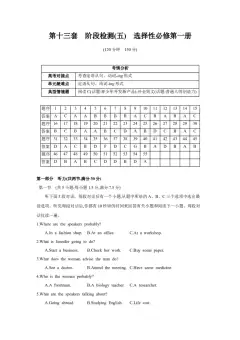
考情分析
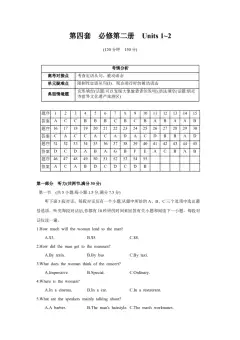
高考对接点 考查定语从句、时态
单元疑难点 非限制性定语从句
典型情境题 阅读B(话题:改变心境积极向上)
第一部分 听力(共两节,满分30分)
第一节 (共5小题;每小题1.5分,满分7.5分)
听下面5段对话。每段对话后有一个小题,从题中所给的A、B、C三个选项中选出最
佳选项。听完每段对话后,你都有10秒钟的时间来回答有关小题和阅读下一小题。每段对
话仅读一遍。
1.What will Bill do?
A.Visit Jack. B.Play football. C.Go swimming.
2.When does the performance start?
A.At 7 o'clock. B.At 8 o'clock. C.At 9 o'clock.
3.Why does the man want to leave?
A.The service is too slow. B.The food is too bad. C.The music is too loud.
4.How did the woman know about the party?
A.From a message. B.From a call. C.From an e-mail.
5.From whom does the woman know about Leo's interest?
A.Tim. B.Carmen. C.Leo.
第二节 (共15小题;每小题1.5分,满分22.5分)
听下面5段对话或独白。每段对话或独白后有几个小题,从题中所给的A、B、C三个
选项中选出最佳选项。听每段对话或独白前,你将有时间阅读各个小题,每小题5秒钟;听完
后,各小题将给出5秒钟的作答时间。每段对话或独白读两遍。
听第6段材料,回答第6、7题。
6.What is the feature of the ice cream company?
A.Bad management. B.Social responsibility. C.Changeable products.
7.What does the woman think of the company?
A.Great. B.Mean. C.Unprofitable.听第7段材料, 回答第8、9题。
8.Where are the speakers?
A.In a hotel. B.In a supermarket. C.In a restaurant.
9.What does the woman suggest?
A.Offering more discount.
B.Adding some background music.
C.Focusing on food taste.
听第8段材料,回答第10至12题。
10.What makes the man like the work?
A.Customers. B.Flexible schedule. C.Office atmosphere.
11.Who is the man's leader?
A.Kayla. B.Sean. C.Angela.
12.Where will the speakers probably go?
A.Canteen. B.The office. C.The man's house.
听第9段材料, 回答第13至16题。
13.Who is going to have dinner with the woman?
A.David. B.Paul. C.Jane.
14.What trouble does the man meet with?
A.His client is difficult to please.
B.He is stuck in the traffic.
C.The printer doesn't work.
15.What does the woman say about the man's problem?
A.It is easy to handle. B.It is demanding. C.It needs more time.
16.What will the woman probably do next?
A.Get something changed. B.Call for a technician. C.Ring her husband.
听第10段材料, 回答第17至20题。
17.In which month does Canadian Clean Air Day come?
A.May. B.June. C.July.
18.How many Canadians die each year because of air pollution?
A.About 2,000. B.Nearly 3,000. C.Around 5,000.
19.What causes more than half of the air pollution in Canada?
A.The smoke from factories.B.The burning coals.
C.Gas-powered cars.
20.What may the speaker talk about next?
A.Ways to fight against air pollution.
B.Aims of Canadian Clean Air Day.
C.Damage caused by air pollution.
第二部分 阅读(共两节,满分50分)
第一节 (共15小题;每小题2.5分,满分37.5分)
阅读下列短文,从每题所给的A、B、C、D四个选项中选出最佳选项。
A
Most high schools offer dozens of clubs.In this article, we highlight and explain four of the
most popular.
Engineering Club
Whether you are certain about what engineering you're interested in or simply have a knack
(本领) for building, join this club.Probably, you'll get to work on many cool projects.If you have a
wish to go after engineering in college and as a career, it helps to pick up the basics in high school.
Photography Club
If you're interested in pursuing photography as a career or simply want to further explore this
hobby, this club would be a great fit.Not only will you be surrounded by those who share your
interests, but you'll also learn more about the field.
Debate Club
Debate club will provide you with many important life and career skills, including how to be
an effective public speaker, how to form a well-reasoned argument, how to persuade others to
share your point of view, and more.As a member of a debate club, you may compete against
students from your own school or those in debate clubs at nearby schools and discuss a wide range
of topics.
Model United Nations
As a program administered by most high schools and middle schools in the United States,
Model United Nations teaches students about diplomacy, foreign relations, and the operations of
the United Nations.It is a simulation of the UN General Assembly in which students role-play asdelegates representing countries around the world and discuss major global issues, including
climate change, global health, and much more.
21.Who are these clubs intended for?
A.Undergraduates. B.Laid-off workers.
C.Primary school students. D.High school students.
22.What can participants do in the Debate Club?
A.Work on many cool projects.
B.Explore the fields and hills further.
C.Learn to form a well-reasoned argument.
D.Represent different countries to discuss global issues.
23.Which club suits you best if you want to learn foreign relations?
A.Debate Club. B.Engineering Club.
C.Photography Club. D.Model United Nations.
B
More than 20 months of hard time has affected me.Many friendships have faded away
because of the life choices, leaving me sad.And then, of course, I was spending too much time on
social media, which never lowers the temperature.
People around me had noticed these emotional changes.I even found myself shouting rudely
at the grocery store cashier.I began to see I was turning into a joyless, angry person I didn't want
to be.
My lack of pleasure really hit me when my family was on a road trip vacation over the
summer.As I looked out of my window at the beautiful scenery I realized that, as hard as I tried, I
felt nothing.
After searching the Internet, I found by chance a blog post that recommended keeping a
“pleasure diary”.I was attracted.I was willing to try almost anything to kick me out of my bad-
tempered fear.I even happened to have an extra notebook hanging around.
So, for several months now, I've kept track daily of all things large and small that have
brought me delight, satisfaction and enjoyment.I've recorded feeling experiences (the smell and
taste of my morning coffee), emotional increase (recovering an old friendship), and little delights,
such as the surprise I felt when an insect flew across my path on a morning walk.In fact, I've discovered the endless source that lies in some easy activities such as listening to
music, enjoying a great novel or hugging my children.
“At any given time, there is good and not-so-good in our lives,” author Elizabeth told me.She
said keeping a pleasure diary can be helpful “for people with anxiety or depression because it
forces a broader focus from what is wrong to what is right or enjoyable”.
24.What can we learn about the author from paragraph 1?
A.Friends always left her sad.
B.She never got tired of social media.
C.Life choices made her busy all day.
D.Social media failed to make her happy.
25.Why does the author mention her family's road trip?
A.To prove it was a boring trip.
B.To stress her lack of pleasure.
C.To suggest pleasure can't be bought.
D.To indicate her family affected her emotion.
26.Who made the author keep a diary?
A.Her friend. B.Her family. C.A blogger. D.A teacher.
27.What's the author's purpose of writing this text?
A.To highlight the importance of friends.
B.To show a common phenomenon of lacking pleasure.
C.To suggest an effective way to deal with emotional matters.
D.To uncover the hidden reasons for being angry and depressed.
C
What makes a great teacher? You may have some ideas.Maybe they don't give homework or
try to get to know you.However, a great teacher plans cool science experiments and inspires
students to try something new.They also get to know each person in their class.But who trains
great teachers? Other teachers, of course! But it has to start somewhere—so, who taught the first
teacher?
Many people think Confucius was the first teacher.During Confucius' time, schools were for
boys from wealthy households.But he thought everyone should be educated.Confucius thought
that education was the path to self-improvement and virtue.Confucius never taught in a school, buthe had many pupils.These students continued to share Confucius' ideas and teachings long after
he died.This is why many think he was the first teacher.
While Confucius was self-taught, today's teachers need formal training.In some countries,
such as the United States and Germany, teachers must earn a degree from a college.They study
subjects—such as mathematics, English, or music—to become experts in their field. Educators
also learn pedagogy (教育学).If you have ever made a Venn diagram (维恩图), done a group
project, or taken part in a discussion, your teacher was using pedagogy.
Along with going to college, new teachers may spend time in the classrooms of mentor
teachers.This practice is called cadet teaching in some countries or student teaching in the United
States.The student teacher plans and presents lessons under the guidance of the mentor teacher.
Teachers make up the largest profession today.There are over 80 million people teaching in
schools and universities throughout the world.This number includes teachers at all levels—
elementary, middle, and high school as well as college professors.
Teachers help students learn and manage how learners act in their communities.However,
teachers also plan lessons and create content to use with their students.They might do research to
improve their teaching or belong to professional groups.Many communities view teachers as
leaders.
28.What is paragraph 1 mainly about?
A.Arguments about teachers' plans.
B.Different ideas about great teachers.
C.Questions about the teaching methods.
D.Discussions about the history of teaching.
29.What does the underlined phrase “cadet teaching” in paragraph 4 refer to?
A.Students' learning from new teachers.
B.Teachers' earning a degree from a college.
C.Teachers' joining professional groups.
D.New teachers' learning teaching in the classroom.
30.What does the author mention about teachers in the communities?
A.Their important roles. B.Their social status.
C.Their professional levels. D.Their university diplomas.
31.Which of the following is the most suitable title for the text?A.Who trains great teachers?
B.Who taught the first teacher?
C.What does a great teacher look like?
D.What makes teachers the largest profession today?
D
Researchers are developing an artificial intelligence (AI) system that can imitate different
types of laughter to improve natural conversations between humans and robots. The AI system,
named Erica, aims to recreate the very slight differences of humour by laughing appropriately at
the right time. The team behind the laughing robot believe that the system could improve empathy
between humans and robots.
Dr Koji Inoue, the lead author of the research, stated “We think that one of the important
functions of conversational AI is empathy, so we decided that one way a robot can empathise with
users is to share their laughter.” Inoue and his team gathered training data from over 80 speed-
dating dialogues between male university students and Erica, who was initially teleoperated by
four female amateur actors.
The dialogue data was then used to train the machine learning system to decide whether to
laugh and to choose the appropriate type. The AI system was trained to differentiate between solo
laughs, social laughs, and laughter of mirth, and to mimic these appropriately.
The team tested Erica's “sense of humor” by creating four short dialogues for it to share with
a person, integrating the new shared-laughter algorithm (算法) into existing conversation
software. The clips were played to 130 volunteers who rated the shared-laughter algorithm most
favorably for empathy, naturalness, human-likeness, and understanding.
However, experts have cautioned that robots or algorithms will never truly understand
humans, despite being able to simulate understanding through behaviors like laughter. Prof Sandra
Wachter of the Oxford Internet Institute at the University of Oxford warns that they're not sentient,
but they might get very good at making you believe they understand what's going on.
The researchers believe that laughter could help create robots with their own distinct
character. “We think that they can show this through their conversational behaviors, such as
laughing, eye gaze, gestures and speaking style,” says Inoue, though he adds that it could take
over 20 years before robots can engage in a casual chat like a friend.32.What is the main purpose of the AI system Erica?
A.To create jokes and entertain humans.
B.To improve empathy between humans and robots.
C.To differentiate between different types of laughter.
D.To train robots to relieve human's emotional problems.
33.Why did experts collect training data from over 80 speed-dating dialogues?
A.To allow the AI system to mimic different types of laughter.
B.To enable the AI system to classify different dialogues.
C.To train the AI system to respond with proper laughter.
D.To test the sense of humor of the AI system.
34.What does Prof Sandra Wachter probably agree with?
A.Robots understand human feelings.
B.Training robots to laugh is meaningless.
C.Robots cannot really understand humans.
D.Robots can create their own distinct character.
35.What is the best title for the text?
A.Humans are developing AI system to be more willing to chat
B.Scientists find the right way to teach AI system to laugh
C.The empathy is the most important in conversational AI
D.Scientists try to teach robots to laugh at the right time
第二节 (共5小题;每小题2.5分,满分12.5分)
阅读下面短文,从短文后的选项中选出可以填入空白处的最佳选项。选项中有两项为多
余选项。
Cloud storage is a flexible and convenient way to store data with complete peace of mind.
36 This means you can store all your digital things remotely, without taking up space on your
computer.There are two options available.Public cloud storage allows you to share hosting space
with other users; private cloud storage is the ideal choice for companies who want to have their
data stored in their own environment.
3 7 Once you have registered and set up your account, you simply save your files via the
Internet using your username and password.This ensures your data remains secure andinaccessible to anyone else.Should you choose, you can put certain permissions in place, which
makes it easy to share your data with your colleagues or your family.
When you sign up to cloud storage, you can choose the amount of space you need. 3 8
You can store anything digital: all your files, videos and pictures.Whether you want to use this
storage solution to store your family photographs or you want to use it to store your work
documentation, you will find it quite convenient.
Is it better than your computer or an external drive? The answer is a definite yes. 3 9 This
is the most common cause of lost work and memories.External hard drives can still break, or
fail.Here you also have the added risk of misplacing it or having it stolen.There are so many
advantages to cloud computing, from the ability to access your data from wherever, whenever, to
not needing expensive external storage devices. 4 0
A.Computers crash all the time.
B.Cloud storage is very simple to use.
C.You will find cloud storage very cheap.
D.It enables you to store your data on hosted servers.
E.Cloud storage providers offer multiple layers of data security.
F.The only disadvantage, however, is that you need Internet to access files.
G.You can start with a small amount and increase the storage size later on.
第三部分 语言运用(共两节,满分30分)
第一节 (共15小题;每小题1分,满分15分)
阅读下面短文,从每题所给的A、B、C、D四个选项中选出可以填入空白处的最佳选项。
I once joined a group of elderly adventurers in climbing the Himalayas.Though I was the
youngest member of the expedition, I was the only one who 4 1 .I eventually gave up, while
they 4 2 made it to the peak of the mountain.Focusing on the goal of reaching the peak and
43 by what still lay ahead, I was unable to enjoy the climb, so I lost my desire and my 4 4
to carry on.They also focused on the peak but 4 5 to make sure they were staying on 4 6
, because they thought reaching the peak itself was not the most important. Knowing that they
were headed in the right direction 4 7 them to focus their attention and enjoy each step at the
same time.Focusing on goals is human nature, but without enjoying emotional 4 8 in the process, it
is rather difficult to 4 9 the long-term action.The greatest benefit that goals provide is
direction, and 5 0 we have a clear direction, all our energy can be focused on the process.
And focusing on the process leads to more 5 1 over the long term.
If we want to be a great writer, then having a best-selling book is a goal.But the only 5 2
way to reach that result is to fall in love with the process of 5 3 .If we want to be in the best
54 , then losing 20 pounds might be necessary.But the only way to reach that result is to fall in
love with the process of eating healthily and exercising 5 5 .
So, let's enjoy the process of doing anything.All the journey is a reward.
41.A.completed B.explored C.struggled D.stretched
42.A.effortlessly B.breathlessly C.carefully D.relevantly
43.A.inspired B.impressed C.disturbed D.permitted
44.A.ability B.strength C.direction D.time
45.A.never B.even C.hardly D.just
46.A.course B.duty C.holiday D.business
47.A.advised B.restricted C.allowed D.forbade
48.A.satisfaction B.change C.relief D.demand
49.A.call for B.work out C.put off D.keep up
50.A.unless B.until C.once D.though
51.A.results B.solutions C.responses D.assumptions
52.A.moderate B.practical C.convenient D.respective
53.A.writing B.reading C.traveling D.shopping
54.A.mood B.place C.order D.shape
55.A.stressfully B.playfully C.consistently D.creatively
第二节 (共10小题;每小题1.5分,满分15分)
阅读下面短文,在空白处填入1个适当的单词或括号内单词的正确形式。
Smartphones have made people's life much easier over the last decade.People can 5 6
(simple) download apps that allow them 5 7 (make) free video calls and send messages to
other people around the world.You can travel without fear that you 5 8 (get) lost in an
unknown city because the navigation (导航) system on your smartphone can guide you to yourdestination.Children don't have to go to the library to find important information; all the
knowledge that they need can 5 9 (acquire) by clicking on a search site.
Life goes on 6 0 a fast pace these days and it seems that the young generation has no
problem with that.However, smartphones and technology do come with certain 6 1
(disadvantage), too.On the one hand, for many teenagers, they seldom have a real, 6 2
(meaning) face-to-face conversation with others as the social connection now is just a few clicks
away at any 6 3 (give) moment.Teenagers today are less likely to go outside and seek
connections in real-life interactions.On the other hand, the use of smartphones and other devices
before bed affects people's body clock, 6 4 can prevent the release of melatonin (褪黑
素).This makes 6 5 difficult for them to fall asleep.
第四部分 写作(共两节,满分40分)
第一节 (满分15分)
你校举办主题为“A Famous Figure in Chinese History”的英语作文比赛,请你写一篇短文
参赛。内容包括:
1.人物简介;
2.人物贡献;
3.该人物对你的影响。
注意:
1.写作词数应为 80 左右;
2.请按如下格式在相应位置作答。
A Famous Figure in Chinese History
_______________________________________________________________________________
_______________________________________________________________________________
_______________________________________________________________________________
_______________________________________________________________________________
_______________________________________________________________________________
_______________________________________________________________________________
第二节 (满分25分)
阅读下面材料, 根据其内容和所给段落开头语续写两段, 使之构成一篇完整的短文。“What will we be singing for the contest this year?” a student from my high school choir
asked eagerly.I panicked this moment. “I was thinking,” I said, “maybe we'll skip the contest and
just work hard on the concerts this year.”
“NO!” the kids protested.
“We've got to go to the contest!”
“In Class A.”
“It's a tradition!”
This was true. Medals lined the front wall of the music room from the past successes of large,
talented classes. But my section leaders had graduated or been forced to drop music classes,
leaving me with young, inexperienced kids who couldn't read music, couldn't hold their parts, and
could sing only some simple songs.
“Maybe we could enter Class B this year,” I suggested, knowing even that would be a near-
impossible mission. “No!” the kids screamed. “Class A!”
I shook my head. “Class A is extremely difficult.”
“We can do it!” They shouted, “We can do it!”
“I'll have to think about it,” I said, hoping their enthusiasm would die off in a couple of
weeks.
But that didn't happen. Every day they begged, they pleaded, they insisted. Because I had to
protect their self-esteem, I couldn't tell them they weren't good enough.
I struggled to make a decision, If I crushed their hope, would I crush their spirit? On the other
hand, if we entered Class A, would they be hurt by the judges' comments? Finally, one morning I
stormed into class and declared we would sing for the contest and entered Class A.
Each morning they vocalized, learned musical terms, practiced signature changes, rehearsed
concert music, and went over and over the songs. Their progress was so remarkable even I began
believing in their dream.
注意:
1.续写词数应为150左右;
2.请按如下格式在相应位置作答。
Seven months into the school year, when the contest day finally arrived, the kids felt ready to
take on the world!________________________________________________________________
______________________________________________________________________________________________________________________________________________________________
_______________________________________________________________________________
_______________________________________________________________________________
_______________________________________________________________________________
_______________________________________________________________________________
After all the choirs had performed, we waited in our assigned room for the results._________
_______________________________________________________________________________
_______________________________________________________________________________
_______________________________________________________________________________
_______________________________________________________________________________
_______________________________________________________________________________
_______________________________________________________________________________