2020年9月六级真题(第1套)
Part I Writing (30 minutes)
Directions: For this part, you are allowed 30 minutes to write an essay on the saying What比 worth
doing 比 worth doing well. You should write at le 邸 t堕words but no more than空
words.
Part Il Listening Comprehension (30 minutes)
Section A
Directions: In this section, you w讥hear two long conversations. At the end of each
conversation, you will hear four questions. Both the conversation and the
questions will be spo枷only once. After you hear a question, you must
choose the best answer from the four c加ices marked A), B), C) and D).
Then mark the corresponding let阮onAnswer Sheet 1 with a single line
through the c tre.
邠
Questions 1 to 4 are b ed on the conversation you have just heard.
邸
1. A) She can devote all her life to pUl'Suing her passion.
B) Her accumulated expertise helps her to achieve her goals.
C) She can spread her academic ideas on a weekly TV show.
D) Her research fmdings are widely acclaimed in the world.
2. A) Provision of guidance for nuclear labs in Europe.
B) Touring the globe to attend science TV shows.
C) Overseeing two research groups at Oxford.
D) Science education and scientific research.
3. A) A better understanding of a subject. C) A broader胚owledge of related fields.
B) A stronger w诅to meet challenges. D) A closer relationship with yo皿g people.
4. A) By applying the latest research methods. C) By building upon previous discoveries.
B) By making full use of the existing da组 D) By utilizing more powerful computers.
Questions 5 to 8 are b ed on the conversation you have just heard.
邸
5. A) They can predict future events. C) They have cultural connotations.
B) They have no special meanings. D) They cannot be easily explained.
6. A) It was canceled due to bad weather. C) She dreamed of a plane crash.
B) She overslept and m访sed the flight. D) It was postponed to the following day.
7. A) They can be affected by people's childhood experiences.
B) They may sometimes seem ridi叫ous to a rational mind.
C) They usually result from people's unpleasant memories.
D) They can have an impact as great as rational thinking.
8. A) They call for scientific methods to interpret. C) They reflect their complicated emotions.
B) They mirror their long-cherished wishes. D) They are often related to irrational feelings.
2020. s / 1 (第1套)Section B
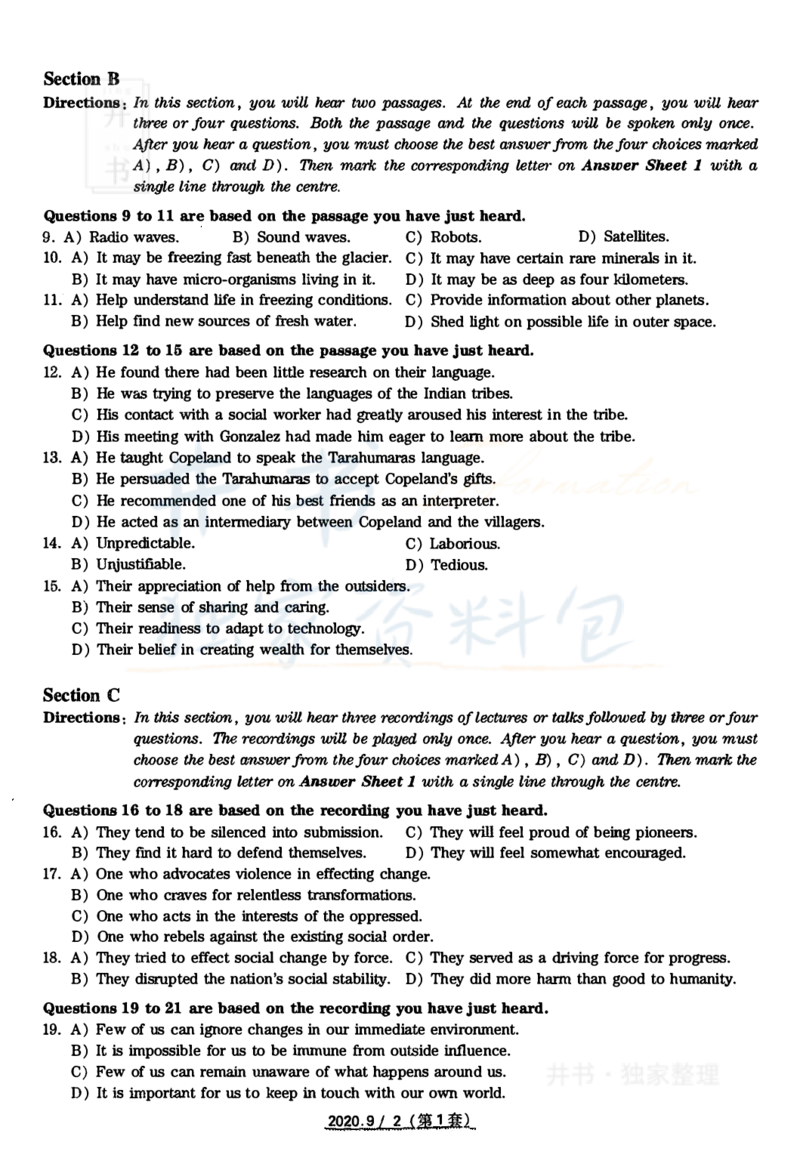
Directions: In this section, you will hear two passages. At the end of each passage, you will加ar
three or four questions. Both the passage a砬the questions will be spoken only once.
扣you hear a question, you must choose the best answer from the four或oicesmarked
A), B), C) a t D). Then rk the corn po砬ing letter on Answer Sheet 1 with a
饥 血 邸
single line through the centre.
Questions 9 to 11 are based on the passage you have just heard.
9. A) Radio waves. B) Sound waves. C) Robots. D) Satellites.
10. A) It may be freezing fast beneath the glacier. C) It may have certain rare m加rals in it.
B) It may have micro-organisms living in it. D) It may be as deep as four kilometers.
11. A) Help understand life in freezing conditions. C) Provide information about other planets.
B) Help find new sources of fresh water. D) Shed light on possible life in outer space.
Questions 12 to 15 are based on the passage you have just heard.
12. A) He found there had been little research on their language.
B) He w 邸 trying to preserve the languages of the Indian tribes.
C) His contact with a social worker had greatly aroused his interest in the tribe.
D) His meeting with Gonzalez had made him eager to learn more about the tribe.
13. A) He taught Copeland to speak the Tarahumaras language.
B) He persuaded the Tarahumaras to accept Copeland's gifts.
C) He recommended one of his best friends as an interpreter.
D) He acted as an intermediary between Copeland and the villagers.
14. A) Unpredictable. C) Laborious.
B) U司ustifiable. D) Tedious.
15. A) Their appreciation of help from the outsiders.
B) Their sense of sharing and caring.
C) Their readiness to adapt to technology.
D) Their belief in creating wealth for themselves.
Section C
Directions : In this section, you will hear th co动ngsof lectures or tal尥Jo肋wedby thrne or four
咳芘
questions. 加recordings will be play必only o e. 加youhear a question, you must
奴,
choose the best answer from the four choices marked A) , B) , C) a叫D). Then markthe
corresponding let阮onAnswer Sheet 1 with a single line through the c tre.
砌
Questions 16 to 18 are based on the recording you have just heard.
16. A) They tend to be silenced into submission. C) They w诅feel proud of being pioneers.
B) They find it hard to defend themselves. D) They w诅feel somewhat encouraged.
17. A) One who advocates violence in effecting change.
B) One who craves for relentless transformations.
C) One who acts in the interests of the oppressed.
D) One who rebels against the existing social order.
18. A) They tried to effect social change by force. C) They seived as a driving force for progress.
B) They disrupted the n扰ion's social stability. D) They did more hann than good to humani灯
Questions 19 to 21 are b ed on the recording you have just heard.
邸
19. A) Few of us can ignore changes in our immediate envirorunent.
B) It is impossible for us to be immune from outside influence.
C) Few of us can remain unaware of what happens around us.
D) It is important for us to keep in touch with our own world.
�0�0 9_{�_{第1套)
.-20. A) Malce up his mind to start all over again.
B) Stop making unfair judgements of others.
C) Try to find a more exciting job somewhere else.
D) Recognise the negative impact of his coworke
岱
21. A) They are quite susceptible to suicide. C) They suffer a great deal from ill health.
B) They improve people•s quality of life. D) They help people solve mental problems.
Questions 22 to 25 are based on the recording you have j皿t heard.
22. A) Few people can identify its texture. C) Its real value is open to interpretation.
B) Few people can describe it precisely. D) Its importance is often over-estimated.
23. A) It has never seen any change. C) It is a well-protected government secret.
B) It has much to do with color. D) It is a subject of study by many forgers.
24. A) People had little faith in paper money. C) It predicted their value would increase.
B) They could last longer in circulation. D) They were more difficult to counterfeit.
25. A) The stabilization of the dollar value. C) A gold standard for American currency.
B) The issuing of government securities. D) A steady appreciation of the U.S. dollar.
Part 川 Reading Comprehension (40 minutes)
Section A
Directions: In this section, there is a passage with ten blanks. You are required to select one word for
each blank from a list of choices given in a word bank following the passage. Read the
passage through carefully before making your choices. Each choice in the bank is
identified by a letter. Please mark the corresponding letter for each item on Answer
Sheet 2 with a single line through the centre. You may not use any of the words in the
bank more than once.
Overall, men are more likely than women to make excuses. Several studies suggest that men feel
the need to appear competent in all阜,while women wo可only about the skills in which they've
invested工. 压k a man and a woman to go diving for the first time, and the woman is likely to
jump in, while the man is likely to say he's not feeling too well.
Ironically, it is often success that leads people to flirt with failure. Praise won for _J巠_ a skill
suddenly pu岱one in the position of having everything to lose. Rather than putting their reputation on
the line again, many successful people develop a handicap-chinking, 塑_, depression-that allows
them to keep their status no matter what the future brings. An advertising executive _堕_ for
depression shortly after winning an award put it this way: "Without my depression, I'd be a failure
now; with it, rm a success'on hold.'"
In fact, the people most likely to become chronic excuse makers are those�with success.
Such people are so afraid of being _塾_a failure at anything that they constantly develop one handicap
or another in order to explain away failure.
Though self-handicapping can be an effective way of coping with performance anxiety now and
then, in the end, researchers say, it will lead to _£L. In the long run, excuse makers fail to live up
to their true�and lose the status they care so much about. And despite their protests to the
—--
35 , they have only themselves to blame.
A) contn叩 I) momentum
B) fatigue J) obsessed
C) heavily K) potential
D) heaving L) realms
E) hospitalized M) reciprocal
F) labeled N) ruin
G) legacies 0) viciously
H) mastering
�9?.9.-..� .l-�(第1套)Section B
Directions: 1
九
this secti叨,you are going to read a p心sage with ten statements at垃ched to it. Each
S比如呻t C
叨
tains in/ormat如gi
扼
n切one of the pa呻aphs. 11如tify the paragraph
from which the切iformat加is derived. You may choose a paragraph more tha once.
九
Each paragraph is marked with a letter. Answ the questions by mark切g the
衍
C
听
esp叨di叨letter
叩
Answer Sheet 2.
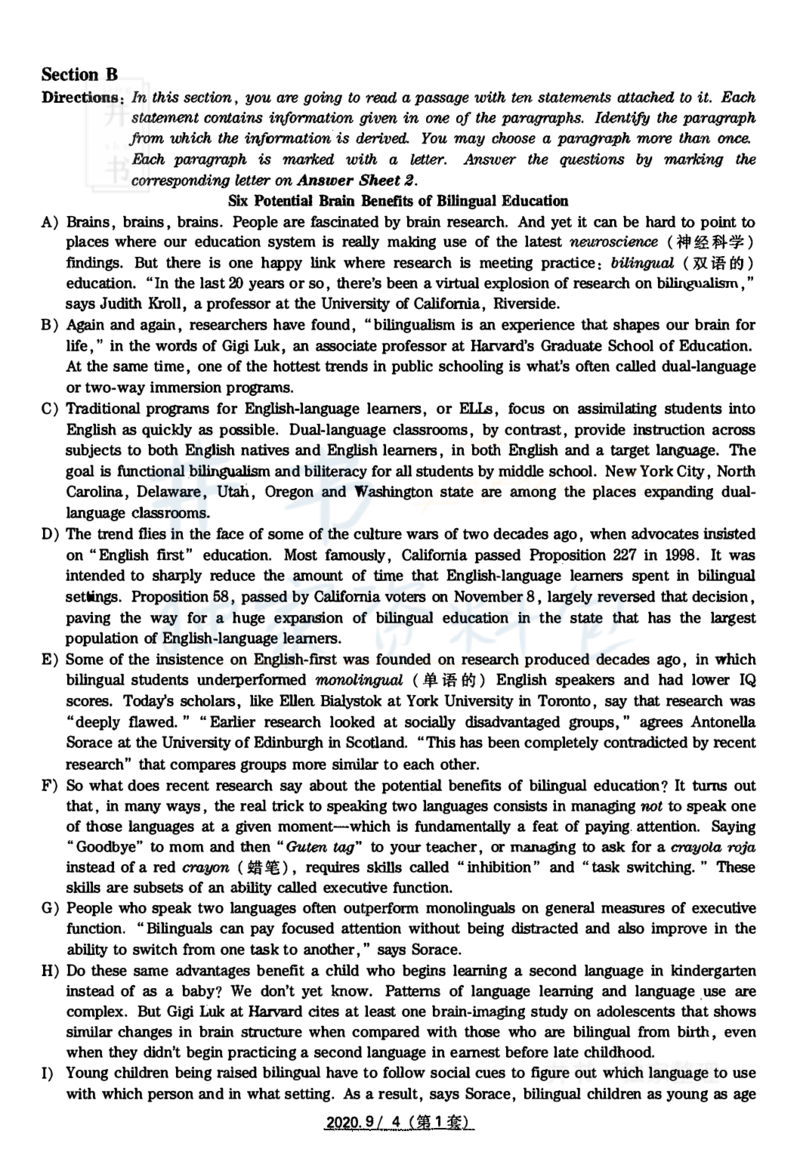
Six Potential Brain Benefits of Bilingual Education
A) Brains, brains, brains. People are fascinated by brain research. And yet it can be hard to point to
places where our education system is really making use of the latest uroscience (神经科学)
砒
findings. But there is one happy link where research is meeting practice: bilingual (双语的)
education. "In the last 20 years or so, there's been a virtual explosion of research on bilingualism, "
says Judith Kroll, a professor at the University of California, Riverside.
B) Again and again, researchers have found, "bilingualism is an experience that shapes our brain for
life, " in the words of Gigi Luk, an associate professor at Harvard's Graduate School of Education.
At the same time, one of the hottest trends in public schooling is what's often called dual-language
or two-way immersion programs.
C) Traditional programs for English-language learners, or ELLs, focus on assimilating studen岱into
English as quickly as possible. Dual-language classrooms, by contrast, provide instruction across
subjects to both English natives and English learners , in both English and a target language. The
goal is functional bilingualism and biliteracy for all students by middle school. New York City, North
Carolina, Delaware, Ut.ah, Oregon and Washington state are among the places expanding dual
language classrooms.
D) The trend flies in the face of some of the culture wars of two decades ago, when advocates insisted
on " English first" education. Most famously, California passed Proposition 227 in 1998. It was
intended to sharply reduce the amount of time that English-language learners spent in bilingual
settings. Proposition 58, passed by California voters on November 8 , largely reversed that decision,
paving the way for a huge expansion of bilingual education in the state that has the largest
population of English-language learners.
E) Some of the insistence on English-first was founded on research produced decades ago, in which
bilingual studen岱underperfo皿ed O l切gual (单语的) English speakers and had lower IQ
饥 彻
scores. Today's scholars, like Ellen Bialystok at York University in Toronto, say that research was
"deeply flawed. " " Earlier research looked at socially disadvantaged groups, " agrees Antonella
Sorace at the University of Edinburgh in Scotland. "This has been completely contradicted by recent
research" that compares groups more similar to each other.
F) So what does recent research say about the potential benefi岱of bilingual education? It turns out
that, in many ways, the real trick to speald.ng two languages consis岱in managing t to speak one
初
of those languages at a given moment一which is fundament.ally a feat of paying attention. Saying
.. Goodbye" to mom and then "Gu砌四" to your teacher, or managing to ask for a crayo比仅加
instead of a red u叨(蜡笔),requires skills called " inhibition" and "啦k switching. " These
叩
skills are subse区of an ability called executive function.
G) People who speak two languages often outperform monolinguals on general measures of executive
function. " Bilinguals can pay focused attention without being distracted and also improve in the
ability to switch from one task to another, " says Sorace.
H) Do these same advantages benefit a child who begins learning a second language in kindergarten
instead of as a baby? We don't yet lmow. Patterns of language learning and language .use are
complex. But Gigi Luk at Harvard cites at least one brain-imaging study on adolescen岱that shows
similar changes in brain structure when compared with those who are bilingual from b血,even
when they didn't begin practicing a second language in earnest before late childhood.
I) Young children being raised bilingual have to follow social cues to figure out which language to use
with which person and in what setting. As a result, says Sorace, bilingual children as young as age
2020. 9 / 4 (第1套)3 have demonstrated a head start on tests of perspective-taking and theory of mind-both of which
are fundamental social and emotional skills.
J) About 10 percent of students in the Portland, Oregon public schools are assigned by lotter:y to dual
language classrooms that offer instruction in Spanish, Japanese or Mandarin, 啦ngside English.
Jem诅er Steele at American University conducted a four-year, random讫edtrial and found that these
dual-language students outperformed their peers in English-reading skills by a full school-year's
worth of learning by the end of middle school. Because the effects are found in reading, not in math
or science where there were few_ differences, Steele suggests that learning two languages makes
students more aware of how language works in general.
K) The research of Gigi Luk at Harvard offers a slightly different explanation. She has recently done a
small study looking at a group of 100 fourth-graders in Massachusetts who had s血lar reading scores
on a standard test, but ve可different language experiences. Some were foreign-language dominant
and others were English natives. Here's what's interesting. The students who were dominant in a
foreign language weren't yet comfortably bilingual; they were just starting to learn English.
Therefore, by de血tion, they had a much weaker English vocabulary than the native speakers. Yet
they were just as good at interpreting a text. " This is ve可surprising," Luk says. " You would
expect the reading comprehension performance to mirror the vocabulary一酝it's a cornerstone of
comprehension. "
L) How did the foreign-language dominant speakers manage this feat? Well, Luk found, they also
scored higher on tests of executive functioning. So, even though they didn't have huge mental
dictionaries to draw on, they may have been great puzzle-solvers , 国ting into account higher-level
concepts such as whether a single sentence made sense within an overall story line. They got to the
same results as the monolinguals, by a different path.
M)American public school classrooms as a whole are becoming more segregated by race and class.
Dual-language programs can be an exception. Because they are composed of native English speakers
deliberately placed together with recent immigrants, they tend to be more ethnically and
economically balanced. And there is some evidence that this helps kids of all backgrounds gain
comfort with diversity and different cultures.
N) Several of the researchers also pointed out that, in bilingual education, non-English-dominant
students and their families tend to feel that their home language is heard and valued, compared with
a classroom where the home language is left at the door in favor of English. This can improve
students' sense of belonging and increase parents' involvement in their children's education,
including behaviors like reading to children. " Many parents fear their language is an o氐伐cle, a
problem, and if they abandon it their child will integrate better," says Antonella Sorace of the University
of Edinburgh. "We tell them they're not doing their child a favor by giving up their language."
0) One theme that was striking in speaking to all these researchers was just how strongly they
advocated for dual-language classrooms. Thomas and Collier have advised many school systems on
how to expand their dual-language progn皿s, and Sorace runs " Bilingualism Matters, " an
international network of researchers who promote bilingual education projec岱. This type of
advocacy among scientis岱isunusual; even more so because the "bilingual advantage hypothesis" is
being challenged once again.
P) A review of studies published last year found that cognitive advan组gesfailed to appear in 83 percent
of published studies, though in a separate analysis, the sum of effec岱was still significantly positive.
One potential explanation offered by the researchers is that advantages that are measurable in the
very young and very old tend to fade when testing young adul岱at the peak of their cognitive
powers. And, they countered that no neg啦ve effec区of bilingual education have been found. So,
even if the advan组ges are small, they are still worth it. Not to mention one obvious, outst.anding
fact: "Bilingual children can speak two languages! "
36. A study found that there are similar changes in brain structure between those who are bilingual from
birth and those who start learning a second language later.
2020. 9 / 5 (第1套)37. Unlike tradi廿onal monolingual programs, bilingual classrooms aim at developing students' ability to
use two languages by middle school.
38. A study showed that dual-language students did significantly better than their peers in reading
English texts.
39. About twenty years ago, bilingual practice was strongly discouraged, especially in California.
40. Ethnically and economically balanced bilingual classrooms are found to be helpful for kids to get
used to social and cultural diversity.
41. Researchers now claim that earlier research on bilingual education was seriously flawed.
42. According to a researcher, dual-language experiences exert a lifelong influence on one's brain.
43. Advocates of bilingual education argued that it produces positive effects though they may be liinited.
44. Bilingual speakers often do better than monolinguals in completing certain tasks because they can
concentrate better on what they are doing.
45. When their native language is used, parents can become more involved in their children's education.
Section C
Directions: There are 2 passages in this section. Each passage is followed by so加questions or
U对inished statements. For each of them酝e are four choices rkedA), B), C) and
血
D). You shoul,d, decide on the best choice a叫m,ark the corresponding屈阮on A wer
邱
Sheet 2 with a sing比line through the centre.
Passage One
Questions 46 to 50 are b
邸
ed on the following p 邸S码e.
It is not controversial to say that an unhealthy diet causes bad health. Nor are the basic elements of
healthy eating disputed. Obesity raises susceptibility to cancer, and Britain is the s血most obese
country on Earth. That is a public health emergency. But naming the problem is the easy part. No one
disputes the costs in quality of life and depleted health budgets of an obese population, but the quest for
solutions gets diverted by ideological arguments 江ound responsibility and choice. And the water is
muddied by lobbying from the industries that profit from consumption of obesity-inducing products.
Historical precedent sugges岱that science and politics can overcome resistance from businesses that
pollute and poison but it takes time, and success often starts small. So it is heartening to note that a
programme in Leeds has achieved a reduction in childhood obesity, becoming the first UK city to
reverse a fattening trend. The best resul讫were among younger children and in more deprived areas.
When 28% of English children aged two to 15 are obese, a national shift on the scale achieved by Leeds
would lengthen hundreds of thousands of lives. A significant factor in the Leeds experience appears to
be a scheme called HENRY, which helps paren岱reward behaviours that prevent obesity in children.
Many members of parliament are uncomfortable even with their own government's anti-obesity
strategy, since it involves a "sugar tax" and a ban on the sale of energy drinks to under-16s. Bans and
taxes can be blunt instruments, but their harshest critics can rarely suggest better methods. These
critics just oppose regulation i岱elf.
The relationship between poor health and inequality is too pronounced for governmen岱to be
passive about large-scale inteIVention. People living in the most deprived areas are four times more
prone to die from avoidable causes than counterparts in more affluent places. As the structural nature of
public health problems becomes harder to ignore, the complaint about overprotective government loses
potency.
In fact, the polarised·debate over public health interventions should have been abandoned long ago.
Government action works when individuals are motivated to respond. Individuals need governmen岱that
expand access to good choices. The HENRY programme was delivered in part through children's
centres. Closing such centres and cutting council budge岱 doesn't magically increase reserves of
individual self-reliance. The function of a well designed晔te intervention is not to deprive people of
心
liberty but to build social c叩acity and infrastructure that helps people take responsibility for their
�020. 9 / 6 (第1套)wellbeing. The obesity crisis not have a solution devised by leit or right ideology--but experience
will
indicates that the private sector needs the incentive of regulation before it starts taking public health
emergencies seriously.
46. Why is the obesity problem in Britain so difficult to solve'?
A) Government health budgets are depleted.
B) People disagree as to who should do what.
C) Individuals are not ready to take theirre sponsibilities.
D) Industry lobbying m吐es it hard to get healthy foods.
47. What can we learn from the past experience in tackling public health emergencies?
A) Governments have a role to play.
B) Public health is a scientific issue.
C) Priority should be given to deprived regions.
D) Businesses'responsibility should be stressed.
48. What does the author imply about some critics of bans and taxes concerning unhealthy drinks?
A) They are not aware of the consequences of obesity.
B) They have not come up with anything more constructive.
C) They are uncomfortable with parliament's anti-obesity debate.
D) They have their own motives in opposing government regulation.
49. Why does the author stress the relationship between poor health and inequality?
A) To demonstrate the dilemma of people living in deprived areas.
B) To bring to light the root cause of widespread obesity in Bri呻.
C) To highlight the area deserving the most attention from the public.
D) To justify government inteivention in solving the obesity problem.
60. When will government action be effective?
A) When the polarised debate is abandoned.
B) When ideological differences are resolved.
C) When individuals have the incentive to act accordingly.
D) When the private sector realises the severity of the crisis.
P sage Two
邸
Questions 51 to 55 are based on the follow血pas�e.
Home to virgin reefs, rare sharks and vast numbers of exotic fish, the Coral Sea is a皿que haven
of biodiversity off the northeastern coast of Australia. If a proposal by the Australian government goes
ahead, the region w出also become the world's largest marine protected area, with restrictions or bans
on fishing, mining and m呻e farming.
The Coral Sea reseive would cover almost 990 000 square kilometres and stretch as far as
kilometres from the coast. Unveiled recently by environment minister Tony Burke, the proposal
1 100
would be the last in a series of proposed marine reseives around Australia's coast.
But the scheme is attracting criticism from scientists and conseivation groups, who argue that the
government hasn't gone far enough in protecting the Coral Sea, or in other marine reseives in the
coastal network.
Hugh Possingham, director of the Centre of Excellence for Environmental Decisions at the
University of Queensland, poin岱out that little more than of the Coral Sea reseive is proposed as
half
"no take" area, in which all fishing would be banned. The world's largest existing marine reseive,
es灿lished last year by the British government in the Indian Ocean, spans 654 000 km2 and is a no-take
zone throughout. An alliance of campaigning conversation groups argues that more of the Coral Sea
should receive this level of protection.
"I would like to have seen more protection for coral reefs, " says Terry Hughes, director of the
Centre of Excellence for Coral Reef Studies at James Cook University in Queensland. "More than 20 of
them would be ou区ide the no-take area and vulnerable to catch-and-release fishing".
As Nature went to press, the Australian government had not responded to specific criticisms of the
2020. 9/ 7 _(第1套)plan. But Robin Beaman, a matine geologist at James Cook University, says that the reserve does
"broadly pro比ct the range of habitats" in the sea. " I can testify to the huge effort that government
agencies and other organisations have put into trying to understand the ecological values of this vast
area," he says.
Reserves proposed earlier this year for Australi昨southwestern and northwestern coastal regions
have also been criticised for failing to give habitats adequate protection. In August, 173 marine scientists
signed an open letter to the government saying they were "greatly concerned,, that the proposals for the
southwestern region had not been based on the " core science principles" of reserves-the protected
regions were not, for instance, representative of all the habitats in the region, they said.
Critics say that the southwes比rn reserve offers the greatest protection to the offshore·areas where
commercial opportunities are fewest and where there is little threat to the environment, a con忱ntion
also levelled at the Coral Sea plan.
51. What do we learn from the passage about the Coral Sea?
A) It is exceptionally rich in marine life.
B) It is the biggest marine pro比啦d area.
C) It remains largely undisturbed by humans.
D) It is a unique haven of endangered species.
52. What does the Australian government plan to do according to Tony Burke?
A) Make a new proposal to pro比ct the Coral Sea.
B) Revise its conserv啦on plan owing to criticisms.
C) Upgrade the established reserves to pro比ct marine life.
D) Comple比 the series of·marme reserves around its coast.
53. What is scientists'argument about the Coral Sea proposal?
A) The government has not done enough for marine protection.
B) It will not improve the marine reseives along Australia's coast.
C) The government has not consulted them in dra咖g up the proposal.
D) It is not based on sufficient investigations into the ecological system.
54. What does marine geologist Robin Beaman say about the Coral Sea plan?
A) It can compare with the British government's effort in the Indian Ocean.
B) It will result in the establishment of the world's largest marine reseive.
C) It w诅ensure the sustainability of the fishing industry around the coast.
D) It is a tremendous joint effort to protect the range of marine habitats.
55. What do critics think of the Coral Sea plan?
A) It w山do more hann than good to the environment.
B) It will adversely affect Australia's fishing industry.
C) It will pro忱ct regions that actually require little protection.
D) It will win little support from environmental organisations.
Part IV
Translation (30 minutes)
Directions: 氏r this part, you are吵wed 30 m切utes to translate a passage from Chinese i to
九
晌lish. You should write your a onA werSheet 2.
叩窃 邱
《酉避记》(Journey to the West)也许是中国文学四大经典小说中最具影响力的一部,当然也是在国
外最广为人知的一部小说。这部小说描绘了著名僧侣玄装在三个随从的陪同下穿越中国西部地区前往印
度取经(Buddhist scripture)的艰难历程。虽然故事的主题基于佛教,但这部小说采用了大抵中国民间故
事和神话的素材,创造了各种栩栩如生的人物和动物形象。其中最著名的是孙悟空,他与各种各样妖陇作
斗争的故事几乎为每个中国孩子所熟知。
2020. 9 / a c 第1套)