大学英语四级考试冲刺模考一
Part Ⅰ Writing (30 minutes)
(请于正式开考后半小时内完成该部分,之后将进行听力考试)
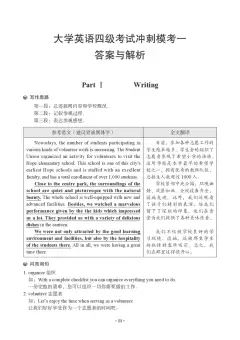
Directions: For this part, you are allowed 30 minutes to write a news report to your campus
newspaper on a visit to a Hope elementary school organized by your Student Union.
You should write at least 120 words but no more than 180 words.
*请用黑色签字笔在答题卡1指定区域内作答作文题,在试题册上的作答无效!
Part Ⅱ Listening Comprehension (25 minutes)
Section A
Directions: In this section, you will hear three news reports. At the end of each
news report, you will hear two or three questions. Both the news
reports and the questions will be spoken only once. After you hear
a question, you must choose the best answer from the four choices
marked A), B), C) and D). Then mark the corresponding letter on
扫一扫,随便听
Answer Sheet 1 with a single line through the centre.
Questions 1 and 2 are based on the news report you have just heard.
1.A) He set a record by swimming to and from an island.
B)He celebrated his ninth birthday on a small island.
C)He visited a prison located on a faraway island.
D)He swam around an island near San Francisco.
2.A) He doubled the reward. B)He set him an example.
C)He cheered him on all the way. D)He had the event covered on TV.
Questions 3 and 4 are based on the news report you have just heard.
3.A) To end the one-child policy. B)To encourage late marriage.
C)To increase working efficiency. D)To give people more time to travel.
·1·4. A) They will not be welcomed by young people.
B) They will help to popularize early marriage.
C) They will boost China’s economic growth.
D) They will not come into immediate effect.
Questions 5 to 7 are based on the news report you have just heard.
5. A) Cleaning service in great demand all over the world.
B) Two ladies giving up well-paid jobs to do cleaning.
C) A new company to clean up the mess after parties.
D) Cleaners gainfully employed at nights and weekends.
6. A) It takes a lot of time to prepare. B) It leaves the house in a mess.
C) It makes party goers exhausted. D) It creates noise and misconduct.
7. A) Hire an Australian lawyer. B) Visit the U.S. and Canada.
C) Settle a legal dispute. D) Expand their business.
Section B
Directions: In this section, you will hear two long conversations. At the end of each conversation,
you will hear four questions. Both the conversation and the questions will be spoken
only once. After you hear a question, you must choose the best answer from the four
choices marked A), B), C) and D). Then mark the corresponding letter on Answer
Sheet 1 with a single line through the centre.
Questions 8 to 11 are based on the conversation you have just heard.
8. A) He had a driving lesson. B) He got his driver’s license.
C) He took the driver’s theory exam. D) He passed the driver’s road test.
9. A) He was not well prepared. B) He did not get to the exam in time.
C) He was not used to the test format. D) He did not follow the test procedure.
10. A) They are tough. B) They are costly.
C) They are helpful. D) They are too short.
11. A) Pass his road test the first time. B) Test-drive a few times on highways.
C) Find an experienced driving instructor. D) Earn enough money for driving lessons.
Questions 12 to 15 are based on the conversation you have just heard.
12. A) Where the woman studies. B) The acceptance rate at Leeds.
C) Leeds’ tuition for international students. D) How to apply for studies at a university.
13. A) Apply to an American university. B) Do research on higher education.
C) Perform in a famous musical. D) Pursue postgraduate studies.
14. A) His favorable recommendations. B) His outstanding musical talent.
C) His academic excellence. D) His unique experience.
15. A) Do a master’s degree. B) Settle down in England.
C) Travel widely. D) Teach overseas.
·2·Section C
Directions: In this section you will hear three passages. At the end of each passage, you will hear
three or four questions. Both the passage and the questions will be spoken only once.
After you hear a question, you must choose the best answer from the four choices
marked A), B), C) and D). Then mark the corresponding letter on Answer Sheet 1
with a single line through the centre.
Questions 16 to 18 are based on the passage you have just heard.
16. A) They help farmers keep diseases in check.
B) Many species remain unknown to scientists.
C) Only a few species cause trouble to humans.
D) They live in incredibly well-organized colonies.
17. A) They are larger than many other species.
B) They can cause damage to people’s homes.
C) They can survive a long time without water.
D) They like to form colonies in electrical units.
18. A) Deny them access to any food. B) Keep doors and windows shut.
C) Destroy their colonies close by. D) Refrain from eating sugary food.
Questions 19 to 21 are based on the passage you have just heard.
19. A) The function of the human immune system.
B) The cause of various auto-immune diseases.
C) The viruses that may infect the human immune system.
D) The change in people’s immune system as they get older.
20. A) Report their illnesses. B) Offer blood samples.
C) Act as research assistants. D) Help to interview patients.
21. A) Strengthening people’s immunity to infection.
B) Better understanding patients’ immune system.
C) Helping improve old people’s health conditions.
D) Further reducing old patients’ medical expenses.
Questions 22 to 25 are based on the passage you have just heard.
22. A) His students had trouble getting on with each other.
B) A lot of kids stayed at school to do their homework.
C) His students were struggling to follow his lessons.
D) A group of kids were playing chess after school.
23. A) Visit a chess team in Nashville. B) Join the school’s chess team.
C) Participate in a national chess competition. D) Receive training for a chess competition.
24. A) Most of them come from low-income families.
B) Many have become national chess champions.
·3·C) A couple of them have got involved in crimes.
D) Many became chess coaches after graduation.
25. A) Actions speak louder than words. B) Think twice before taking action.
C) Translate their words into action. D) Take action before it gets too late.
Part Ⅲ Reading Comprehension (40 minutes)
Section A
Directions: In this section, there is a passage with ten blanks. You are required to select one word
for each blank from a list of choices given in a word bank following the passage. Read
the passage through carefully before making your choices. Each choice in the bank is
identified by a letter. Please mark the corresponding letter for each item on Answer
Sheet 2 with a single line through the centre. You may not use any of the words in the
bank more than once.
Ships are often sunk in order to create underwater reefs (暗礁) perfect for scuba diving (水
肺式潜泳) and preserving marine 26 . Turkish authorities have just sunk something a little
different than a ship, and it wouldn’t normally ever touch water, an Airbus A300. The hollowed-out
A300 was 27 of everything potentially harmful to the environment and sunk off the Aegean
coast today. Not only will the sunken plane 28 the perfect skeleton for artificial reef growth,
but authorities hope this new underwater attraction will bring tourists to the area.
The plane 29 a total length of 54 meters, where experienced scuba divers will 30 be
able to venture through the cabin and around the plane’s 31 . Aydin Municipality bought the
plane from a private company for just under US $ 100, 000, but they hope to see a return on that
32 through the tourism industry. Tourism throughout Turkey is expected to fall this year as
the country has been the 33 of several deadly terrorist attacks. As far as sunken planes go, this
Airbus A300 is the largest 34 sunk aircraft ever.
Taking a trip underwater and 35 the inside of a sunken A300 would be quite an
adventure, and that is exactly what Turkish authorities are hoping this attraction will make people
think. Drawing in adventure seekers and experienced divers, this new artificial Airbus reef will be
a scuba diver’s paradise (天堂).
A) create I) intentionally
B) depressed J) investment
C) eventually K) revealing
D) experiences L) stretches
E) exploring M) stripped
F) exterior N) territory
G) habitats O) victim
H) innovate
·4·Section B
Directions: In this section, you are going to read a passage with ten statements attached to it.
Each statement contains information given in one of the paragraphs. Identify the
paragraph from which the information is derived. You may choose a paragraph more
than once. Each paragraph is marked with a letter. Answer the questions by marking
the corresponding letter on Answer Sheet 2.
Living with parents edges out other living arrangements for 18-to 34-year-olds
A) Broad demographic (人口的) shifts in marital status, educational attainment and employment
have transformed the way young adults in the U.S. are living, and a new Pew Research Center
analysis highlights the implications of these changes for the most basic element of their lives—
where they call home. In 2014, for the first time in more than 130 years, adults ages 18 to 34
were slightly more likely to be living in their parents’ home than they were to be living with a
spouse or partner in their own household.
B) This turn of events is fueled primarily by the dramatic drop in the share of young Americans
who are choosing to settle down romantically before age 35. Dating back to 1880, the most
common living arrangement among young adults has been living with a romantic partner,
whether a spouse or a significant other. This type of arrangement peaked around 1960, when
62% of the nation’s 18- to 34-year-olds were living with a spouse or partner in their own
household, and only one-in-five were living with their parents.
C) By 2014, 31.6% of young adults were living with a spouse or partner in their own household,
below the share living in the home of their parent (s) (32.1%). Some 14% of young adults
lived alone, were a single parent or lived with one or more roommates. The remaining 22%
lived in the home of another family member (such as a grandparent, in-law or sibling (兄弟姐
妹)), a non-relative, or in group quarters like college dormitories.
D) It’s worth noting that the overall share of young adults living with their parents was not at a
record high in 2014. This arrangement peaked around 1940, when about 35% of the nation’s
18-to 34-year-olds lived with mom and/or dad (compared with 32% in 2014). What has
changed, instead, is the relative share adopting different ways of living in early adult-hood,
with the decline of romantic coupling pushing living at home to the top of a much less uniform
list of living arrangements.
E) Among young adults, living arrangements differ significantly by gender. For men ages 18 to
34, living at home with mom and/or dad has been the dominant living arrangement since 2009.
In 2014, 28% of young men were living with a spouse of partner in their own home, while
35% were living in the home of their parent (s).Young women, however, are still more likely
to be living with a spouse of romantic partner (35%) than they are to be living with their parent
(s) (29%).
F) In 2014, more young women (16%) than young men (13%) were heading up a household with-
out a spouse or partner. This is mainly because women are more likely than men to be single
parents living with their children. For their part, young men (25%) are more likely than young
women (19%) to be living in the home of another family member, a non-relative or in some
·5·type of group quarters.
G) A variety of factors contribute to the long-run increase in the share of young. Adults living
with the parents. The first in the postponement of, if not retreat from, marriage. The average
age of first marriage has risen steadily for decades. In addition, a growing share of young adult
may be avoiding marriage altogether. A previous Pew Research Center analysis projected
that as many as one-in-four of today’s young adult may never marry. While cohabitation (同
居) has been on the rise, the overall share of young adults either married or living with an
unmarried partner has substantially fallen since 1990.
H) In addition, trends in both employment status and wages have likely contributed to the growing
share of young adults who are living in the home of their parent (s), and this is especially true
of young men. Employed young men are much less likely to live at home than young men
without a job, and employment among young men has fallen significantly in recent decades.
The share of young men with jobs peaked around 1960 at 84%. In 2014, only 71% of 18- to-
34-year-old men were employed. Similarly with earnings, young men’s wages (after adjusting
for inflation) have been on a downward trajectory (轨迹) since 1970 and fell significantly
from 2000 to 2010. As wages have fallen, the share of young men living in the home of their
parent (s) has risen.
I) Economic factors seem to explain less of why young adult women are increasingly likely to
live at home. Generally, young women have had growing success in the paid labor market
since 1960 and hence might increasingly be expected to be able to afford to live independently
of their parents. For women, delayed marriage—which is related, in part, to labor market
outcomes for men—may explain more of the increase in their living in the family home.
J) The Great Recession (and modest recovery) has also been associated with an increase in young
adults living at home. Initially in the wake of the recession, college enrollments expanded,
boosting the ranks of young adults living at home. And given the weak job opportunities facing
young adults, living at home was part of the private safety net helping young adults to weather
the economic storm.
K) Beyond gender, young adults’ living arrangements differ considerably by education which
is tied to financial means. For young adults without a bachelor’s degree, as of 2008 living at
home with their parents was more prevalent than living with a romantic partner. By 2014, 36%
of 18- to 34-year-olds who had not completed a bachelor’s degree were living with their parent
(s) while 27% were living with a spouse or partner. Among college graduates, in 2014 46%
were married or living with a partner, and only 19% were living with their parent (s). Young
adults with a college degree have fared much better in the labor market than their less educated
counterparts, which has in turn made it easier to establish their own households.
36. Unemployed young men are more likely to live with their parents than the employed.
37. In 2014, the percentage of men aged 18 to 34 living with their parents was greater than that of
their female counterparts.
38. The percentage of young people who are married or live with a partner has greatly decreased in
the past three decades or so.
39. Around the mid-20th century, only 20 percent of 18- to 34-year-olds lived in their parents’
·6·home.
40. Young adults with a college degree found it easier to live independently of their parents.
41. Young men are less likely to end up as single parents than young women.
42. More young adult women live with their parents than before due to delayed marriage.
43. The percentage of young men who live with their parents has grown due to their decreased pay
in recent decades.
44. The rise in the number of college students made more young adults live with their parents.
45. One reason for young adults to live with their parents is that they get married late or stay single
all their lives.
Section C
Directions: There are 2 passages in this section. Each passage is followed by some questions
or unfinished statements. For each of them there are four choices marked A), B), C)
and D). You should decide on the best choice and mark the corresponding letter on
Answer Sheet 2 with a single line through the centre.
Passage One
Questions 46 to 50 are based on the following passage.
In the classic marriage vow (誓约) couples promise to stay together in sickness and in health.
But a new study finds that the risk of divorce among older couples rises when the wife—not the
husband—becomes seriously ill.
“Married women diagnosed with a serious health condition may find themselves struggling
with the impact of their disease while also experiencing the stress of divorce.” said researcher
Amelia Karraker.
Karraker and co-author Kenzie Latham analyzed 20 years of data on 2, 717 marriages from a
study conducted by Indiana University since 1992. At the time of the first interview, at least one of
the partners was over the age of 50.
The researchers examined how the onset (发生) of four serious physical illnesses affected
marriages. They found that, overall, 31% of marriages ended in divorce over the period studied.
The incidence of new chronic (慢性的) illness onset increased over time as well, with more
husbands than wives developing serious health problems.
“We found that women are doubly vulnerable to marital break-up in the face of illness, ”
Karraker said. “They’re more likely to be widowed, and if they’re the ones who become ill, they’re
more likely to get divorced.”
While the study didn’t assess why divorce is more likely when wives but not husbands be-
come seriously ill, Karraker offers a few possible reasons. “Gender norms and social expectations
about care-giving may make it more difficult for men to provide care to sick spouses, Karraker
said. “And because of the imbalance in marriage markets, especially in older ages, divorced men
have more choices among prospective partners than divorced women.”
Given the increasing concern about health care costs for the aging population, Karraker be-
lieves policymakers should be aware of the relationship between disease and risk of divorce.
·7·“Offering support services to spouses caring for their other halves may reduce marital stress
and prevent divorce at older ages,” she said. “But it’s also important to recognize that the pressure
to divorce may be health-related and that sick ex-wives may need additional care and services to
prevent worsening health and increased health costs.”
46. What can we learn about marriage vows from the passage?
A) They may not guarantee a lasting marriage.
B) They are as binding as they used to be.
C) They are not taken seriously any more.
D) They may help couples tide over hard times.
47. What did Karraker and co-author Kenzie Latham find about elderly husbands?
A) They are generally not good at taking care of themselves.
B) They can become increasingly vulnerable to serious illnesses.
C) They can develop different kinds of illnesses just like their wives.
D) They are more likely to contract serious illnesses than their wives.
48. What does Karraker say about women who fall ill?
A) They are more likely to be widowed.
B) They are more likely to get divorced.
C) They are less likely to receive good care.
D) They are less likely to bother their spouses.
49. Why is it more difficult for men to take care of their sick spouses according to Karraker?
A) They are more accustomed to receiving care.
B) They find it more important to make money for the family.
C) They think it more urgent to fulfill their social obligations.
D) They expect society to do more of the job.
50. What does Karraker think is also important?
A) Reducing marital stress on wives.
B) Stabilizing old couples’ relations.
C) Providing extra care for divorced women.
D) Making men pay for their wives’ health costs.
Passage Two
Questions 51 to 55 are based on the following passage.
People have grown taller over the last century, with South Korean women shooting up by
more than 20cm on average, and Iranian men gaining 16.5cm. A global study looked at the average
height of 18-year-olds in 200 countries between 1914 and 2014.
The results reveal that while Swedes were the tallest people in the world in 1914, Dutch men
have risen from 12th place to claim top spot with an average height of 182.5cm. Latvian women,
meanwhile, rose from 28th place in 1914 to become the tallest in the world a century later, with an
average height of 169.8cm.
James Bentham, a co-author of the research from Imperial College, London, says the global
·8·trend is likely to be due primarily to improvements in nutrition and healthcare. “An individual’s
genetics has a big influence on their height, but once you average over whole populations, genetics
plays a less key role,” he added.
A little extra height brings a number of advantages, says Elio Riboli of Imperial College.
“Being taller is associated with longer life expectancy,” he said. “This is largely due to a lower risk
of dying of cardiovascular (心血管的) disease among taller people.”
But while height has increased around the world, the trend in many countries of north and
sub-Saharan Africa causes concern, says Riboli. While height increased in Uganda and Niger dur-
ing the early 20th century, the trend has reversed in recent years, with height decreasing among
18-year-olds.
“One reason for these decreases in height is the economic situation in the 1980s,” said Alex-
ander Moradi of the University of Sussex. The nutritional and health crises that followed the policy
of structural adjustment, he says, led to many children and teenagers failing to reach their full po-
tential in terms of height.
Bentham believes the global trend of increasing height has important implications. “How tall
we are now is strongly influenced by the environment we grew up in,” he said. “If we give children
the best possible start in life now, they will be healthier and more productive for decades to come.”
51. What does the global study tell us about people’s height in the last hundred years?
A) There is a remarkable difference across continents.
B) There has been a marked increase in most countries.
C) The increase in peoples height has been quickening.
D) The increase in women’s height is bigger than in men’s.
52. What does James Bentham say about genetics in the increase of people’s height?
A) It counts less than generally thought.
B) It outweighs nutrition and healthcare.
C) It impacts more on an individual than on a population.
D) It plays a more significant role in females than in males.
53. What does Elio Riboli say about taller people?
A) They tend to live longer. B) They enjoy an easier life.
C) They generally risk fewer fatal diseases. D) They have greater expectations in life.
54. What do we learn about 18-year-olds in Uganda and Niger?
A) They grow up slower than their peers in other countries.
B) They are actually shorter than their earlier generations.
C) They find it hard to bring their potential into full play.
D) They have experienced many changes of government.
55. What does James Bentham suggest we do?
A) Watch closely the global trend in children’s development.
B) Make sure that our children grow up to their full height.
C) Try every means possible to improve our environment.
D) Ensure our children grow up in an ideal environment.
·9·Part Ⅳ Translation (30 minutes)
Directions: For this part, you are allowed 30 minutes to translate a passage from Chinese into
English. You should write your answer on Answer Sheet 2.
剪纸是中国民间艺术的一种独特形式,已有2000多年历史。剪纸很可能源于汉代,继
纸张发明之后。从此,它在中国的许多地方得到了普及。剪纸用的材料和工具很简单:纸
和剪刀。剪纸作品通常是用红纸做成的,因为红色在中国传统文化中与幸福相联。因此,
在婚礼、春节等喜庆场合,红颜色的剪纸是门窗装饰的首选。
·10·