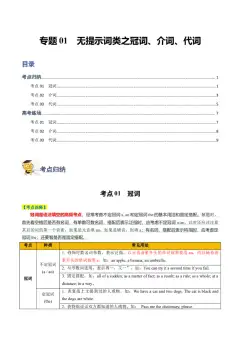
重难语法 01 名词冠词介词代词及其它
目录
题型综述.............................................................................................................................................2
解题攻略.............................................................................................................................................2
考向01 名词................................................................................................................................3
考向02 冠词................................................................................................................................5
考向03 介词................................................................................................................................9
考向04 代词..............................................................................................................................10
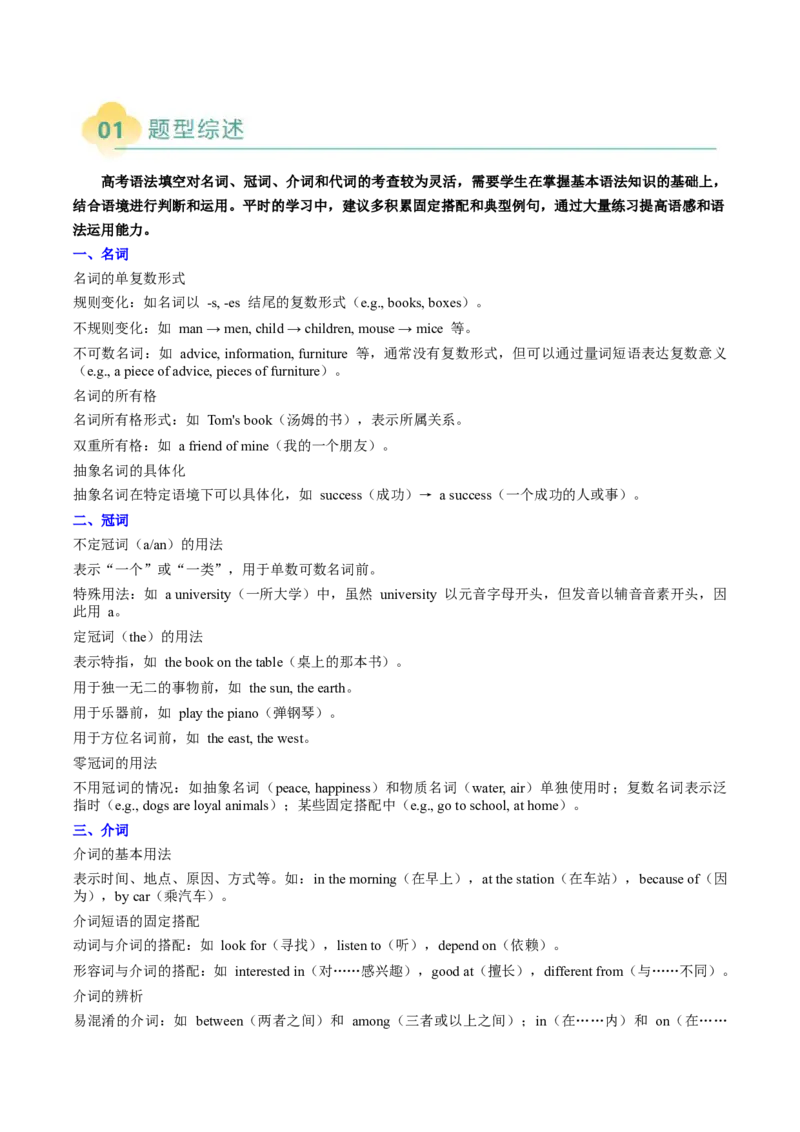
高考练场...........................................................................................................................................15高考语法填空对名词、冠词、介词和代词的考查较为灵活,需要学生在掌握基本语法知识的基础上,
结合语境进行判断和运用。平时的学习中,建议多积累固定搭配和典型例句,通过大量练习提高语感和语
法运用能力。
一、名词
名词的单复数形式
规则变化:如名词以 -s, -es 结尾的复数形式(e.g., books, boxes)。
不规则变化:如 man → men, child → children, mouse → mice 等。
不可数名词:如 advice, information, furniture 等,通常没有复数形式,但可以通过量词短语表达复数意义
(e.g., a piece of advice, pieces of furniture)。
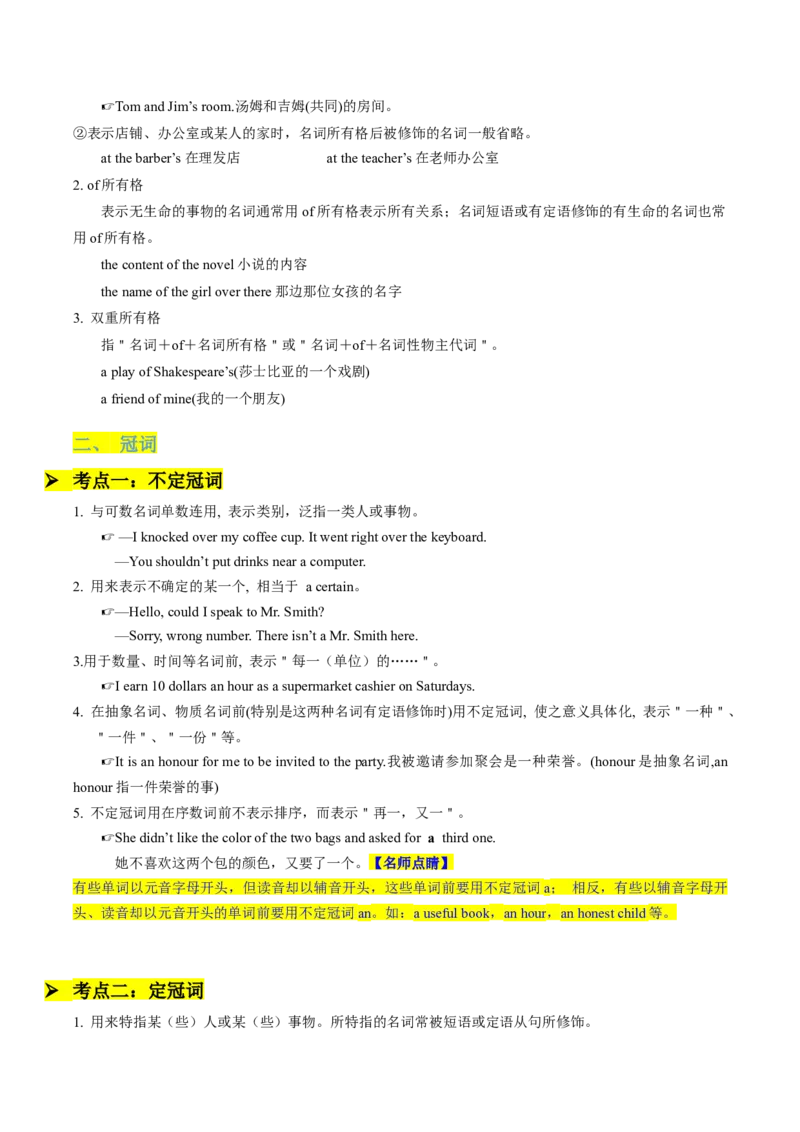
名词的所有格
名词所有格形式:如 Tom's book(汤姆的书),表示所属关系。
双重所有格:如 a friend of mine(我的一个朋友)。
抽象名词的具体化
抽象名词在特定语境下可以具体化,如 success(成功)→ a success(一个成功的人或事)。
二、冠词
不定冠词(a/an)的用法
表示“一个”或“一类”,用于单数可数名词前。
特殊用法:如 a university(一所大学)中,虽然 university 以元音字母开头,但发音以辅音音素开头,因
此用 a。
定冠词(the)的用法
表示特指,如 the book on the table(桌上的那本书)。
用于独一无二的事物前,如 the sun, the earth。
用于乐器前,如 play the piano(弹钢琴)。
用于方位名词前,如 the east, the west。
零冠词的用法
不用冠词的情况:如抽象名词(peace, happiness)和物质名词(water, air)单独使用时;复数名词表示泛
指时(e.g., dogs are loyal animals);某些固定搭配中(e.g., go to school, at home)。
三、介词
介词的基本用法
表示时间、地点、原因、方式等。如:in the morning(在早上),at the station(在车站),because of(因
为),by car(乘汽车)。
介词短语的固定搭配
动词与介词的搭配:如 look for(寻找),listen to(听),depend on(依赖)。
形容词与介词的搭配:如 interested in(对……感兴趣),good at(擅长),different from(与……不同)。
介词的辨析
易混淆的介词:如 between(两者之间)和 among(三者或以上之间);in(在……内)和 on(在……上)。
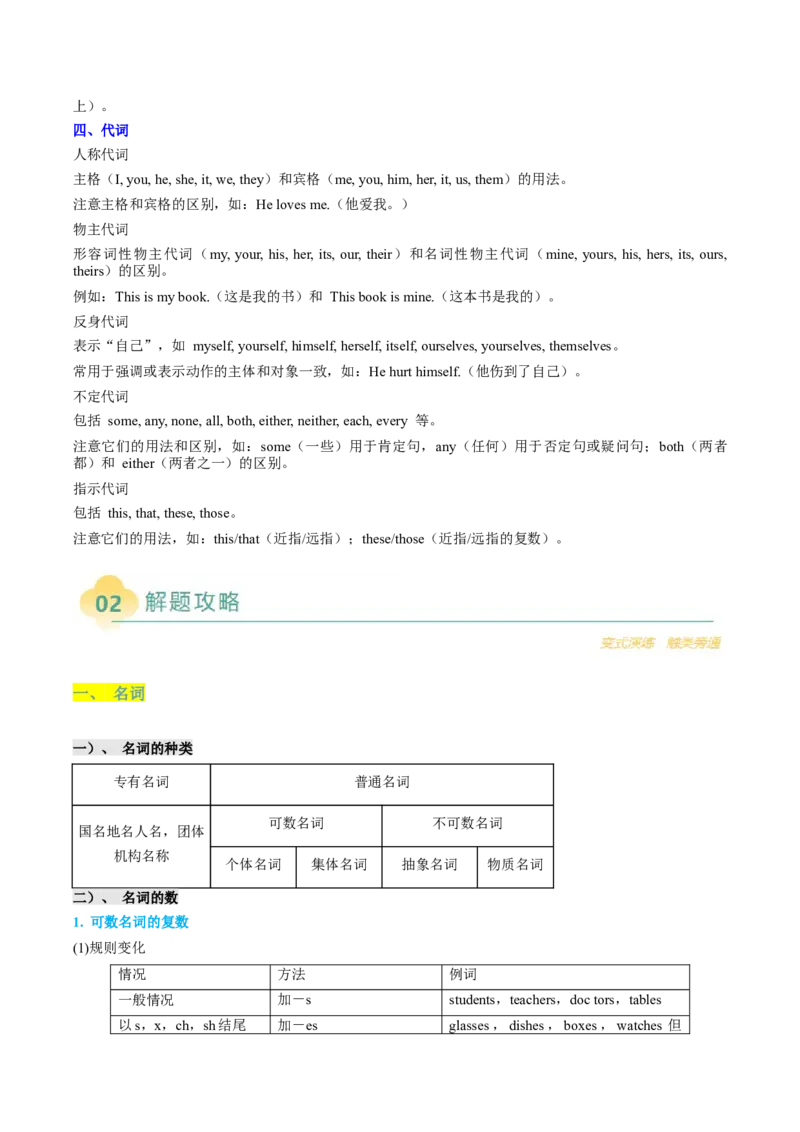
四、代词
人称代词
主格(I, you, he, she, it, we, they)和宾格(me, you, him, her, it, us, them)的用法。
注意主格和宾格的区别,如:He loves me.(他爱我。)
物主代词
形容词性物主代词(my, your, his, her, its, our, their)和名词性物主代词(mine, yours, his, hers, its, ours,
theirs)的区别。
例如:This is my book.(这是我的书)和 This book is mine.(这本书是我的)。
反身代词
表示“自己”,如 myself, yourself, himself, herself, itself, ourselves, yourselves, themselves。
常用于强调或表示动作的主体和对象一致,如:He hurt himself.(他伤到了自己)。
不定代词
包括 some, any, none, all, both, either, neither, each, every 等。
注意它们的用法和区别,如:some(一些)用于肯定句,any(任何)用于否定句或疑问句;both(两者
都)和 either(两者之一)的区别。
指示代词
包括 this, that, these, those。
注意它们的用法,如:this/that(近指/远指);these/those(近指/远指的复数)。
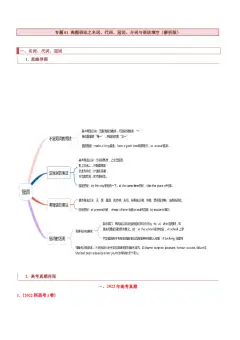
一、 名词
一)、 名词的种类
专有名词 普通名词
可数名词 不可数名词
国名地名人名,团体
机构名称
个体名词 集体名词 抽象名词 物质名词
二)、 名词的数
1. 可数名词的复数
(1)规则变化
情况 方法 例词
一般情况 加-s students,teachers,doc tors,tables
以s,x,ch,sh结尾 加-es glasses,dishes,boxes,watches 但stomach 复 数 形 式 直 接 加 s , 即
stomachs
以辅音字母+y结尾 变y为i再加-es families,babies,armies,bodies
以元音字母+y结尾 加-s boys,toys,pianos,photos
大都变f或fe为v,再加 thieves,wives,knives,shelves,
以f或fe结尾 -es lives
少数加-s beliefs,proofs,roofs,chiefs
通常加-s radios,videos,zoos,tobaccos
以o结尾
有的加-es heroes,potatoes,tomatoes
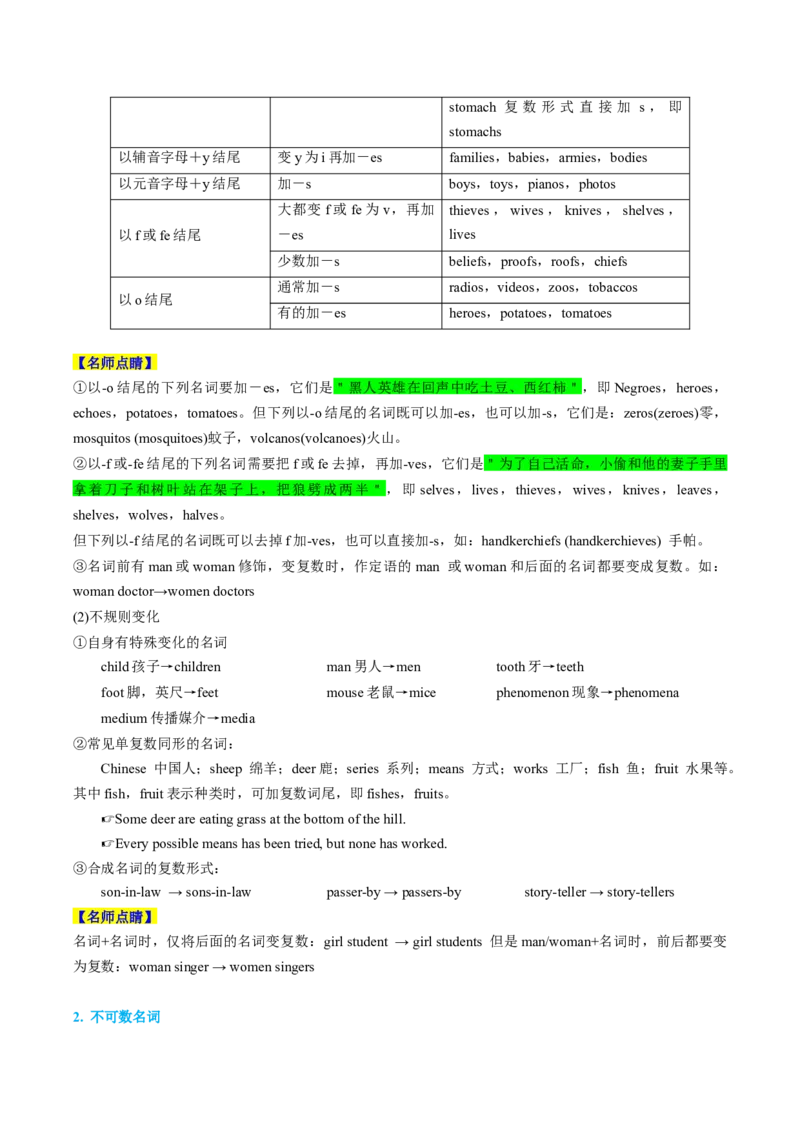
【名师点睛】
①以-o结尾的下列名词要加-es,它们是"黑人英雄在回声中吃土豆、西红柿",即Negroes,heroes,
echoes,potatoes,tomatoes。但下列以-o结尾的名词既可以加-es,也可以加-s,它们是:zeros(zeroes)零,
mosquitos (mosquitoes)蚊子,volcanos(volcanoes)火山。
②以-f或-fe结尾的下列名词需要把f或fe去掉,再加-ves,它们是"为了自己活命,小偷和他的妻子手里
拿着刀子和树叶站在架子上,把狼劈成两半",即 selves,lives,thieves,wives,knives,leaves,
shelves,wolves,halves。
但下列以-f结尾的名词既可以去掉f加-ves,也可以直接加-s,如:handkerchiefs (handkerchieves) 手帕。
③名词前有man或woman修饰,变复数时,作定语的man 或woman和后面的名词都要变成复数。如:
woman doctor→women doctors
(2)不规则变化
①自身有特殊变化的名词
child孩子→children man男人→men tooth牙→teeth
foot脚,英尺→feet mouse老鼠→mice phenomenon现象→phenomena
medium传播媒介→media
②常见单复数同形的名词:
Chinese 中国人;sheep 绵羊;deer鹿;series 系列;means 方式;works 工厂;fish 鱼;fruit 水果等。
其中fish,fruit表示种类时,可加复数词尾,即fishes,fruits。
☞Some deer are eating grass at the bottom of the hill.
☞Every possible means has been tried, but none has worked.
③合成名词的复数形式:
son-in-law → sons-in-law passer-by → passers-by story-teller → story-tellers
【名师点睛】
名词+名词时,仅将后面的名词变复数:girl student → girl students 但是man/woman+名词时,前后都要变
为复数:woman singer → women singers
2. 不可数名词(1)通常只用作不可数名词的名词:advice建议, furniture家具, fun乐趣;information信息,news新闻,
weather天气, progress进步,wealth财富,value价值等。
(2)不可数名词具体化
①具有某种特性、状态、情感的抽象名词在表示具体的概念时,可以与不定冠词连用,常考的有:
单词 抽象名词意义 具体化名词意义
success 成功 成功的人或事
pleasure 乐趣 令人高兴的事
beauty 美;美丽 美丽的人或事物
comfort 安慰;慰藉 令人感到安慰的人或事物
danger 危险 危险的人或因素
delight 高兴 令人高兴的事
failure 失败 失败的人或事物
surprise 惊奇 令人惊奇的事情
shock 震惊 令人震惊的事情
pride 骄傲 令人骄傲的事情
Your contribution will certainly make the event a huge success.你的贡献一定会使这个事件很成功。
②物质名词具体化
drink饮料→two drinks 两杯饮料 coffee咖啡→a coffee一杯咖啡
chalk 粉笔→a chalk 一支粉笔 hair 头发→a hair 一根头发
③抽象名词与a(an)连用,淡化了抽象概念,转化为似乎可以体验到的动作、行为或类别。例如:
☞Being able to afford a drink would be a comfort in those tough times.
在那些艰难的时期,能够买得起一杯酒会是一件欣慰的事。
(3)“of+抽象名词”相当于形容词。能用在此结构中的抽象名词有importance, value, use, significance,
help 等。
☞It’s of no practical use to me. 这对我没什么实际用途。
☞The work I am doing is not of much value. 我做的工作没有多大价值。
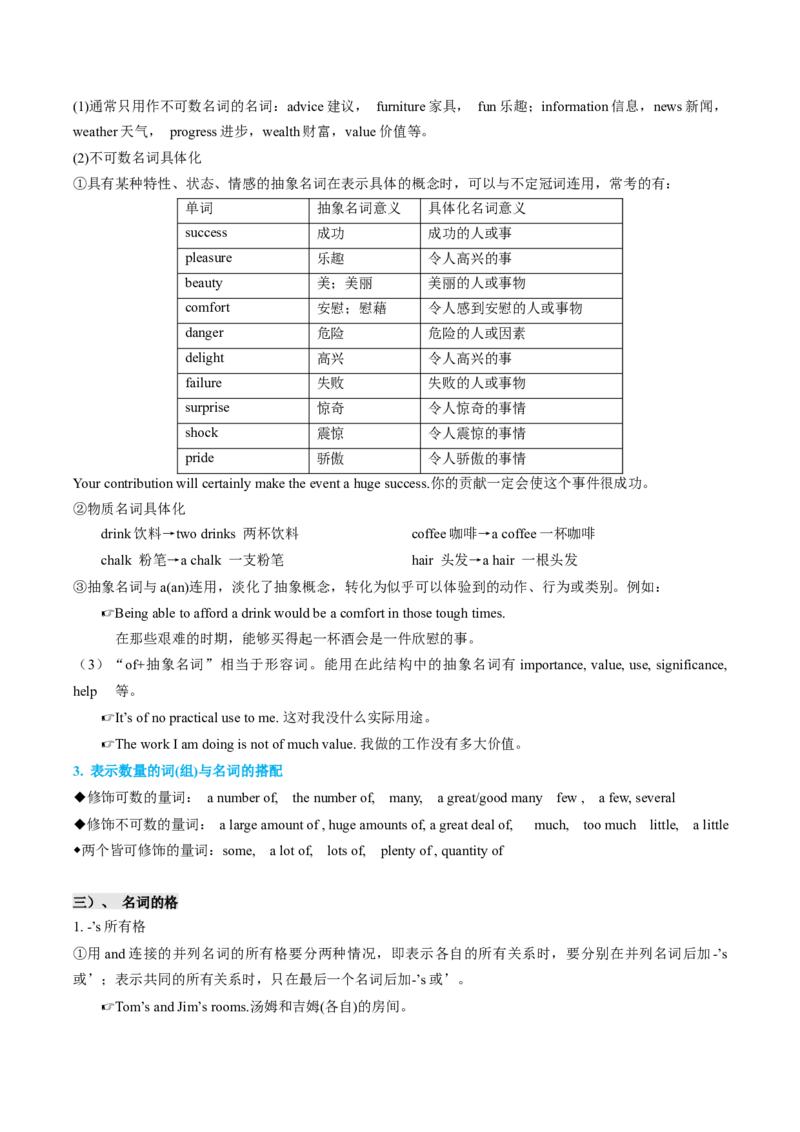
3. 表示数量的词(组)与名词的搭配
◆修饰可数的量词: a number of, the number of, many, a great/good many few , a few, several
◆修饰不可数的量词: a large amount of , huge amounts of, a great deal of, much, too much little, a little
◆两个皆可修饰的量词:some, a lot of, lots of, plenty of , quantity of
三)、 名词的格
1. -’s所有格
①用and连接的并列名词的所有格要分两种情况,即表示各自的所有关系时,要分别在并列名词后加-’s
或’;表示共同的所有关系时,只在最后一个名词后加-’s或’。
☞Tom’s and Jim’s rooms.汤姆和吉姆(各自)的房间。☞Tom and Jim’s room.汤姆和吉姆(共同)的房间。
②表示店铺、办公室或某人的家时,名词所有格后被修饰的名词一般省略。
at the barber’s在理发店 at the teacher’s在老师办公室
2. of所有格
表示无生命的事物的名词通常用of所有格表示所有关系;名词短语或有定语修饰的有生命的名词也常
用of所有格。
the content of the novel小说的内容
the name of the girl over there那边那位女孩的名字
3. 双重所有格
指"名词+of+名词所有格"或"名词+of+名词性物主代词"。
a play of Shakespeare’s(莎士比亚的一个戏剧)
a friend of mine(我的一个朋友)
二、 冠词
考点一:不定冠词
1. 与可数名词单数连用, 表示类别,泛指一类人或事物。
☞ —I knocked over my coffee cup. It went right over the keyboard.
—You shouldn’t put drinks near a computer.
2. 用来表示不确定的某一个, 相当于 a certain。
☞—Hello, could I speak to Mr. Smith?
—Sorry, wrong number. There isn’t a Mr. Smith here.
3.用于数量、时间等名词前, 表示"每一(单位)的……"。
☞I earn 10 dollars an hour as a supermarket cashier on Saturdays.
4. 在抽象名词、物质名词前(特别是这两种名词有定语修饰时)用不定冠词, 使之意义具体化, 表示"一种"、
"一件"、"一份"等。
☞It is an honour for me to be invited to the party.我被邀请参加聚会是一种荣誉。(honour是抽象名词,an
honour指一件荣誉的事)
5. 不定冠词用在序数词前不表示排序,而表示"再一,又一"。
☞She didn’t like the color of the two bags and asked for a third one.
她不喜欢这两个包的颜色,又要了一个。【名师点睛】
有些单词以元音字母开头,但读音却以辅音开头,这些单词前要用不定冠词a; 相反,有些以辅音字母开
头、读音却以元音开头的单词前要用不定冠词an。如:a useful book,an hour,an honest child等。
考点二:定冠词
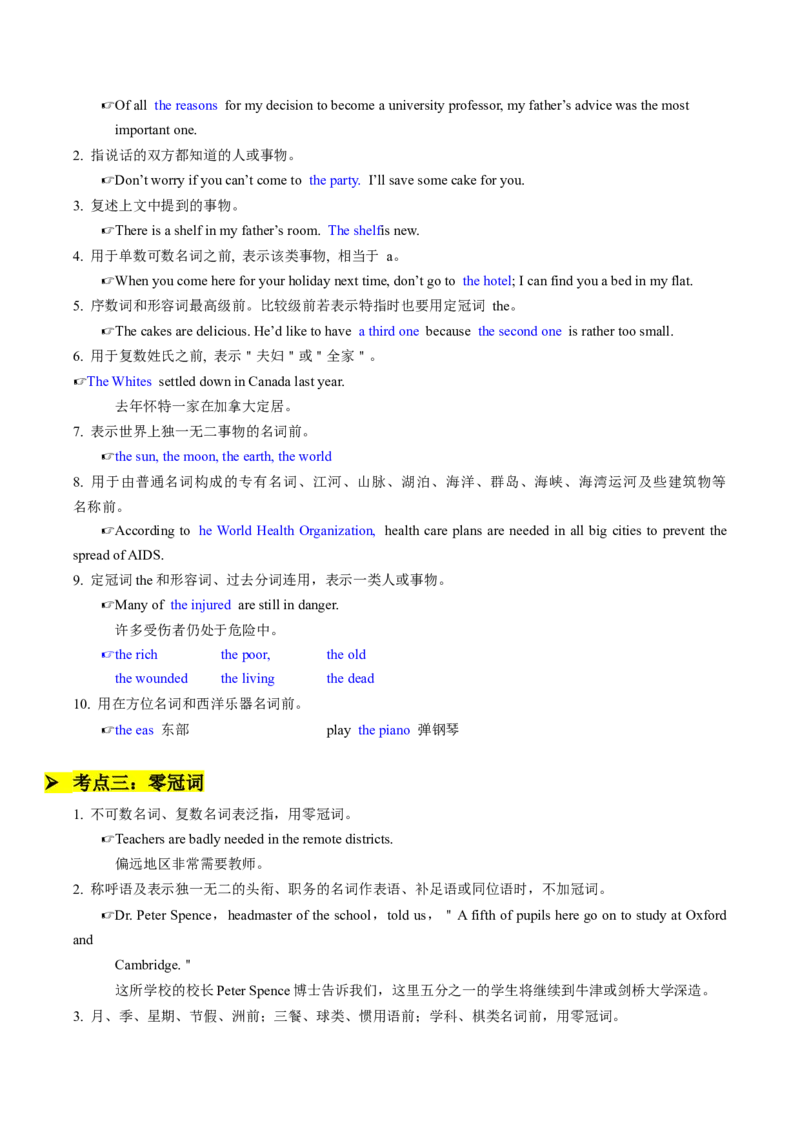
1. 用来特指某(些)人或某(些)事物。所特指的名词常被短语或定语从句所修饰。☞Of all the reasons for my decision to become a university professor, my father’s advice was the most
important one.
2. 指说话的双方都知道的人或事物。
☞Don’t worry if you can’t come to the party. I’ll save some cake for you.
3. 复述上文中提到的事物。
☞There is a shelf in my father’s room. The shelfis new.
4. 用于单数可数名词之前, 表示该类事物, 相当于 a。
☞When you come here for your holiday next time, don’t go to the hotel; I can find you a bed in my flat.
5. 序数词和形容词最高级前。比较级前若表示特指时也要用定冠词 the。
☞The cakes are delicious. He’d like to have a third one because the second one is rather too small.
6. 用于复数姓氏之前, 表示"夫妇"或"全家"。
☞The Whites settled down in Canada last year.
去年怀特一家在加拿大定居。
7. 表示世界上独一无二事物的名词前。
☞the sun, the moon, the earth, the world
8. 用于由普通名词构成的专有名词、江河、山脉、湖泊、海洋、群岛、海峡、海湾运河及些建筑物等
名称前。
☞According to he World Health Organization, health care plans are needed in all big cities to prevent the
spread of AIDS.
9. 定冠词the和形容词、过去分词连用,表示一类人或事物。
☞Many of the injured are still in danger.
许多受伤者仍处于危险中。
☞the rich the poor, the old
the wounded the living the dead
10. 用在方位名词和西洋乐器名词前。
☞the eas 东部 play the piano 弹钢琴
考点三:零冠词
1. 不可数名词、复数名词表泛指,用零冠词。
☞Teachers are badly needed in the remote districts.
偏远地区非常需要教师。
2. 称呼语及表示独一无二的头衔、职务的名词作表语、补足语或同位语时,不加冠词。
☞Dr. Peter Spence,headmaster of the school,told us,"A fifth of pupils here go on to study at Oxford
and
Cambridge."
这所学校的校长Peter Spence博士告诉我们,这里五分之一的学生将继续到牛津或剑桥大学深造。
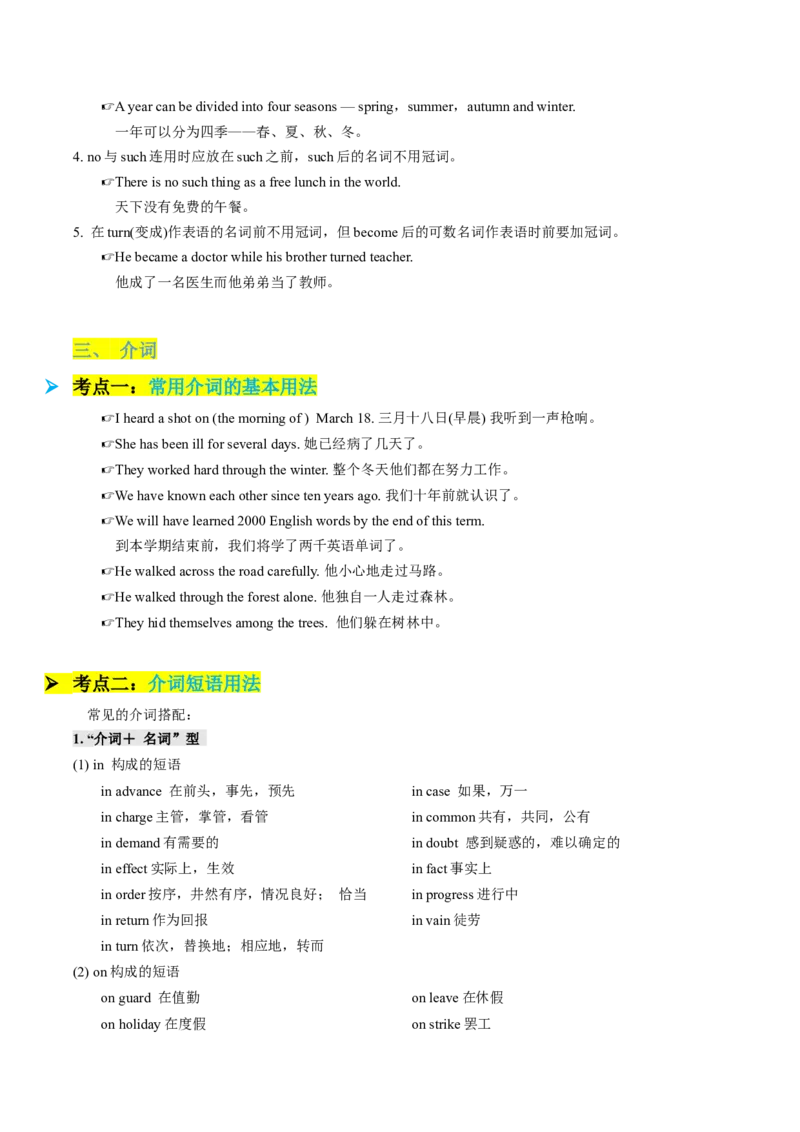
3. 月、季、星期、节假、洲前;三餐、球类、惯用语前;学科、棋类名词前,用零冠词。☞A year can be divided into four seasons — spring,summer,autumn and winter.
一年可以分为四季——春、夏、秋、冬。
4. no与such连用时应放在such之前,such后的名词不用冠词。
☞There is no such thing as a free lunch in the world.
天下没有免费的午餐。
5. 在turn(变成)作表语的名词前不用冠词,但become后的可数名词作表语时前要加冠词。
☞He became a doctor while his brother turned teacher.
他成了一名医生而他弟弟当了教师。
三、 介词
考点一:常用介词的基本用法
☞I heard a shot on (the morning of ) March 18. 三月十八日(早晨) 我听到一声枪响。
☞She has been ill for several days. 她已经病了几天了。
☞They worked hard through the winter. 整个冬天他们都在努力工作。
☞We have known each other since ten years ago. 我们十年前就认识了。
☞We will have learned 2000 English words by the end of this term.
到本学期结束前,我们将学了两千英语单词了。
☞He walked across the road carefully. 他小心地走过马路。
☞He walked through the forest alone. 他独自一人走过森林。
☞They hid themselves among the trees. 他们躲在树林中。
考点二:介词短语用法
常见的介词搭配:
1. “介词+ 名词”型
(1) in 构成的短语
in advance 在前头,事先,预先 in case 如果,万一
in charge主管,掌管,看管 in common共有,共同,公有
in demand有需要的 in doubt 感到疑惑的,难以确定的
in effect实际上,生效 in fact事实上
in order按序,井然有序,情况良好; 恰当 in progress进行中
in return作为回报 in vain徒劳
in turn依次,替换地;相应地,转而
(2) on构成的短语
on guard 在值勤 on leave在休假
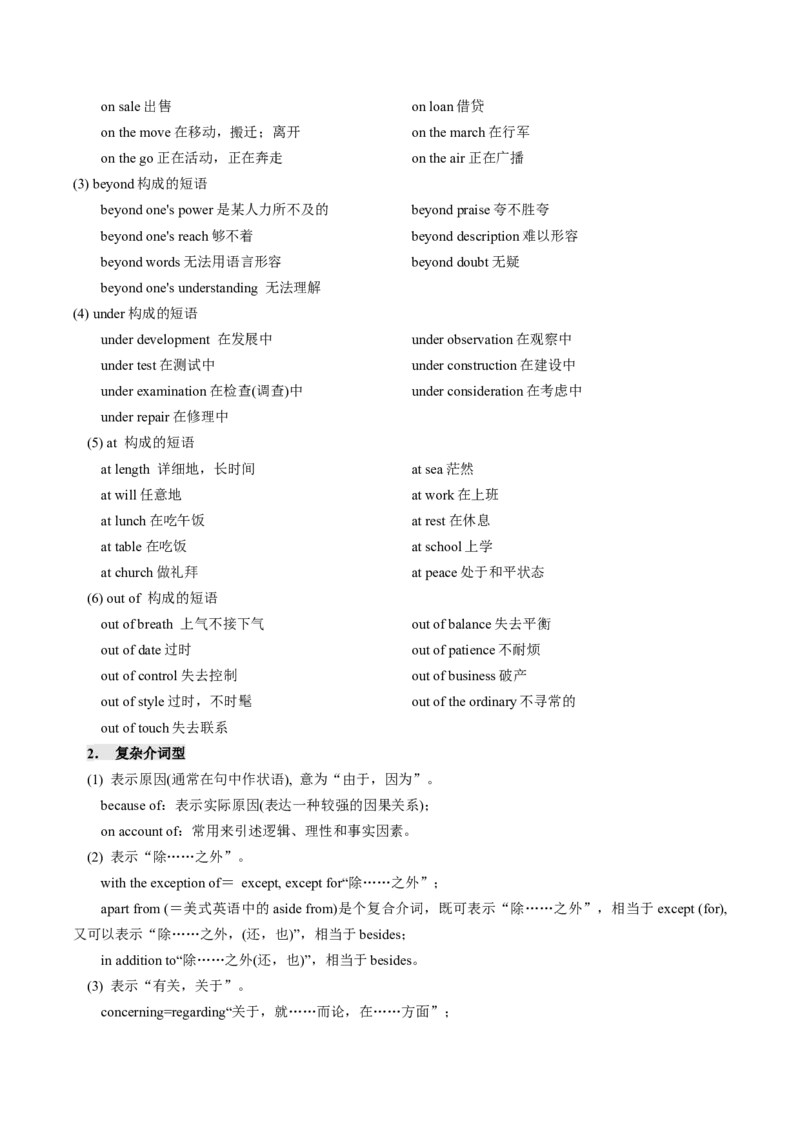
on holiday在度假 on strike罢工on sale出售 on loan借贷
on the move在移动,搬迁;离开 on the march在行军
on the go正在活动,正在奔走 on the air正在广播
(3) beyond构成的短语
beyond one's power是某人力所不及的 beyond praise夸不胜夸
beyond one's reach够不着 beyond description难以形容
beyond words无法用语言形容 beyond doubt无疑
beyond one's understanding 无法理解
(4) under构成的短语
under development 在发展中 under observation在观察中
under test在测试中 under construction在建设中
under examination在检查(调查)中 under consideration在考虑中
under repair在修理中
(5) at 构成的短语
at length 详细地,长时间 at sea茫然
at will任意地 at work在上班
at lunch在吃午饭 at rest在休息
at table在吃饭 at school上学
at church做礼拜 at peace处于和平状态
(6) out of 构成的短语
out of breath 上气不接下气 out of balance失去平衡
out of date过时 out of patience不耐烦
out of control失去控制 out of business破产
out of style过时,不时髦 out of the ordinary不寻常的
out of touch失去联系
2. 复杂介词型
(1) 表示原因(通常在句中作状语), 意为“由于,因为”。
because of:表示实际原因(表达一种较强的因果关系);
on account of:常用来引述逻辑、理性和事实因素。
(2) 表示“除……之外”。
with the exception of= except, except for“除……之外”;
apart from (=美式英语中的aside from)是个复合介词,既可表示“除……之外”,相当于except (for),
又可以表示“除……之外,(还,也)”,相当于besides;
in addition to“除……之外(还,也)”,相当于besides。
(3) 表示“有关,关于”。
concerning=regarding“关于,就……而论,在……方面”;with respect to“关于,就……而言”;
as for和as to用于句首时表示“至于”。
(4) 表示“在……之前”。
ahead of=in advance of,可表示“(在空间或时间上比某人或某事物)更前,更早”, 还可表示“领先,
优于”;
in front of 多指空间的前后关系,“在……前方”。
(5) 表示“支持,赞成”。
in support of 维护,支持,支援;
in favor of 可指某人“支持,赞成”,也可指事物“有利于……”
(6) 表示“鉴于,由于;根据,按照”。
in the light of 按照,考虑到 in terms of 就……而言,谈到
according to 根据;按照 in view of 鉴于,因为
(7) 表示“尽管”。
in spite of 尽管,不管
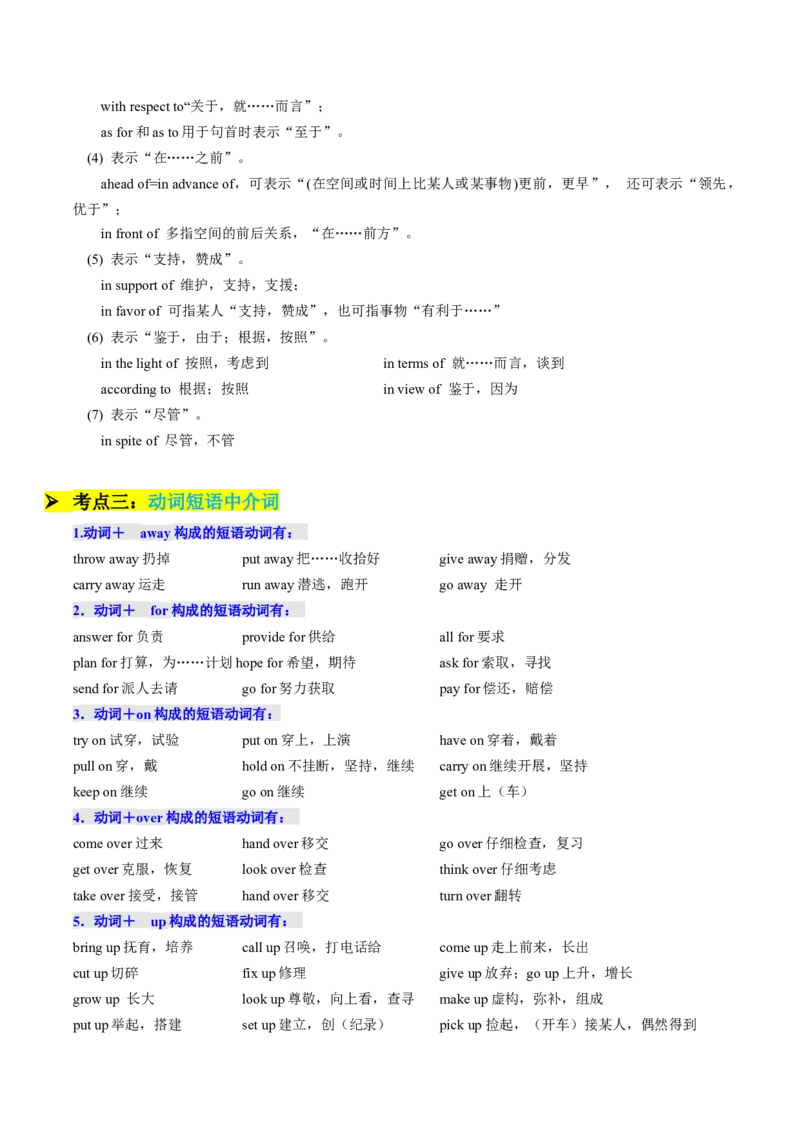
考点三:动词短语中介词
1.动词+ away构成的短语动词有:
throw away扔掉 put away把……收拾好 give away捐赠,分发
carry away运走 run away 潜逃,跑开 go away 走开
2.动词+ for构成的短语动词有:
answer for负责 provide for供给 all for要求
plan for打算,为……计划hope for希望,期待 ask for索取,寻找
send for派人去请 go for努力获取 pay for偿还,赔偿
3.动词+on构成的短语动词有:
try on试穿,试验 put on穿上,上演 have on穿着,戴着
pull on穿,戴 hold on不挂断,坚持,继续 carry on继续开展,坚持
keep on继续 go on继续 get on上(车)
4.动词+over构成的短语动词有:
come over过来 hand over移交 go over仔细检查,复习
get over克服,恢复 look over检查 think over仔细考虑
take over接受,接管 hand over 移交 turn over翻转
5.动词+ up构成的短语动词有:
bring up抚育,培养 call up召唤,打电话给 come up走上前来,长出
cut up切碎 fix up修理 give up放弃;go up 上升,增长
grow up 长大 look up尊敬,向上看,查寻 make up虚构,弥补,组成
put up举起,搭建 set up建立,创(纪录) pick up 捡起,(开车)接某人,偶然得到send up发射 show up 揭露,露面 turn up出现,把……调高一点
6.动词+out构成的短语动词有:
come out出来 go out出去,熄灭 look out留神,当心
walk out走出 set out出发,开始 put out扑灭,生产
give out发出,发表 hand out分发 pick out挑选
find out找出,发现 speak out大声地说 turn out生产,结果是
get out出去,离开 carry out实行,执行 work out计算出,解决,实行,行得通
bring out出版 start out 出发,动身。
四、 代词
考点一:人称代词、物主代词和反身代词
一、 人称代词
1. 人称代词的分类和数:
2. 人称代词作主语时要用主格,作宾语时用宾格,作表语时常用宾格。
☞She’s my classmate.
☞I bought a present for him.
【名师点睛】
在强调句中人称代词的使用应该根据人称代词具体作什么成分而定。
☞I met her in the hospital.→It was her who I met in the hospital.
☞It was I that first arrived at the airport.
二、 物主代词
1.物主代词的分类和数:
人称 第一人称 第二人称 第三人称
人称代词 单数 复数 单数 复数 单数 复数
形容词性物主代词 my our your your his/her/its their名词性物主代词 mine ours yours yours his/hers/its theirs
2. 物主代词的用法:
(1)形容词性物主代词相当于形容词,在句中只能作名词或动名词的前置定语,不能单独使用。
(2)名词性物主代词相当于“形容词性物主代词+名词”,可单独作主语、表语和宾语,也可与of连用作
后置定语,但不能单独作定语
☞This isn’t my shirt; mine is over there.
三、 反身代词
1. 反身代词的形式
第一人称 第二人称 第三人称
单数 myself yourself himself / herself /itself
复数 ourselves yourselves themselves
2. 反身代词常在enjoy, teach, hurt, buy, introduce等动词后和by, for, to ,of 等介词后作宾语
☞All of them enjoyed themselves. 所有的人都玩得很好。
☞Help yourself to some fish. 请自己动手吃点鱼吧。
3. 反身代词有时用于 be, feel, seem, look 等后作表语,表示身体或精神处于正常状态。
☞You don’t seem yourself today. 你今天好像不太好。
4. 强调用法:
反身代词在强调用法中表示强调,即用来加强某个名词或者代词的语气,可译成“亲自”、“本人”。
此时,它在句中作同位语。即使去掉,也不影响句子的完整性。如:
☞You must do it yourself. 你必须自己做。
☞I myself did the homework last night。
昨晚是我自己做了家庭作业。
5. 含有反身代词的短语
for oneself 给(为)自己,独自 to oneself 对自己
say to oneself 心 里 想
talk / speak to oneself 自言自语
come to oneself 苏醒过来 absent
oneself 缺席
beside oneself 失常,若狂 by oneself 独
自地,单独地of oneself 独自,自发地
考点二:指示代词和替代词
1. this, that, these, those的区别
(1)this(these)一般指时间或空间上较近的人或物;that(those)常指时间或空间上较远的人或物。
☞This is my desk and that is yours.
☞In those days they could not go to school.
(2)this常指后面要讲到的事物,有启下的作用;that则指前面讲到过的事物,有承上的作用。
☞I want to tell you this:the English party will be held on Saturday afternoon.
☞He hurt his leg yesterday. That’s why he didn’t come.
(3)为了避免重复,常用that或those代替前面已提过的名词。
☞The weather of Beijing is colder than that of Nanjing.
☞The ears of a rabbit are longer than those of a fox.
(4)this在电话用语中用于作自我介绍,that用于询问对方;this和that可以当副词用,相当于副词 so。
☞Can hard work change a person that much?
2. one, the one, that, it的区别
易混词 含义
this 指代上文说过的事物或下文要提到的事物。代替可数名词复数用these。
that 用来指代上文提到的某一个名词,可以是可数名词,也可以是不可数名
词,表示特指。代替可数名词复数用those(相当于the ones),后面必须有定
语。
one (复数形式是ones)只能用来指代上文提到的某一个可数名词单数,表示同名
异物。其前可以有定语,其后也可以有定语。
it 指上文提到的同一个事物,也可指代前面(或后面)整句话的意思。通常还可
用作形式主语或形式宾语。
☞The population of Shandong is larger than that of Qinghai. 山东的人口比青海的人口多。
☞I don’t like the blue shirt. I like the yellow one. 我不喜欢这件蓝色的衬衫。我喜欢那件黄色的。
☞I can’t find my hat. I don’ t know where I put it. 我找不到我的帽子。我不知道我把它放在哪儿了。
考点三:不定代词
1. both, either, neither, , all, none, no one, nobody
☞Both of my parents are doctors. 我的父母都是医生。
☞All of the students are interested in it. 所有的学生对此都很感兴趣。
☞He has two sons, neither of whom is rich. 他有两个儿子,都不富有。
☞He has three sons, none of whom is rich. 他有三个儿子,都不富有。
2. few, a few 与 little, a little的用法☞It is very difficult, and few people understand it. 它很难,没几个人能懂。
☞It is very difficult, but a few people understand it. 他虽难,但是有些人懂。
☞Unfortunately, I had little money on me. 很不巧,我身上没带什么钱。
☞Fortunately, I had a little money on me. 幸好我身上带着一点钱。
3. other, the other, another与others的用法
(1) 指单数时的区别:若泛指用another,若特指用 the other。如:
☞Give me another (one). 另外给我一个。
☞Shut the other eye, please. 请把另一只眼睛也闭上。
(2) 指复数时的区别:若泛指用 other(后接复数名词),若特指用the other(后接复数名词)。如:
☞There are other ways of doing it. 做这事还有其他的办法。
☞Where have the other students gone? 其他学生都到哪里去了?
(3) others的用法:它永远表示复数意义(且其后不能再接名词)。其用法大致相当于“other+复数名词”,同
样
地 the others 大致相当于“the other+复数名词”。如:
☞Other people [Others] may not think that way. 别的人可能不这样想。
☞He is cleverer than the others [the other students] in her class. 他比班上其他学生聪明。
(4) another的用法:一般只能表单数,且其后接名词也只能接单数名词。但是若其后有数词或 few 修饰时,
则也可接复数名词。如:
☞We need another few chairs. 我们还需要几把椅子。
☞In another two weeks it’ll be finished. 再过两个星期就可做完了。
考点四:it的用法
一、用作形式主语,替代动词不定式,动名词或从句
1. It is clear (obvious,true,possible,certain...) that...该句型中it是形式主语,真正的主语是that引导的主
语
从句,常译为"清楚(显然,真的,可能,肯定……)"。
☞ It is very clear that he doesn’t like it.=That he doesn’t like it is very clear. 很明显他不喜欢它。
2. It is said (reported/learned/believed/thought/known/told/hoped...) that...该句型中的it仍是形式主语,真正主
语
是that引导的主语从句;该结构常译为"据说(据报道,据悉……)"。
☞ It is reported that another satellite has been put into orbit. 据报道又一颗卫星被送入轨道。
3. It is time (about time,high time) that...该句型中that后的从句应该用虚拟语气,值得注意的是从句的谓语
动词常用过去时态表示虚拟,有时也用should+动词原形,should不能省略,常译为"是(正是)……
的
时候了"。
☞ It is time that children should go to bed.=It is time that children went to bed. 孩子们该睡了。4. It is the first (second...) time that...该句型中的that从句不用虚拟语气,而用完成时态。至于用什么完成时
态,
由主句的谓语动词的时态决定。如果是一般现在时,后面从句用现在完成时态;如果是一般过去时,后
面从句则用过去完成时态,该结构中that可以省去;it有时用this/that替换,常译为"是第一次做……"。
☞ It is the first time I have been here. 这是我第一次到这里来。
5. It is a pity (a shame/an honour/a good thing/a fact/a surprise/...) that...该句型中,that后的从句一般用虚拟语气
(should+动词原形),should可省略,表示出乎意料,常译为"竟然"。没有这种意义时,则不用虚拟语
气。
☞ It is a pity that such a thing (should) happen in your class. 这种事竟然发生在你们班上,真是遗憾!
☞ It is a pity that he is ill. 他生病了,真遗憾!
6. It happens (seems,looks,appears) that...该句型中it是形式主语,that引导的是主语从句,主句中的
happen,
seem等词是不及物动词。
☞ It seems that he will be back in a few days. 看来他再过几天才能回来。
7. It be+adj.(kind, nice, brave, clever, stupid...) of sb+to do sth该句型中的不定式短语是真正主语,如果不定
式的逻辑主语由of引起,句中的形容词必须是表示逻辑主语特征的形容词(即句中的形容词是修饰逻辑
主语的)。常见的形容词有 bad,brave,careless,clever,cruel,foolish,good(好心的),honest,
horrible,
kind,lazy,modest,naughty,nice,polite,rude,silly,stupid,wise,wrong等。这个句型可以转换为:
sb is+adj.+to do sth
☞ It is kind of you to say so.=You are kind to say so. 你这么说真是太善良了。
8. It be+adj.(difficult,easy,hard,important) for sb to do sth该句型与上一个同属一个句型。不定式的逻辑
主语由for引起,形容词常表示重要性、紧迫性、频繁程度、难易、安全等情况(即句中的形容词是修
饰
动词不定式的)。常见的形容词有important,necessary,natural,easy,safe,common,normal,hard,
difficult,
dangerous,unusual,impossible,pleasant等。
☞ It is important for her to come to the party.=It is important that she (should) come to the party.
对她来说,参加这次聚会很重要。
9. It takes sb some time to do sth 做某事花费某人……时间
☞ It took me five days to solve the problem. 解决这个问题花了我五天时间。
10. It costs sb some money to do sth 做某事花费某人……钱
☞ It will cost my father five thousand yuan to buy such a computer. 买这台电脑花了我父亲5, 000元。
11. It’s up to sb to do sth 应由某人(负责)做……
☞ It is up to you to decide whether to take the job or not. 做不做这份工作由你决定。
12. It’s useless/(of) no use/(of) no good doing sth
该句型常译为"做……是徒然的/没有益处的",句中的动名词短语是真正的主语,表语可以是 nouse(=not any use),no good(=not any good)等。
☞ It’s no use arguing with her. 跟她争论没有用。
二、作形式宾语
1. 用于 "主语+及物动词+宾语+宾语补足语" 句型中:当复合宾语中的宾语是不定式、动名词或宾语
从句时,常用it作形式宾语,而往往把真正的宾语——不定式、动名词或宾语从句置于补足语之后。
☞ I think it important that we should keep calm. 我认为我们应该保持安静,这很重要。
☞ I feel it my duty that I should devote myself to teaching. 我感到致力于教学是我的责任。
☞ I make it a rule that I read English every morning. 每天早晨读英语是我的习惯。
2. 用于"主语+及物动词+宾语"句型中:有些动词或短语动词不能直接跟that引导的宾语从句,需
要在从句前先加上形式宾语it。
①appreciate,dislike,hate,like,love,make(按时到达,成功),have(表明,坚持说),take(认为,猜
想),hide(隐瞒),publish(公布),put(表达,写出来)等。
☞ I take it that you will be leaving Shanghai soon. 我认为你会很快离开上海。
☞ The report has it that no one was to blame for the accident. 报告表明没有人要对这次事故负责。
☞ We published it that we had finished the project ahead of time. 我们宣布我们已提前竣工了。
②answer for(承担……的后果),count on(期待),depend on(依靠),insist on(坚持主张,坚决要求),see
to(确保)等。
☞ I am counting on it that you will come. 我期待你会来。
三、it构成强调句
1. 强调句型的基本结构为:It is/was+被强调部分+that/who+其他成分。
2. 强调句型强调的成分
强调句型强调的成分:主语、宾语、状语。被强调部分指人时,用who或that皆可;指物时,只能用
that;被强调部分是时间、地点,原因或方式状语时,不用when,where,why或how而用that。
☞ It was the beautiful lady that/who I met in the hotel yesterday.
我昨天在旅馆里遇到的正是这位漂亮女士。(强调宾语)
☞ It was in Beijing that we visited the Bird’s Nest and Water Cube.
正是在北京我们参观了鸟巢和水立方。(强调地点状语)
☞ It is my mother who/that reminds me to get up on time every day.
每天都是我妈妈提醒我按时起床。(强调主语)
3. 对not...until结构的强调
not...until结构的强调句型为"It is/was not until...that..."在这一固定句型中,由于not已经前移,that后
只能用肯定形式。
☞ He didn’t go to bed until ten o’clock.→It was not until ten o’clock that he went to bed. 直到10点他才睡觉。
☞ I didn’t realize it until I got off the bus.→It was not until I got off the bus that I realized it.一、单句语法填空
1.It is the fact that (graduate) from British Universities are working all over the island. (给词的适当
形式填空)
2.She got a headache if she had to read for any (long) of time. (所给词的适当形式填空)
3.The little boy gave his all in the game, playing without (hesitate) even when he was injured. (所给
词的适当形式填空)
4.People often have different opinions on some hot issues, so it is impossible to make (assume) about
people's reactions. (所给词的适当形式填空)
5.Outsiders have often overlooked the huge variety of musical (instrument) in Africa in the
mistaken belief that Africans play only drums. (所给词的适当形式填空)
6.Today is September 10th. It’s (teacher) Day. Let’s say “Thank you” to our teachers. (所给词的适当
形式填空)
7.The meat at this (butcher) is always very fresh. (所给词的适当形式填空)
8.The (president) attending the meeting himself gave them a great deal of encouragement. (所给词的
适当形式填空)
9.Realizing small goals will also give you (encourage) to achieve your long-term goal. (所给词
的适当形式填空)
10.There are different (activity) in our school clubs. (所给词的适当形式填空)
11.It can be big headache for the working parents to find reliable childcare during the busy holiday
season. (用适当的词填空)
12.It’s dangerous for a green hand like you to drive at speed of 120 kilometres an hour. (用适当的词
填空)
13.People have tendency to lean towards whatever they are interested in. (用适当的词填空)
14.There, I would always see same elderly lady feeding the pigeons. (用适当的词填空)
15.It is evident that AI will have impact on people’s lives in the future. (用适当的词填空)
16.As consequence, children become so reliant on their parents that they have no independent thought
or creative ideas. (用适当的词填空)
17.It shows that a knowledge of first aid can make real difference. (所给词的适当形式填空)
18.This restaurant offers unique dining experience, combining flavors from different cultures. (用适
当的词填空)
19.He would rather earn honest income than bet on becoming rich overnight. (用适当的词填空)
20.Army helicopters tried to evacuate injured after the earthquake. (用适当的词填空)21.Traditional Miao clothing and jewellery are recognized worldwide their high quality of craft
skills and unique designs, which include hundreds of different styles. (用适当的词填空)
22.There is no better place to get delicious, filling, fun and glorious food in one of the many wet
markets in Shanghai. (用适当的词填空)
23.I think she has many good qualities being beautiful. (用适当的词填空)
24.He won the badminton match the fact that he was playing with the wrong hand. (用适当的词
填空)
25.Live, high-detail satellite mapping could probably be used to keep tags on anybody at any time, the
person’s knowledge. (用适当的词填空)
26.It started with things assessing credit risk from loan applications, sorting the mail by reading
handwritten characters from zip codes. (用适当的词填空)
27.76 participants different countries walked shoulder to shoulder through the performance zone in a
program that greeted all the people around the world. (用适当的词填空)
28.However, it did not stop her from completing her college and graduate studies before becoming a white-collar
worker in Shanghai, her parents’ great support. (用适当的词填空)
29.Everybody was touched words after they heard her moving story. (用适当的词填空)
30.We should adopt positive attitude failures in life. (用适当的词填空)
31.Bored, Tom couldn’t concentrate what his mother was saying. (用适当的词填空)
32. all the terrifying facts, however, some conservationists say there is still hope. (用适当的词填空)
33.These days, many totem poles no longer exist of decay and rot. (用适当的词填空)
34.The total amount of packaging increased 12% between 1999 and 2005. (用适当的词填空)
35.When I took the money from her grandparents, I looked back the girl, who was giving me the most
optimistic, largest smile I had ever seen. (用适当的词填空)
36.Appearance isn’t : in the long run, people will form their opinions about us based on how we
behave, not on how we look. (用适当的词填空)
37.The taboos of one culture may be very different from of another. (用适当的词填空)
38.“ made me feel that there were many things worth sharing in my life, and it also gave me a sense
of mission,” she explains. (用适当的词填空)
39.Instead of having to choose one or the other, we can benefit from of the approaches. (用适当的词
填空)
40.The little boy pulled right hand out of the pocket. (用适当的词填空)
41.The difference between a man who succeeds and who does not lies only in the way each treats
opportunities. (用适当的词填空)
42.In order to keep team members positive and motivated, the team leader needs to show these
qualities. (用适当的词填空)
43.Equipped with modern facilities, today’s libraries differ greatly from of the past. (用适当的词填空)
44.Over time, as the population grew, people began cutting food into small pieces so would cook more
quickly. (用适当的词填空)
45.I like singing my sister likes dancing. (用适当的词填空)
46.I could have ignored him when he fell down, I stopped to help him. (用适当的词填空)
47.Office workers tried to put out the fire, it was impossible to control it. (用适当的词填空)
48.Drug abuse has serious effects on individuals physically and mentally, the economic losses caused
by drug abuse are great. (用适当的词填空)
49.As a result of showing up, Jason took opportunities got him closer to his goal. He sent work to a
student show and was accepted by Robin Rule, the owner of Rule Gallery. (用适当的词填空)
50.Hotels are largely given over to rooms for individuals, “Home is thought of as a place for a family
over years, hosting lots of different activities.” (用适当的词填空)
51.Their rich cultural heritage promotes health and well-being, both physically mentally. (所给词
的适当形式填空)
52.Visitors can not only observe a wide variety of kites, traditional and modern, small and giant, also
engage in kite-making workshops, art performances and experiential activities. (用适当的词填空)
53.Either Tom his twin sisters are going to put on a performance tomorrow evening. (用适当的词填
空)
54.After contrasting advanced literature abstract art, I have determined to choose the latter as my
optional course. (用适当的词填空)
55.The resultant material was to be studied by experts psychology. (用适当的词填空)
56.Opportunity and challenge are two things of one issue, either of which can transform the other. (用
适当的词填空)
57.The boss wishes that his sick outstanding manager could pull and come back to work as soon as
possible. (用适当的词填空)
58.With the Chinese New Year the corner, children are eagerly expecting the reunion dinner and other
celebrations. (用适当的词填空)
59.The old man’s voice was shaking, all his efforts to control it. (用适当的词填空)
60.You need to find the right balance these two conflicting goals. (用适当的词填空)
二、语篇语法填空
阅读下面短文,在空白处填入1个适当的单词或括号内单词的正确形式。
Chinese medicine is an old way of healing that has been used in China for thousands of years. In recent
years, the preservation of Chinese medicine 1 (become) a subject of concern due to various factors such
as modernization and globalization.
Chinese medicine represents a 2 (value) aspect of the world’s medical diversity. 3(protect) it is crucial not only for preserving China’s cultural heritage but also for contributing to global medical
knowledge. Just as biodiversity is critical to ecosystems, diversity in medical practice is critical to human health.
Chinese medicine carries 4 it a deep understanding of the human body’s relationship to nature and
the concept of balance between yin and yang. By safeguarding this practice, we preserve a wealth of knowledge of
health, 5 can offer alternative perspectives on treatment and prevention.
In the digital age, technology can aid in the preservation and 6 (promote) of traditional Chinese
medicine. Efforts should 7 (make) to create digital archives (档案) of ancient texts, medicinal recipes,
and treatment methodologies. The development of applications and online platforms can facilitate the learning and
the sharing of knowledge among doctors and enthusiasts worldwide.
Preserving Chinese medicine is not 8 (mere) about maintaining a medical tradition; it is about
protecting a cultural legacy and ensuring the continued relevance of 9 (it) wisdom in modern healthcare.
By recognizing 10 importance and integrating modern research methods, we can ensure that
Chinese medicine continues to evolve and benefit humanity.
阅读下面短文,在空白处填入1个适当的单词或括号内单词的正确形式。
Traditional handicrafts are getting a new life through poverty 11 (reduce) programs in China. The
Sixth China Intangible Cultural Heritage Expo (展览会) 12 (kick) off on Oct 23 in Jinan and showed
several poverty-alleviation (扶贫) projects 13 used intangible cultural heritage.
14 (dress) in clothing bearing horsetail embroidery (刺绣), Song Shuixian, a national-level inheritor
of the intangible heritage in Southwest China’s Guizhou province, promoted such embroidered products at the
expo.
Horsetail embroidery uses horse hair and silk thread 15 raw materials. The skill of weaving (编
织)horse hair with thread 16 sewing traditional patterns has been passed down for generations by the
Shui ethnic group in Guizhou. “In the past, the embroidery 17 (main) appeared on aprons, but now we
put them on daily clothes, handbags and notebooks to increase the embroidery’ s 18 (commerce) value
and meet consumers' demand,” Song says.
The 54-year-old ethnic Shui woman started learning horsetail embroidery from her mother as a child. Since
then, she has vowed to herself that she would dedicate her life to 19 (protect) the handicraft.
Following her suggestion, 20 center for protecting and inheriting horsetail embroidery was
founded in Sandu last year. “Now we have a better place to train more women in the skills of horsetail embroidery,”
Song says.
阅读下面短文,在空白处填入1个适当的单词或括号内单词的正确形式。
A new study by researchers from the University of Toronto, Hangzhou Normal University and Harvard
University has found that 21 (simple) expressing trust in young children can promote their honesty.
Conducted through 22 series of field experiments with 328 kindergarteners, the international study
was intended to know whether children were less likely to cheat in a simple test of counting accuracy if the adult
23 (direct) the test had previously conveyed her trust in them. The results showed that when adults trustedchildren to help with small tasks, such as holding their house keys, and 24 (express) that they would trust
them in the future, the children were significantly less likely to cheat on a subsequent test compared to children
25 weren’t given such trust messages.
“We were astonished by how powerful an effect a simple expression of trust had 26 children’s
subsequent honesty was,” said Professor Li Zhao of Hangzhou Normal University. “It seems that even at a young
age,children understand the value of trust and are willing to behave more honestly in response to feeling 27
(trust).”
Not only do the findings have important theoretical implications, but they also offer 28 (practice)
guidance to help parents and educators in developing moral character from an early age. “ 29 (we) results
point to the promise of using trust rather than threats or punishment 30 (develop) good qualities in
children,” said Dr. Zhao.
阅读下面短文,在空白处填入1个适当的单词或括号内单词的正确形式。
Chinese consumers are pursuing more personalized and flexible travel options for the National Day holiday,
with significant increases 31 (see) in bookings for self-driving tours and independent travel. Both
traditional cultural tours and autumn short journeys are gaining 32 (popular).
Running a week, the National Day holiday stands as the last long holiday of the year, 33 (lead) to
a considerable increase in flexible scheduling by consumers. As of Sept 20, bookings of flights and hotels during
the holiday both exceeded (超过) 34 (level) recorded during the same period last year, Tuniu said.
The holiday is the best time 35 (enjoy) fall foliage (秋季彩叶). Some of the most popular
domestic destinations include Huangguoshu Waterfall in Guizhou province, 36 stands as the largest
waterfall in Asia; Lushan Mountain as well as Huangshan Mountain in Anhui province.
Taking self-driving tours 37 (emerge) as one of the most popular modes of travel for Chinese
consumers in recent years. For the National Day holiday, 38 increasing number of travelers are choosing
to take high-speed trains to their destinations, and then rent cars for self-driving experiences.
39 (remarkable), more female travelers have embarked on self-driving tours. From beaches with
breathtaking views 40 vast grasslands, women have been traveling further.
阅读下面短文,在空白处填入1个适当的单词或括号内单词的正确形式。
So far, smartphones have been a jack-of-all-trades. But can you imagine that in the near future, you’ll
probably be able to use them to test if milk has gone bad without even 41 (open) the container? Researchers
up to now 42 (develop) a new smartphone sensor to help with this. The high-tech method could one day
reduce the current waste of 20% of dairy products.
43 (interest), the new sensor isn’t the world’s first non-invasive (非侵入性的) method of testing the
freshness of milk. However, previous techniques either were too 44 (convenient) or only worked with
transparent (透明的) and semi-transparent milk containers. The sensor, on the other hand, favors mass 45
(adopt), as it relies on the built-in vibration motor of the average smartphone.
Contrary 46 the popular belief, “best-by” and “use-by” dates can’t accurately predict 47milk will go bad, as that depends on a series of factors. Milk 48 (keep) at correct temperatures can still be
good 49 couple of days after its use-by date. However, improper conditions can cause it to go bad before
the use-by date, so it makes more sense for users to check the freshness right before consumption 50
(avoid) food poisoning.