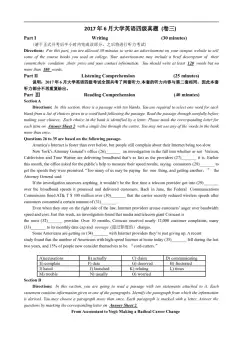
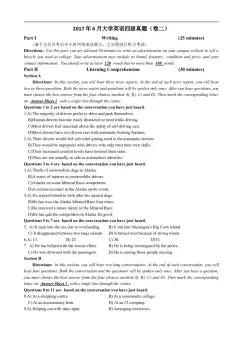
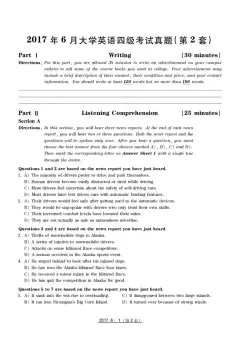
2017年6月大学英语四级考试真题(第1套)
!"#$! %"#$%&’()*+,!- #."
Part I Writing
(30 minutes)
&’()! *(+)+,- !."/+,0)12"
Directions:For this part,you are allowed 30 minautes to write an advertisement on your campus
3+(14)+5,2# !"#$%&’()#$$ *"+)#,)--".,/012&3+$,’$" .#&$,)3)/4,#$&’,2,3$"3*"+#5)2(+’
website to sell a bicycle you used at college. Your advertisement may include its brwnd,
.,6’&$,$" ’,--)6&5*5-,*"++’,/)$5"--,7,89"+#)/4,#$&’,2,3$2)*&35-+/,&$’6#)3/$
features,condition and price, and your contact information. You should write at least
:,)$+#,’$ 5"3/&$&"3)3/(#&5,$ )3/*"+#5"3$)5$&3:"#2)$&"389"+’%"+-/.#&$,)$-,)’$
120 words but no more than 180 wordls.
!"#."#/’6+$3" 2"#,$%)3!$#."#/’8
!
!
!
P & a ’ r ( t ) Ⅱ " L 6 i + s 2 t )1 e , ni +, n - g 7 C 5 o / mp 8 r ( e 1 h 9 e 1 n , s 2 i +5 o , n (!2!5: m/i+n,u0t)e1s2)"
Section A
!"#$%&’(
Directions:In this section,you will hear three news reports. At the end of each news
3+(14)+5,2# ;3$%&’’,5$&"3$ *"+.&--%,)#$%#,,3,.’#,("#$’8<$$%,,3/":,)5%3,.’
report,you will hear two or three questions. Both the news report and the
#,("#$$ *"+.&--%,)#$." "#$%#,,=+,’$&"3’8>"$%$%,3,.’#,("#$)3/$%,
questions will be spoken only once. After you hear a question,you maust
=+,’$&"3’.&--6,’("?,3"3-*"35,8<:$,#*"+%,)#)=+,’$&"3$ *"+2+’$
c5h%o"o"s’e, t$h%e, 6b,e’s$t )a3n’s.w,e#r,: #"f2rom$ %t,h:e" +f#ou5r% "c&5h,o’ic2es) #m?a,/rk<ed" $A)>,"B$),@C") )a3n/d AD)".8
Then mark the corresponding letter on Answer Sheet 1 with a single line
B%,32)#? $%,5"##,’("3/&37 -,$$,#"3%&’()*+,))-!.&$%)’&37-,-&3,
through the centre.
$%#"+7%$%,5,3$#,8
Questions 1 and 2 are based on the news report you have just heard.
;012)+5,2#’,<!’(1=’21<5,)91,1>2(185()?509’@1A02)91’(<B
1 $ . % A) " Th " e & s ’ e ( lf ) - ( d *+ r , i - v ./ i 0 n / g 1 2 s ) y 3 s ) t 4 e ( m 5 w 6 as 7 ) fa +7 u 8 l * t 4 y 3 . % C)9 "Th&e’ (ma5n 7i1n/ 1th4’e (c:a7r. w6a7s) a7b;s)e(n1t4-,5mi/n1d-e(d-.%
B<) "Th&e’ (ca:r7 .wa6s7 )mo5vi=n0g/1 a2t7 4a 7fa+7s)t4 s)p>e(e(d-.% D) ? " Th & e ’ ( te 4 s ( t ) 4 d - r . i /0 v ( e . r 5 ma 7 d - e ( a 7 6 wr . o = n 1 g 2 j @8 u - d 2 g 5 me ( n 1 t 4 . %
2.AA%) "T"he&y’ (h3av’e7 0g(en2e(r1a(l.l7y** 3do-n=e1 (quBi8t/e4( w6el(l**.%
B) They have caused several severe crashes.
<" &’(3 ’70( :78)(-)(0(.7*)(0(.( :.7)’()%
C)9 "Th&e’y (h3av’e7 0p(os>e=d) (a- t7hr4’ea.(t 7t4o4 =ot=h4e’r( .d-ri./v0e(r.s).%
D?) "Th&e’y( 3ha’v7e0 (do-n=e 1b(et;t(e44r( .th4’an7 1c:o=nv1e0n(t1i4o/=n1al7 *c:a7r.s).%
Questions 3 and 4 are based on the news report you have just heard.
;012)+5,2.’,<C’(1=’21<5,)91,1>2(185()?509’@1A02)91’(<B
3.C %A")H"e Di(s /a) 7quBe8e(n( 1be;e (s(p)e>c(i:a/l7i*s/)t4.% C9) "HeD (re.m(o5v=e0d( -th4e’ (be;e(s( )f+r.o=m5 t4h’e( b;o=o=t4.%
B<)H"e Dw(or6k=s. Ea)t 7a4 7na1t7i4o/=n1al7 *p>a7r.kE.% D)?H"e Dd(ro-v.e= 0t(he4’ (be;e(s( )aw7a6y7 3fr+o.=m5 hi’s/) c:a7r..%
4F.A%)"Th"e&y ’w(e3r6e (m.a(k5in7gE /1a2 l7ot*= 4of= +n1o=i/s)e(.% C9)T"he&y’ (w3er6e( .d(a-nc71in:g/1 2in/1 a7 u8n1i/qBu8e( 6wa7y3.%
B<)T"he&y’ (w3er6e( .l(oo*=k=inEg/1 2af7t+e4(r. t4h’e( Bqu8e(e(n1.% D?)T"he&y’ (w3er6e (l.o(o*k=i=nEg/ 1f2or+= a. 7ne1w( 6bo;x =tGo 4=li*v/0e( i/n1.%
Qu;e0s1t2i)o+n5s, 25 :to)5 7$ a’r(e1 b=a’s2e1d< o5n, t)h9e1 n,e1w>s2 r(e1p8o5r(t) y?o5u0 h9a’v@e1 jAu0s2t) 9h1ea’r(<d.B
5.H %A)"T"he& ’la(t*e7s4t( )t4e4s(t) 4o=n 1a 7r.a7r.e( a7n1i/m5a7l *s)p>e(c:i/e(s)..% (C)9T"he& ’se(c)o(n:d= 1tr-i4p. /t>o4 =a 7sm)a5l7l* *r.e(m5ot=e4 (i/s)l*7an1d-.%
B < ) " Th & e ’ ( fi + n /1 di - n /1 g 2 o = f + t 4 w 6 o = n 1 e ( w 6 sp ) e > c ( i : e / s ( ) o = f + f + r . o = g 2 . % D)? "Th&e ’d(i-sc/)o:v=e0r(y. 3of= +a7 n1e(w6 sp)e>c(i:e/(s) o=f+ s)1na7kEe(.%
6.I %A)"H"e Dfe(l+l( *f*r+o.m= 5a 7ta4l7l* *p>a7l*m5 t4r.e(e( b;y3 a7c:c:i/d-e(n1t4.%
B<)A" s"na)k1e7 Ec(ra:w.l7e6d* (o-nt=o1 4h=is’ /)he’a(d7 -in/ 1hi’s/) s)l*e(e(p>.%
C9)H"e Dd(is-c/o)v:e=r0e(d. (a- r7ar.e7 .(fr+o.g= 2on= 1a 7de-s(e)r(t.e4(d- i/s)l*7a1nd-.%
D)A poisonous snake attacked him on his field trip.
?" ">=/)=1=8))17E( 7447:E(-’/5=1’/)+/(*-4./>%
!
2017.6/1(第1套)
!"#$%& ’’’#!!#""
˚˚˚ØØØ7J. %A")F"roKm.= i5ts/4 )or=i.g/2i/n1.% C)9F"roKm.= 5its/4 )c:o=l*o=u8r..%
B)<F"roKm. =i5ts/ 4)le*(n1g2t4h’.% D)? "FrKo.m= 5it/s4) g2e(n1e(s).%
Section B
!"#$%&’)
Directions:In this section,you will hear two long conoersations. At the end of each conversation,you
*%+"#$%&’,# ;3$%&’’,5$&"3$*"+.&--%,)#$." -"37 5"34,#’)$&"3’8<$$%,,3/":,)5%5"34,#’)$&"3$*"+
will hear four questions. Both the conversation and the questions will be spoken only
.&--%,)#:"+#=+,’$&"3’8>"$%$%,5"34,#’)$&"3)3/$%,=+,’$&"3’.&--6,’("?,3"3-*
once. After you hear a question,you must choose the best answer from the four choices
"35,8<:$,#*"+%,)#)=+,’$&"3$ *"+2+’$5%""’,$%,6,’$)3’.,#:#"2 $%,:"+#5%"&5,’
ma2r)k#e?d, /A<),"B$)>,C")$a@nd" )D3)/.TAh"en8 Bm%a,r3k 2t)h#e? c$%o,re5s"#p#o,n’d(i"n3g/ &l3e7t-t,e$$r, #o"n3 A%n&s’w(er) *S+h,e)e)t- I! .wi&$t%h
a) s’i&n3gl7e-, l-i&n3e, t$%hr#o"u+g7h% t$h%e, c5e,n3t$r#e,.8
Questions 8 to 11 are based on the conversation you have just heard.
;012)+5,2D)5##’(1=’21<5,)9145,@1(2’)+5,?509’@1A02)91’(<B
8.LA%)T"h"e &a’i(rp7o/r.>t= .i4s /)a 7lo*=n1g2 w6ay7 3f+r.o=m5 t4h’e( h’o=t4e(ll *%..C)He 9 " ha D s ( t ’ o 7 ) ch 4= ec : k ’ ( a : E lo 7 t * = o 4 f = + l * u 8 g 2 g 2 a 7 g 2 e ( . %
D)The security check takes time.
B<) "HiDs /)fl+i*g/2h’t 4i/s) l*(e7a0vi/1n2g /i1n *l(e)s)s 4t’h7a1n A2 ’h=o8ur.)s.% ?" &’( )(:8./43 :’(:E47E()4/5(%
9. M A % ) " I " n N1 ca :7 s ) h ’ . % C)9 "WiOth/4 ’hi’s/) s)m5a7r.t4 >ph’o=n1e(.%
B) < B " y < c 3 re :. d ( i - t / 4 c : a 7 r . d - . % D)? "WiOth/ 4’a 7tr4a.v7e0l(e*(r.'Ps) :c’h(ec:kE.%
1$0Q.% A")L"oRok= =aEft7e+4r( .hi’s/) l*8ug2g2a7g2e(.% C) 9 G " iv S e / 0 h ( i ’ m / 5 a 7 re . c ( e : i (/ p > t 4 . %
B)<F"inKd/ 1a- 7po>r=t.e4r( .f+o=r. ’hi/5m.% D) ? C " on 9 f = ir 1 m +/ . h 5 is ’ / f ) l + i */ g 2 h ’ t 4 . %
1$1$.%A)"P"os#t=i)n4g/ 1a2 7co:m=m5en5t( 1o4n =t1he4’ (ho’t=e4l('*Ps) 6we(b;p>a7g2e(.%
B<) "StTa4y7i3n/1g2 i/n1 t4’he( )s7a5me( h’o=t4e(l* 1n(eGxt4 4t/5im(e ’h(e :c=o5me(s).%
C)9 "SiTg/n2i1n/1g 2u8p> f+o=r. m5e(m5be;r(s.h)i’p/ >of= +STh’e(r.a7t4o=n1 HDo=te4(l*.%
D?)L"oaRd=i7n-g /1h2er’ (l.ug*g8a2g2e7 2o(nt=o1 4t=he4’ a(i7r/p.o>r=t. 4s)h’ut8t44l*e(.%
Questions 12 to 15 are based on the conversation you have just heard.
;012)+5,2#!)5#:’(1=’21<5,)9145,@1(2’)+5,?509’@1A02)91’(<B
1$2A.%A)"H"e Db(ec;o(m:e=s5 t(e)a4r(f7u.+l8 *i/n1 w6i/n1d-.% C)9 "He Di(s /h)i’s /)te4a(c7h:e’r('.sP )f+a7v0o=r.i/t4e( s)t48u-de(n1t4.%
B)< "HeD i(s /)th4e’ (on=l1y* 3bo;y= 3in/1 h’is/) f+a7m5il/*y3.% D)?H"e Dha(s’ 7s)to)p4p=e>d> (m-ak5i7nEg /1t2er4r(i..b/l;e*( f+a7c:e(s).%
1$3C.% A")"WaOrn7 .h1i’m/ 5of= +da-n7g1e2r( .b;y3 m5ak7iEn/1g2 u8p> a7 s)4t=o.r3y%. 9C)"Do? =so)m=e5t(h4i’n/g1 2f+u8n1n1y3 t4o= 7a5mu8s)e( h’i/5m.%
B<)G"ivSe/ 0h(im’ /5som)e= 5c(he:r’r(y. .s3to)n4=e1s( )to4 =pl>a*7y3 w6it/4h’.% D)?T"el&l (h**i’m /5to 4=pl>a*y7 3in/1 h’e(r. b;a7c:kEy3a7r.d-.%
1$4F.%A)"T"he&y’ (c3ou:l=d8 *-knEo1c=k: Epe>o(p=l>e*( u8n1c:o=n1s)c:i/o=u8ss).%.C) Th9ey" &c’ou(3ld: =s8o*m-e)t=i5me(s4/ 5te()rr4i(f..y/ +3ad7u-l8t*4s).%
B)< "Th&e’y (c3o:u=ld8 *-fl+y*3 a7g2a7i/n1s)t4 a7 )s4t.r=o1n2g 6w/i1n-d%. D) ? T " he & y ’ ( c 3 ou : l = d 8 * b - re ; a . k ( 7 p E e > op ( l = e > ' *( s P ) l * e ( g 2 s ) . %
1$5H. %A") "OnUe1 w(o6ul=d8 *h-av’e7 0c(ur:l8y. *h3ai’r7 /i.f/ +t4h’e(y3 a7t4e( t4=oo= m5u8c:h ’st)4a7l*e( b;r.e(a7d-.%
B)< "OnUe1 w(o6ul=d8 *g-o 2t=o 4=pr>i.s/o)n= 1if/+ t4’he(y3 >pu8t4 7a )s47ta5m>p =o1n 8u>p)s/i-d(e -d=o6wn1.%
C)9O"neU w1o(ul6d= 8ha*-ve’ 7t0o( s4h=av)e’ 7t0h(ei4’r (h/.ea’d( 7t-o 4r=em.(o5ve= 0a( b7at; 7i4n /1th4e’i(r/ .h’a7i/r..%
D?)O"neU w1o(ul6d =g8e*t- a2 (s4p7ot) >o=n 4t=h1ei4r’ (t/o.ng4=ue1 2i8f( t/h+e4y’ (t3ol4d= *a- l7ie*/ (de-l(i*b/;e(ra.7te4(l*y3.%
Section C
!"#$%&’-
Directions:In this section,you will hear three passages. At the end of each passage, you will hear
3+(14)+5,2# ;3$%&’’,5$&"3$ *"+.&--%,)#$%#,,()’’)7,’8<$$%,,3/":,)5%()’’)7,$ *"+.&--%,)#
three or four questions. Both the passage and the questions will be spoken only once.
$%#,,"#:"+#=+,’$&"3’8>"$%$%,()’’)7,)3/$%,=+,’$&"3’.&--6,’("?,3"3-*"35,8
After you hear a question,you must choose the best answer from the four choices marked
<:$,#*"+%,)#)=+,’$&"3$*"+2+’$5%""’,$%,6,’$)3’.,#:#"2$%,:"+#5%"&5,’2)#?,/
A<)",B$)>,"C$)a@n"d )D3)/.TAhe"n8 Bma%r,3k 2th)e# ?c$o%r,re5"s#p#o,n’(d"i3n/g& 3l7et-t,$e$r,# o"n3 A%n&s’u(er) *S+h,ee))t- 1! w.i&t$%h )a
single line through the centre.
’&37-,-&3,$%#"+7%$%,5,3$#,8
Qu;e0s1t2i)o+n5s, 216# %to)5 1#8D a’r(e1 b=a’s2e1d< o5n, t)h9e1 p8a’s2s2a’g-e1 y?o5u0 h9a’v@e1 jAu0s2t) 9h1e’ar(<d.B
16.A)Everything seemed to be changing. C)People were excited to go traveling overseas.
$I%"" V0(.34’/12 )((5(-4=;( :’712/12% 9" #(=>*( 6(.( (G:/4(-4=2=4.70(*/12 =0(.)(7)%
B)<P"eo#p(l=e> *w(er6e( .f(or+=ma.5l 7a*n7d1 -di-s/c)i:p/>l*i/n1e(d-.% D?)T"hi&n’g/s1 2f)ro+.m= 5the4 ’V(iWct/:o4r=i.a/n7 1e(ra.7 c:a7m5e (ba;c7k: Eal7i*/v0e(.%
2017.6/2(第1套)
!"#$%& ’’’’!!!#""1$7J.% A")"WaOt7c4h:i’n/1g2 T&VW a7t4 ’h=o5me(.% C)9D"ri?n.k/1iEn/g1 2co:f=f++e(e(.%
B)< "MeXe(t(i4n/1g2 p>e(o=p>l*e(.% D?)T"ry&i.3n/g1 2n1e(w6 f+o=o=d-s).%
18$.L %A)"H"e Dw(as6 i7n)te/1r4e(s.t(e)d4 (i-n /1st)y4l3i*/s)h’ d-r.e(s)s)e(s).% C)9H"e Dw(as6 a7 )y7ou3n=g8 1s2tu)d48en-t( 1i4n/ 1t4h’e( 1$9M6I0Qs).%
B<)H"e Dw(as6 7a)bl7e; *(to4 =ma5k7eE (a 7lo*=t4 o=f+ 5mo=n1e(y3.% D?)H"e Dw(as6 a7 )m7an5 f7u1l+l8 *o*f= +im/5ag7i2n/1a7t4i/o=n1.%
Questions 19 to 21 are based on the passage you have just heard.
;012)+5,2#E)5!#’(1=’21<5,)918’22’-1?509’@1A02)91’(<B
19.A)They avoid looking at them. C) They show anger on their faces.
$M%"" &’(3 70=/-*==E/12 744’(5% 9" &’(3 )’=6712(.=14’(/.+7:()%
B) < T " he & y ’ ( r 3 u . n 8 1 aw 7 a 6 y 7 3 im /5 me 5 d ( i - a / t 7 e 4( l * y 3 . % D)? "Th&e’y( 3ma5k7eE t(h4r’e.a(t7e4(n1i/n1g2 s)o=u8n1d-s).%
20.A)It turns to its owner for help. C)It looks away and gets angry too.
AQ%"" N448.1)4=/4)=61(.+=.’(*>% 9" N4*==E)7673 71-2(4)712.3 4==%
B<)I"t Nt4u4r8n.s1 )aw7a6y7 3to4 =av7o0i=d/ -co:n=f1l+i*/c:t4.% D?)I"t Nf4o+c=u:s8e)s( )it/s4) e(y3e(s) o=n1 t4h’e(i/.r 5mo=u8t4h’s).%
21A.$ %A)"B"y <ob3se=r;v)i(n.g0 /t1h2ei4’r (f/.ac+i7a:l/7 *fe+a(t7u48re.(s )c:a7r.e(f+u8l*l*y3.%
B<)B"y <f3oc+=u:s8in)/g1 2on= 1a 7p>ar7t.4i/:c8ul*7a.r ;b=o-d3y 5m=o0v(e5me(n1t4.%
C)9B"y <ta3k4i7nEg/ 1i2n /t1he4’i(r/ .fa+7c:i/a7l* (exGp>r.e(s)s)i/=o1ns) 7a)s 7a 6wh’o=l*(e.%
D)?B"y <in3te/1r4p(r.e>t.i(n4g/1 2di-f/f+e+(re.(n1t 4e(m5ot=i4o/=ns1 )i/n1 d-i/f+f+(e.r(e1n4t 6wa7y3s).%
Qu;e0s1t2i)o+n5s, 222! !to)5 2!5: a’r(e1 b=a’s2e1d< o5n, t)h9e1 p8a’s2s2a’g-e1 y?o5u0 h9a’v@e1 jAu0s2t) 9h1e’ar(<d.B
22. A)They have to look for food and shelter underground.
AA%"" &’(3 ’70( 4=*==E+=.+==-71-)’(*4(.81-(.2.=81-%
B)<T"he&y’ t(a3ke47 Eli(t*t/l44e* (n1ot=i4/c:e( o=f+ t4’he( :c’ha7n1g2e(s) i/1n 4t(e5mp>e(r.a7t4u8r.e(.%
C)9T"he&y ’r(e3so.r(t) =t.o4 4d=if-f/e++r(e.n(t1 4me5a(n7s 1t)o 4=su)r8v.i0v/e0 (th4e’ (bi;t/4t4e(r. :co=l*-d.%
D?)T"he&y’ (h3av’e7 0d(if-f/i+c+/u:l8t*y43 a7d-a7p>t4i/n1g2 t4=o 4t’h(e :c’h7a1n2g(e-d (e1n0v/i.r=o1n5me(n1t4.%
23. A)They have their weight reduced to the minimum.
AC%"" &’(3 ’70( 4’(/.6(/2’4.(-8:(-4=4’( 5/1/585%
B)<T"he&y’ (c3on:s=u1m)e8 5en(er(g1y( .s2t3o)r4e=d. (b-ef;o(r+=e .(th4e’ (lo*=n1g2 s)l*e(e(p>.%
C)9T"he&y’ c(a3n: 7ma1i5nt7a/i1n4 7t/1he4i’r( /h.e’a(r7t .4be;a(t7 4at7 4t4h’e( n1o=r.m5al7 *r.a7t4e(.%
D)They can keep their body temperature warm and stable.
?" &’(3 :71E((>4’(/.;=-3 4(5>(.748.( 67.571-)47;*(%
24A.F %A)"B"y <st3ay)i47ng3 /1i2n /h1id’i/n-g/ 1p2la>c*e7s: (a)nd7 1e-at(i7n4g/ 1v2er0y( .l3it*/t4l4*e(.%
B)<B"y <s3ee)k(i(nEg/ 1f2oo+d= =a-nd7 1s-he)l’t(e*4r( .in/1 p>e(o=p>le*('Ps) ’h=ou8s)e(s).%
C)9B"y <g3ro2w.i=n6g/ 1t2hi4’ck/:eEr( .ha’i7r/. t4o= )s4t7a3y 6w7a.r5m.%
D)?B"y <s3to)r4=i.n/g1 2en(1ou=g8h2 ’f+o=o=d- b;e(f+o=r.e(h’a7n1d-.%
25A.H %A") "To& =st)a47y3 s)a7f+e(.% C9) "T&o =kEe(e(p> c:=o5mp>a7n1y3.%
B)To save energy. D) To protect the young.
<" &=)70( (1(.23% ?" &=>.=4(:44’( 3=812%
Part Ⅲ
Reading Comprehension (40 minutes)
&’()# F1’<+,-75/8(191,2+5, !C"/+,0)12"
Section A
!"#$%&’(
Directions;In this section,there is a passage with ten blamks. You are required to select one word
3+(14)+5,2# ;3$%&’’,5$&"3$ $%,#,&’)()’’)7,.&$%$,36-)3?’89"+)#,#,=+&#,/$" ’,-,5$"3,."#/
for each blank from a list of choices given in a word bank following the passage.Read the
:"#,)5%6-)3? :#"2)-&’$":5%"&5,’7&4,3&3)."#/6)3? :"--".&37 $%,()’’)7,8C,)/$%,
passage through carefully before making your choices. Each choice in the bamk is
()’’)7,$%#"+7%5)#,:+--*6,:"#,2)?&37 *"+#5%"&5,’8D)5%5%"&5,&3$%,6)3? &’
identified by a letter. Please mark the corresponding letter for each item on Answer
&/,3$&:&,/6*)-,$$,#8E-,)’,2)#? $%,5"##,’("3/&37 -,$$,#:"#,)5%&$,2 "3%&’()*
Sheet 2 with a single line through the centre. Yoa may not use angy of the words in the
+,))-".&$%)’&37-,-&3,$%#"+7%$%,5,3$#,89"+2)*3"$+’,)3*":$%,."#/’&3$%,
bank more than once.
6)3? 2"#,$%)3"35,8
Qu;e0s1t2i)o+n5s, 226! %to)5 3.5: a’r(e1 b=a’s2e1d< o5n, t)h9e1 fGo5lHHl5o>wi+,n-g 8p’a2s2s’a-g1e.B
T&he’ (m5et(h4o’d= -fo+r= .m5ak7iEn/g1 2be;e(r( .h’a7s) c:h’a7n1g2e(d- o=v0e(r. t4i/5me(.%HoFp"s( ’(!啤#酒$花%)",$f+o=r. (eGx7a5mp>l*e(,$ w6h’i/c:h’ g2i/0v(e
many a moderm beer its bitter flavor, are a 26 recent addition to the beverage. This was first
5713 7 5=-(.1;((./4);/44(.+*70=.$ 7.( 7 !AI! .(:(147--/4/=14=4’( ;(0(.72(%&’/)67)+/.)4
mentioned in reference to brewing in the ninth century. Now,researchers have found a 27
5(14/=1(-/1.(+(.(1:( 4=;.(6/12 /14’( 1/14’:(148.3%Y=6$ .()(7.:’(.)’70( +=81-7 !AJ!
2017.6/3(第1套)
!"#$%& ’’’’(!!#""i/n1g2r.e(d-i/e(n1t4 i/n1 r#,e’s&i/d+au,e!(&残’留(物)" f+.r=o5m 5H,$Q0Q0Q0,-3y(e7a.r,-=o*l-d ;b(e(e.r ;b.r(e6wi/1n2g (eBq8ui/>p5me(n1t.4% WOhi’l/e*( d-ig/2g2i/n1g2 t4w6o= p>it/4s) a7t4
a site in the central plains of China, scientists discovered fragments from pots and vessels. The
7 )/4( /14’( :(14.7*>*7/1)=+9’/17$ ):/(14/)4)-/):=0(.(-+.725(14)+.=5 >=4)71-0())(*)%&’(
different shapes of the containers 28 they were used to brew,filter, and store beer. They may be
-/++(.(14)’7>()=+4’( :=147/1(.)!AL! 4’(3 6(.( 8)(-4=;.(6$ +/*4(.$ 71-)4=.( ;((.%&’(3 573 ;(
ancient"beer-making tools," and the earliest 29 evidence of beer brewing in China,the
71:/(14%;((.,57E/12 4==*)$& 71-4’( (7.*/()4!AM! (0/-(1:( =+;((.;.(6/12 /19’/17$ 4’(
researchers reported in the Proceedings of the National Academy of Sciences. To 30 that theory,
.()(7.:’(.).(>=.4(-/14’( E#"5,,/&37’":$%,G)$&"3)-<5)/,2*":H5&,35,’%&=!CQ! 4’744’(=.3$
the team examined the yellowish, dried 31 inside the vessels. The majority of the grains, about
4’( 4(75(G75/1(-4’( 3(**=6/)’$ -./(-!C$! /1)/-( 4’( 0())(*)%&’( 57@=./43 =+4’( 2.7/1)$ 7;=84
8L0Q??Zwe$r6e (f.r(om+. =c5er:e(a.l( 7c*r:o.p=s> )li*/kEe( b6a)r#l-,e*y(!)大*麦")$,71a-nd7 ;a=b8o4u$tQ Z10w6e(r.e( b;i/4t)s =o+f. =r=o4o)t$s!,C3A2! li*/l*3y,$6wh’i/:c’h
would have made the beer sweeter, the scientists say.Barley was an unexpected find: the crop was
6=8*-’70( 57-( 4’( ;((.)6((4(.$ 4’( ):/(14/)4))73%<7.*(3 67)7181(G>(:4(-+/1-# 4’( :.=>67)
domesticated in Western Eurasia and didn't become a 33 food in central China until about 2,000
-=5()4/:74(-/1O()4(.1V8.7)/7 71--/-1P4;(:=5( 7 !CC! +==-/1:(14.7*9’/17 814/*7;=84A$QQQ
years ago,according to the researchers. Based on that timing, they indicate barley may have 34 in
3(7.)72=$ 7::=.-/12 4=4’( .()(7.:’(.)%<7)(-=14’744/5/12$ 4’(3 /1-/:74( ;7.*(3 573 ’70( !CF! /1
the region not as food, but as 35 material for beer brewing.
4’( .(2/=11=47)+==-$ ;847)!CH! 574(./7*+=.;((.;.(6/12%
A) arived I)relatively
"" 7../0(- N" .(*74/0(*3
B) consuming J)remains
<" :=1)85/12 [" .(57/1)
C) direct K)resources
9" -/.(:4 \" .()=8.:()
D) exclusively L)staple
?" (G:*8)/0(*3 R" )47>*(
E) including M) suggest
V" /1:*8-/12 X")822()4
F) inform N)surprising
K" /1+=.5 Y" )8.>./)/12
G)raw O) test
S" .76 U" 4()4
H) reached
D" .(7:’(-
Secion B
!"#$%&’)
Directions: In this section,you are going to read a passage with ten statements attached to it.Each
3+(14)+5,2# ;3$%&’’,5$&"3$ *"+)#,7"&37 $" #,)/)()’’)7,.&$%$,3’$)$,2,3$’)$$)5%,/$" &$8D)5%
statement contains information given in ome of the paragraphs. Identify the parugruph
’$)$,2,3$5"3$)&3’&3:"#2)$&"37&4,3&3"3,":$%,()#)7#)(%’8;/,3$&:*$%,()#)7#)(%
from which the information is deried. You may choose a paragraph more than once.
:#"2.%&5%$%,&3:"#2)$&"3&’/,#&4,/89"+2)*5%""’,)()#)7#)(%2"#,$%)3"35,8
Each paragraph is marked with a letter. Answer the questions by marking the
D)5%()#)7#)(%&’2)#?,/.&$%)-,$$,#8<3’.,#$%,=+,’$&"3’6* 2)#?&37 $%,
corresponding letter on Answer Sheet 2.
5"##,’("3/&37 -,$$,#"3%&’()*+,))-"%
The Blessing and Curse of the People Who Never Forget
I91JH122+,-’,<70(215G)91&158H1*95K1@1(L5(-1)
A handful of people can recall almost every day of their lives in enormous detail—amd after years
<%)3/:+-":(,"(-,5)3#,5)--)-2"’$,4,#*/)*":$%,&#-&4,’&3,3"#2"+’/,$)&-’)3/):$,#*,)#’
of research,neuroscientists are finally beginning to understand how they do it.
":#,’,)#5%$ 3,+#"’5&,3$&’$’)#,:&3)--*6,7&33&37 $" +3/,#’$)3/%".$%,*/" &$8
A)For most of us, memory is a mess of blurred and faded pictures of our lives. As much as we would
"" K=.5=)4=+8)$ 5(5=.3 /)7 5())=+;*8..(-71-+7-(->/:48.()=+=8.*/0()%")58:’7)6( 6=8*-
like to cling on to our past,even the saddest moments can be washed away with time.
*/E( 4=:*/12 =14==8.>7)4$ (0(14’( )7--()45=5(14):71;( 67)’(-7673 6/4’4/5(%
B<)A"sk" )NEimYa /5Ve7isWe(h/) (w’ha6t ’h7e4 ’wa(s6 d7o)in-g= /1fo2r+ =a.ny7 1d3a-y 7i3n/ 1th4’e (p>a7st)4 1$5H 3ye(a7r.)s$, ’h=o6we(v0e(r.,$an7d1 -he’ (w6il/l** g2i/0v(e 3y=o8u
the details of the weather, what he was wearing, or even what side of the train he was sitting on his
4’( -(47/*)=+4’( 6(74’(.$6’74’( 67)6(7./12$=.(0(16’74)/-( =+4’( 4.7/1’( 67))/44/12 =1’/)
jo@=u8rn.1ey( 3to4= w6or=k..E"%My% Xme3mo5ry( 5is= .l3i/k)e */aE (li7br*/a;r.y7 .o3f= v+i0d/e-o( =ta47pe>s(,) $wa6l7k*-Et,h4r’o.u=g8h2s’ )of= +e(ve0r(y. 3d-a7y 3o=f +m5y 3l*i/f+(e
from waking to sleeping,"he explains.
+.=567E/12 4=)*((>/12$& ’( (G>*7/1)%
C)Veiseh can even put a date on when those tapes started recording:15 December 2000, when he met
9" W(/)(’:71(0(1>847 -74( =16’(14’=)( 47>())47.4(-.(:=.-/12#$H ?(:(5;(.AQQQ$6’(1’( 5(4
his first girlfriend at his best friend's 16th birthday party. He had always had a good memory,but
’/)+/.)42/.*+./(1-74’/);()4+./(1-P)$I4’;/.4’-73 >7.43%D( ’7-7*673)’7-7 2==-5(5=.3$ ;84
the thrill of young love seems to have shifted a gear in his mind: from now on,he would start
4’( 4’./**=+3=812 *=0( )((5)4=’70( )’/+4(-7 2(7./1’/)5/1-# +.=5 1=6=1$ ’( 6=8*-)47.4
recording his whole life in detail."I could tell you everything about every day after that."
.(:=.-/12 ’/)6’=*( */+( /1-(47/*%%N:=8*-4(**3=8(0(.34’/12 7;=84(0(.3 -73 7+4(.4’74%&
D)Needless to say,,people like Veiseh are of great interest to neuroscientists(神经科学专家)hoping
?" Y((-*())4=)73$ >(=>*( */E( W(/)(’7.( =+2.(74/14(.()44=3,+#"’5&,3$&’$’!+,-./0" ’=>/12
to understand the way the brain records our lives. A couple of recent papers have finally opened a
4=81-(.)471-4’( 673 4’( ;.7/1.(:=.-)=8.*/0()%":=8>*( =+.(:(14>7>(.)’70( +/17**3 =>(1(-7
window on these people's extraordinary minds. And such research might even suggest ways for us
6/1-=6=14’()( >(=>*(P)(G4.7=.-/17.3 5/1-)%"1-)8:’.()(7.:’5/2’4(0(1)822()4673)+=.8)
2!0"1#7$.%6&/4’’’’)(!第
!
1#套
"
)"all to relive our past with greater clarity.
7**4=.(*/0( =8.>7)46/4’2.(74(.:*7./43%
EV)'"Hi(gDh/l2y’ *s3up)8er>i(o./r= .au7t8o4b=i;o/=g2ra.7p>h’ic/:a7l* 5me(m5or=y.'3()or! =H.SADM Tf"oXr s+=h.or)t’)=,. 4f"i$rs+t/. )c4a:m7e5 t(o 4l=ig*/h2t’ 4in/1 t4h’e( e(a7r.l*3y
20A0Q0QsQ,) $wi6t/h4’ a7 y3o=u8n1g2 w6om=a5n 7n1am1e7d5 J(i-ll[/ *P*r#i.c/e:.( %EmVa5il7i/*n/1g2 t4h’e( n1e(u8r.o=s)c:i/e(n1t4/i)s4t7 1an-d 5m(e5mo=r.y3 r.e(s)(ea7r.:c’h(e.r
Jim McGaugh one day, she claimed that she could recall every day of her life since the age of 12.
[/5X:S782’=1( -73$ )’( :*7/5(-4’74)’( :=8*-.(:7**(0(.3 -73 =+’(.*/+( )/1:( 4’( 72( =+$A%
Could he help explain her experiences?
9=8*-’( ’(*>(G>*7/1’(.(G>(./(1:()*
F)KM"cGXau:gSh 7i8n2v’it/1e0d /4h(e-r ’t(o. h4=is’ /l)ab*7,;an$d7 1be-ga;n( 2t7o1 t4e=s4t( )h4er’:( .h#e’ w(o6ul=d8 *g-iv2e/ 0h(e’r (a. 7da-t7e4 (an7d1 -as7k) Ehe’r( .t4o= t4e(l**l
him about the world events on that day. True to her word, she was correct almost every time.
’/57;=844’( 6=.*-(0(14)=14’74-73%&.8( 4=’(.6=.-$ )’( 67):=..(:47*5=)4(0(.3 4/5(%
G)It didn't take long for magazines and documentary film-makers to come to understand her"total
S" N4-/-1P447E( *=12 +=.5727]/1()71--=:85(147.3 +/*5,57E(.)4=:=5( 4=81-(.)471-’(.%4=47*
recall", and thanks to the subsequent media interest, a few dozen other subjects(including
.(:7**&$ 71-4’71E)4=4’( )8;)(B8(145(-/7 /14(.()4$ 7 +(6 -=](1=4’(.)8;@(:4)!/1:*8-/12
VeWi(s/e)h()’h"av’e7 0s(in)c/e1 :c(om:e= 5fo(rw+=a.r6d 7a.n-d 7c1o-nt:a=c1t4e7d: 4t(h-e 4t’e(am4( 7a5t t7h4e 4’U(ni^ve1r/s0i(t.y)/ 4o3f =C+a9li7f*/o+r=n.i1a/7, $INr.v0i/n1e(.%
H)DI"ntNe1r4e(s.t(i)n4/g1l2y*,3 $t4h’e(i/r. 5me(m5or=i.e/(s) a7r.e( h’i/2g’hl*3y )s(e*+l,f:-(c1e4n.t(r-e#d7:a*4l’t=h8o2u’gh4 ’t(h3ey: 7c1an.( 5re(m5em;b(e.r"%a7u8t4o=b;i/o=g2r.a7p>h’i/c:a7l*&"
life events in extraordinary detail, they seem to be no better than average at recalling impersonal
*/+( (0(14)/1(G4.7=.-/17.3 -(47/*$ 4’(3 )((54=;( 1=;(44(.4’7170(.72( 74.(:7**/12 /5>(.)=17*
in/1f+o=r.m5at7i4/o=n1,$s)u8c:h’ a7s) r#a)n3d/o"m2 (!任1意2选3取的4)5l"is*t/)s4 )of= +wo6r=ds.-.) %NoYr =a.re7 .t(he4’y( 3nec1e(s:s(a)r)7i.l/y*3 b;et(t44e(r. a7t4
remembering a round of drinks, say. And although their memories are vast, they are still likely to
.(5(5;(./12 7 .=81-=+-./1E)$ )73%"1-7*4’=82’4’(/.5(5=./()7.( 07)4$ 4’(3 7.( )4/***/E(*3 4=
suffer from"false memories". Clearly, there is no such thing as a"perfect"memory—their
)8++(.+.=5 %+7*)( 5(5=./()&%9*(7.*3$ 4’(.( /)1=)8:’4’/12 7)7 %>(.+(:4& 5(5=.3’4’(/.
extraordinary minds are still using the same flawed tools that the rest of us rely on. The question is,
(G4.7=.-/17.3 5/1-)7.( )4/**8)/12 4’( )75( +*76(-4==*)4’744’( .()4=+8).(*3 =1%&’( B8()4/=1/)$
how?
’=6*
I)N" LaRw7r6en.c(e1 :P(at#i7h4i/s’ /)at7 4th4e’ (Un^i1v/e0r(s.i)t/y43 o=f+ STo=u8t4h’e(r.n1 MXis/s)i)s/)s)i/p>p>i/ .r(e:c(e1nt4*l3y )s48tu-d/(i-ed 7a.=ro8u1n-d A2Q0 >p(e=o>pl*(e 6wi/4t’h
HSAM and found that they scored particularly high on two measures∶ fantasy proneness(倾向)and
DT"X71-+=81-4’744’(3 ):=.(->7.4/:8*7.*3 ’/2’=146=5(7)8.()#+7147)3 (#"3,3,’’!67" 71-
absorption. Fantasy proneness could be considered a tendency to imagine and daydream, whereas
7;)=.>4/=1%K7147)3 >.=1(1()):=8*-;( :=1)/-(.(-7 4(1-(1:3 4=/572/1( 71--73-.(75$ 6’(.(7)
absorption is the tendency to allow your mind to become fully absorbed in an activity—to pay
7;)=.>4/=1/)4’( 4(1-(1:3 4=7**=63=8.5/1-4=;(:=5( +8**3 7;)=.;(-/1717:4/0/43’4=>73
co:m=p5l>e*t(e4 (a7t4t4e(n1t4/i=o1n 4t=o 4t’h(e ’s,e3n’s)a$t&"i3on’s!(8感9受") 7a1n-d 4t’h(e (eGx>p(e.r/(i1e:n(c)e%s.%"INmP5 ex(tGr4.e(m5el(y*3 se)(n1si)/t4i/0v(e 4t=o
sounds, smells and visual detail,"explains Nicole Donohue, who has taken part in many of these
)=81-)$ )5(**)71-0/)87*-(47/*$& (G>*7/1)Y/:=*( ?=1=’8($ 6’=’7)47E(1>7.4/15713 =+4’()(
studies."I definitely feel things more strongly than the average person."
)48-/()%%N-(+/1/4(*3 +((*4’/12)5=.( )4.=12*3 4’714’( 70(.72( >(.)=1%&
J[)" Th&e’ (ab7s;or)=pt.>io4/n= 1he’l(p*s> )th4e’m( 5to4 =es(t)a4b7l;i*s/)h’ s)t4r.o=n1g2 f+o=u8n1d-a7t4i/=on1s) f+=o.r .r(e:c=o*l*(l:ec4/t=i1o$n,)s7a3y)s #P7a4t/i’h/)i$s,7a1n-d t4’h(e
fantasy proneness means that they revisit those memories again and again in the coming weeks and
+7147)3 >.=1(1())5(71)4’744’(3 .(0/)/44’=)( 5(5=./()727/171-727/1/14’( :=5/12 6((E)71-
months. Each time this initial memory trace is"replayed", it becomes even stronger. In some
5=14’)%V7:’4/5( 4’/)/1/4/7*5(5=.3 4.7:( /)%.(>*73(-&$ /4;(:=5()(0(1)4.=12(.%N1)=5(
ways, you probably go through that process after a big event like your wedding day—but the
673)$ 3=8>.=;7;*3 2=4’.=82’4’74>.=:())7+4(.7 ;/2 (0(14*/E( 3=8.6(--/12 -73’;844’(
d-if/+f+e(r.e(n1c:e( i/s) t4’ha7t4 4t’h7a1nEks) 4t=o 4t’h(e/i.r= o4’th(e.r> )p3sy:c’h=o*l=o2g/i:c7a*l4 (t1e-nd(e1n:c/i(e)s$, 4’th(eD HTS"AMX s)u8b;je@(c:ts4) a7r.e( d-o=i/n1g2 i/t4 -d7a3y
in, day out, for the whole of their lives.
/1$ -73 =84$ +=.4’( 6’=*( =+4’(/.*/0()%
K\)N"otY =e4ve(r0y(o.n3e= 1w(it6h/ 4a’ t7en4(d1e-nc(y1 :t3o 4=fa+n7t1a4s7i)s/)e( w6il/*l* -d(e0v(e*l=o>p DHTSA"MX, $th4’o=u8g2h’,s$o )=Pat#i7h4/i’s/ )s)u8g2g2e(s)t4s) t4’ha7t4
something must have caused them to think so much about their past."Maybe some experience in
)=5(4’/12 58)4’70( :78)(-4’(54=4’/1E)=58:’7;=844’(/.>7)4%%X73;( )=5( (G>(./(1:( /1
th4’ei(r/. c:h’i/*l-d’h=o=o-d 5me(a7n1t4 4t’h7a4t 4’t(h3ey; (b:e7c5am(e "o6b’s,e’s’,s/ed!(
:
着
;
迷")6wi/4t’h :c7a*l(e1n-d7a.r)s 71an-d 6w’h7a4t ’h7a>p>p(e1n(e-d 4t=o
them,"says Patihis.
4’(5$& )73)#74/’/)%
L)RT"he& ’p(eo>p(l=e >w*(it6h /4H’SADMT "I'XveN P0i(nt/e1r4v(i.0e/w(e6d (w-ou6l=d8 *c-er:t(a.i4n7l/1y* 3ag7r2e.e( (th4’a7t4 i/4t :c7a1n ;b(e 7a 5mi/Gx(e-d ;bl*(e)s)s/i1n2g%. UO1n
the plus side, it allows you to relive the most transformative and enriching experiences. Veiseh, for
4’( >*8))/-($/47**=6)3=84=.(*/0( 4’( 5=)44.71)+=.574/0( 71-(1./:’/12 (G>(./(1:()%W(/)(’$+=.
instance, travelled a lot in his youth. In his spare time, he visited the local art galleries, and the
/1)471:($ 4.70(**(-7 *=4/1’/)3=84’%N1’/))>7.( 4/5($ ’( 0/)/4(-4’( *=:7*7.427**(./()$ 71-4’(
paintings are now lodged deep in his autobiographical memories.
>7/14/12)7.( 1=6*=-2(--((>/1’/)784=;/=2.7>’/:7*5(5=./()%
M)X""Im%aNg5in7e2 /1b(ei;n(g/ 1a2bl7e; *(to4 =re.m(e5m(b5er; (e.ve(r0y( .p3ai>n7t/1in4/g1,2 $on= 1ev(e0r(y. 3wa6l7l*,* $i/n1 e(v0e(r.y3 g2a7l**l(e.r3y )s>p7a:c(e$, ;b(e46tw(e(e1n
nearly 40 countries,"he says."That's a big education in art by itself."With this comprehensive
1(7.*3 FQ :=814./()$& ’( )73)%%&’74P)7 ;/2 (-8:74/=1/17.4;3 /4)(*+%& O/4’4’/):=5>.(’(1)/0(
knowledge of the history of art, he has since become a professional painter.
E1=6*(-2( =+4’( ’/)4=.3 =+7.4$ ’( ’7))/1:( ;(:=5( 7 >.=+())/=17*>7/14(.%
NY)D"on?o=hu1e=,’n8o(w$ a1 =h6ist7or’y/) 4t=e.a3ch4(er7,: ’a(g.r$e7es2 .(t(h)at4 ’i7t4 /h4el’p(e*>d( d-u-ri8n.g/1 2ce:r(t.a4i7n/1 p>a7r.t4s) o=f+ ’h(e.r (e-d8u:c7a4t/i=o1n#:%"NI :c7a1n
definitely remember what I learned on certain days at school. I could imagine what the teacher was
-(+/1/4(*3 .(5(5;(.6’74N*(7.1(-=1:(.47/1-73)74):’==*%N:=8*-/572/1( 6’744’( 4(7:’(.67)
2017.6/5(第1套)
!"#$%& ’’’’*!!#""saying or what it looked like in the book."
)73/12 =.6’74/4*==E(-*/E( /14’( ;==E%&
O)U "NoYt =e4v(e0r(y.o3n=e1 (wi6th/4 ’HSDATM" hXas’ e7)xp(eGr>ie(n./c(e1d: (t-he4s’e( )(be;ne(f1i(t+/s4),$ h’o=w6ev(e0r(.. %ViWe/(w6in/1g2 th4’e( p>a7s)t4 i/1n h’i/2g’h
definition can make it very difficult to get over pain and regret."It can be very hard to forget
-(+/1/4/=1:7157E( /40(.3 -/++/:8*44=2(4=0(.>7/171-.(2.(4%%N4:71;( 0(.3 ’7.-4=+=.2(4
embarrassing moments,"says Donohue."You feel the same emotions—it is just as raw,just as
(5;7..7))/12 5=5(14)$& )73)?=1=’8(%%_=8+((*4’( )75( (5=4/=1)’/4/)@8)47).76$ @8)47)
fresh...You can't turn off that stream of memories, no matter how hard you try."Veiseh agrees:"It
+.()’‘ _=8:71P448.1=++4’74)4.(75=+5(5=./()$1=5744(.’=6’7.-3=84.3%& W(/)(’72.(()#%N4
is like having these open wounds—they are just a part of you,"he says.
/)*/E( ’70/12 4’()( =>(16=81-)’4’(3 7.( @8)47 >7.4=+3=8$& ’( )73)%
P)#T"hi&s’ m/)ea5ns( 7t1h)ey4 ’o(f3te=n+ 4h(a1ve’ 7t0o( m4a=ke5 7aE s(pe7c)i>al( :e/7f*fo(r+t+= t.4o 4l=ay*7 3th4e’ (pa>s7t) 4to4= r.e(s)t4.% B<i/l**l$, +f=o.r/ 1i)n4s7t1a:n(c$e,=o+f4t(e1n
gets painful"flashbacks", in which unwanted memories intrude into his consciousness, but overall
2(4)>7/1+8*%+*7)’;7:E)&$ /16’/:’816714(-5(5=./()/14.8-( /14=’/):=1):/=8)1())$ ;84=0(.7**
he has chosen to see it as the best way of avoiding repeating the same mistakes."Some people are
’( ’7):’=)(14=)(( /47)4’( ;()4673 =+70=/-/12 .(>(74/12 4’( )75( 5/)47E()%%T=5( >(=>*( 7.(
absorbed in the past but not open to new memories, but that's not the case for me. I look forward
7;)=.;(-/14’( >7)4;841=4=>(14=1(65(5=./()$ ;844’74P)1=44’( :7)( +=.5(%N*==E+=.67.-
to each day and experiencing something new."
4=(7:’-73 71-(G>(./(1:/12 )=5(4’/12 1(6%&
36. People with HSAM have the same memory as ordinary people when it comes to impersonal
CI%#(=>*( 6/4’DT"X ’70( 4’( )75( 5(5=.3 7)=.-/17.3 >(=>*( 6’(1/4:=5()4=/5>(.)=17*
information.
/1+=.574/=1%
37. Fantasy proneness will not necessarily cause people to develop HSAM.
CJ%K7147)3 >.=1(1())6/**1=41(:())7./*3 :78)( >(=>*( 4=-(0(*=>DT"X%
38. Veiseh began to remember the details of his everyday experiences after he met his first young love.
CL%W(/)(’;(2714=.(5(5;(.4’( -(47/*)=+’/)(0(.3-73 (G>(./(1:()7+4(.’( 5(4’/)+/.)43=812 *=0(%
39. Many more people with HSAM started to contact researchers due to the mass media.
CM%X713 5=.( >(=>*( 6/4’DT"X)47.4(-4=:=147:4.()(7.:’(.)-8( 4=4’( 57))5(-/7%
40. People with HSAM often have to make efforts to avoid focusing on the past.
FQ%#(=>*( 6/4’DT"X=+4(1’70( 4=57E( (++=.4)4=70=/-+=:8)/12 =14’( >7)4%
41. Most people do not have clear memories of past events.
F$%X=)4>(=>*( -=1=4’70( :*(7.5(5=./()=+>7)4(0(14)%
42. HSAM can be both a curse and a blessing.
FA%DT"X:71;( ;=4’7 :8.)( 71-7 ;*())/12%
43.A young woman sought explanation from a brain scientist when she noticed her unusual memory.
FC%"3=812 6=571)=82’4(G>*7174/=1+.=57 ;.7/1):/(14/)46’(1)’( 1=4/:(-’(.818)87*5(5=.3%
44. Some people with HSAM find it very hard to get rid of unpleasant memories.
FF%T=5( >(=>*( 6/4’DT"X+/1-/40(.3 ’7.-4=2(4./-=+81>*(7)7145(5=./()%
45. A recent study of people with HSAM reveals that they are liable to fantasy and full absorption in an
FH%".(:(14)48-3 =+>(=>*( 6/4’DT"X.(0(7*)4’744’(3 7.( */7;*( 4=+7147)3 71-+8**7;)=.>4/=1/171
activity.
7:4/0/43%
Section C
!"#$%&’-
Directions:There are 2 passages in this section.Each passage is followed by some questions or
3+(14)+5,2# B%,#,)#,I()’’)7,’&3$%&’’,5$&"38D)5%()’’)7,&’:"--".,/6*’"2,=+,’$&"3’"#
unfinished statements. For each of them there are four choices marked A),B),C)and
+3:&3&’%,/’$)$,2,3$’8!"#,)5%":$%,2$%,#,)#,:"+#5%"&5,’2)#?,/<"$ >"$ @" )3/
D). You should decide on the best choice and mark the corresponding letter on Answer
A"89"+’%"+-//,5&/,"3$%,6,’$5%"&5,)3/2)#? $%,5"##,’("3/&37 -,$$,#"3%&’()*
Sheet 2 with a single line through the centre.
+,))-".&$%)’&37-,-&3,$%#"+7%$%,5,3$#,8
Passage One
&’22’-1M,1
Questions 46 to 50 are based on the following passage.
;012)+5,2C%)5:"’(1=’21<5,)91G5HH5>+,-8’22’-1B
The phrase almost completes itself: midlife crisis. It's the stage in the middle of the journey when
&’( >’.7)( 7*5=)4:=5>*(4()/4)(*+# 5/-*/+( :./)/)%N4P)4’( )472( /14’( 5/--*( =+4’( @=8.1(3 6’(1
people feel youth vanishing, their prospects narrowing and death approaching.
>(=>*( +((*3=84’071/)’/12$ 4’(/.>.=)>(:4)17..=6/12 71--(74’7>>.=7:’/12%
Th&e’r(e.'(sP )on=l1y* 3on=e1 (pr>o.b=l;em*( 5wit6h /t4’he4 ’c(li5c-h&é5%(J套!"话)<." %ItN 4is/)n1'Pt4 t4.r8u(e.%
"In fact, there is almost no hard evidence for midlife crisis other than a few small pilot studies
%N1+7:4$ 4’(.( /)7*5=)41=’7.-(0/-(1:( +=.5/-*/+( :./)/)=4’(.4’717 +(6)57**>/*=4)48-/()
conducted decades ago,"Barbara Hagerty writes in her new book,Life Reimagined. The bulk of the
:=1-8:4(--(:7-()72=$& <7.;7.7 D72(.43 6./4()/1’(.1(6;==E$ K&:,C,&2)7&3,/%&’( ;8*E=+4’(
research shows that there may be a pause,or a shifting of gears in the 40s or 50s, but this shift"can be
.()(7.:’)’=6)4’744’(.( 573 ;( 7 >78)($=.7 )’/+4/12 =+2(7.)/14’(FQ)=.HQ)$;844’/))’/+4%:71;(
exciting, rather than terrifying. "
(G:/4/12$ .74’(.4’714(../+3/12%&
Barbara Hagerty looks at some of the features of people who turn midlife into a rebirth. They break
<7.;7.7 D72(.43 *==E)74)=5( =+4’( +(748.()=+>(=>*( 6’=48.15/-*/+( /14=7 .(;/.4’%&’(3 ;.(7E
routines, because"autopilot is death."They choose purpose over happiness—having a clear sense of
.=84/1()$ ;(:78)( %784=>/*=4/)-(74’%& &’(3 :’==)( >8.>=)( =0(.’7>>/1())’’70/12 7 :*(7.)(1)( =+
purpose even reduces the risk of Alzheimer's disease. They give priority to relationships. as careers
>8.>=)( (0(1.(-8:()4’( ./)E=+"*]’(/5(.P)-/)(7)(%&’(3 2/0( >./=./43 4=.(*74/=1)’/>)$ 7):7.((.)
of=t+e4(n1 r#e,c5e,d/e,(!逐=渐>淡?化@)".%
2017.6/6(第1套)
!"#$%& ’’’’&!!#""Life Reimagined paints a picture of middle age that is far from gloomy. Midlife seems like the
K&:,C,&2)7&3,/>7/14)7 >/:48.( =+5/--*( 72( 4’74/)+7.+.=52*==53%X/-*/+( )((5)*/E( 4’(
second big phase of decision-making. Your identity has been formed; you've built up your resources;
)(:=1-;/2 >’7)( =+-(:/)/=1,57E/12%_=8./-(14/43 ’7);((1+=.5(-+ 3=8P0( ;8/*48>3=8..()=8.:()+
and now you have the chance to take the big risks precisely because your foundation is already secure.
71-1=63=8’70( 4’( :’71:( 4=47E( 4’( ;/2 ./)E)>.(:/)(*3 ;(:78)( 3=8.+=81-74/=1/)7*.(7-3 )(:8.(%
Karl Barth described midlife precisely this way. At middle age, he wrote,"the sowing is behind;
\7.*<7.4’-():./;(-5/-*/+( >.(:/)(*3 4’/)673%"45/--*( 72($ ’( 6.=4($ %4’( )=6/12 /);(’/1-+
now is the time to reap. The run has been taken; now is the time to leap. Preparation has been made;
1=6/)4’( 4/5( 4=.(7>%&’( .81’7);((147E(1+ 1=6/)4’( 4/5( 4=*(7>%#.(>7.74/=1’7);((157-(+
now is the time for the venture of the work itself."
1=6/)4’( 4/5( +=.4’( 0(148.( =+4’( 6=.E/4)(*+%&
The middle-aged person, Barth continued, can see death in the distance,but moves with a
&’( 5/--*(,72(->(.)=1$ <7.4’:=14/18(-$ :71)(( -(74’/14’( -/)471:($ ;845=0()6/4’7
"measured haste"to get big new things done while there is still time.
%5(7)8.(-’7)4(& 4=2(4;/2 1(64’/12)-=1( 6’/*( 4’(.( /))4/**4/5(%
What Barth wrote decades ago is even truer today. People are healthy and energetic longer. We have
O’74<7.4’6.=4( -(:7-()72=/)(0(14.8(.4=-73%#(=>*( 7.( ’(7*4’3 71-(1(.2(4/: *=12(.%O( ’70(
presidential candidates running for their first term in office at age 68,69 and 74.A longer lifespan is
>.()/-(14/7*:71-/-74().811/12 +=.4’(/.+/.)44(.5/1=++/:( 7472( IL$ IM 71-JF%"*=12(.*/+()>71/)
changing the narrative structure of life itself. What could have been considered the beginning of a descent
:’712/12 4’( 17..74/0()4.8:48.(=+*/+(/4)(*+%O’74:=8*-’70(;((1:=1)/-(.(-4’(;(2/11/12=+7-():(14
is now a potential turning point—the turning point you are most equipped to take full advantage of.
/)1=67 >=4(14/7*48.1/12 >=/14’4’( 48.1/12 >=/143=87.( 5=)4(B8/>>(-4=47E( +8**7-071472( =+%
46. What does the author think of the phrase"midlife crisis"?
FI%O’74-=()4’( 784’=.4’/1E=+4’( >’.7)( %5/-*/+( :./)/)&*
A) " " It N 4 ha ’ s 7 ) le *( d - t 4 o = a 7 l * o = t 4 = of + - d ( e ; ba 7 t 4( e. % C)9I"t Ni4s/ )no1 =lo*=n1g2er( .f+a7s)h’i/o=n1a7b;l*e(.%
B)<I"t N4is/) w6i/d-e(l*y3 7a:cEk1n=o6wl*e(d-g2e(d-.% D)? "ItN 4mi5sr/)e.p(r>e.s(e)n(t1s 4)re.a(l7 *l*i/f+(e.%
47. How does Barbara Hagerty view midlife?
FJ%D=6-=()<7.;7.7 D72(.43 0/(65/-*/+(*
A)"I"t Nm4a5y 7b3e ;t(he4 ’b(eg;i(n2n/1i1ng/1 2of= +a 7cr:i./s)i/s).% C)9I"t Nc4a:n7 1be; t(e4r(r.i.f/+y3i/n1g2 f+=or. 4t’h(e 8u1n>p.r(e>p7ar.(e-d.%
B)<I"t Nc4a:n7 1be; (a 7ne1w( 6pha>s’e7 )o(f =o+n=e1's( P)li*/f+e(.% D) ? I " t N m 4 a 5 y 7 s 3 ee )( ( ol = d * - - a , g 7 e 2 ( di - s /) e ( a 7 s ) e ( s ) a 7 p > p > r . o = a 7 c : h ’ i / n 1 g 2 . %
48.How is midife pictured in the book Life Reimagined?
FL%D=6/)5/-*/+( >/:48.(-/14’( ;==EK&:,C,&2)7&3,/*
A)"I"t Nc4a:n7 1be; (quBi8t/4e( r.o=s)y3.% C 9 )I " t N u 4 n 8 d 1 e - r ( g . o 2 e = s ( ) ra . d 7 i - c / a : l 7 * t 4 r . a 7 n 1 s ) f += or .5 ma 7 t 4 i /= on 1 . %
B)<I"t N4c:a7n1 b;e( b;u8r.-d(e1n)s=o5me(.% D ? )I " t N m 4 a 5 ke 7 s E f ( o ) r + = t . he 4 ’ b ( es ; t ( ) p 4 ar > t 7 . o 4 f = + on = e 1 ' ( s P ) li */ f + e ( . %
49.According to Karl Barth,midife is the time
FM%"::=.-/12 4=\7.*<7.4’$ 5/-*/+( /)4’( 4/5( %
A) to relax B) to mature C) to harvest D) to reflect
"" 4=.(*7G <" 4=5748.( 9" 4=’7.0()4 ?" 4=.(+*(:4
50. What does the author say about midlife today?
HQ%O’74-=()4’( 784’=.)73 7;=845/-*/+( 4=-73*
A")I"t Ni4s/ )m5or=e. (me5an(i7n1g/f1u2l+ 8t*ha4’n7 o1th=e4’r (s.t)a4g7e2s( )of= +li*/f+e(.%
B)<I"t Ni4s /)li*k/Eel(y*3 t4o= c:h’an7g1e2 (th4e’ (na1r7ra..t7iv4/e0 (of= +on=e1'(s P)li*f/+e(.%
C9)I"t Ni4s/ )mo5r=e .(im/p5or>t=a.n4t7 1t4o4 =th4o’s=e) (wi6th/4 ’a 7lo*=ng1e2r( .li*/f+e(s)p>a7n1.%
D)?It" iN4s /l)ik*/eEl(y* 3to4 =be; (a 7cr:i.t/i4c/:al7 *t4u8r.n1i/n1g2 p>oi=n/t1 4i/n1 o=n1e'(sP) l*i/f+(e.%
Passage Two
&’22’-1I>5
Questions 51 to 55 are based on the following passage.
;012)+5,2:#)5::’(1=’21<5,)91G5HH5>+,-8’22’-1B
In spring, chickens start laying again, bringing a welcome source of protein at winter's end. So it's
N1)>./12$ :’/:E(1))47.4*73/12 727/1$;./12/12 7 6(*:=5( )=8.:( =+>.=4(/1746/14(.P)(1-%T=/4P)
no surprise that cultures around the world celebrate spring by honoring the egg.
1=)8.>./)( 4’74:8*48.()7.=81-4’( 6=.*-:(*(;.74( )>./12 ;3 ’=1=./12 4’( (22%
Some traditions are simple,like the red eggs that get baked into Greek Easter breads. Others
T=5( 4.7-/4/=1)7.( )/5>*($ */E( 4’( .(-(22)4’742(4;7E(-/14=S.((EV7)4(.;.(7-)%U4’(.)
elevate the egg into a fancy art, like the heavily jewel-covered"eggs"that were favored by the
(*(074( 4’( (22 /14=7 +71:3 7.4$ */E( 4’( ’(70/*3 @(6(*,:=0(.(-%(22)& 4’746(.( +70=.(-;3 4’(
Russians starting in the 19th century.
a8))/71))47.4/12 /14’( $M4’:(148.3%
One ancient form of egg art comes to us from Ukraine. For centuries, Ukrainians have been
U1( 71:/(14+=.5 =+(22 7.4:=5()4=8)+.=5 ^E.7/1(%K=.:(148./()$ ^E.7/1/71)’70( ;((1
drawing complicated patterns on eggs. Contemporary artists have followed this tradition to create eggs
-.76/12 :=5>*/:74(->744(.1)=1(22)%9=14(5>=.7.3 7.4/)4)’70( +=**=6(-4’/)4.7-/4/=14=:.(74( (22)
that speak to the anxieties of our age: Life is precious,and delicate. Eggs are, too.
4’74)>(7E4=4’( 71G/(4/()=+=8.72(# R/+( /)>.(:/=8)$ 71--(*/:74(%V22)7.($ 4==%
"There's something about their delicate nature that appeals to me,"says New Yorker cartoonist
%&’(.(P))=5(4’/12 7;=844’(/.-(*/:74( 1748.( 4’747>>(7*)4=5($& )73)G,.9"#?,#:7.4==1/)4
Roz Chast. Several years ago,she became interested in eggs and learned the traditional Ukarainian
a=]9’7)4%T(0(.7*3(7.)72=$ )’( ;(:75( /14(.()4(-/1(22)71-*(7.1(-4’( 4.7-/4/=17*^E.7/1/71
technique to draw her very modern characters."I've broken eggs at every stage of the process—from
4(:’1/B8( 4=-.76’(.0(.3 5=-(.1:’7.7:4(.)%%NP0( ;.=E(1(22)74(0(.3 )472( =+4’( >.=:())’+.=5
the very beginning to the very, very end."
4’( 0(.3 ;(2/11/12 4=4’( 0(.3$ 0(.3 (1-%&
2017.6/7(第1套)
!"#$%& ’’’’$!!#""But there's an appeal in that vulnerability."There's part of this sickening horror of knowing you're
<844’(.(P)717>>(7*/14’7408*1(.7;/*/43%%&’(.(P)>7.4=+4’/))/:E(1/12 ’=..=.=+E1=6/12 3=8P.(
walkng on the edge with this, that I knd of like,knowing that it could all fall apart at any second."
67*E/12 =14’( (-2( 6/4’4’/)$ 4’74NE/1-=+*/E($ E1=6/12 4’74/4:=8*-7**+7**7>7.474713 )(:=1-%&
Chast's designs,such as a worried man alone in a tiny rowboat,reflect that delicateness.
9’7)4P)-()/21)$ )8:’7)7 6=../(-5717*=1( /17 4/13 .=6;=74$ .(+*(:44’74-(*/:74(1())%
Traditional Ukrainian decorated eggs also spoke to those fears. The elaborate patterns were
&.7-/4/=17*^E.7/1/71-(:=.74(-(22)7*)=)>=E( 4=4’=)( +(7.)%&’( (*7;=.74( >744(.1)6(.(
believed to offer protection against evil.
;(*/(0(-4==++(.>.=4(:4/=1727/1)4(0/*%
"There's an ancient legend that as long as these eggs are made,evil will not prevail in the world,"
%&’(.(P)7171:/(14*(2(1-4’747)*=12 7)4’()( (22)7.( 57-($ (0/*6/**1=4>.(07/*/14’( 6=.*-$&
says Joan Brander,a Canadian egg-painter who has been painting eggs for over 60 years, having
)73)[=71<.71-(.$ 7 9717-/71(22,>7/14(.6’=’7);((1>7/14/12 (22)+=.=0(.IQ 3(7.)$ ’70/12
learned the art from her Ukrainian relatives.
*(7.1(-4’( 7.4+.=5’(.^E.7/1/71.(*74/0()%
The tradition, dating back to 300 B.C., was later incorporated into the Christian church. The old
&’( 4.7-/4/=1$ -74/12 ;7:E4=CQQ <%9%$ 67)*74(./1:=.>=.74(-/14=4’( 9’./)4/71:’8.:’%&’( =*-
symbols, however,still endure. A decorated egg with a bird on it,given to a young married couple, is
)35;=*)$ ’=6(0(.$ )4/**(1-8.(%"-(:=.74(-(22 6/4’7 ;/.-=1/4$ 2/0(14=7 3=812 57../(-:=8>*($ /)
a wish for children. A decorated egg thrown into the field would be a wish for a good harvest.
7 6/)’+=.:’/*-.(1%"-(:=.74(-(22 4’.=61/14=4’( +/(*-6=8*-;( 7 6/)’+=.7 2==-’7.0()4%
51. Why do people in many cultures prize the egg?
H$%O’3 -=>(=>*( /15713 :8*48.()>./]( 4’( (22*
A) It is a welcome sign of the coming of spring.
"" N4/)7 6(*:=5( )/21=+4’( :=5/12 =+)>./12%
B)It is their major source of protein in winter.
<" N4/)4’(/.57@=.)=8.:( =+>.=4(/1/16/14(.%
C)9 "ItN 4c:a7n1 e(a7si)/l*y3 b;e( m5a7d-e (i/n1t4o= a7 w6o=r.kE o=f+ a7r.t4.%
D?) "ItN 4c:a7n1 b;r.i/n1g2 w6e(a7l*t4h’ 7an1d- h’o=n1o=r. t4=o 4t’h(e5m.%
52. What do we learn about the decorated"eggs"in Russia?
HA%O’74-=6( *(7.17;=844’( -(:=.74(-%(22)& /1a8))/7*
A)" "Th&e’y( 3ar7e. (sh)a’p7e>d( -li*k/Ee( j@e(w6e(l* c:a7s)e(s).% C) 9 " Th & e ’ y ( a 3 r 7 e .( he ’ a ( v 7 i 0 l / y * 3 p > ai 7 n /1 t 4 e ( d - i / n 1 r .( ed - . %
B) They are cherished by the rich. D)They are favored as a form of art.
<" &’(3 7.( :’(./)’(-;3 4’( ./:’% ?" &’(3 7.( +70=.(-7)7 +=.5=+7.4%
53. Why have contemporary artists continued the egg art tradition?
HC%O’3 ’70( :=14(5>=.7.3 7.4/)4):=14/18(-4’( (22 7.44.7-/4/=1*
A)"E"ggVs2 2s)er)v(e. 0a(s7 )an7 1en(d1u-r8i.n/g1 2sy)m3b5o;l= *of= +n1e(w6 li*/f+e(.%
B)<E"ggVs2 2ha)v’e7 0a(n 7o1va=l0 7s*ha)p’e7 >a(pp7e>a>l(i7n*g/1 t2o4 =ar7t.i4s/)t4s).%
C9)E"ggVs2 2r)ef.l(e+c*(t: t4h4e’ (an7x1iGe/t(i4e/(s) o=f+ p>e(o=p>l*e( t4=o-da7y3.%
D?) "EgVg2s2 p)r>o.v=i0d/e- (a 7un8i1q/uBe8 (su)r8f.a+7c:e( t4o= p>a7i/n1t4 =on1.%
54. Why does Chast enjoy the process of decorating eggs?
HF%O’3 -=()9’7)4(1@=3 4’( >.=:())=+-(:=.74/12 (22)*
A)"S"heT ’n(ev1e(r0 k(n.oEw1s= i6f) t/h+e4 ’e(gg( 2w2il6l/ **br;e.a(k7 Ebe;f(o+r=e. (t4h’e( d-e(s)i/g2n1 i/)s :c=o5mp>l*e(t4e(d-.%
B<)S"heT ’c(an: 7a1dd7 -m-ul5ti8p*l4/e> *d(et-a(i47l/s* )t4o= t4h’e( d-e(s)i/2g1n 4t=o :c=o5mm5un8i1c/a:t7e4( h’e(r. i/d-e(a7.%
C9)S"heT ’a(lw7a*6ys7 3d)er-i(v.e/0s( )gr2e.a(t7 4p>l*e(a7s)u8r.e( f+.r=o5m d-e(s)i/2g1n/i1n2g )s=o5me(t4’h/i1n2g 1n(e6w.%
D)? "ShTe’ i(s /)ne1v(e0r (s.u)r8e .(wh6at’ 7t4he4 ’f(in+a/1l7 d*e-s(i)g/n2 1wi6ll/* *l*o=o=k Eli*/kEe( u8n1t4i/l* 4t’h(e (e1n-d.%
55. What do we learn from the passage about egg-painting?
HH%O’74-=6( *(7.1+.=54’( >7))72( 7;=84(22,>7/14/12*
A") "ItN 4o=ri./g2i/n1a7t4e(d- i/n1 t4’he( (ea7s)t4(e.r1n >pa7r.4t =o+f VE8u.r=o>pe(.%
B<) "ItN 4h’a7s) a7 h’i/s)t4o=r.y3 =of+ =o0v(e.r 4t6w=o 4t’h=o8us)a7n1d- y3e(a7r.s).%
C9) "ItN 4i/s) t4’h(e 5mo=s)t4 t4/i5me(-,h’o=n1o=r.e(d- f+o=r.m5 of= +f+a7n1c:y3 a7r.t4.%
D)?I"t Ni4s/ )es(p)e>c(i:a/l7l**y3 f+7av0o=r.e(d- a7s) 7a :c’h8ur.:ch’ -de(c:o=r.a7t4i/=o1n.%
Part IV Translation
&’()$ I(’,2H’)+5, (!3.0" m/i+n,u0t)e1s2)"
Directions: For this part, you are allowed 30 minutes to translate a passage from Chinese into
3+(14)+5,2# !"#$%&’()#$$ *"+)#,)--".,/012&3+$,’$" $#)3’-)$,)()’’)7,:#"2 @%&3,’,&3$"
English. You should write your answer on Answer Sheet 2.
D37-&’%89"+’%"+-/.#&$,*"+#)3’.,#"3%&’()*+,))-"%
黄A河B是C亚D洲E第!三F、,G世H界!第I六J长5的B河K流-。%"A黄&"L这M个N字O描P述5的C是Q其B河R水S浑T浊5的U颜色V。- 黄A河B发W源X干Y青Z海[.$
流
K
经
,
九
\
个
M
省
]
份
^
,$最
_
后
‘
注
a
入
b
渤
c
海
[
。-黄
A
河
B
是
C
中
d
国
e
赖
f
以
g
生
h
存
i
的
5
几
j
条
k
河
B
流
K
之一
l
。
m
黄- 河
A
流
B
域
K
(
n
r!i.v/e0r( .b;a7s)i/n1)"C 是
d
中国
e
古
o
代p文q明r的5诞s生h地t,$u也C是d中e国v早期w历x史y上z最_繁{荣|的5地t区}。- 然~而(cid:127),$(cid:128)由Y于(cid:129)极(cid:130)具(cid:131)破(cid:132)坏力(cid:133)的5洪(cid:134)水R频(cid:135)发W,$A黄B河(cid:136)曾(cid:137)造(cid:138)成(cid:139)多
次(cid:140)灾(cid:141)害(cid:142)。-在(cid:143)过(cid:144)去(cid:145)几j十(cid:146)年(cid:147)里(cid:148),$政(cid:149)府(cid:150)采(cid:151)取4了(cid:152)各(cid:153)种(cid:154)措(cid:155)施(cid:156)防(cid:157)止(cid:158)灾(cid:141)害(cid:142)发W生h。-
2017.6/8(第1套)
!"#$%& ’’’’+!!#""