【赢在高考·黄金8卷】备战2024年高考英语模拟卷(江苏专用)
黄金卷08
(考试时间:120分钟 试卷满分:150分)
注意事项:
1.答卷前,考生务必将自己的姓名、考生号等填写在答题卡和试卷指定位置上。
2.回答选择题时,选出每小题答案后,用铅笔把答题卡对应题目的答案标号涂黑。如需改动,用橡
皮擦干净后,再选涂其他答案标号。回答非选择题时,将答案写在答题卡上。写在本试卷上无效。
3.考试结束后,将本试卷和答题卡一并交回。
第一部分 听力(共两节,满分 30 分)
第一节(共5小题;每小题1分,满分5分)
听下面5段对话。每段对话后有一个小题,从题中所给的A、B、C三个选项中选出最佳选项。听完每段对
话后,你都有10秒钟的时间来回答有关小题和阅读下一小题。每段对话仅读一遍。
1.When did the woman arrive home last Friday?
A.About 6: 00. B.About 6: 30. C.About 7: 00.
2.What’s the weather like at the moment?
A.Cloudy. B.Rainy. C.Windy.
3.How does the man usually buy tickets?
A.By booking online. B.By making calls. C.By going to the station.
4.What are the speakers talking about?
A.Why the man is late. B.When the film starts. C.Who the visitor was.
5.Where will the woman probably go first?
A.The teacher’s office. B.The hospital. C.The gym.
第二节(共15小题;每小题1分,满分15分)
听下面5段对话或独白。每段对话或独白后有几个小题,从题中所给的 A、B、C三个选项中选出最佳选
项。听每段对话或独白前,你将有时间阅读各个小题,每小题 5秒钟;听完后,各小题将给出5秒钟的作
答时间。每段对话或独白读两遍。
听下面一段较长对话,回答以下小题。
6.Why did Tom come home late?
A.He lost track of the time.B.He missed the last bus.
C.He finished school late.
7.What does Tom say about the singer?
A.He needs some money.
B.He just wants to be appreciated.
C.He’s good at singing classical songs.
听下面一段较长对话,回答以下小题。
8.What are the speakers talking about?
A.Features of Chinese food.
B.A recipe for chicken soup.
C.A local Chinese restaurant.
9.What does the man think of the dinner?
A.Oily. B.Light. C.Tasty.
听下面一段较长对话,回答以下小题。
10.What is the probable relationship between the speakers?
A.Schoolmates.
B.Former neighbors.
C.Interviewer and interviewee.
11.Why does the man feel upset about the interview on campus?
A.He didn’t attend it.
B.He found it meaningless.
C.He hasn’t received any notice.
12.What advice does Jenny give to the man about interviews?
A.Providing satisfactory answers.
B.Arriving at the company on time.
C.Doing research on the company beforehand.
听下面一段较长对话,回答以下小题。
13.What is the relationship between the speakers?
A.Fellow workers. B.College friends. C.Teacher and student.
14.How did the woman get into volunteer work?
A.She founded a local organization.
B.She followed a group of young people.
C.She got the information from a friend.15.What does the man think of his manager?
A.Strict. B.Generous. C.Energetic.
16.What is the man going to do?
A.Join in the project. B.Visit the company. C.Write an email.
听下面一段独白,回答以下小题。
17.What is the speaker mainly talking about?
A.U.S. students and their future jobs.
B.The life of students in the U.S.
C.Higher education in the U.S.
18.What jobs do American graduate students hope to find?
A.Those that are interesting and well-paid.
B.Those that are very challenging.
C.Those that are quite special.
19.What is the graduate students life like in America?
A.Meaningful. B.Tough. C.Interesting.
20.What do most American graduate students think of spending time on their studies?
A.It is unnecessary. B.It is not rewarding. C.It will pay off.
第二部分 阅读(共两节, 满分50分)
第一节(共15小题:每小题2.5分, 满分37.5分)
阅读下列短文, 从每题所给的A、B、C、D四个选项中选出最佳选项。
A
Searching the OED
How to use the quick search
The quick search bar can be found on the OED(Oxford English Dictionary)homepage and at the top of every
entry page, and finds main dictionary entries, such as alphabet, break, xylophone. It also finds phrases and
compounds listed within main entries, such as to look up or alphabet book, and different forms of spellings such as
dictionaries.
Wildcard searches
A wildcard is a symbol which stands for any character. The question mark ? represents the occurrence of any
one single character, and the asterisk*represents the occurrence of any number of characters (or no character at all).
Wildcards are useful if you do not know how to spell a word, or if you want to lined several terms beginning withthe same root.
How to use the advanced search
An advanced search is a full search of the entire dictionary text which is for readers who have logged in or
subscribed to the dictionary. Advanced search can be especially useful for very specific searches. You can use the
search area functionality to search by each section of an entry. You can also use filters to narrow your search to
match certain criteria.
Browsing by categories
Categories allow you to explore the dictionary through groupings of words in, for instance. a subject or from a
particular origin. If you want to find all the Caribbean borrowings in English, or find the first word related to friend
to enter the dictionary, this is the function for you.
Further explore your search by using the options that appear on the right-hand side of the results page.
21.What will you use if you want to lookup some terms beginning with the same root?
A.The quick search. B.The advanced search.
C.Wildcard searches. D.Browsing by categories.
22.What’s the requirement of using the advanced search?
A.Registering for the dictionary. B.Matching certain criteria.
C.Searching with specific words. D.Searching with purpose.
23.Where is this text probably taken from?
A.A dictionary. B.A website. C.A handbook. D.A magazine.
B
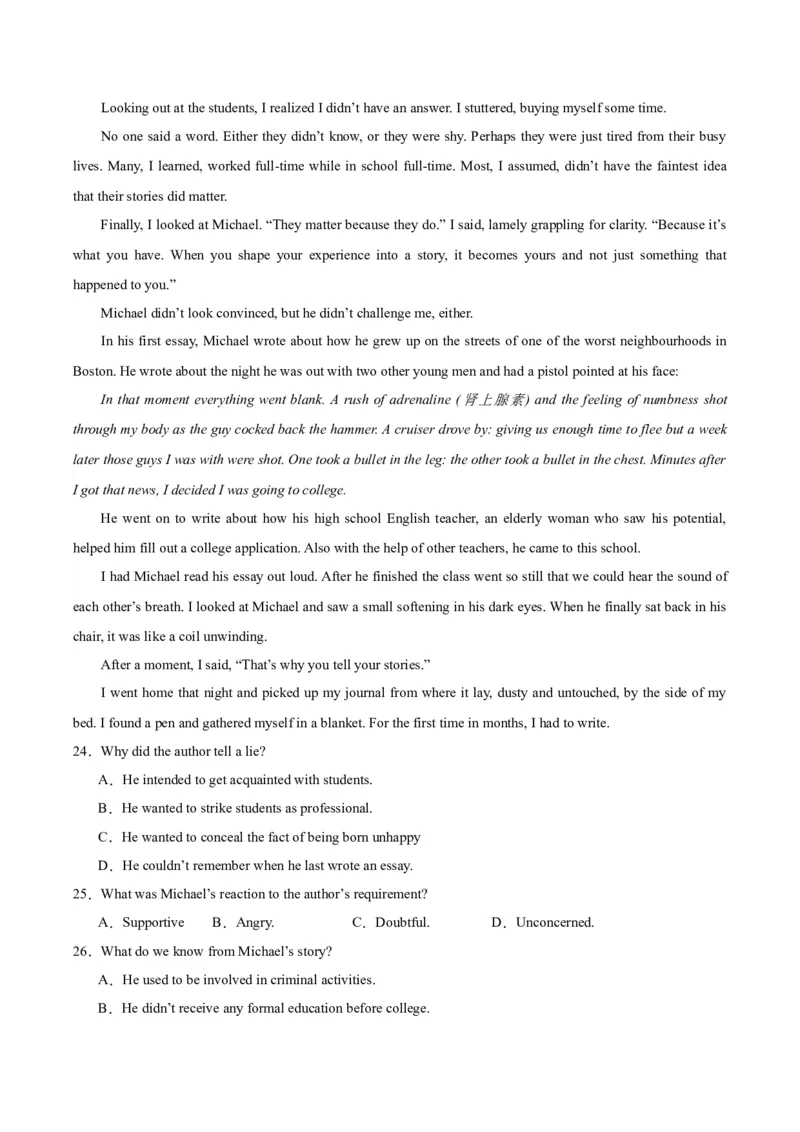
“What kind of stuff do you write?” one student asked on my first day at the University. After a decade away
from the classroom, I was back to teaching.
“I write newspaper and magazine articles,” I said, “and creative non-fiction, as you’ll be doing.” It was a lie. I
couldn’t remember when I’d last written a creative essay. It must have been before my distant mother fell ill,
leaving me resigned to the idea that our story of family dysfunction would not end happily. It seemed that nothing I
wrote could change that.
With a surplus of time and lack of inspiration, I accepted a position to teach creative non-fiction. Although I
couldn’t get myself to tell my own stories, I could require that my students tell theirs. “You’re going to be keeping a
journal,” I said with the kind of firm authority that didn’t work as self-talk. “And I want you to tell your stories like
they matter.”
“Why do they matter?” a boy named Michael asked. Half-Chinese, half-Irish, he was outlaw handsome with a
hard-set jaw and dark eyes. “I mean, who cares about our stories?”Looking out at the students, I realized I didn’t have an answer. I stuttered, buying myself some time.
No one said a word. Either they didn’t know, or they were shy. Perhaps they were just tired from their busy
lives. Many, I learned, worked full-time while in school full-time. Most, I assumed, didn’t have the faintest idea
that their stories did matter.
Finally, I looked at Michael. “They matter because they do.” I said, lamely grappling for clarity. “Because it’s
what you have. When you shape your experience into a story, it becomes yours and not just something that
happened to you.”
Michael didn’t look convinced, but he didn’t challenge me, either.
In his first essay, Michael wrote about how he grew up on the streets of one of the worst neighbourhoods in
Boston. He wrote about the night he was out with two other young men and had a pistol pointed at his face:
In that moment everything went blank. A rush of adrenaline (肾上腺素) and the feeling of numbness shot
through my body as the guy cocked back the hammer. A cruiser drove by: giving us enough time to flee but a week
later those guys I was with were shot. One took a bullet in the leg: the other took a bullet in the chest. Minutes after
I got that news, I decided I was going to college.
He went on to write about how his high school English teacher, an elderly woman who saw his potential,
helped him fill out a college application. Also with the help of other teachers, he came to this school.
I had Michael read his essay out loud. After he finished the class went so still that we could hear the sound of
each other’s breath. I looked at Michael and saw a small softening in his dark eyes. When he finally sat back in his
chair, it was like a coil unwinding.
After a moment, I said, “That’s why you tell your stories.”
I went home that night and picked up my journal from where it lay, dusty and untouched, by the side of my
bed. I found a pen and gathered myself in a blanket. For the first time in months, I had to write.
24.Why did the author tell a lie?
A.He intended to get acquainted with students.
B.He wanted to strike students as professional.
C.He wanted to conceal the fact of being born unhappy
D.He couldn’t remember when he last wrote an essay.
25.What was Michael’s reaction to the author’s requirement?
A.Supportive B.Angry. C.Doubtful. D.Unconcerned.
26.What do we know from Michael’s story?
A.He used to be involved in criminal activities.
B.He didn’t receive any formal education before college.C.He successfully applied for a college all on his own.
D.He was dissatisfied with his previous life and wanted to make a change.
27.What is the importance of telling your stories according to the author?
A.It adds color to our busy daily life.
B.It gives us inspiration for future life.
C.It provides us with an opportunity to rewrite our destiny.
D.It allows us to make meaning of what we’ve been through.
C
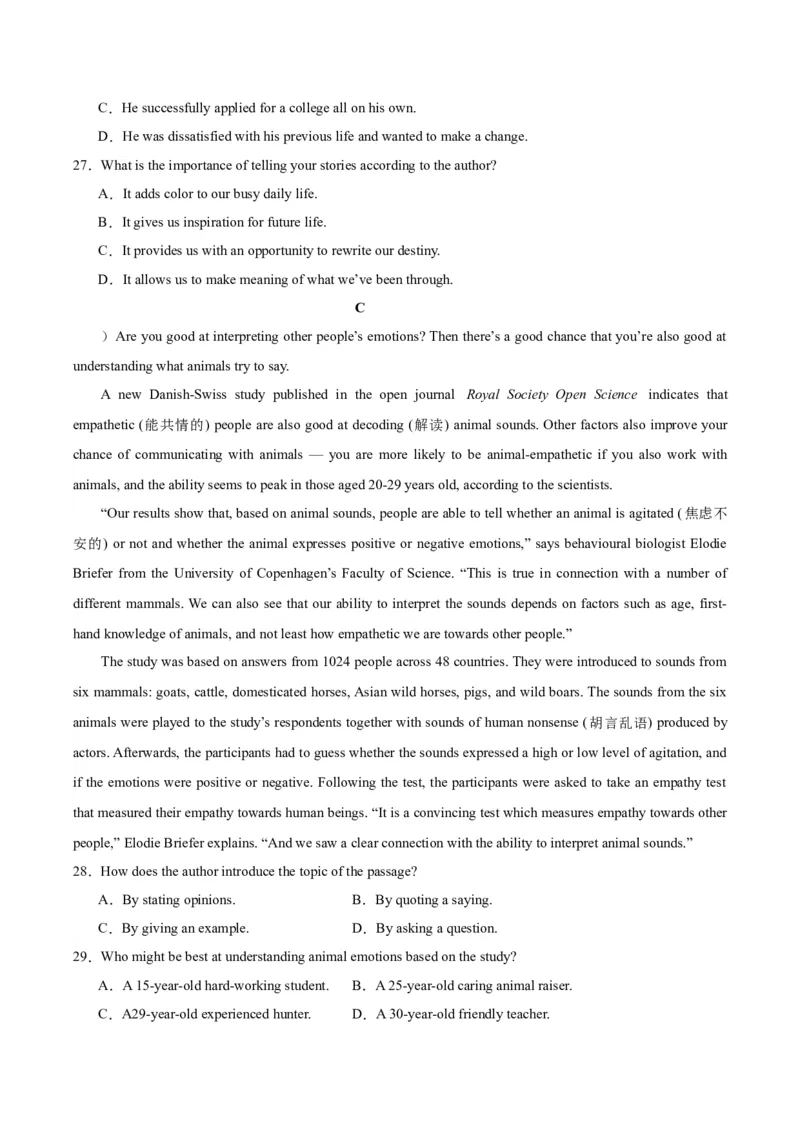
)Are you good at interpreting other people’s emotions? Then there’s a good chance that you’re also good at
understanding what animals try to say.
A new Danish-Swiss study published in the open journal Royal Society Open Science indicates that
empathetic (能共情的) people are also good at decoding (解读) animal sounds. Other factors also improve your
chance of communicating with animals — you are more likely to be animal-empathetic if you also work with
animals, and the ability seems to peak in those aged 20-29 years old, according to the scientists.
“Our results show that, based on animal sounds, people are able to tell whether an animal is agitated (焦虑不
安的) or not and whether the animal expresses positive or negative emotions,” says behavioural biologist Elodie
Briefer from the University of Copenhagen’s Faculty of Science. “This is true in connection with a number of
different mammals. We can also see that our ability to interpret the sounds depends on factors such as age, first-
hand knowledge of animals, and not least how empathetic we are towards other people.”
The study was based on answers from 1024 people across 48 countries. They were introduced to sounds from
six mammals: goats, cattle, domesticated horses, Asian wild horses, pigs, and wild boars. The sounds from the six
animals were played to the study’s respondents together with sounds of human nonsense (胡言乱语) produced by
actors. Afterwards, the participants had to guess whether the sounds expressed a high or low level of agitation, and
if the emotions were positive or negative. Following the test, the participants were asked to take an empathy test
that measured their empathy towards human beings. “It is a convincing test which measures empathy towards other
people,” Elodie Briefer explains. “And we saw a clear connection with the ability to interpret animal sounds.”
28.How does the author introduce the topic of the passage?
A.By stating opinions. B.By quoting a saying.
C.By giving an example. D.By asking a question.
29.Who might be best at understanding animal emotions based on the study?
A.A 15-year-old hard-working student. B.A 25-year-old caring animal raiser.
C.A29-year-old experienced hunter. D.A 30-year-old friendly teacher.30.What does Elodie Briefer think of the test involved?
A.Doubtful. B.Reliable. C.Ineffective. D.Disappointing.
31.What can be a suitable title for the text?
A.Human empathy extends to animals B.Emotion interpretation helps animals
C.Sound interpretation depends on ages D.Emotion expression protects animals
D
Is future you…you? It might seem like a strange philosophical question. But the answer to how you think
about your future self could make the difference between decisions you ultimately find satisfying and ones you
might eventually regret.
The brain patterns that emerge on an MRI (核磁共振) when people think about their future selves most
resemble the brain patterns that arise when they think about strangers. This finding suggests that, in the mind’s eye,
our future selves look like other people. If you see future you as a different person, why should you save money, eat
healthier or exercise more regularly to benefit that stranger?
However, if you see the interests of your distant self as more like those of your present self, you are
considerably more likely to do things today that benefit you tomorrow. A paper in the journal PLOS One revealed
that college students who experienced a greater sense of connection and similarity to their future selves were more
likely to achieve academic success. Relationships with our future selves also matter for general psychological well-
being. In a project led by Joseph Reiff, which includes 5,000 adults age 20 to 75, he found that those who perceived
a great overlap (重叠) in traits between their current and future selves ended up being more satisfied with their lives
10 years after filling out the initial survey.
So how can we better befriend our future selves and feel more connected to their fates? The psychological
mindset with what we call “vividness interventions” works. We have found, for instance, that showing people
images of their older, grayer selves increases intentions to save for the long term. Besides, you might try writing a
letter to—and then from—your future self. As demonstrated by Yuta Chishima and Anne Wilson in their 2020 study
in the journal Self and Identity, when high-school students engaged in this type of “send-and-reply” exercise, they
experienced elevated levels of feelings of similarity with their future selves.
Letter-writing and visualization exercises are just a couple of ways we can connect with our future selves and
beyond, but the larger lesson here is clear: If we can treat our distant selves as if they are people we love, care about
and want to support, we can start making choices for them that improve our lives—both today and tomorrow.
32.What’s the function of paragraph 2?
A.Generating further discussion. B.Introducing a research result.
C.Showing the effect of the finding. D.Concluding various viewpoints.33.How does the author prove his statements?
A.By offering relevant statistics. B.By using quotations.
C.By referring to previous findings. D.By making comparisons.
34.What is paragraph 4 mainly about?
A.Benefits of befriending our future selves.B.Ways of connecting with our future selves.
C.Methods of changing psychological mindsets.D.Possibilities of us becoming our future selves.
35.What does the article want to tell us?
A.Making future plans makes a difference. B.Our future selves look like other people.
C.Getting to know your future self benefits. D.Your choice determines future happiness.
第二节(共5小题:每小题2. 5分, 满分12. 5分)
阅读下面短文, 从短文后的选项中选出可以填入空白处的最佳选项。选项中有两项为多余选项。
Dispose of Your Credit Card Without Burying It
Disposing of unwanted items in our lives often means simply throwing them into the garbage or recycling bin
— or, if they’re still useful, giving them away. It’s different with old credit cards, which should be destroyed so
nobody can use them fraudulently (欺诈地). 36 Here’s how to get rid of an old card.
First, contact the issuer
If closing the account is your goal, you’ll have to call the number on the back of your card and ask to do so. If
your card is a rewards card, remember to first redeem points or cash back. Change any automatic payments to a
different card, and be sure to pay the final card bill.
Cut up plastic cards
Sharp scissors and smart trimming will do the job here. “We recommend that consumers cut through the EMV
chip, then further cut the card a few times along the short side, and dispose of the sections in more than one trash
bag,” says Sarah Grano, a spokeswoman for the American Bankers Association. 37
Send back metal cards
38 Contact your issuer. Typically, you can mail it back for disposal. “For example, when American
Express sends a replacement card, it also sends an addressed return envelope to mail back an old metal card for
destruction,” says Heather Norton, spokeswoman for American Express.
Check back on your account
Don’t obsess about identity theft of an old credit card. You generally won’t be responsible for fraudulent
charges anyway. 39 It’s a good idea to check your account statement to make sure there’s been no fraud.
Closing an account can hurt youClosing a credit card account can lower your credit rating. That’s because credit scores consider your “credit
utilization ratio’”, or how much of your available credit you’re using. And when you close an account, you have
less available credit. 40 Closing an old card decreases the average age of your accounts.
A.It could be worth closing the account anyway.
B.Scores also consider the length of time you’ve had the card open.
C.Or feed cards into a machine designed to handle them.
D.Take care with debit cards and other plastic where fraud means you might be missing money.
E.But how to destroy a payment card properly is not obvious, especially with new metal credit cards.
F.Destroying a metal card by yourself is harder and potentially dangerous.
G.Skip this step if you’re simply replacing an expired card or one that has been compromised.
第三部分语言运用(共两节,满分30分)
第一节(共15小题:每小题1分,满分15分)
阅读下面短文, 从每题所给的A、B、C、D四个选项中选出可以填入空白处的最佳选项。
As I sat motionless on the steps of the pool, watching everyone else swim back and forth, I realized that I had
spent most of my life watching others enjoy themselves. It was then that I noticed a little girl staring at me with a
look of bewilderment. I smiled at her, hoping to break the 41 by talking to her. Unfortunately, my 42
failed and she just kept on staring. My awkwardness 43 as a little boy swam up to me and said, “I feel sorry
for you.”
After the 44 , a thought 45 me— I had to change how the world viewed me. Because it was
children who stared at me the most, I decided to write a children’s book that taught them about disabilities in a/an
46 way. This is when KatGirl, a superhero in a wheelchair came into my mind.
I quickly wheeled inside my apartment and began creating the story. 47 I wrote each word, I could
48 my future as a world-renowned author and public speaker. My excitement 49 like wildfire. Over the
next two years, the story 50 many changes before it saw the world in the spring of 2011. My perseverance
51 paid off.
One day I was invited to speak to the students at a neighboring school. “How do you feel when you see me?” I
asked them. The kids bravely 52 , “I feel sorry for you.”
I opened my book and started reading. Immediately I noticed the children’s stares turned to 53 . “How
do you feel when you see me?” I asked again. Without hesitation they replied, “You are so cool! Does your 54
fly too?” I just smiled, “No, not yet, but maybe someday.” I knew in my heart that this was 55 . The past
two years had proven to me that with resolution anything was possible.41.A.ice B.rule C.box D.code
42.A.project B.insight C.attempt D.sacrifice
43.A.withdrew B.increased C.accelerated D.vanished
44.A.consultation B.encounter C.argument D.interview
45.A.struck B.enhanced C.refreshed D.overlooked
46.A.harsh B.exclusive C.persistent D.fun
47.A.As B.Although C.Now that D.Even if
48.A.revise B.picture C.boost D.assign
49.A.spread B.recovered C.unfolded D.mounted
50.A.turned down B.got over C.went through D.dried up
51.A.randomly B.ultimately C.instantly D.constantly
52.A.ignored B.responded C.imitated D.recommended
53.A.efforts B.doubts C.smiles D.tears
54.A.body B.dream C.chair D.book
55.A.funny B.strange C.false D.true
第二节(共15小题:每小题1分,满分15分)
阅读下面短文, 从每题所给的A、B、C、D四个选项中选出可以填入空白处的最佳选项。
In the coming era of budget cuts to education, distance learning could become the norm.
The temptation for those in charge of education budgets to trade teachers for technology could be so strong
that they ignore 56 disadvantages of distance learning. School facilities are expensive 57 (build).
Online classes do not require buildings and each class can host hundreds of people at the same time, 58
(result) in greater savings. But moving away from a traditional classroom 59 a living, breathing human
being teaches and interacts with students daily 60 (be) a disaster. Physically attending school has hidden
benefits: getting up 61 (early), interacting more with peers, and building better relationships with teachers.
Moreover, schools should be more than simple institutions of traditional learning. They are places where students
62 (offer) counseling (咨询) and other support.
Those policy-makers are often fascinated by the latest technology in education and its potential to transform
education overnight. 63 , online education does not allow a teacher to keep a struggling student after class
and offer help. Educational videos are unable to make eye contact or assess a student’s level of engagement. Given
these 64 (expect), schools should not become permanently “remote”. Technology, however 65(advance), should simply be a tool of a good teacher.
第四部分 写作(共两节, 满分40分)
第一节(满分15分)
66.假定你是李华,你的英国笔友David想要了解你在学校参加社团活动的经历。请给他回信,内容包
括:
1. 所在社团简介;
2. 具体活动介绍;
3. 收获与感想。
注意:1. 写作词数应为80左右;
2. 请按如下格式在答题卡的相应位置作答。
Dear David,
____________________________________________________________________________________________
____________________________________________________________________________________________
____________________________________________________________________________________________
____________________________________________________________________________________________
__________________________________________________________________________________________
Yours sincerely,
Li Hua
第二节(满分25分)
67.阅读下面材料,根据其内容和所给段落开头语续写两段,使之构成一篇完整的短文。
One day, some young people from a local rehabilitation (康复) center visited a wildlife park. Tippi, a guide,
stood before a cheetah (猎豹). “Her name is Subira. She’s a three-year-old cheetah,” she tole the audience.
All the visitors sitting in the chairs were amazed by the cheetah’s beauty, except a teenage boy, Cory. He
pulled a long face and made noises, showing his boredom.
Tippi continued, “The cheetah is the fastest animal on earth.” “Aren’t you, honey?” She asked in a cheerful
tone, looking at the cheetah lying atop a tree. Giving Subira a dirty look, Cory replied, “Oh, just a skinny cat. Next!
Bring out the stupid tigers or whatever so we can get this over with!” However, the cheetah gently looked at Cory
and make a happy sound. “I think she likes you,” Tippi told Cory. “I don’t care,” the boy just replied.
What had happened to Cory? Why was he so angry? The boy had dreamed of someday playing Major League
Baseball and having many fans. He knew he had a promising future. That was before the car accident. In it, he losthis leg and also lost his hope, joy and spirit. He felt useless and hopeless.
Now he sat in a wheelchair, angry at the world. He was here today on another “boring field trip” from the
rehabilitation program. Suddenly, the creature jumped down. Seeming to show her skills, she immediately ran fast
forward. “Oh, she’s so beautiful,” the crowd said.
注意:
1. 续写词数应为150左右;
2. 请按如下格式在答题卡的相应位置作答。
“She only has three legs!” someone suddenly said, surprised.
____________________________________________________________________________________________
____________________________________________________________________________________________
____________________________________________________________________________________________
____________________________________________________________________________________________
______________
At last, Cory smiled, with his eyes shining with hope and confidence in his professional future.
____________________________________________________________________________________________
____________________________________________________________________________________________
____________________________________________________________________________________________
____________________________________________________________________________________________
_______________