绝密★启用前
2019年全国硕士研究生招生考试
英 语 (一)试题
(科目代码:201)
☆考生注意事项翁
1 . 答题前,考生须在试题册指定位置上填写考生编号和考生姓名;在答题卡
指定位置上填写报考单位、考生姓名和考生编号,并涂写考生编号信息点。
2 . 考生须把试题册上的“试卷条形码”粘贴条取下,粘贴在答题卡的“试卷
条形码粘贴位置”框中。不按规定粘贴条形码而影响评卷结果的,责任由
考生自负Q
3 . 选择题的答案必须涂写在答题卡相应题号的选项上,非选择题的答案必须
书写在答题卡指定位置的边框区域内。超出答题区域书写的答案无效;在
草稿纸、试题册上答题无效。
4 . 填 (书)写部分必须使用黑色字迹签字笔书写,字迹工整、笔迹清楚;涂
写部分必须使用2B铅笔填涂。
5 . 考试结束,将答题卡和试题册按规定交回。
(以下信息考生必须认真填写)
考生编号
考生姓名Section I Use of English
Directions :
Read the following text. Choose the best word(s) for each numbered blank and mark A,
B C or D on theANSWER SHEET. (10 points)
?
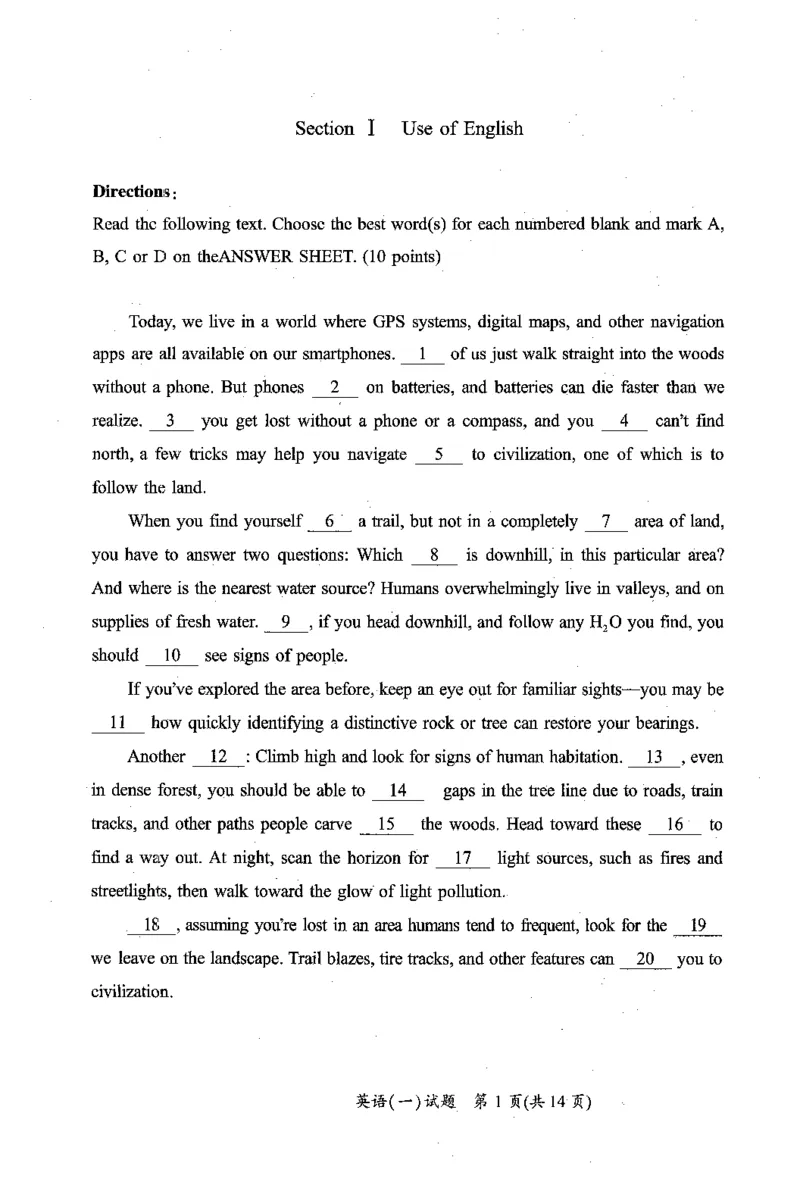
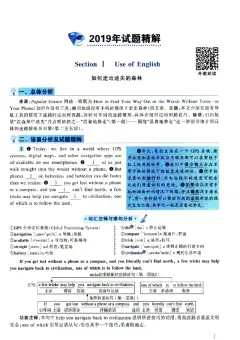
Today, we live in a world where GPS systems, digital maps, and other navigation
apps are all available on our smartphones. ] of us just walk straight into the woods
without a phone. But phones 2 on batteries, and batteries can die faster than we
realize. 3 you get lost without a phone or a compass, and you 4 can't find
north, a few tricks may help you navigate 5 to civilization, one of which is to
follow the land.
When you find yourself 6 a trail, but not in a completely 7 area of land,
you have to answer two questions: Which 8 is downhill, in this particular area?
And where is the nearest water source? Humans overwhelmingly live in valleys, and on
supplies of fresh water. 9 , if you head downhill, and follow any H O you find, you
2
should 10 see signs of people.
If you've explored the area before, keep an eye out for familiar sights—you may be
11 how quickly identifying a distinctive rock or tree can restore your bearings.
Another 12 : Climb high and look fbr signs of human habitation. 13 , even
in dense forest, you should be able to 14 gaps in the tree line due to roads, train
tracks, and other paths people carve 15 the woods. Head toward these 16 to
find a way out. At night, scan the horizon fbr 17 light sources, such as fires and
streetlights, then walk toward the glow of light pollution.
18 assuming you're lost in an area humans tend to frequent, look fbr the 19
,
we leave on the landscape. Trail blazes, tire tracks, and other features can 20 you to
civilization.
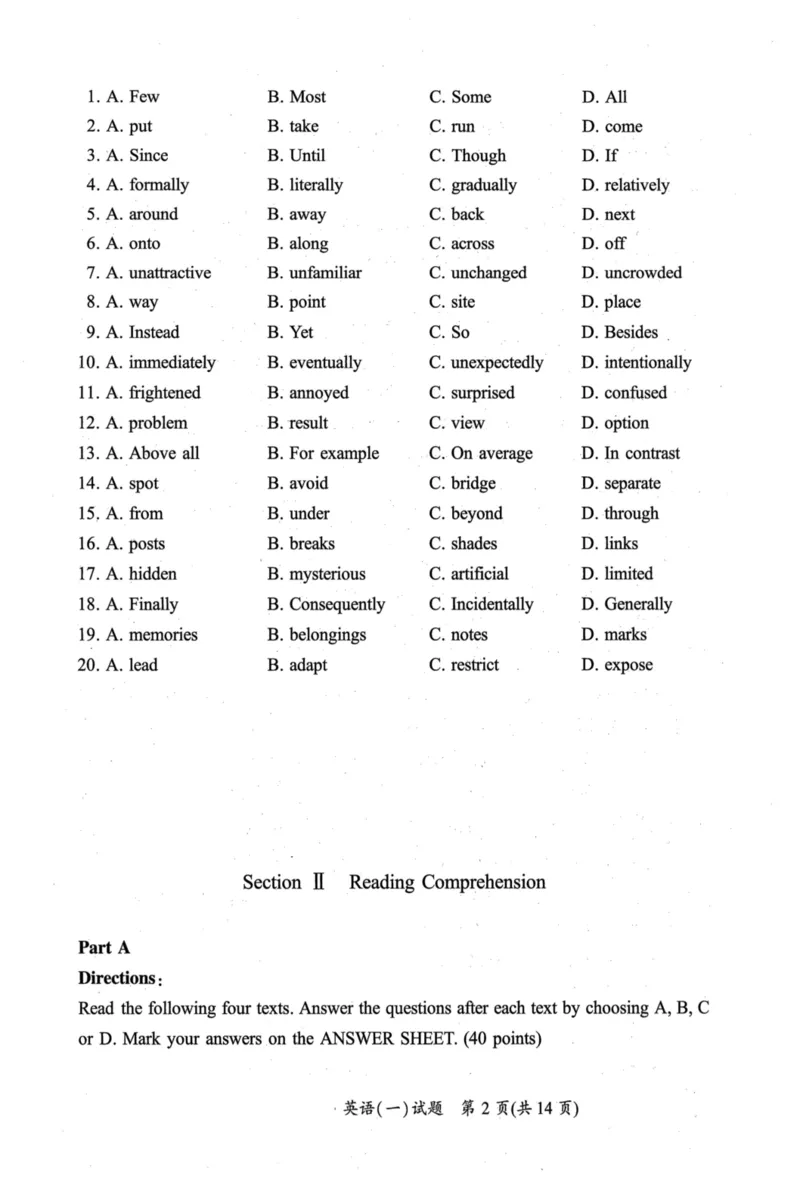
英语(一)试 题 第 1页(共 14页)1. A. Few B. Most C. Some D. All
2. A. put B. take C. run D. come
3. A. Since B. Until C. Though D. If
4. A. formally B. literally C. gradually D, relatively
5. A. around B. away C. back D. next
6. A. onto B. along C. across D. off
7. A. unattractive B. unfamiliar C. unchanged D. uncrowded
8. A. way B. point C. site D. place
9. A. Instead B. Yet C. So D. Besides
10. A. immediately B. eventually C. unexpectedly D. intentionally
11. A. frightened B. annoyed C. surprised D. confused
12. A. problem B. result C. view D. option
13. A. Above all B. For example C. On average D. In contrast
14. A. spot B. avoid C. bridge D. separate
15. A. from B . under C. beyond D. through
16. A. posts B. breaks C. shades D. links
17. A. hidden B. mysterious C. artificial D. limited
18. A. Finally B. Consequently C. Incidentally D. Generally
19. A. memories B. belongings C. notes D. marks
20. A. lead B. adapt C. restrict D. expose
Section D Reading Comprehension
Part A
Directions :
Read the following four texts. Answer the questions after each text by choosing A, B, C
or D. Mark your answers on the ANSWER SHEET. (40 points)
英语(一)试 题 第 2 页(共 14页)Text 1
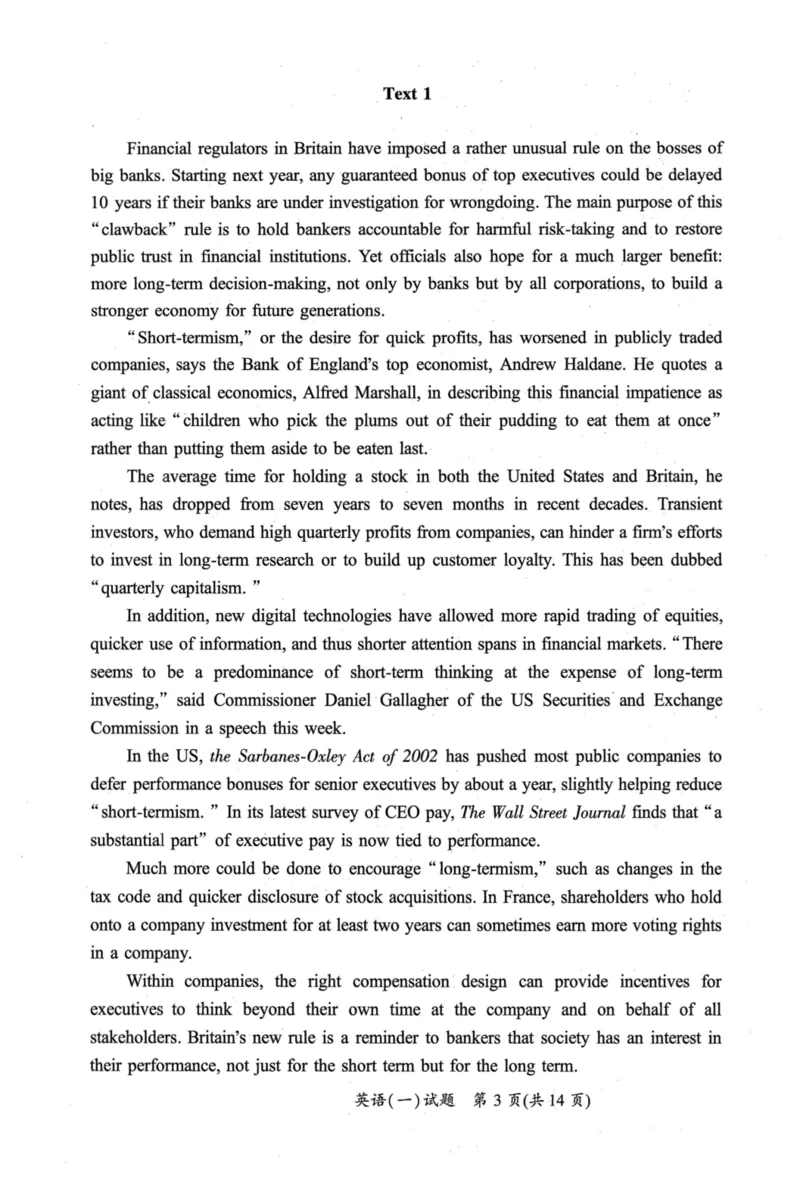
Financial regulators in Britain have imposed a rather unusual rule on the bosses of
big banks. Starting next year, any guaranteed bonus of top executives could be delayed
10 years if their banks are under investigation for wrongdoing. The main purpose of this
“clawback" rule is to hold bankers accountable for harmful risk-taking and to restore
public trust in financial institutions. Yet officials also hope for a much larger benefit:
more long-term decision-making, not only by banks but by all corporations, to build a
stronger economy for future generations.
“Short-termism,“ or the desire for quick profits, has worsened in publicly traded
companies, says the Bank of England's top economist, Andrew Haldane. He quotes a
giant of classical economics, Alfred Marshall, in describing this financial impatience as
acting like u children who pick the plums out of their pudding to eat them at once,,
rather than putting them aside to be eaten last.
The average time for holding a stock in both the United States and Britain, he
notes, has dropped from seven years to seven months in recent decades. Transient
investors, who demand high quarterly profits from companies, can hinder a firm's efforts
to invest in long-term research or to build up customer loyalty. This has been dubbed
“ quarterly capitalism. ”
In addition, new digital technologies have allowed more rapid trading of equities,
quicker use of information, and thus shorter attention spans in financial markets. u There
seems to be a predominance of short-term thinking at the expense of long-term
investing,v said Commissioner Daniel Gallagher of the US Securities and Exchange
Commission in a speech this week.
In the US, the Sarbanes-Oxley Act of 2002 has pushed most public companies to
defer performance bonuses fbr senior executives by about a year, slightly helping reduce
u short-termism. In its latest survey of CEO pay, The Wall Street Journal finds that u a
substantial part" of executive pay is now tied to performance.
Much more could be done to encourage “long-termism," such as changes in the
tax code and quicker disclosure of stock acquisitions. In France, shareholders who hold
onto a company investment for at least two years can sometimes earn more voting rights
in a company.
Within companies, the right compensation design can provide incentives fbr
executives to think beyond their own time at the company and on behalf of all
stakeholders. Britain's new rule is a reminder to bankers that society has an interest in
their performance, not just fbr the short term but for the long term.
英语(一)试 题 第 3 页(共 14页)21. According to Paragraph 1, one motive in imposing the new rule is to
A. guarantee the bonuses of top executives.
B. enhance bankers9 sense of responsibility.
C. build a new system of financial regulation.
-- • .. 」
D. help corporations achieve larger profits.
22. Alfred Marshall is quoted to indicate
A. the solid structure of publicly traded companies.
B. governments9 impatience in decision-making.
C. the conditions for generating quick profits.
D. <^short-termism,, in economic activities.
23. It is argued that the influence of transient investment on public companies can be
A. minimal.
B. indirect.
C. adverse.
D. temporary.
24. The US and France examples are used to illustrate
A. the approaches to promoting “long-termism.”
B. the prevalence of short-term thinking.
C. the significance of long-term thinking.
D. the obstacles to preventing u short-termism.
25. Which of the following would be the best title for the text?
A. Decisiveness Required of Top Executives
B. Failure of Quarterly Capitalism
C. Patience as a Corporate Virtue
D. Frustration of Risk-taking Bankers
英语(一)试 题 第 4 页(共 14页)Text 2
Grade inflation一the gradual increase in average GPAs (grade-point averages) over
the past few decades- is often considered a product of a consumer era in higher
education, in which students are treated like customers to be pleased. But another, related
force- a policy often buried deep in course catalogs called u grade forgivenessn- is
helping raise GPAs.
Grade forgiveness allows students to retake a course in which they received a low
grade, and the most recent grade or the highest grade is the only one that counts in
calculating a students overall GPA.
The use of this little-known practice has accelerated in recent years, as colleges
continue to do their utmost to keep students in school (and paying tuition) and improve
their graduation rates. When this practice first started decades ago, it was usually limited
to freshmen, to give them a second chance to take a class in their first year if they
struggled in their transition to college-level courses. But now most colleges, save for
many selective campuses, allow all undergraduates, and even graduate students, to get
their low grades forgiven.
College officials tend to emphasize that the goal of grade forgiveness is less about
the grade itself and more about encouraging students to retake courses critical to their
degree program and graduation without incurring a big penalty. u Ultimately/J said Jack
Miner, Ohio State University's registrar, ""we see students achieve more success because
they retake a course and do better in subsequent courses or master the content that
allows them to graduate on time. ”
That said, there is a way in which grade forgiveness satisfies colleges9 own needs
as well. For public institutions, state funds are sometimes tied partly to their success on
metrics such as graduation rates and student retention- so better grades can, by boosting
figures like those, mean more money. And anything that raises GPAs will likely make
students—who, at the end of the day, are paying the bill- feel they've gotten a better
value for their tuition dollars, which is another big concern for colleges.
Indeed, grade forgiveness is just another way that universities are responding to
consumers9 expectations for higher education. Since students and parents expect a
college degree to lead to a job, it is in the best interest of a school to turn out graduates
who are as qualified as possible- or at least appear to be. On this, students9 and
colleges9 incentives seem to be aligned.
,英 语 (一 )试 题 第 5 页(共14页)26. What is commonly regarded as the cause of grade inflation?
A. Colleges9 neglect of GPAs.
B. The influence of consumer culture.
C. Students9 indifference to GPAs.
D. The change of course catalogs.
27. What was the original purpose of grade forgiveness?
A. To maintain colleges9 graduation rates.
B. To increase universities9 income from tuition.
C. To prepare graduates for a challenging fixture.
D. To help freshmen adapt to college learning.
, 1, ,
28. According to Paragraph 5 grade forgiveness enables colleges to
,
A. obtain more finaneial support.
B. improve their teaching quality.
C. boost their student enrollments.
D. meet local govemments, needs.
29. What does the phrase" to be aligned(Para. 6) most probably mean?
A. To counterbalance each other.
B. To be contradictory to each other.
C. To be identical with each other.
D. To complement each other.
30. The author examines the practice of grade forgiveness by
A. assessing its feasibility.
B. listing its long-run effects.
. ' . ■■
C. comparing different views on it.
D. analyzing the causes behind it.
英语(一)试 题 第 6 页(共 14页)Text 3
This year marks exactly two centuries since the publication of Frankenstein ; or,
The Modern Prometheus, by Mary Shelley. Even before the invention of the electric light
bulb, the author produced a remarkable work of speculative fiction that would
foreshadow many ethical questions to be raised by technologies yet to come.
Today the rapid growth of artificial intelligence (AI) raises fundamental questions:
“ What is intelligence, identity, or consciousness? What makes humans humans? ”
What is being called artificial general intelligence, machines that would imitate the
way humans think, continues to evade scientists. Yet humans remain fascinated by the
idea of robots that would look, move, and respond like humans, similar to those recently
depicted on popular sci-fi TV series such as “Westworld” and “Humans. ”
Just how people think is still far too complex to be understood, let alone
reproduced, says David Eagleman, a Stanford University neuroscientist. u We are just in
a situation where there are no good theories explaining what consciousness actually is
and how you could ever build a machine to get there.”
But that doesn't mean crucial ethical issues involving AI aren't at hand. The coining
use of autonomous vehicles, for example, poses thorny ethical questions. Human drivers
sometimes must make split-second decisions. Their reactions may be a complex
combination of instant reflexes, input from past driving experiences, and what their eyes
and ears tell them in that moment. AI “vision“ today is not nearly as sophisticated as
that of humans. And to anticipate every imaginable driving situation is a difficult
programming problem.
Whenever decisions are based on masses of data, “ you quickly get into a lot of
ethical questions,n notes Tan Kiat How, chief executive of a Singapore-based agency
that is helping the government develop a voluntary code for the ethical use of AL Along
with Singapore, other governments and mega-corporations are beginning to establish
their own guidelines. Britain is setting up a data ethics center. India released its AI ethics
strategy this spring.
On June 7 Google pledged not to u design or deploy AI" that would cause u overall
harm,“ or to develop Ai-directed weapons or use AI for surveillance that would violate
international norms. It also pledged not to deploy AI whose use would violate
international laws or human rights.
While the statement is vague, it represents one starting point. So does the idea that
decisions made by AI systems should be explainable, transparent, and fair.
To put it another way: How can we make sure that the thinking of intelligent
machines reflects humanity's highest values? Only then will they be useful servants and
not Frankenstein's out-of-control monster.
英语(一)试 题 第 7 页(共 14页)31. Mary Shelley's novel Frankenstein is mentioned because it
A. involves some concerns raised by AI today.
B. has remained popular fbr as long as 200 years.
C. fascinates AI scientists all over the world.
D. has sparked serious ethical controversies.
「 .. ■ ■
32. In David Eagleman9s opinion, our current knowledge of consciousness
A. helps explain artificial intelligence.
B. is too limited fbr us to reproduce it.
C. inspires popular sci-fi TV series.
D. can be misleading to robot making.
33. The solution to the ethical issues brought by autonomous vehicles
A. can hardly ever be found.
. , -- '
B. has aroused much curiosity.
C. is still beyond our capacity.
D. causes little public concern.
34. The authofs attitude toward Google's pledges is one of
A. contempt.
B. skepticism.
C. respect.
D. affirmation.
35. Which of the following would be the best title for the text?
A. The Conscience of AI: Complex But Inevitable
B. the Novel Predicting the Age of AI
C. APs Future: In the Hands of Tech Giants
D. AI Shall Be Killers Once Out of Control
英语(一)试 题 第 8 页(共 14页)Text 4
States will be able to force more people to pay sales tax when they make online
purchases under a Supreme Court decision Thursday that will leave shoppers with
lighter wallets but is a big financial win for states.
The Supreme Courfs opinion Thursday overruled a pair of decades-old decisions
that states said cost them billions of dollars in lost revenue annually. The decisions made
it more difficult for states to collect sales tax on certain online purchases.
The cases the court overturned said that if a business was shipping a customer's
purchase to a state where the business didn't have a physical presence such as a
warehouse or office, the business didn't have to collect sales tax for the state. Customers
were generally responsible for paying the sales tax to the state themselves if they weren't
charged it, but most didn't realize they owed it and few paid.
Justice Anthony Kennedy wrote that the previous decisions were flawed. u Each
year the physical presence rule becomes further removed from economic reality and
results in significant revenue losses to the states,“ he wrote in an opinion joined by four
other justices. Kennedy wrote that the rule u limited states9 ability to seek long-term
prosperity and has prevented market participants from competing on an even playing 6eld.”
The mling is a victory fbr big chains with a presence in many states, since they
usually collect sales tax on online purchases already. Now, rivals will be charging sales
tax where they hadn't before. Big chains have been collecting sales tax nationwide
because they typically have physical stores in whatever state a purchase is being shipped
to. Amazon. com, with its network of warehouses, also collects sales tax in every state
that charges it, though third-party sellers who use the site don't have to.
Until now, many sellers that have a physical presence in only a single state or a few
states have been able to avoid charging sales taxes when they ship to addresses outside
those states. Sellers that use eBay and Etsy, which provide platforms fbr smaller sellers,
also havetft been collecting sales tax nationwide. Under the ruling Thursday, states can
pass laws requiring out-of-state sellers to collect the state's sales tax from customers and
send it to the state.
Retail trade groups praised the ruling, saying it levels the playing field fbr local and
online businesses. The losers, said retail analyst Neil Saunders, are online-only retailers,
especially smaller ones. Those retailers may face headaches complying with various state
sales tax laws. The Small Business & Entrepreneurship Council advocacy group said in
a statement, u Small businesses and internet entrepreneurs are not well served at all by
this decision.”
英语(一)试 题 第 9 页(共 14页)36. The Supreme Court decision Thursday will
A. put most online businesses in a dilemma.
B. force some states to cut sales tax.
C. make more online shoppers pay sales tax.
D. better businesses9 relations with states.
37. It can be learned from Paragraphs 2 and 3 that the overruled decisions
A. were widely criticized by online purchasers.
B. have cost consumers a lot over the years.
C. have led to the dominance of e-commerce.
D. were considered unfavorable by states.
38. According to Justice Anthony Kennedy, the physical presence rule has
A. hindered economic development.
B. harmed fair market competition.
C. boosted growth in states9 revenue.
D. brought prosperity to the country.
39. Who are most likely to welcome the Supreme Court ruling?
A. Big-chain owners.
B. Third-party sellers.
C. Internet entrepreneurs.
D. Small retailers.
40. In dealing with the Supreme Court decision Thursday, the author
A. presents its main points with conflicting views on them.
B. gives a factual account of it and discusses its consequences.
C. cites some cases related to it and analyzes their implications.
D. describes the long and complicated process of its making.
英语(一)试题 第10页(共 14页)Part B
Directions:
The following paragraphs are given in a wrong order. For questions 41-45, you are
required to reorganize these paragraphs into a coherent text by choosing from the list
A-G and filling them into the numbered boxes. Paragraphs C and F have been
correctly placed. Mark your answers on the ANSWER SHEET. (10 points)
A. These tools can help you win every argument- not in the unhelpfiil sense of beating
your opponents but in the better sense of learning about the issues that divide people,
learning why they disagree with us and learning to talk and work together with them.
If we readjust our view of arguments- from a verbal fight or tennis game to a
reasoned exchange through which we all gain mutual respect and understanding一
then we change the very nature of what it means to “win” an argument.
B. In his 1936 work How to Win Friends and Influence People, Dale Carnegie wrote:
u There is only one way...to get the best of an argument- and that is to avoid it. ”
This aversion to arguments is common, but it depends on a mistaken view of
arguments that causes profound problems for our personal and social lives- and in
many ways misses the point of arguing in the first place.
C. None of this will be easy, but you can start even if others refuse to. Next time you
state your position, formulate an argument for what you claim and honestly ask
yourself whether your argument is any good. Next time you talk with someone who
takes a stand, ask them to give you a reason for their view. Spell out their argument
fully and charitably. Assess its strength impartially. Raise objections and listen
carefiilly to their replies.
D. Of course, many discussions are not so successful. Still, we need to be carefol not to
accuse opponents of bad arguments too quickly. We need to learn how to evaluate
them properly. A large part of evaluation is calling out bad arguments, but we also
need to admit good arguments by opponents and to apply the same critical standards
to ourselves. Humility requires you to recognize weaknesses in your own arguments
and sometimes also to accept reasons on the opposite side.
英语(一)试 题 第 11页(共 14页)E. There is a better way to win arguments. Imagine that you favor increasing the
minimum wage in our state, and I do not. If you yell, “Yes," and I yell, “No,”
neither of us learns anything. We neither understand nor respect each other, and we
have no basis for compromise or cooperation. In contrast, suppose you give a
reasonable argument: that full-time workers should not have to live in poverty. Then I
counter with another reasonable argument: that a higher minimum wage will force
businesses to employ fewer people for less time. Now we can understand each othefs
positions and recognize our shared values, since we both care about needy workers.
, ,■ ' .
F. These views of arguments also undermine reason. If you see a conversation as a fight
or competition, you can win by cheating as long as you don't get caught. You will be
happy to convince people with bad arguments. You can call their views stupid, or
joke about how ignorant they are. None of these tricks will help you understand them,
their positions or the issues that divide you, but they can help you win—in one way.
G. Carnegie would be right if arguments were fights, which is how we often think of
them. Like physical fights, verbal fights can leave both sides bloodied. Even when
you win, you end up no better off. Your prospects would be almost as dismal if
arguments were even just competitions—like, say, tennis games. Pairs of opponents
hit the ball back and forth until one winner emerges from all who entered.
Everybody else loses. This kind of thinking is why so many people try to avoid
arguments, especially about politics and religion.
• 、 ■, ■
|4L |臼4 2 .]T F T ^ n T 4 4 . |T C T |45.
英语(一)试 题 第 12页(共 14页)PartC
Directions :
Read the following text carefully and then translate the underlined segments into
Chinese. Write your answers on the ANSWER SHEET. (10 points)
It was only after I started to write a weekly column about the medical journals, and
began to read scientific papers from beginning to end, that I realised just how bad much
of the medical 出erature frequently was. I came to recognise various signs of a bad
paper: the kind of paper that purports to show that people who eat more than one kilo of
broccoli a week were 1.17 times more likely than those who eat less to suffer late in life
from pernicious anaemia. (46) There is a great deal of this kind of nonsense in the
medical journals which, when taken up by broadcasters and the lay press, generates both
health scares and short-lived dietary enthusiasms.
Why is so much bad science published? A recent paper, titled “ The Natural
Selection of Bad Science",published on the Royal Society's open science website,
attempts to answer this intriguing and important question. It says that the problem is not
merely that people do bad science, but that our current system of career advancement
positively encourages it. What is important is not truth, but publication, which has
become almost an end in itself. There has been a kind of inflationary process at work:
(47) nowadays anyone applying for a research post has to have published twice the
number of papers that would have been required fbr the same post only 10 years ago.
Never mind the quality, then, count the number.
(48) Attempts have been made to curb this tendency, for example, by trying to
incorporate some measure of quality as well as quantity into the assessment of an
applicant's papers. This is the famed citation index, that is to say the number of times a
paper has been quoted elsewhere in the scientific literature, the assumption being that an
important paper will be cited more often than one of small account. (49) This would be
reasonable if it were not for the fhet that scientists can easily arrange to cite themselves in
their fiiture publications, or get associates to do so for them in return similar favours.
Boiling down an individuaFs output to simple metrics, such as number of
publications or journal impacts, entails considerable savings in time, energy and
ambiguity. Unfortunately, the long-term costs of using simple quantitative metrics to
assess researcher merit are likely to be quite great. (50) If we are serious about ensuring
that our science is both meaningful and reproducible, we must ensure that our
institutions encourage that kind of science.
英语(一)试题 第13页(共14页)Section UI Writing
Part A
51. Directions :
Suppose you are working for the u Aiding Rural Primary Schools” project of your
university. Write an email to answer the inquiry from an international student volunteer,
specifying the details of the project.
You should write about 100 words on the ANSWER SHEET.
Do not use your own name in the email; use “Li Ming" instead. (10 points)
Part B
52. Directions:
Write an essay of 160-200 words based on the picture below. In your essay,
you should
1) describe the picture briefly,
2) interpret the implied meaning, and
3) give your comments.
Write your answer on the ANSWER SHEET. (20 points)
途中
英语(一)试 题 第 14页(共 14页)