绝密★启用前
2025年全国硕士研究生招生考试
英 语 (一 )
(科目代码:201)
试卷条形码
☆考生注意事项翁
1 . 答题前,考生须在试题册指定位置上填写考生编号和考生姓名;在答题卡指
定位置上填写报考单位、考生姓名和考生编号,并涂写考生编号信息点。
2 . 考生须把试题册上的“试卷条形码”粘贴条取下,粘贴在答题卡的“试卷条
形码粘贴位置”框中。不按规定粘贴条形码而影响评卷结果的,责任由考生
自负。 ,
3 . 选择题的答案必须涂写在答题卡相应题号的选项上,非选择题的答案必须书
写在答题卡指定位置的边框区域内。超出答题区域书写的答案无效;在草稿
,纸、试题册上答题无效。
4 . 填 (书)写部分必须使用黑色字迹签字笔书写,字迹工整、笔迹清楚;涂写
部分必须使用2B铅笔填涂。
5 . 考试结束,将答题卡和试题册按规定交回。
(以 下 信 息 考 生 必 须 认 真 填 写 )
考生编号 । ~ ~ I l I ~ r n n ~ i
考生姓名Section I Use of English
Directions:
Read the following text. Choose the best word(s) for each numbered blank and mark A,
B CorD on the ANSWER SHEET. (10 points)
?
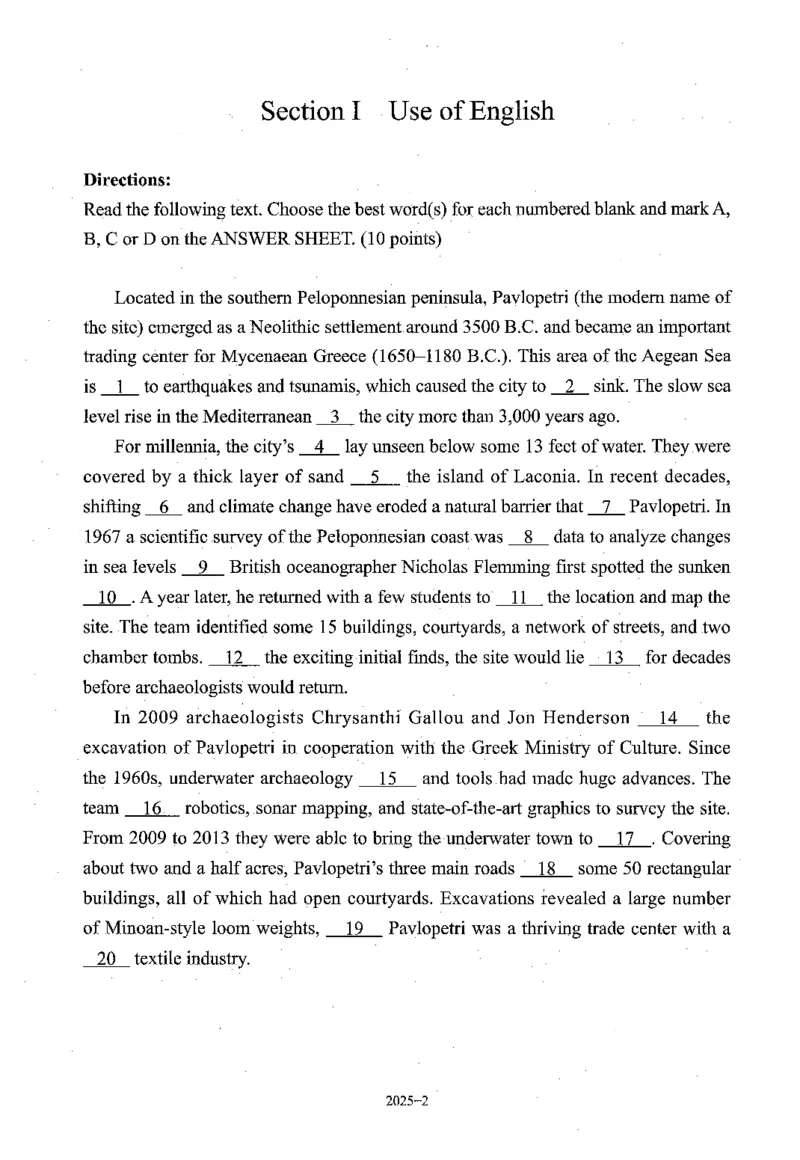
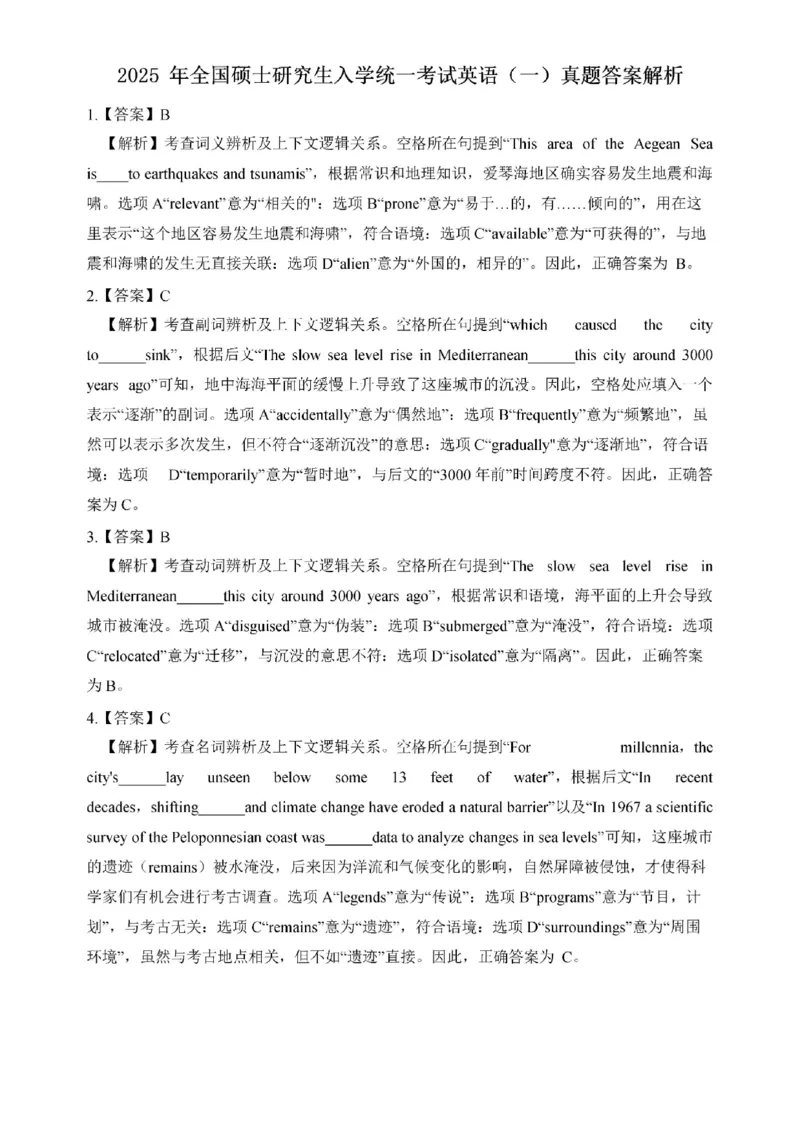
Located in the southern Peloponnesian peninsula, Pavlopetri (the modem name of
the site) emerged as a Neolithic settlement around 3500 B.C. and became an important
trading center fbr Mycenaean Greece (1650-1180 B.C.). This area of the Aegean Sea
is ] to earthquakes and tsunamis, which caused the city to 2 sink. The slow sea
level rise in the Mediterranean 3 the city more than 3,000 years ago.
For millennia, the city's 4 lay unseen below some 13 feet of water. They were
covered by a thick layer of sand 5 the island of Laconia. In recent decades,
shifting 6 and climate change have eroded a natural barrier that 7 Pavlopetri. In
1967 a scientific survey of the Peloponnesian coast was 8 data to analyze changes
in sea levels 9 British oceanographer Nicholas Flemming first spotted the sunken
10 . A year later, he returned with a few students to 11 the location and map the
site. The team identified some 15 buildings, courtyards, a network of streets, and two
chamber tombs. 12 the exciting initial finds, the site would lie 13 fbr decades
before archaeologists would return.
In 2009 archaeologists Chrysanthi Gallon and Jon Henderson 14 the
excavation of Pavlopetri in cooperation with the Greek Ministry of Culture. Since
the 1960s underwater archaeology 15 and tools had made huge advances. The
?
team 16 robotics, sonar mapping, and state-of-the-art graphics to survey the site.
From 2009 to 2013 they were able to bring the underwater town to 17 . Covering
about two and a half acres, Pavlopetri5s three main roads 18 some 50 rectangular
buildings, all of which had open courtyards. Excavations revealed a large number
of Minoan-style loom weights, 19 Pavlopetri was a thriving trade center with a
20 textile industry.
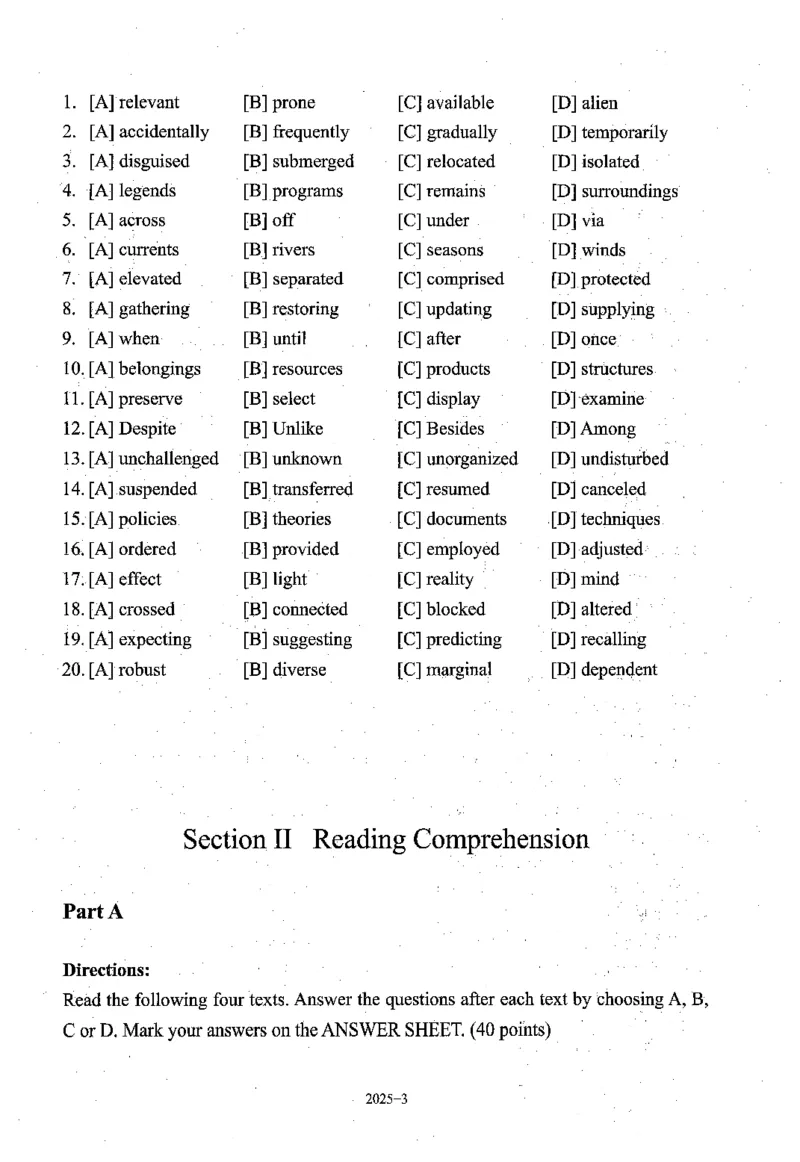
2025-21. [A] relevant [B] prone [C] available [D] alien
2. [A] accidentally [B] frequently [C] gradually [D] temporarily
3. [A] disguised [B] submerged [C] relocated [D] isolated
4. [A] legends [B] programs [C] remains [D] surroundings
5. [A] across [B] off [C] under [D] via
6. [A] currents [B] rivers [C] seasons [D] winds
7. [A] elevated [B] separated [C] comprised [D] protected
8, [A] gathering [B] restoring [C] updating [D] supplying
9. [A] when [B] until [C] after [D] once
10. [A] belongings [B] resources [C] products [D] structures
11. [A] preserve [B] select [C] display [D] examine
12. [A] Despite [B] Unlike [C] Besides [D] Among
13. [A] unchallenged [B] unknown [C] unorganized [D] undisturbed
14. [A] suspended [B] transferred [C] resumed [D] canceled
15. [A] policies [B] theories [C] documents [D] techniques
16. [A] ordered [B] provided [C] employed [D] adjusted
17. [A] effect [B] light [C] reality [D]mind
18. [A] crossed [B] connected [C] blocked [D] altered
19. [A] expecting [B] suggesting [C] predicting [D] recalling
20. [A] robust [B] diverse [C] marginal [D] dependent
Section II Reading Comprehension
Part A
Directions:
Read the following four texts. Answer the questions after each text by choosing A B,
?
C or D. Mark your answers on the ANSWER SHEET. (40 points)
2025-3Text 1
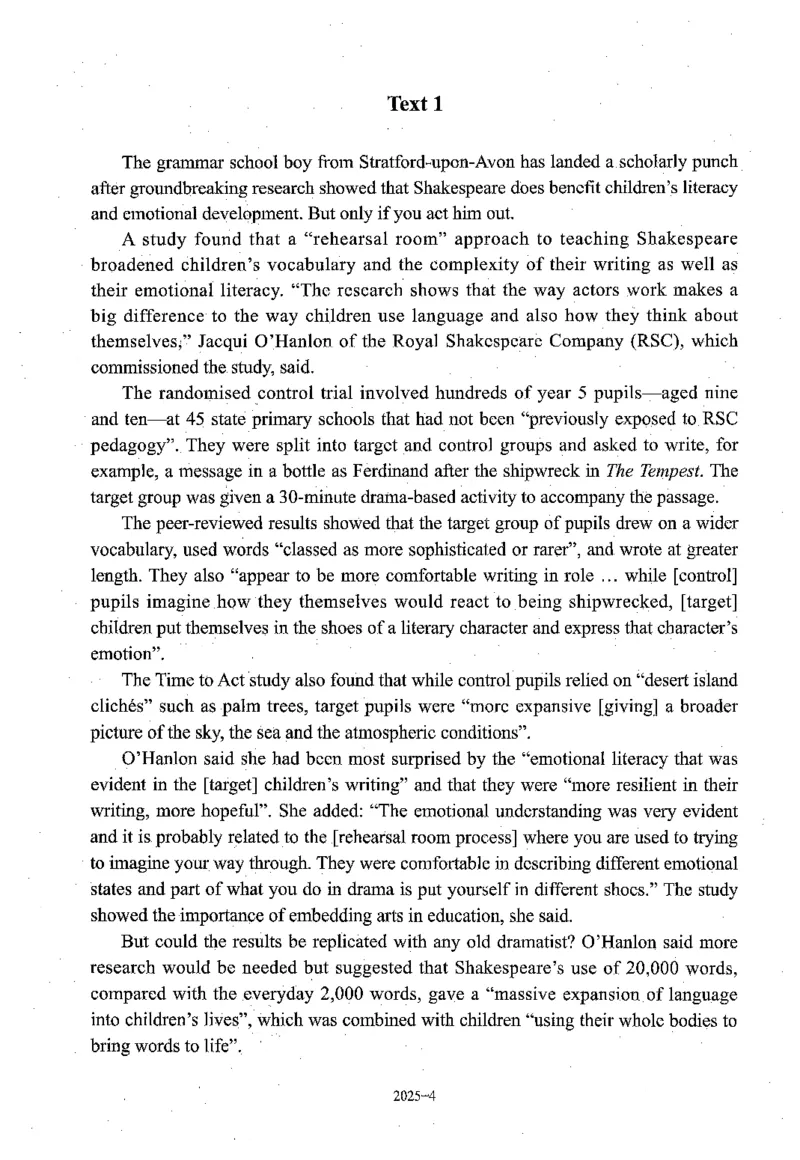
The grammar school boy from Stratford-upon-Avon has landed a scholarly punch
after groundbreaking research showed that Shakespeare does benefit children's literacy
and emotional development. But only if you act him out.
A study found that a "'rehearsal room^^ approach to teaching Shakespeare
broadened children's vocabulary and the complexity of their writing as well as
their emotional literacy. "The research shows that the way actors work makes a
big difference to the way children use language and also how they think about
themselves/5 Jacqui O'Hanlon of the Royal Shakespeare Company (RSC), which
commissioned the study, said.
The randomised control trial involved hundreds of year 5 pupils-aged nine
and ten- at 45 state primary schools that had not been "'previously exposed to RSC
pedagogy^^. They were split into target and control groups and asked to write, for
example, a message in a bottle as Ferdinand after the shipwreck in The Tempest. The
target group was given a 3O-minute drama-based activity to accompany the passage.
The peer-reviewed results showed that the target group of pupils drew on a wider
vocabulary, used words “classed as more sophisticated or rarer”, and wrote at greater
length. They also/'appear to be more comfortable writing in role ... while [control]
pupils imagine how they themselves would react to being shipwrecked, [target]
children put themselves in the shoes of a literary character and express that character's
emotion".
The Time to Act study also found that while control pupils relied on "desert island
cliches” such as palm trees, target pupils were "more expansive [giving] a broader
picture of the sky, the sea and the atmospheric conditions^^.
O5Hanlon said she had been most surprised by the “emotional literacy that was
evident in the [target] children^ writing^^ and that they were “more resilient in their
writing, more hopefiil”. She added: uThe emotional understanding was very evident
and it is probably related to the [rehearsal room process] where you are used to trying
to imagine your way through. They were comfortable in describing different emotional
states and part of what you do in drama is put yourself in different shoes?5 The study
showed the importance of embedding arts in education, she said.
But could the results be replicated with any old dramatist? O'Hanlon said more
research would be needed but suggested that Shakespeare9s use of 20,000 words,
compared with the everyday 2,000 words, gave a “massive expansion of language
into children's lives99, which was combined with children "using their whole bodies to
bring words to life,9.
2025-421. The "rehearsal room" approach requires pupils to . .
[A] rewrite the lines from Shakespeare
[B] watch RSC actors5 performances
[C] play the roles in Shakespeare
[D] study drama under RSC artists
22. The study divided the pupils into two groups to find whether .
[A] the change in instruction enhances learning outcomes
[B] expanding vocabulary helps develop reading fluency
[C] emotion affects understanding of sophisticated works
[D] the classroom activity stimulates interest in the arts
23. Control pupils9 reliance on “desert island clichSs“ shows their
[A] weakness in description
[B] omission of small details
[C] casual style of writing
[D] preference for big words
,:; , . ., . . . i . . . . ; :
, .; 」 ., 一 二 .
24. What can promote children^ emotional literacy according to O'Hanlon?
[A] Writing in an imaginative manner.
[B] Identifying with literary characters.
[C] Drawing inspiration from nature.
[D] Concentrating on real-life situations.
25. It can be inferred from the last paragraph that
「 一
[A] the new teaching method may work best with Shakespeare
[B] the language of Shakespeare may be formidable for pupils
1 , ■ . • . ; , ■ • -- . 1 . :
[C] other old dramatists may be included in primary education
[D] pupils may be reluctant to work on other old dramatists
2025-5Text 2
I was shocked to learn recently that some scientists want to scale back their
research in an effort to decrease carbon emissions. The crisis is here, they said, and
we need to cut back on our energy-intensive modelling. At the very least, we need to
make our energy use far more sustainable.
It is unarguable that our laboratories, scientific instruments, rockets and
satellites- the tools we scientists need to measure the planefs pulse—demand
significant amounts of energy both in their construction and operation. And it
is equally true that science's unrelenting appetite for information has caused a
mushrooming of energy-intensive data centres around the world. According to the
International Energy Agency, these buildings now consume about 1 per cent of the
world's electricity.
However, this is a price we must pay for understanding the world. How can we
inform decision makers about the best ways to bring down carbon emissions if we
can't track the amount of carbon dioxide in the atmosphere, where ifs coming from
and who's producing it? The carbon emissions from technological research are well
spent: ultimately this research will safeguard the future of our planet.
It can be hard for scientists to make the case because our work is complex, often
takes place behind closed doors and does not always lend itself to easy interpretation
or explanation. But demonstrating the efficacy of science will be crucial if we are to
solve humanity's greatest challenges.
Recognising the hope that science and engineering can bring was the impetus
behind the creation of the Millennium Technology Prize, which is now entering its
20th year as a celebration of human ingenuity. One of the past winners, Professor
Martin Green from the University of New South Wales, Australia, is the inventor of
the Passivated Emitter and Rear Cell technology which is now found in most of the
world's solar panels. Thanks to his invention, we have a real chance to decrease the
world's carbon emissions.
Every day, scientists, technologists and engineers are discovering new ways to
exploit renewable energy sources and develop techniques not just to use power more
intelligently but to power our intelligence; A great example of this is Europe9s largest
supercomputer, LUMI in Finland, which is astonishingly carbon-negative. Established
in an old paper mill, it is powered by a nearby river and its remote heat warms the
people who live in the surrounding town of Kajaani.
If the world is to meet its net-zero ambitions, we must think hard about how we
can deliver sustainable computing and deliver more LUMIs.
2025-626. The author expressed great surprise at some scientists5 二
[A] unwillingness to cut carbon emissions
[B] intention to reduce their research
[C] suspicions about sustainable energy
[D] waste of electricity in their projects
27. The author believes that carbon emissions from r e s e a r c h .
[A] have caused grave consequences
[B] have aroused groundless worries
[C] are hard to handle at present
[D] are justifiable in the long run
28. The example of Green in Paragraph 5 is used to illustrate
[A] the achievements of great scientists
[B] the urgency of addressing climate change
[C] the rewards of scientific endeavours
[D] the value of fostering human ingenuity
29. It can be learned from the last two paragraphs that LUMI .
[A] is a model of sustainability efforts
[B] is a triumph against energy shortage
[C] owes much to global net-zero initiatives
[D] aims to explore the power of intelligence
30. Which of the following statements would the author agree with?
[A] Emission-free modelling demands extra funding.
[B] The need for supercomputers is difficult to meet.
[C] Energy-intensive research work is inevitable.
[D] The goals of researchers ought to be realistic.
2025-7Text 3
Ever since taking on Netflix Inc. at its own game, old Hollywood has struggled
to turn a profit in streaming, with the likes of Disney+ Peacock and Paramount+
?
losing billions of dollars each year, sparking concerns that the services will never
be as profitable as cable once was. But the age of streaming has been a boon for
some unintended winners: pirates that use software to rip a film or television
show in seconds from legitimate online video platforms and host the titles on their
own, illegitimate services, which rake in about $2 billion annually from ads and
subscriptions.
With no video production costs, illegal streaming sites have achieved profit
margins approaching 90%, according to the Motion Picture Association (MPA), a trade
group representing Hollywood studios thafs working to crack down on the thousands
of illegal platforms that have cropped up in recent years.
Initially the rise of legitimate online businesses such as Netflix actually helped
curb digital piracy, which had largely been based on file uploads. But now piracy
involving illegal streaming services as well as file-sharing costs the US economy
about $30 billion in lost revenue a year and some 250,000 jobs, estimates the US
Chamber of Commerce's Global Innovation Policy Center. The global impact is about
$71 billion annually.
“The people who are stealing our movies and our television shows and operating
piracy sites are not mom and pop operations^^ says Charlie Rivkin, chief executive
,
officer of the MPA. "This is organized crime.55 Rivkin joined the MPA in 2017 after
the organization failed five years earlier to build consensus between Hollywood and
Silicon Valley to win passage of legislation in Congress aimed at stopping online
piracy. In 2017 the association formed the Alliance fbr Creativity and Entertainment
(ACE), an enforcement task force of about 100 detectives circling the globe to help
local authorities arrest streaming pirates.
ACE says ifs helped shrink the number of illegal streaming services in North
America to 126, from more than 1,400 in 2018, aided in part by the MPA's support for
a 2020 federal law that made large-scale streaming of copyrighted material a serious
crime.
Consulting firm Parks Associates predicts that legitimate US streaming services5
cumulative loss from piracy since 2022 will reach $113 billion in the next two years.
“While there is some optimism that emerging countermeasures and best practices may
see piracy begin to plateau by 2027, there is no consensus among stakeholders as to
when it may begin to decline/, says analyst Steve Hawley.
2025-831. According to Paragraph 1, legitimate streaming services
[A] have drawn lessons from Hollywood
[B] have surpassed cable in revenue
[C] are unpopular with advertisers
[D] are confronted with a real threat
■ ... . . , : , ■. . . .. . .. -
■■■- - .
32. It can be learned that streamers like Netflix .
[A] played a part in the fight against illegal file-sharing
[B] reaped benefits from the war with digital pirates
[C] promised to become big job creators in the US
[D] used to collaborate with file-uploading platforms
.. . , . , . , ,.
33. It can be inferred from Paragraph 4 that the MPA
[A] was denied cooperation by Silicon Valley
[B] led a national protest against online piracy
[C] was urged to form an enforcement task force
[D] failed to win support from local authorities
34. According to Hawley, digital piracy .
[A] cannot be checked in spite of new legislation
[B] will possibly overwhelm legitimate streamers
[C] is unlikely to diminish in the near future
[D] has been underestimated by some analysts
35. Which of the following is emphasized in the text?
[A] The need to coordinate anti-piracy action.
[B] The criminal nature of copyright violation.
: ,, ,• , . • M , • 1 1 1 . - 一,
[C] The prospect of eliminating online piracy.
[D] The economic harm from illegal streaming.
2025-9Text 4
Visit any antiques store and you911 encounter artifacts from the past: photographs,
letters, a brochure detailing the Sinclair dinosaur exhibit from the 1964-65 World's
Fair, the ephemera of history. Yet these objects aren't truly ephemeral, because they're
still here, decades, even centuries later. Why? Because they're tangible.
Have you pondered the life cycle of intangible formats, digital information,
given that those who produce these artifacts seldom make provision for their long
term preservation? For millennia, we've known what we've known due to artifacts
that have survived, often despite their original creators5 neglect. The thing itself is the
medium that delivers the information. At the time of creation, no attempts were made
at intentional preservation, yet analog materials have a chance of surviving and serving
as the historical record that biographers, historians, and novelists rely on. Libraries and
archives have traditionally shouldered the responsibility of organization, preservation,
and access to information. Librarians digitize the tangible so that researchers the world
over can quickly search and access their holdings. The result is an embarrassment of
historical riches, which brings its own needle-and-haystack problems.
Librarians9 selfless devotion can act against us when users point to universality
of access by holding up a cell phone and saying, "it's all in here“ as evidence that
libraries are less vital for researchers today. Yet how was that universality of access
made possible and, perhaps more importantly, how is it maintained? Who curates what
is preserved? When it comes to bom-digital information, the terrifying answer can be:
if not librarians and archivists, then no one. Digital information requires a great deal
more care than analog.
Even when a digital object is preserved, it may only be the carrier that's saved,
not the information itself. As technology advances and a format becomes obsolete, the
object is useless. Have you ever stared helplessly at a ZIP disk, thinking: how do I get
the files off this? Without constant migration of digital assets, a nightmare about the
foreseeable future is what keeps historians up at night: a historical record that abruptly
stops when digital replaces analog.
As a librarian whose day job revolves around special collections and digital
assets, I share the night terrors of historians, and I'd be lying if I said a comprehensive
preservation solution currently exists. Yet researchers can take some comfort in
the fact that there are a multitude of librarians devoted to discovering, organizing,
and preserving digital information for researchers current and future. While future
researchers may find the digital realm a challenging place to ply their trade, they won't
find it an impossible one.
2025-1036. The author mentions the artifacts from the past t o .
[A] introduce the collection of antiques
[B] contrast them with everyday items
[C] bring up the issue of preservation
[D] comment on their historical value
■ • -
37. Compared with digital objects, tangible artifacts .
[A] are less subject to their creators9 neglect
[B] convey information in a more direct way
[C] require more intentional preservation
[D] are less likely to suffer serious damage
1 • ;•••• • • :
38. According to Paragraph 3, librarians9 work may result in
「
[A] oversupply of materials
[B] undervaluation of libraries
[C] researchers9 underperformance
[D] users9 overreliance on technology
39. The “ZIP disk“ is cited as an example to show .
[A] the hazard of retrieving files through unusual means
[B] the infeasibility of constantly migrating digital assets
[C] the possibility of losing information in obsolete formats
[D] the inconvenience of storing information on analog devices
40. Which of the following statements best summarizes the text?
[A] Hard work should be done to preserve artifacts.
[B] Contributions of librarians should be recognized.
[C] Accessing databases is essential to researchers.
[D] Keeping digital historical records is a challenge.
2025-11Part B
Directions:
The following paragraphs are given in a wrong order. For questions 41-45, you are
required to reorganize these paragraphs into a coherent text by choosing from the list
A-H and filling them into the numbered boxes. Paragraphs A, C and H have been
correctly placed. Mark your answers on the ANSWER SHEET. (10 points)
[A] Peters likes to photograph butterflies in a landscape, celebrating the beauty of
their surroundings as well as the insects themselves. His pictures of a Glanville
fritillary rising from the sea-pinks beside the chalk cliffs of Compton Bay on
the Isle of Wight are particularly glorious. These take-off shots are even more
challenging because they require a wide-angle lens, which means he must be less
than 2cm from the butterfly. Ifs incredibly difficult to get that close to a skittish,
sun-warmed insect. Unlike some photographers, who “cheat“ by keeping insects
in a fridge to slow them down, Peters refuses to tamper with wild butterflies.
[B] Peters5 signature shot is a butterfly t6take-ofF\ showing the multiple wing-beats
of one butterfly in one frame as it lifts off from a flower. How does he capture it?
Technology helps. A typical digital SLR camera shoots 20 frames a second. He
uses a high-speed OM System which shoots 120 frames a second.
[C] Britain has relatively few butterfly species compared with mainland Europe and
80% are in decline, mostly because intensive chemical farming has reduced many
species to tiny fragments of habitat and small nature reserves. Global heating is
benefiting some species but others are too isolated to find suitable new habitat,
and gardening habits- paving over gardens and using pesticides-aren5t helping
either. Butterflies may not pollinate as many plants as wild bees and hoverflies,
but because British butterflies are the best-studied group of insects in the world,
they are an extremely useful indicator of the wider declines in flying insects.
[D] Five years ago, at summer's end, Andrew Fusek Peters was diagnosed with bowel
cancer. £aI was waiting for surgery, feeling really ill, sitting in my garden. It was
amazing weather and there were painted lady butterflies everywhere/9 he says.
2025-12“They were a symbol of fragile life, of hope and defiance, and something appealed
tomy soul.^^
[E] That makes it sound easy, and artificial, but Peters insists it is still a massive
challenge. He typically takes between 10,000 and 20,000 shots to get one butterfly
- - ■■■ , ■ , ■ ■ , ■ : , ■
take-off sequence in focus. At such high shutter speeds, the depth of field is tiny,
and as butterflies do not fly in a straight line they swiftly flutter out of focus.
As well as thousands of attempts, it takes patience and fieldcraft to anticipate a
butterfly9s likely flight-line—and catch it- in focus.
[F] So whafs the appeal of a long, sweaty day in pursuit of an elusiye, fast-moving
wild animal? C6It just feels bloody brilliant/9 says Peters. C6If Fve had a full day
of good encounters with butterflies, met interesting butterfly people and Fve got
some good shots; that becomes a vault in my spiritual bank. Ifs a happy fueling.”
[G] A children's author and poet who had become a keen amateur photographer,
Peters watched the butterflies and idly wondered if he could capture them in
flight. It swiftly became an obsession as he recovered from a successful operation
to remove the cancer. In recent summers, he has travelled the length and breadth
of Britain to photograph all 58 native species of butterfly. Now the fruits of those
summers have been published in a beautiful new book.
[H] A butterfly takes off so quickly it is still impossible to react quickly enough to
capture that take-off but if he half-presses the shutter, the camera saves the 70
previous frames before the moment he actually takes the picture. “It's time travel,
so I don,t miss the moment of take-off,he says. After he's captured the butterfly
taking off, he layers 10 to 15 frames together in Photoshop.
「 「』
41. | I 42.1 C j 4 3 1 H j 44. | j A j 45,
2025-13PartC
Directions:
Read the following text carefully and then translate the underlined segments into
Chinese. Write your answers on the ANSWER SHEET. (10 points)
Innovation and research have relied on public participation in science for
centuries. It was a musician who discovered the planet Uranus in the 18th century
by making his own telescope with mirrors composed of copper and tin. (46) Recent
decades have seen science move into a convention where engagement in the subject
can only be done through institutions such as a university. Citizen science provides an
opportunity for greater public engagement and the democratisation of science.
In the information era, large data sets, small teams and financial restrictions have
slowed scientific process. (47) But by utilising the natural curiosity of the general
public it is possible to overcome many of these challenges by engaging nori-scientists
directly in the research process. Anyone can be a citizen scientist, regardless of age,
nationality or academic experience. You don5t even need any formal training, just an
inquisitive mind and the enthusiasm to join one of the thousands of citizen science
projects to generate new knowledge and the means to understand a genuine scientific
outcome.
(48) Scientists have employed a variety of ways to engage the general public in
their research, such as making data analysis into an online game or sample collection
into a smartphone application. They've implored citizen scientists to help with bug
counting and categorising cancer cells, and even identifying distant galaxies.
This form of accessible science means that great minds are able to join the race to
create and develop projects with the potential to change the world. A citizen science
based approach can extend the field of vision and include more ideas and different
brains to problem-solve and create, making innovation faster and more effective.
The rise of citizen science has grown alongside the rise of do-it-yourself biology
laboratories around the world. (49) These groups of people are part of a rapidly
expanding biotechnological social movement of citizen scientists and professional
scientists seeking to take discovery out of institutions and put it into the hands of
anyone with the enthusiasm.
There are around 40 official do-it-yourself biology centres across the globe in
locations including Paris, London, Sydney, and Tel Aviv. (50) They pool resources,
collaborate, think outside the box, and find solutions and ways around obstacles to
explore science for the sake of science without the traditional boundaries of working
inside a fbrmal setting. So is it time to take the Petri dish out of the laboratory and into
the garage?
2025-14Section III Writing
Part A
51. Directions:
Read the following email from your classmate Paul and write him a reply.
Dear Li Ming,
I was really excited to hear that you'd invite some young craftsmen to
demonstrate their innovative craft-making on campus. May I know more
about what they'll show? Also, Fd like to help with your preparation work.
Please let me know what I can do.
Yours,
Paul
Write your answer in about 100 words on the ANSWER SHEET.
Do not use your own name in your email; use “Li Ming,9 instead. (10 points)
Part B
52. Directions:
Write an essay based on the table below. In your essay, you should
1) describe the table briefly,
2) interpret the table, and
3) give your comments.
Write your answer in 160-200 words on the ANSWER SHEET. (20 points)
空调 洗衣机 电冰箱(柜)
年份
(台) (台 ) (台)
2014 75.2 83.7 85.5
2017 96.1 91.7 95.3
2020 117.7 96.7 101.8
2023 145.9 98.2 103.4
近年来全国居民平均每百户年末主要耐用消费品拥有量
2025-15<答案速查>
Section I Use of English exhibits.
Your support would be greatly appreciated. Please
1.B 2. C 3.B 4.C 5.B
let me know if you are available to help.
6.A 7.D 8. A 9. A 10. D
Best regards,
11.D 12. A 13. D 14. C 15. D
Li Ming
16. C 17. B 18. B 19. B 20. A
Part B
Section H Reading Comprehension
This table depicts an increase in the national
Part A
average year-end ownership of major consumer
21. C 22. A 23. A 24. B 25. A durables per 100 households in the past decade in
26. B 27. D 28.C 29. A 30. C our country. The data indicate that the number of air
31.D 32. A 33. A 34. C 35. D
conditioners owned per 100 households surged from
36. C 37. B 38. B 39. C 40. D 75.2 to 145.9. Similarly, washing machine ownership
Part B
rose from 83.7 to 98.2, and refrigerator ownership
41. D 42. G 43. B 44. E 45. F
increased from 85.5 to 103.4.
Part C
This upward trend can be attributed to several
46 .近几十年来,科学研究已经进入了一种惯
factors. Firstly, the sustained economic growth in our
例,即只有通过诸如大学这样的机构才能参与课
country has significantly boosted household incomes.
究。
The rise in disposable income has empowered
47 .但是,利用公众天生的好奇心,让不是科
more families to purchase these essential household
学家的人直接参与研究过程,就有可能克服其中
appliances. Secondly, technological advancements
的许多挑战。
have made these appliances more affordable and
48 .科学家们采用了多种方式去吸引公众参与
accessible. Innovations in manufacturing have led
他们的研究,例如将数据分析做成一款网络游戏,
to more energy-efficient and cost-effective products,
或将样本采集开发成一个智能手机应用程序。
which made it easier for people to purchase and
49 .这些群体是由公民科学家和专业科学家发
upgrade their home appliances. Additionally,
起的、迅速扩大的一个生物技术社会运动的一部
government policies aimed at improving living
分,他们寻求将科学发现从机构中解放出来,将
standards and encouraging domestic consumption
其交到任何有热情的人手中。
have also played a significant role. Policies that
50 . 他们汇集资源,相互协作,打破常规思
promote the purchase of energy-efficient appliances
维,想方设法克服障碍,为了科学而探索科学,
and provide subsidies have made it more attractive
而不拘泥于在正式环境中工作的传统界限。
for people to buy these goods.
Section HI Writing In conclusion, the rise in ownership of major
Part A durable consumer goods reflects our country's
Dear Paul, economic development, technological progress and
Thank you for your interest and willingness to supportive government policies. These factors have
help. The craftsmen we invite will be demonstrating a collectively contributed to improving the standard of
range of innovative crafts, including modem pottery, living for many families.
woodwork, paper art and 3D-printed art. It will be an
exciting opportunity to see their creativity.
As for the preparation work, we need help with
setting up the exhibition space, arranging the crafts
and promoting the event on social media. Additionally,
we need some assistance on the day of the event to
help guide visitors and provide information about the
2025-16