绝密★启用前
2025年全国硕士研究生招生考试
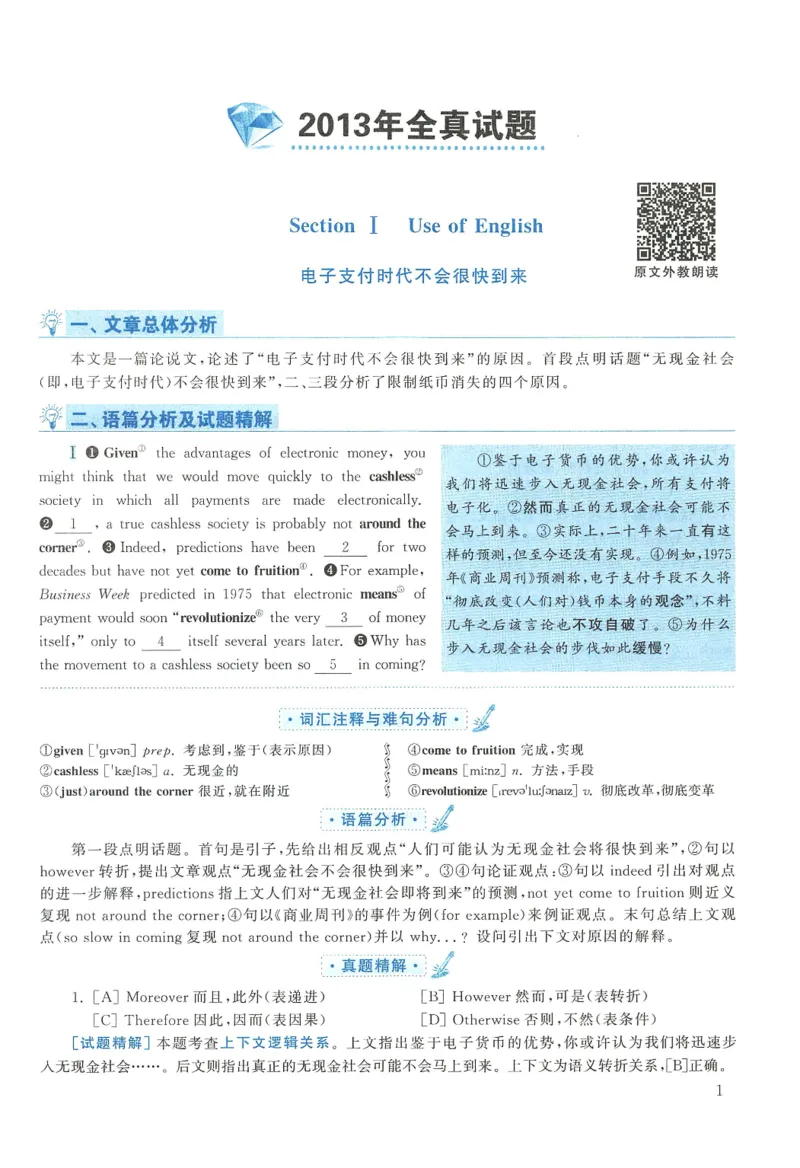
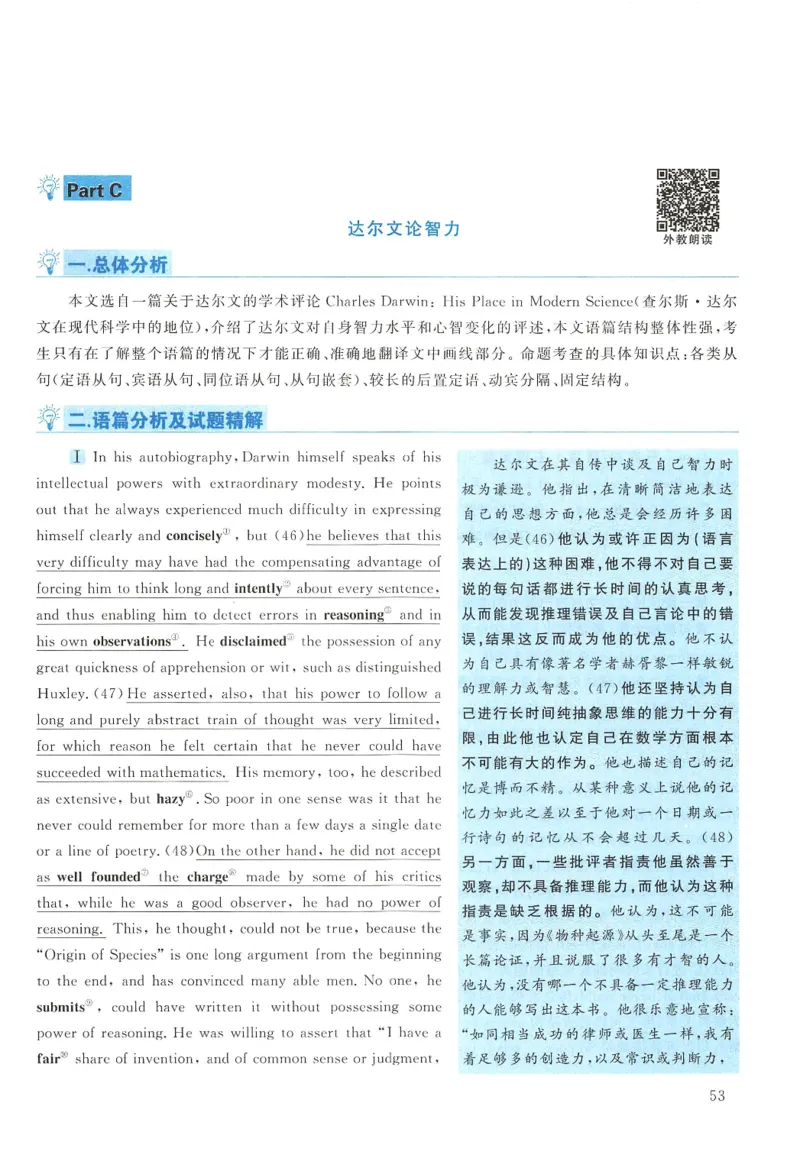
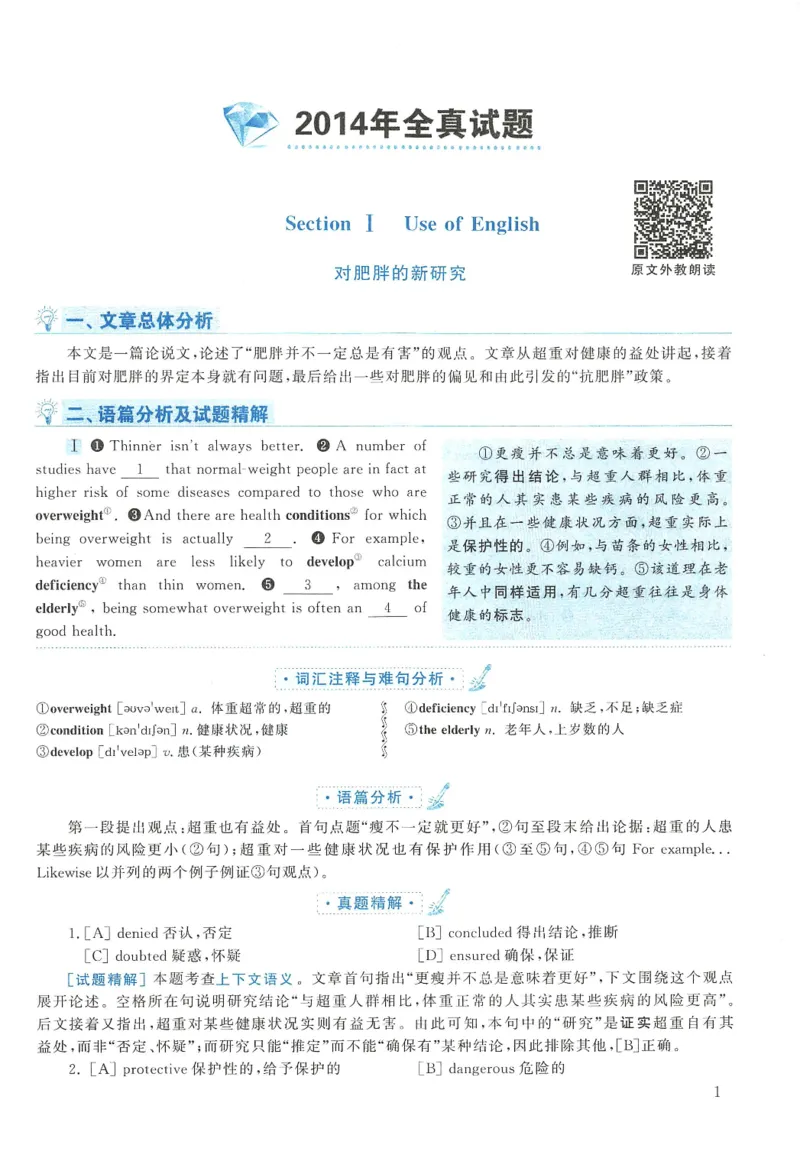
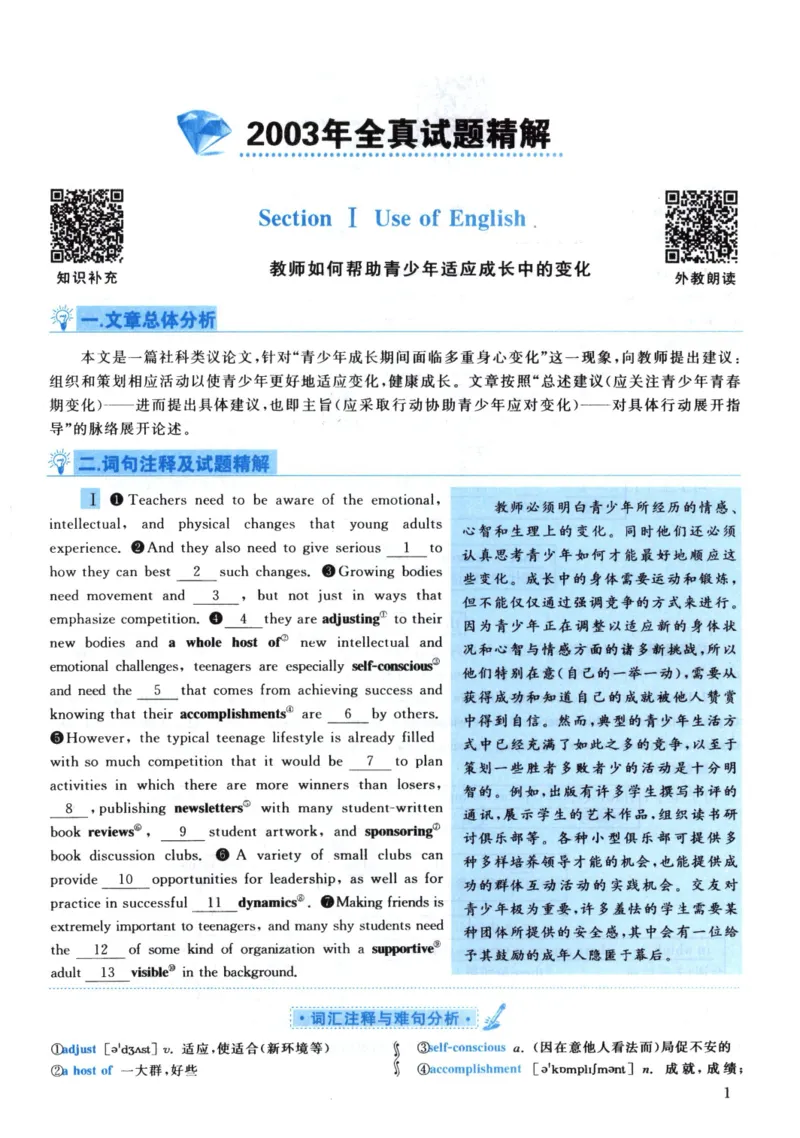
英 语 (二 )
(科目代码:204)
试 卷 条 形 码
☆考生注意事项翁
1 . 答题前,考生须在试题册指定位置上填写考生编号和考生姓名;在答题卡指
定位置上填写报考单位、考生姓名和考生编号,并涂写考生编号信息点。
2 . 考生须把试题册上的“试卷条形码”粘贴条取下,粘贴在答题卡的“试卷条
形码粘贴位置”框中。不按规定粘贴条形码而影响评卷结果的,责任由考生
自负。
3 . 选择题的答案必须涂写在答题卡相应题号的选项上,非选择题的答案必须书
写在答题卡指定位置的边框区域内。超出答题区域书写的答案无效;在草稿
纸、试题册上答题无效。
4 . 填 (书)写部分必须使用黑色字迹签字笔书写,字迹工整、笔迹清楚;涂写
部分必须使用2B铅笔填涂。
5 . 考试结束,将答题卡和试题册按规定交回。
(以 下 信 息 考 生 必 须 认 真 填 写 )
考 生 编 号 r n " " 1 ~~~~~~~~~~
考生姓名Section I Use of English
Directions:
Read the following text. Choose the best word(s) fbr each numbered blank and mark A,
B CorD on the ANSWER SHEET. (10 points)
?
There are many understandable reasons why you might find it difficult to ask for
help when you need it. Psychologists have been interested in this ] fbr decades, not
least because people's widespread 2 to ask fbr help has led to some high-profile
failures.
Asking fbr help takes 3 , It involves communicating a need on your part一
there9s something you can't do. 4 , you're broadcasting your own weaknesses,
which can be 5 . You might worry about coming across as incompetent. You
might have 6 about losing control of whatever it is you're asking fbr help with.
7 someone starts to help, perhaps they'll take over, or get credit fbr your earlier
efforts. Yet another 8 that you might be worried about is being a nuisance or
9 the person you go to for help.
If you struggle with low self-esteem, you might find it especially difficult to
10 fbr help because you have the added worry of the other person 11 your
request. You might see such refusals as implying something 12 about the status of
your relationship with them. To 13 these difficulties, try to remind yourself that
everyone needs help sometimes. Nobody knows everything and can do everything
all by themselves. And while you might 14 coming across as incompetent, there9s
actually research that shows that advice-seekers are 15 as more competent, not
less.
Perhaps most encouraging of all is a paper from 2022 by researchers at Stanford
University that involved a mix of contrived help-seeking interactions and asking
people to 16 times they?d sought help in the past. The findings showed that help
seekers generally underestimate how 17 other people will be to help and how good
if 11 make the help-giver feel (for most people, having the chance to help someone is
highly 18 ).
So, bear all this in mind the next time you need to ask fbr help. 19 , take care
over who you ask and when you ask them. And if someone can't help right now, avoid
taking it personally. They might just be too 20 , or they might not feel confident
about their ability to help.
2025-21. [A] illusion [B] discussion [C] tradition [D] question
2. [A] reluctance [B] ambition [C] tendency [D] enthusiasm
3. [A] attention [B] talent [C] courage [D] patience
4. [A] At any time [B] In other words [C] By all means [D] On the contrary
5. [A] unrealistic [B] deceptive [C] tiresome [D] uncomfortable
6. [A] doubts [B] concerns [C] suggestions [D] secrets
7. [A] Once [B] Unless [C] Although [D] Before
8; [A] theory [B] choice [C] factor [D] context
9. [A] overpraising [B] outperforming [C] reassessing [D] inconveniencing
10. [A] reach out [B] settle down [C] turn over [D] look back
11. [A] declining [B] considering [C] criticising [D] evaluating
12. [A] unnecessary [B] negative [C] strange [D] impractical
13. [A] explain [B] identify [C] predict [D] overcome
14. [A] deny [B] forget [C] miss [D] fear
15. [A] disguised [B] perceived [C] followed [D] introduced
16. [A] recall [B] classify [C] analyse [D] compare
17. [A] brave [B] disappointed [C] willing [D] hesitant
18. [A] relaxing [B] surprising [C] rewarding [D] demanding
19. [A] Thus [B] Also [C] Finally [D] Instead
20. [A] polite [B] proud [C] busy [D] lazy
Section II Reading Comprehension
Part A
Directions:
Read the following four texts. Answer the questions after each text by choosing A, B,
C or D. Mark your answers on the ANSWER SHEET. (40 points)
2025-3Text 1
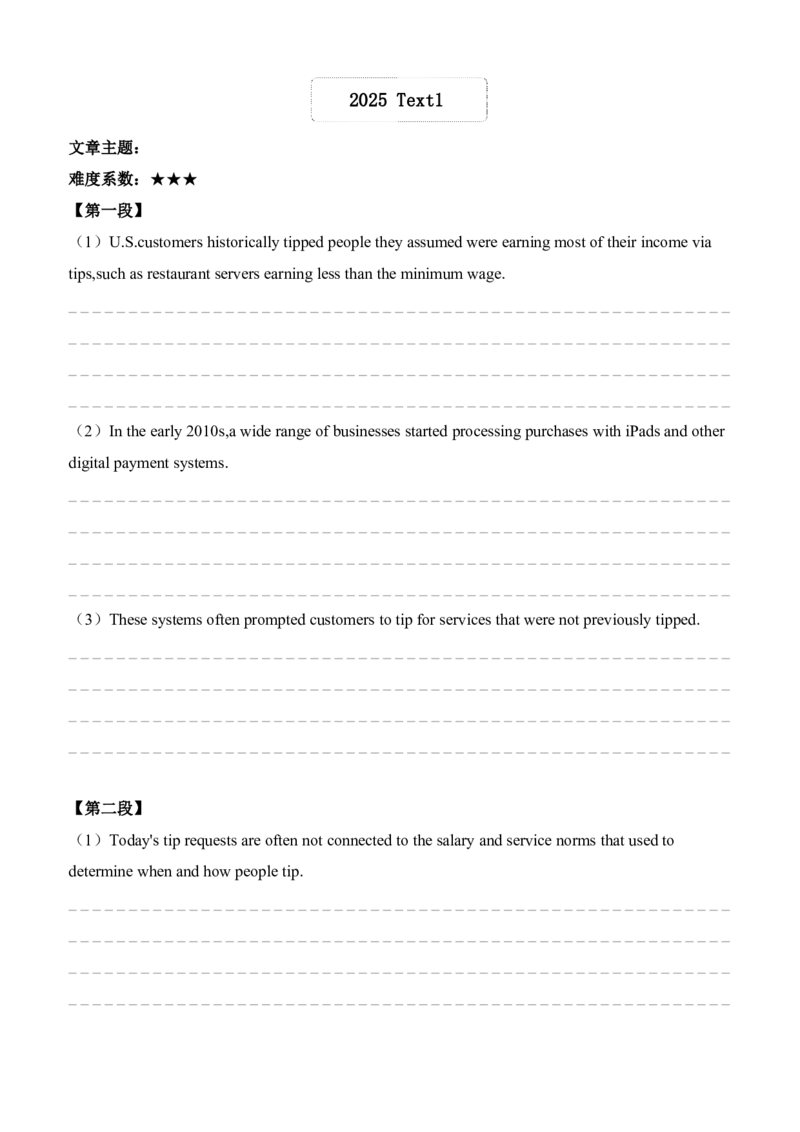
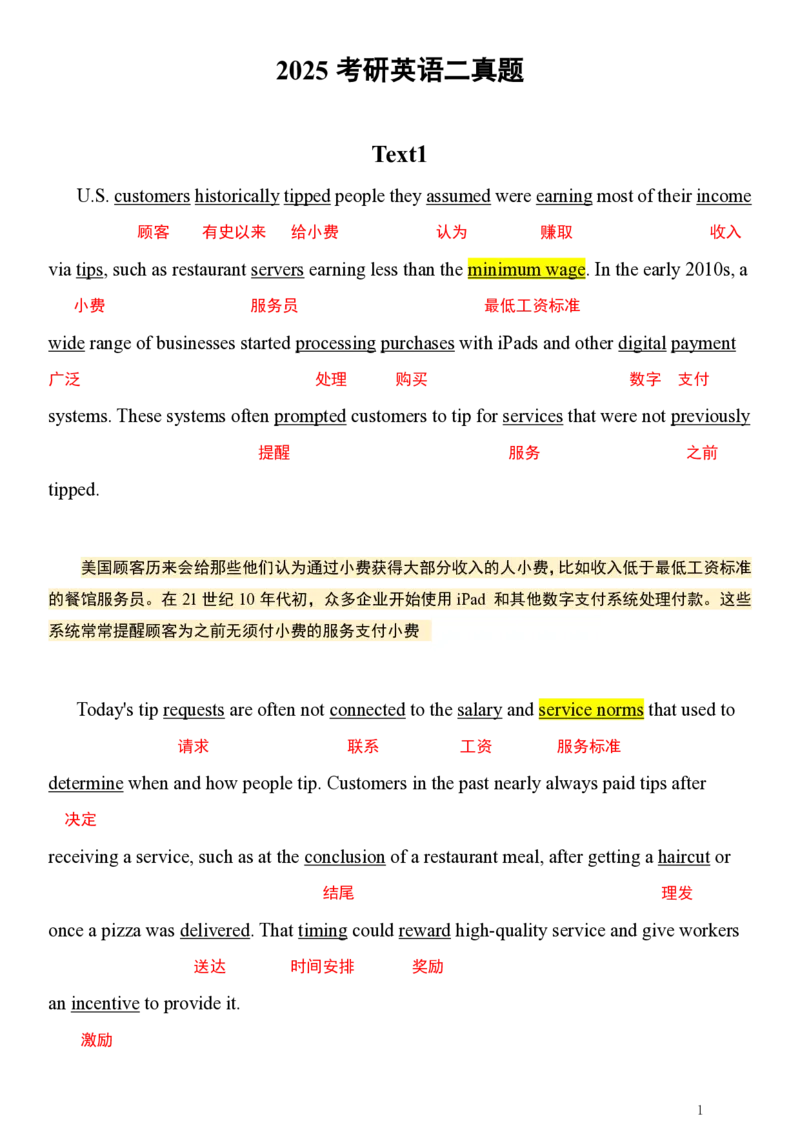
U.S. customers historically tipped people they assumed were earning most of their
income via tips, such as restaurant servers earning less than the minimum wage. In
the early 2010s, a wide range of businesses started processing purchases with iPads
and other digital payment systems. These systems often prompted customers to tip for
services that were not previously tipped.
Today's tip requests are often not connected to the salary and service norms that
used to determine when and how people tip. Customers in the past nearly always
paid tips after receiving a service, such as at the conclusion of a restaurant meal, after
getting a haircut or once a pizza was delivered. That timing could reward high-quality
service and give workers an incentive to provide it.
It's becoming more common for tips to be requested beforehand. And new tipping
technology may even automatically add tips.
The prevalence of digital payment devices has made it easier to ask customers
for a tip. That helps explain why tip requests are creeping into new kinds of services.
Customers now routinely see menus of suggested default options——often well above
20% of what they owe. The amounts have risen from 10% or less in the 1950s to
15% around the year 2000 to 20% or higher today. This increase is sometimes called
tipflation——the expectation of ever-higher tip amounts.
Tipping has always been a vital source of income for workers in historically tipped
services, like restaurants, where the tipped minimum wage can be as low as US$2.13
an hour. Tip creep and tipflation are now further supplementing the income of many
low-wage service workers.
Notably, tipping primarily benefits some of these workers, such as waiters, but
not others, such as cooks and dishwashers. To ensure that all employees were paid
fair wages, some restaurants banned tipping and increased prices, but this movement
toward no-tipping services has largely fizzled out.
So, to increase employee wages without raising prices, more employers are
succumbing to the temptations of tip creep and tipflation. However, many customers
are frustrated because they feel they are being asked fbr too high of a tip, too often.
And, as our research emphasizes, tipping now seems to be more coercive, less
generous and often completely dissociated from service quality.
2025-421. According to Paragraph 1, the practice of tipping in the U.S.
[A] was regarded as a sign of generosity
[B] was considered essential fbr waiters
[C] was a way of rewarding diligence
[D] was optional in most businesses
22 Compared with tips in the past, today's tips .
。
[A] are paid much less frequently
[B] are less often requested in advance
[C] have less to do with service quality
[D] contribute less to workers5 income
23. Tip requests are creeping into new kinds of services as a result of
[A] the advancement of technology
[B] the desire fbr income increase
[C] the diversification of business
[D] the emergence of tipflation
24. The movement toward no-tipping services was intended to
[A] promote consumption
[B] enrich income sources
[C] maintain reasonable prices
[D] guarantee income fairness
25. It can be learned from the last paragraph that t i p p i n g .
[A] is becoming a burden for customers
[B] helps encourage quality service
[C] is vital to business development
[D] reflects the need to reduce prices
2025-5Text 2
When it was established, the National Health Service (NHS) was visionary:
offering high-quality, timely care to meet the dominant needs of the population it
served. Nearly 75 years on, with the UK facing very different health challenges, it is
clear that model is out of date.
From life expectancy to cancer and infant mortality rates, we are lagging behind
many of our peers. With more than 6.8 million on waitlists, healthcare is becoming
increasingly inaccessible for those who cannot opt to pay for private treatment; and the
cost of providing healthcare is increasingly squeezing out investment in other public
services. As demand for healthcare continues to grow, pressures on the workforce—
which is already near breaking point~~will only become more acute.
Many of the answers to the crisis in health and care are well rehearsed. We need
to be much better at reducing and diverting demand on health services, rather than
simply managing it. Much more needs to be invested in communities and primary care
to reduce our reliance on hospitals. And capacity in social care needs to be greater, to
support the growing number of people living with long-term conditions.
Yet despite two decades of strategies and a number of major health reforms, we
have failed to make meaningful progress on any of these aims. That is why the Reform
think tank is launching a new programme of work entitled ^Reimagining health",
supported by ten former health ministers. Together, we are calling for a much more
open and honest conversation about the future of health in the UK, and an "urgent
rethink" of the hospital-centric model we retain.
This must begin with the question of how we maximise the health of the nation,
rather than “fix” the NHS. It is estimated, for example, that healthcare accounts for
only about 20% of health outcomes. Much more important are the places we live, work
and socialise- yet there is no clear cross-government strategy for improving these
social determinants of health. Worse, when policies like the national obesity strategy
are scrapped, taxpayers are left with the heavy price tag of treating the illnesses, like
diabetes, that result.
Reform wants to ask how power and resources should be distributed in our health
system. What health functions should remain at the centre, and what should be given
to local leaders, often responsible for services that create health, and with a much
better understanding of the needs of their populations?
2025-626. According to the first two paragraphs, the NHS
[A] is troubled by funding deficiencies
[B] can hardly satisfy people's needs
[C] can barely retain its current employees
[D] is rivalled by private medical services
27. One answer to the crisis in health and care is to
[A] boost the efficiency of hospitals
[B] lighten the burden on social care
[C] increase resources for primary care
[D] reduce the pressure on communities
28. “Reimagining health" is aimed to
[A] reinforce hospital management
[B] readjust healthcare regulations
[C] restructure the health system
[D] resume suspended health reforms
29. To maximise the nation's health, the author suggests
[A] introducing relevant taxation policies
[B] paying due attention to social factors
[C] reevaluating major health outcomes
[D] enhancing the quality of healthcare
30. It can be inferred that local leaders should .
[A] exercise their power more reasonably
[B] develop a stronger sense of responsibility
[C] play a bigger role in the health system
[D] understand people's health needs better
2025-7Text 3
Heat action plans, or HAPs, have been proliferating in India in the past few years.
In general, an HAP spells out when and how officials should issue heat warnings and
alert hospitals and other institutions. Nagpur9s plan, for instance, calls for hospitals
to set aside "cold wards“ in the summer for treating heatstroke patients, and advises
builders to give construction laborers a break from work on very hot days.
But implementation of existing HAPs has been uneven, according to a report
from the Centre fbr Policy Research. Many lack adequate funding, it found. And their
triggering thresholds often are not customized to the local climate. In some areas, high
daytime temperatures alone might serve as an adequate trigger for alerts. But in other
places, nighttime temperatures or humidity might be as important a gauge of risk as
daytime highs.
Mumbai9s April heatstroke deaths highlighted the need for more nuanced and
localized warnings, researchers say. That day's high temperature of roughly 36℃
was 1℃ shy of the heat wave alert threshold for coastal cities set by national
meteorological authorities. But the effects of the heat were amplified by humidity- an
often neglected factor in heat alert systems- and the lack of shade at the late-morning
outdoor ceremony.
To help improve HAPs, urban planner Rajashree Kotharkar?s team is working
on a model plan that outlines best practices and could be adapted to local conditions.
Among other things, she says, all cities should create a vulnerability map to help focus
responses on the populations most at risk.
Such mapping doesn't need to be complex, Kotharkar says. “A useful map can be
created by looking at even a few key parameters." For example, neighborhoods with
a large elderly population or informal dwellings that cope poorly with heat could get
special warnings or be bolstered with cooling centers. The Nagpur project has already
created a risk and vulnerability map, which enabled Kotharkar to tell officials which
neighborhoods to fbcus on in the event of a heat wave this summer.
HAPs shouldn't just include short-term emergency responses, researchers say, but
also recommend medium- to long-term measures that could make communities cooler.
In Nagpur, fbr example, Kotharkar 5s team has been able to advise city officials about
where to plant trees to provide shade. HAPs could also guide efforts to retrofit homes
or modify building regulations. "Reducing deaths in an emergency is good target to
have, but ifs the lowest target/9 says climate researcher Chandni Singh.
2025-831. According to Paragraph 1, Nagpur^ plan proposes measures to .
[A] tackle extreme weather
■ 「 , ■ ■
[B] ensure construction quality
[C] monitor emergency warnings
[D] address excessive workloads
32. One problem with existing HAPs is that t h e y .
[A] prove too costly to be implemented
[B] lack localized alert-issuing criteria
[C] give delayed responses to heat waves
[D] keep hospitals under great pressure
33. Mumbai9s case shows that India's heat alert systems need to .
[A] include other factors besides temperature
[B] take subtle weather changes into account
[C] prioritize potentially disastrous heat waves
[D] draw further support from local authorities
34. Kotharkar holds that a vulnerability map can help ,
[A] prevent the harm of high humidity
[B] target areas needing special attention
[G] expand the Nagpur projects coverage
[D] make relief plans for heat-stricken people
35. According to the last paragraph, researchers believe that HAPs should
• .
[A] fbcus more on heatstroke treatment
[B] apply for more government grants
[C] invite wider public participation
[D] serve a broader range of purposes
2025-9Text 4
Navigating beyond the organised pavements and parks of our urban spaces, desire
paths are the unofficial footprints of a community, revealing the unspoken preferences,
shared shortcuts and collective choices of humans. Often appearing as trodden dirt tracks
through otherwise neat green spaces, these routes of collective disobedience cut comers,
bisect lawns and cross hills, representing the natural capability of people (and animals) to
go from point A to point B most efifectively.
Urban planners interpret desire paths as more than just convenient shortcuts; they
offer valuable insights into the dynamics between planning and behaviour. Ohio State
University allowed its students to navigate the Oval, a lawn in the centre of campus, freely,
then proceeded to pave the desire paths, creating a web of effective routes students had
established.
Yet, reluctance persists among other planners to integrate desire paths into formal
plans, citing concerns about safety, environmental impact, or primarily, aesthetics. A Reddit
webpage devoted to the phenomenon, boasting nearly 50,000 members, showcases images
of local desire paths adorned with signs instructing pedestrians to adhere to designated
walkways, underscoring the rebellious nature inherent in these human-made tracks. This
clash highlights an ongoing struggle between the organic, user-driven evolution of public
spaces and the desire for a visually curated and controlled urban environment.
The Wickquasgeck Trail is an example of a historical desire path, created by Native
Americans to cross the forests of Manhattan and move between settlements quickly. This
trail, when Dutch colonists arrived, was widened and made into one of the main trade roads
across the island, known at the time as de Heere Straat, or Gentlemen's Street. Following
the British assumption of control in New York, the street was renamed Broadway. Notably,
Broadway stands out as one of the few areas in NYC that defies the grid-based system
applied to the rest of the city, cutting a diagonal across parts of the city.
In online spaces, desire paths have sparked a fascination that can approach obsession,
with the Reddit page serving as a hub. Contributors offer a wide array of stories, from
little-known new shortcuts to long-established alternate routes.
Animal desire paths, such as ducks forging trails through frozen ponds or dogs carving
direct routes in gardens, highlight the adaptability of these trails in both human and animal
experiences. As desire paths criss-cross through both physical and virtual landscapes,
they stand as a proof of the collective insistence on forging unconventional routes and
embracing the spirit of communal choice.
2025-1036. According to Paragraph 1, desire paths are a result of
[A] the curiosity to explore surrounding hills
[B] the necessity to preserve green spaces
[C] the tendency to pursue convenience
[D] the wish to find comfort in solitude
37. It can be inferred that Ohio State University
[A] intends to improve its desire paths
[B] leads in the research on desire paths
[C] guides the creation of its desire paths
[D] takes a positive view of desire paths
38. The images on the Reddit webpage reflect
[A] conflicting opinions on the use of desire paths
[B] the call to upgrade the designing of public spaces
[C] the demand for proper planning of desire paths
[D] growing concerns over the loss of public spaces
39. The example of the Wickquasgeck Trail i l l u s t r a t e s .
[A] the growth of New York City
[B] the Dutch origin of desire paths
[C] the importance of urban planning
[D] the recognition of desire paths
40. It can be learned from the last paragraph that desire paths
[A] reveal humans9 deep respect for nature
[B] are crucial to humans9 mental wellbeing
[C] are a human imitation of animal behaviour
[D] show a shared trait in humans and animals
2025-11Directions:
Read the following text and answer the questions by choosing the most suitable
subheading from the list A-G for each of the numbered paragraphs (41-45). There
are two extra subheadings which you do not need to use. Mark your answers on the
ANSWER SHEET. (10 points)
[A] Stay positive.
[B] Respect the past.
[C] Use channels.
[D] Give it time.
[E] Invite resistance.
[F] Be a salesman.
[G] Be humble.
Five Steps to Suggesting a Change at Work
That'll Actually Get Taken Seriously
Everyone wants to be that person- the one who looks at the same information as
everyone else, but who sees a fresh, innovative solution. However, it takes more than
simply having a good idea. How you share it is as important as the suggestion itself.
Why? Because writing a new script-literally or figuratively-means that other team
members will have to adapt to something new. Not to mention, if the process you're
scrapping is one someone else suggested, there?s the possibility of hurt feelings. To
gain buy-in on an innovative, new idea, follow these steps:
4L___________________
Great ideas don5t stand alone. In other words, you can't mention your suggestion
once and expect it to be adopted. To see a change, you'll need to champion your plan
and sell its merits. In addition, you need to be willing to stand up to scrutiny and
criticism and be prepared to explain your innovation in different ways fbr various
audiences.
2025-1242. -_______________
Sometimes it makes sense to go to your boss first. But other times, ifs useful
to build a coalition among your co-workers or other stakeholders. When it works, it
works great——because you5re ready for your stubborn supervisor's pushback with
answers like, “Actually, I connected with a few people in our tech department to
discuss how much time these kinds of website updates would take, and they suggested
they have the bandwidth.”
43.
One of the biggest barriers to gaining buy-in occurs when the owner of an idea is
viewed as argumentative, defensive or close-minded. Because, lefs be honest: No one
9
likes a know-it-all. So, if people disagree with you, don't be indignant. Instead, listen
to their concerns fully, try to understand their perspective, and include their concerns
(and possible remedies) in future discussions. So, instead of saying, “Martha, our
current slogan is confusing and should be updated,95 you could try, “Martha raises a
great point that our current slogan has a long history for our stakeholders, but I wonder
if we might be able to brainstorm a tagline that could build on that- and be clearer for
new customers/9
44. _______________
New ideas are the grandchildren of old ones. In other words, don't throw old
solutions under the bus to make your improvement stand out. Remember that in light
of whatever the problem the old system solved一or maybe, has failed to solve in
9
recent memory- it was a great idea at the time. Appreciating the older contributions as
you suggest future innovations helps bolster the credibility of your idea.
45.
When pitching a new idea, it's important to use the language of abundance instead
of the language of deficit. Instead of saying what is wrong, broken, or suboptimal, talk
about what is right, fixable, or ideal. For example, try, "I can see lots of applications
for this new approach59 rather than, “This innovation is the only way." Be optimistic
but realistic, and you will stand out.
2025-13Section III Translation
46. Directions:
Translate the following text into Chinese. Write your translation on the ANSWER
SHEET. (15 points)
You know the moment- the conversation slows, then there9s a pause. It's
awkward, and so awkward that some people will panic and say anything. Do we all
find such silences so stressful?
Researchers analysed the frequency and impact of gaps greater than 2 seconds
during conversations, including an overview of previous studies which indicate that
the fear of awkward silences can be so extreme that people avoid talking to strangers,
even though doing so is likely to be an enjoyable experience.
During conversations with short gaps, people feel more connected to their
conversation partners. But such feelings of connection markedly dip when entering a
long gap. Long gaps between strangers are likely to be followed by a change in topic.
But the opposite seems to be true for conversations between friends. Long gaps
there saw increased connection. Between friends, longer gaps seem to provide natural
moments fbr reflection and expression.
Section IV Writing
Part A
47. Directions:
Suppose you are planning a short play based on a classic Chinese novel. Write
your friend John an email to
1) introduce the play, and
2) invite him to take part in it.
Write your answer in about 100 words on the ANSWER SHEET.
Do not use your own name in your email; use “Li Ming99 instead. (10 points)
2025-14Part B
48. Directions:
Write an essay based on the chart below. In your essay, you should
1) describe and interpret the chart, and
2) give your comments.
Write your answer in about 150 words on the ANSWER SHEET. (15 points)
90.8%
看电视 散步 养花 阅读 下棋
某社区老年人主要日常休闲活动调查
2025-15Section I Use of English The performance is scheduled for March 15,
with rehearsals starting January 5, every Saturday
1.D 2. A 3.C 4.B 5.D
afternoon. We'd love for you to join our cast and
6.B 7. A 8. C 9.D 10. A
bring one of these fascinating characters to life.
11.A 12. B 13. D 14. D 15. B
Looking forward to your response.
16. A 17. C 18. C 19.B 20. C
Yours,
Section II Reading Comprehension
Li Ming
Part A
Part B
21.B 22. C 23. A 24. D 25. A
The chart describes a survey on the main
26. B 27. C 28. C 29. B 30. C
daily leisure activities of elderly people in a certain
31. A 32. B 33.A 34. B 35. D
community. The results show that watching TV and
36. C 37. D 38.A 39. D 40. D
taking a walk are popular activities, with 90.8%
Part B
and 68.3% of the elderly participating in them
41. F 42. C 43. G 44. B 45. A
respectively. Other activities such as gardening,
Section III Translation reading, and playing chess have lower participation
你知道那种时刻吧一一谈话开始放缓,然后 rates, with 34.7%, 31.8% and 18.4% respectively.
就停了。这种情况令人尴尬,尴尬到有些人会惊 The reasons behind these choices are varied.
慌失措,什么都说。我们都觉得这种沉默让人如 Watching TV is highly favored due to its ease of
此紧张吗? access, and it requires minimal physical effort,
研究人员分析了谈话中超过2秒的停顿的频 which is particularly suitable for those who have
率及其影响,包括一些以往研究的概述,这些研 mobility issues or prefer indoor activities. Taking a
究表明,人们极其害怕这种尴尬的沉默,以至于 walk, the second most popular activity, is a simple
他们会避免与陌生人交谈,即使与陌生人交谈可 form of exercise that helps maintain physical fitness.
能是一次愉快的经历。 It also provides an opportunity for the elderly to
在谈话中有短暂的停顿,人们会感觉与其谈 interact with neighbors and friends, thereby reducing
话对象的关系更紧密。但进入长时间的停顿时, their feelings of loneliness and isolation. Gardening,
这种联系感就会明显下降。陌生人在交谈时,长 reading, and playing chess, although less popular,
时间停顿之后很可能就会转移话题。 still play important roles in the daily lives of some
但朋友之间的对话似乎恰恰相反。长时间的 elderly people.
停顿会增加其关联。朋友之间,较长的停顿似乎 In summary, elderly individuals choose these
提供了反思和表达的自然契机。 leisure activities based on their physical abilities, the
need for mental stimulation and social interaction.
Section IV Writing
Communities can offer a diverse range of leisure
Part A
activities that cater to these preferences to enhance
Dear John,
the quality of life for the elderly.
I hope you're well. I'm excited to share that
we're adapting the famous classic Chinese novel
Dream of the Red Chamber into a short play. The
novel highlights themes of love, betrayal, and
the fleeting nature of wealth and power. In our
adaptation, we focus on the love triangle between
Baoyu, Daiyu and Baochai, set against the backdrop
扫码查看2025年真题词汇
of the family's decline.
文字版及视频版真题详解
2025-16