成都七中 2025~2026 学年度高三(下)二诊模拟考试
英 语
注意事项:
1. 答题前,考生务必将自己的姓名、准考证号填写在答题卡上。
2. 回答选择题时,选出每小题答案后,用铅笔把答题卡上对应题目的答案标号涂黑。如需改
动,用橡皮擦干净后,再选涂其它答案标号。回答非选择题时,将答案写在答题卡上,写在本试卷
上无效。
3. 考试结束后,只将答题卡交回。
第一部分 听力(共两节,满分30分)
做题时,先将答案标在试卷上。录音内容结束后,你将有两分钟的时间将试卷上的答案转涂
到答题卡上。
第一节(共5小题;每小题1.5分,满分7.5分)
听下面5段对话。每段对话后有一个小题,从题中所给的A、B、C三个选项中选出最佳选项,
并标在试卷的相应位置。听完每段对话后,你都有10秒钟的时间来回答有关小题和阅读下一小题。
每段对话读两遍。
1.How will the woman go to the Grand Hotel?
A.On foot. B.By taxi. C.By car.
2.How much were the coat and the gloves in total?
A.$150. B.$125. C.$75.
3.What is the man doing?
A.Doing shopping. B.Checking in. C.House hunting.
4.What is the woman concerned about?
A.Jim’s suit was ruined. B.Jim’s laptop could be damaged. C. The table needed cleaning.
5.Which sport will the man do?
A.Diving. B.Sailing. C.Swimming.
第二节(共15小题;每小题1.5分,满分22.5分)
听下面5段对话或独白。每段对话或独白后有几个小题,从题中所给的A、B、C三个选项中
选出最佳选项,并标在试卷的相应位置。听每段对话或独白前,你将有时间阅读各个小题,每小题
5秒钟;听完后,各小题将给出5秒钟的作答时间。每段对话或独白读两遍。
听第6段材料,回答第6至7题。
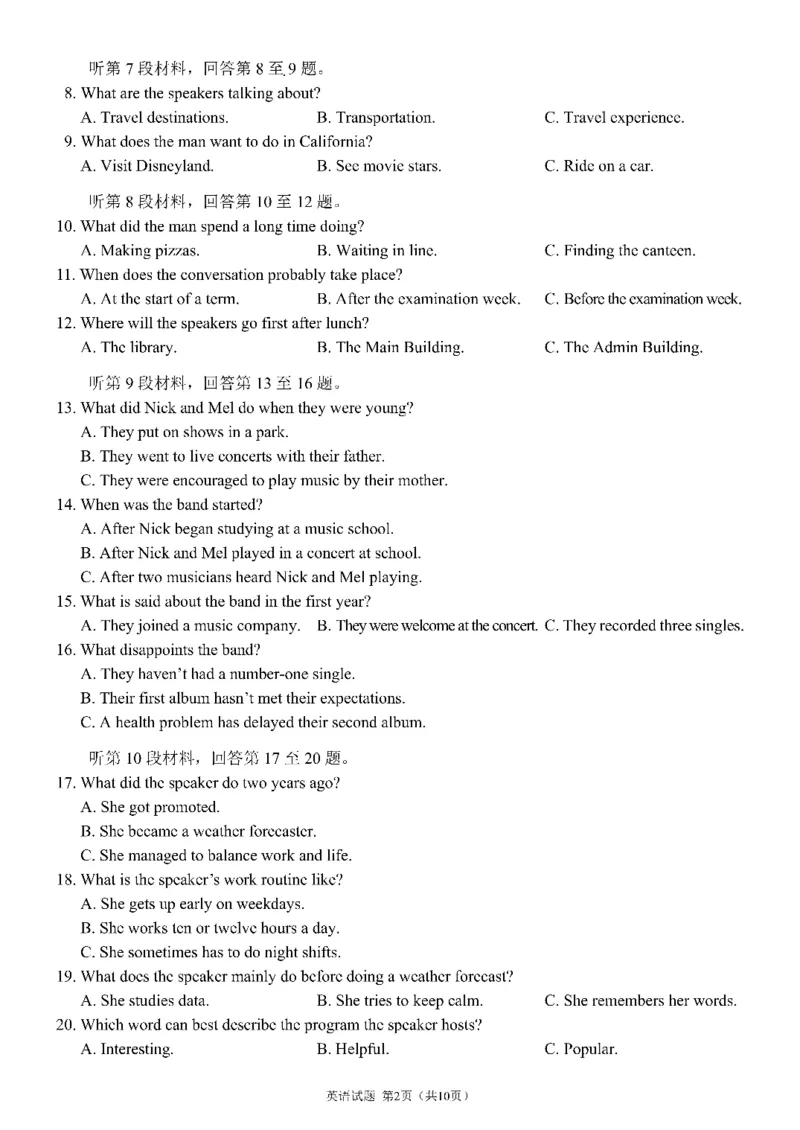
6.What does the man complain about?
A.His purchases are too expensive. B.His home is too far away. C.His bag is too heavy.
7.What do we know about the woman?
A.She doesn’t like to travel.
B.She has been to Hong Kong before.
C.She bought many presents for her kids.
英语试题 第1页(共10页)第二部分 阅读理解(共两节,满分50分)
第一节(共15小题;每小题2.5分,满分37.5分)
阅读下列短文,从每题所给的A、B、C和D四个选项中选出最佳选项。
A
Part of STEM learning is seeing and doing, and then recording and analysing the results. But not all
online or homeschool programmes are set up to accommodate science experiments or other STEM learning
activities. Let’s take a look at a few mind-blowing labs that can help bring STEM topics alive for your
child’s online school experience.
Weather Laboratories
To make learning about weather accessible and fun, the National Oceanic and Atmospheric Administration
(NOAA) created a lot of informative weather activities and virtual labs they recommend for students and
educators. In fact, their weather science content for kids features a Weather Lab application that allows
middle school students to predict weather patterns, and learn what happens when ocean currents and air
masses interact.
Simulations for Science and Math
It is a project of the University of Colorado Boulder and one of the richest single databases of online
science interactives and virtual labs. Investigate more than 150 physics, chemistry, math, biology, and Earth
science topics. Available in dozens of languages, the interactives are searchable by grade level, subject,
and accessibility.
Space Exploration Simulations
The National Aeronautics and Space Administration (NASA) features many STEM learning activities
for students in grades K-12. The interactive simulations are also gamified and make learning engaging and
fun for your child. The app allows users to explore the universe and unlock stories of trailblazing scientists
and their contributions to space exploration and science.
Space Chemistry Workshop
How do different substances react in special space conditions? Space Chemistry Workshop is the best
place to observe how metals rust under space-like radiation. It is fun! The chemical principles come alive
in Space Chemistry Workshop!
21. Who is the text intended for?
A. Parents. B. Students. C. Teachers. D. Researchers.
22. What makes Simulations for Science and Math different from the other labs?
A. It covers the most subjects. B. It allows users to interact online.
C. It offers gamified learning experiences. D. It provides multiple tools for searching.
23. Which lab allows visitors to learn about space scientists?
A. Weather Laboratories B. Space Chemistry Workshop
C. Space Exploration Simulations D. Simulations for Science and Math
英语试题 第3页(共10页)B
The moment Daniel Swain wakes up, he gets whipped about (猛烈吹袭) by hurricane-force winds.
“A Category 5, literally overnight, hits Acapulco,” says the 34-year-old climate scientist and self-described
weather enthusiast, who is hit daily by the flood of catastrophic weather headlines: wildfires, megafloods,
haboobs (an intense dust storm), atmospheric rivers, bomb cyclones. Everyone’s asking: Did climate change
cause these disasters? And, more and more, they want Swain to answer.
Swain is at the same time 1,600 miles away from the hurricane and at the eye of storm. His ability to
explain science to the masses has made him one of the media’s go-to climate experts. He’s a staff research
scientist at UCLA’s Institute of the Environment and Sustainability who spends more than 1,100 hours
each year on public-facing climate and weather communication, explaining whether (often, yes) and how
climate change is raising the number and intensifying the fierceness of weather disasters.
“Climate change is an increasingly big part of what’s driving weather extremes today,” Swain says.
“I connect the dots between the two. There’s a lot of misunderstanding about how a warming climate
affects day-to-day variations in weather, but my goal is to push public perception toward what the science
actually says.” So, when reporters call him, he does his best to call them back.
“Daniel had a very clear vision about how he wanted to contribute to science and the world, using
social media and his website,” says Kareiva, a research professor at UCLA. “We will not solve climate
change without a movement, and communication and social media are key to that. Most science papers are
never even read. What we do as scientists only matters if it has an impact on the world. We need at least
100 more Daniels.”
As global warming continues to worsen, it’s easy to get pulled into overly dramatic ways of looking
at where the world is going amid catastrophic weather headlines. Daniel Swain helps people know how we
can better face those fears with the use of scientific accuracy, which makes his role incredibly valuable.
24.Why do people want Daniel Swain to answer their disaster-related questions?
A.He makes specialised knowledge accessible.
B.He is widely recognised by the public and the media.
C.He is an expert in environmental sustainability research.
D.He works at the eye of storm with first-hand information.
25.What can we learn from Kareiva’s words?
A.Climate change is widely misunderstood.
B.The public should value scientific work more.
C.Scientists should engage the public like Swain.
D.Social media has a direct impact on climate change.
26.How can Daniel Swain be described?
A.Helpful and optimistic. B.Easy-going and humorous.
C.Responsible and serious. D.Purposeful and knowledgeable.
27.What is the suitable title for the text?
A.The Weather Man: Approaching Fear with Science
B.A Valuable Job: Connecting Science with Social Media
C. An Inspiring Figure: Confronting Climate Change Bravely
D. A Distinctive Scientist: Interpreting Climate from a Unique Perspective
英语试题 第4页(共10页)C
Years ago, as a young business reporter, I interviewed James Patterson, an advertising executive who
ran a fast-food chain account, and yet dreamed of being a novelist instead. I remember thinking: Sure, you
and everybody else. A decade or so later, however, I was surprised to see the adman on TV, holding up his
new book. He has since published more than 100 New York Times best sellers and co-authored books with
the likes of Bill Clinton and Dolly Parton.
Mr. Patterson’s ability to see himself as a writer illustrates a concept known as “possible selves”. It
describes how people envision their futures: what they may become, or want to become, or even fear
becoming.
The term, coined in 1986 by the social psychologists Hazel Markus and Paula Nurius, grew out of
research on self-concept and self-perception. While self-concepts – “I am a kind person” or “I am a good
parent” – are rooted in the present, the researchers found that people are also informed by ideas about what
they might become and how they might change.
These possible selves, both positive and negative, are closely related to motivation. A violin student
who envisions life as a professional musician might be motivated to practice. A person whose feared possible
self is an alcoholic may become a non-drinker. In a small study, when young adults were encouraged to
envision themselves as either regular exercisers (hoped-for selves) or inactive (feared selves), both groups
exercised more in the weeks afterward. And researchers have found that constructing positive possible
selves can improve well-being and relieve symptoms of depression by holding out the potential for a better
future.
A possible self can take you beyond daydreams, which are often fleeting and not necessarily grounded
in reality. It can take shape “if you build a bridge from your ‘now’ self to the possible self,” Dr. Markus
said. But how do we construct that bridge?
28. Why is James Patterson mentioned in the first paragraph?
A. To tell a story. B. To inspire the readers.
C. To reveal the topic. D. To introduce the figure.
29. Which of the following is an example of one’s “possible selves”?
A. I am a diligent student. B. I want to travel abroad.
C. I could have become a dentist. D. I worry about being lonely.
30. What can be inferred from paragraph 4?
A. Those who fear failure may end up being a loser.
B. Knowing what can be achieved benefits mental health.
C. A clear ambition guarantees one’s success in the future.
D. A positive possible self is more motivating than a negative one.
31. What might be mentioned in the following paragraph?
A. How to create more possibilities. B. How to realise one’s potential.
C. How to build spiritual connections. D. How to cultivate self-awareness.
英语试题 第5页(共10页)D
However much we learn from things going wrong, we will never become the best decision-makers.
This finding comes from a mathematical game that simulates (模拟) a large economy, and suggests we may
need to rethink assumptions built into economic theories. In such theories, people are typically represented
as reasonable agents who learn from past experiences to enhance their performance, eventually reaching a
stable state in which they know how to maximise their earnings.
To test whether economists are correct in assuming that learning from the past experience enables
individuals to avoid chaos, Garnier-Brun and his colleagues developed a mathematical model for a game
featuring hundreds of simulated players, each capable of choosing between two actions – such as buying
or selling a stock – and interacting with one another over multiple rounds, so each player’s decisions were
influenced by their previous experiences, meaning they could learn from them.
In different game scenarios (设想), the researchers expected that the game would always result in
chaos, with players unable to learn how to optimise their performance. Economic theory would suggest that,
given the right set of parameters (参数), the players would settle into a stable state where they had mastered
the game – but the researchers found this wasn’t really the case. The most likely outcome was a state that
never settled.
Team member Jean-Philippe Bouchaud says that, in the absence of one centralised, all-powerful player
who could coordinate everyone, regular players could only learn how to reach “satisficing” states. That is
a level that satisfied minimum expectations but not much more. Players gained more than they would have
done by playing at random, so learning wasn’t useless, but they still gained less than they would have if
past experience had allowed them to truly optimise their performance.
Bouchaud says the game model is too simple to be immediately adopted for making real-world
predictions, but he sees the study as a challenge to economists to drop many assumptions that currently go
into theorising processes, like merchants choosing suppliers or banks setting interest rates.
32.What effect of past experiences do economists suppose?
A. A stable way of handling issues.
B.A state of confusion and disorder.
C.Better decisions and higher income.
D.Decreased interactions between people.
33.What was the core mechanism of the mathematical game?
A.Players traded stocks to maximise their earnings.
B.Players developed a model to reach a stable state.
C.Players shared experiences to make better choices.
D.Players reflected on prior decisions to adjust strategies.
34.What does the underlined word “satisficing” in paragraph 4 most probably mean?
A.Highly satisfying. B.Constantly improving.
C.Barely acceptable. D.Disappointingly fruitless.
英语试题 第6页(共10页)35.Which of the following is the best title for the text?
A.Reevaluating Economic Assumptions through a Game Model
B.The Impossibility of Learning from Experience in Economics
C.A Mathematical Game Model for Simulating Large Economies
D.Challenges in Predicting Economic Performance through Games
第二节(共5小题;每小题2.5分,满分12.5分)
阅读下面短文,从短文后的选项中选出可以填入空白处的最佳选项。选项中有两项多余选项。
The Downside of Creating Good Habits
Habits create the foundation for mastery. In chess, it is only after the basic movements of the pieces
have become automatic that a player can focus on the next level of the game. Each unit of information that
is memorised opens up the mental space for more effortful thinking. 36 When you know the simple
movements so well that you can perform them without thinking, you are free to pay attention to more
advanced details. In this way, habits are the backbone of any pursuit of excellence.
However, the benefits of habits come at a cost. At first, each repetition develops fluency, speed, and
skill. 37 You fall into mindless repetition. It becomes easier to let mistakes slide. When you can do
it well enough on autopilot, you stop thinking about how to do it better.
The upside of habits is that we can do things without thinking. The downside of habits is that you get
used to doing things a certain way and stop paying attention to little errors. 38 In reality, you are
merely reinforcing your current habits – not improving them. In fact, some research has shown that once a
skill has been mastered there is usually a slight decline in performance over time.
39 To achieve top levels of performance, you need a refined approach. You can’t repeat the same
things blindly and expect to become exceptional. What you need is a combination of automatic habits and
deliberate practice. After one habit has been mastered, you have to return to the effortful part of the work.
Old tasks become easier the second time around, but it doesn’t get easier overall because now you’re
pouring your energy into the next challenge. Each habit unlocks the next level of performance. 40
A.It’s an endless cycle.
B.This is true for any attempt.
C.Next, you will get more positive feedback.
D.Habits are necessary, but not sufficient for mastery.
E.With habits like these, good enough is usually good enough.
F.You assume you’re getting better because you’re gaining experience.
G.But then, as a habit becomes automatic, you become less sensitive to feedback.
英语试题 第7页(共10页)第三部分 英语知识运用(共两节,满分30 分)
第一节(共15 小题;每小题 1 分,满分15 分)
阅读下面短文,从每题所给的A、B、C、D 四个选项中选出可以填入空白处的最佳选项。
When I was a young man, I worked for several years in a sawmill (锯木厂) to support my family. It
was hard, 41 labour in a building that wasn’t properly heated or cooled. We 42 through the hot
summer and suffered bitterly in winter. During the cold months, even with gloves, the skin on my fingers
would crack and split; I once 43 an entire pack of band-aids within just a few weeks. At lunchtime,
we 44 to the parking lot – seeking fresh air in the heat or the 45 warmth of our cars in winter.
One snowy afternoon, my friend and I sat in my old car, eating sandwiches and drinking cans of Coke.
The heater 46 to keep us warm, but the radio played a song we loved. Gazing at the falling snow, my
friend said something that 47 in my mind: “My dad used to say life was one thing after another, so
you’d better enjoy the 48 in between.” We laughed, clinked our cans, and sat in comfortable silence
until the whistle called us back.
For years, I tried to follow that advice. I did my best to love others and 49 those problem-free
times we all get every so often. Yet after almost sixty years here, I am finally also starting to 50 the
one thing after another. I am learning to draw strength from life’s challenges, to grow more 51 through
hardships, and to love more deeply because of them.
The “one thing after another” is not an 52 of life; it is life itself. And each “thing” is an invitation
–to become wiser instead of bitter, kinder instead of 53 , and braver instead of afraid. When we stop
waiting for easier days and begin 54 each moment, we discover that we already possess enough to
appreciate every 55 life offers.
41.A. back-breaking B.breath-taking C.heart-breaking D.hair-raising
42.A. swelled B.sweated C.trembled D.choked
43.A. wasted B.saved C.packed D.used
44.A. wandered B.marched C.escaped D.slid
45.A. strong B.steady C.pure D.faint
46.A. struggled B.attempted C.worked D.paused
47.A. stuck B.faded C.struck D.occurred
48.A. gaps B.events C.breaks D.stops
49.A. rely on B.delight in C.live on D.join in
50.A. avoid B.fear C.adopt D.enjoy
51.A. modest B.cautious C.resilient D.patient
52.A. intention B.interruption C.explanation D.expectation
53.A. ashamed B.disappointed C.hardened D.vain
54.A. observing B.embracing C.imagining D.reviewing
55.A. change B.case C.opportunity D.chapter
英语试题 第8页(共10页)第二节(共10小题;每小题1.5分,满分15分)
阅读下面短文,在空白处填入1个适当的单词或括号内单词的正确形式。
Not long ago, traveling in China meant racing against the clock. Overnight trains, sunrise hikes, and
five scenic spots before lunch 56 (wear) like badges of honour. The faster and more exhausting the
itinerary (行程), the better the story sounded afterward. In the past few years, that logic 57 (give)
way to a new belief quietly among young people that vacations should feel less like boot camp.
According to a 2025 survey released by China Youth Daily, 55.3 percent of young respondents now
prefer “immersive slow travel”, while more than half favour flexible independent trips 58 tightly
organised tours.
The shift is visible in both behaviour and business. Once-popular “special-forces-style tourism” – where
travellers sprint through cities to maximise check-ins – has evolved into 59 social media jokingly calls
“low-consumption travel”. The idea is simple: minimal physical strain, maximum emotional return. At
scenic sites across Guangdong, Zhejiang and Hubei provinces, operators have redesigned 60 (attract)
to match the new pace. On Foshan’s Xiqiao Mountain, for instance, visitors can try an 61 (adapt)
bungee jump that lowers participants 62 (gentle) instead of dropping them at full speed.
Travel, increasingly, is no longer about how far you go – but how deeply you arrive. “When you rush,
every city ends up 63 (look) like the same photo. When you stay, you begin to notice the small things
– the way shop owners talk, the rhythm of the streets,” said Pan Yuchen, a university student visiting
Chengdu, 64 city often seen as a symbol of slow travel for its famously unhurried pace, 65 locals
linger over hotpot at all hours, and spend their afternoons in teahouses.
第四部分 写作(共两节,满分40分)
第一节(满分15分)
你校New Babel英语杂志社正在举办主题为
“Modern Life in Cartoons”的征文活动。请你根
据这幅漫画,写一篇短文投稿,内容包括:
1. 描述漫画内容及反映的社会现象;
2. 谈谈你的看法或建议。
注意:
1. 写作词数为80个左右;
2. 请按照如下格式在答题卡的相应位置作答。
Modern Life in Cartoons
英语试题 第9页(共10页)第二节(满分25分)
阅读下面材料,根据其内容和所给段落开头语续写两段,使之构成一篇完整的短文。
Studying abroad in Canada, I never thought that the small chopsticks would become a unique barrier
in my cross-cultural adaptation.
For a Chinese student, using chopsticks to eat is the most natural thing. But here, every time I ate in
the cafeteria and skilfully picked up food with chopsticks, the foreign classmates around me always cast
curious and slightly confused looks, and from time to time, there were whispers: “How do they do that?”
At first, I would smile and briefly explain how to use chopsticks to them. But as the number of times increased,
the sense of strangeness brought about by cultural differences gradually made me feel uncomfortable. Even
for a moment, I hesitated to switch to a knife and fork to eat in order to fit in.
During a group dinner, everyone sat around the restaurant. I habitually reached out for chopsticks. Jack,
who was in the same group, saw this and exclaimed excitedly, “Hey, let’s see your magic with chopsticks!”
As he spoke, he also picked up a pair of chopsticks and clumsily imitated. But before he could pick up
anything, the chopsticks slipped from his hand. The other classmates laughed, and my face burned. I
lowered my head to eat awkwardly, but my heart was in a mess. I realised that in their eyes, chopsticks
were just a novel “performance prop (道具)”, and I, as a “foreigner” using chopsticks, seemed to have
become an object of observation.
After that, when facing others’ curiosity about chopsticks, I lost the initial enthusiasm to share and
just casually smiled. I was afraid of this overwhelming attention, afraid that my cultural habits would become
an “outsider label” in the eyes of others. I even began to deliberately reduce the number of times I used
chopsticks in public, trying to make myself “fit in” with the local dining style.
注意:
1. 续写词数应为150左右;
2. 请按如下格式在答题卡的相应位置作答。
Until one day, the school held an international cultural festival.
I started to patiently explain how to hold chopsticks and what they symbolise.
英语试题 第10页(共10页)