成都石室中学高2026届2025-2026学年度下期专项练习一
英语试卷
第一部分 听力 (共两节,满分30分)
第一节 (共5小题;每小题1.5分,满分7.5分)
听下面5段对话。每段对话后有一个小题,从题中所给的 A、B、C,三个选项中选出最佳选
项,并标在试卷的相应位置。听完每段对话后,你都有 10秒钟的时间来回答有关小题和阅读
下一小题。每段对话读两遍。
1. Why does the man feel sorry for the woman?
A. Her mother was ill.
B. She failed to meet Emma.
C. She missed the picnic.
2. What will Sam probably do tomorrow afternoon?
A. Have a painting class. B. Take some exercise. C. Attend a meeting.
3. What’s the most probable relationship between Paul and Dora?
A. Landlord and gardener. B. Good friends. C. A couple.
4. What do we know about Alice?
A. She has an eye disease.
B. She dislikes her current role.
C. She just took up a new position.
5. What are the speakers mainly talking about?
A. Handling an accident. B. Improving driving skills. C. Repairing a car.
第二节(共15小题;每小题1.5分,满分22.5分)
听下面5段对话或独白。每段对话或独白后有 2至4个小题,从题中所给的A、B、C三个选
项中选出最佳选项,并标在试卷的相应位置。听每段对话或独白前,你将有 5秒钟的时间阅
读各个小题;听完后,各小题将给出5秒钟的作答时间。每段对话或独白读两遍。
听第6段材料,回答第6、7题。
6. Why does Linda talk to Andrew?
A. To invite him. B. To congratulate him. C. To encourage him.
7. What will Andrew do on Saturday?
A. Visit a recycling station. B. Collect rubbish. C. Hold an art exhibition.
听第7段材料,回答第8至10题。
8. What does the man think of Avatar 2?
A. Average. B. Impressive. C. Disappointing.
9. Which part of Avatar attracted the man most?
A. The plot. B. The special effects. C. The characters.
10. What does the woman suggest the man do in the end?
A. Compare the two movies.
B. Explain his love for Avatar.
第1页 /共 11页
命题人/审题人:成都石室中学文庙校区高2026届英语备课组
学科网(北京)股份有限公司C. Appreciate Avatar 2 again.
听第8段材料,回答第11至13题。
11. What does the man find exciting about diving?
A. Discovering unknown sea life.
B. Exploring historic sites.
C. Diving into the depths.
12. What does the man stress about special training for scuba diving?
A. Knowing how to use scuba equipment.
B. Understanding underwater signs.
C. Mastering swimming skills.
13. What does the woman mean in the end?
A. She has encountered many new species.
B. She has a strong desire to dive.
C. She will go to a diving school.
听第9段材料,回答第14至16题。
14. Where are the speakers?
A. In a library. B. In a studio. C. In a museum.
15. Who does the man admire most?
A. Kristal. B. Ansel. C. Ronald.
16. What did the man do in the summer?
A. He met a photographer.
B. He took pictures of the rocks.
C. He went fishing with his friends.
17. What’s the most probable relationship between the man and the woman?
A. Interviewer and interviewee.
B. Employer and employee.
C. Fashion designer and supporter.
听第10段材料,回答第17至20题。
18. What is the talk mainly about?
A. Dogs and humans make sounds in a similar way.
B. Dogs and humans have a different ancestor.
C. Dogs respond to calls like humans.
19. What can be learned about the dogs in Attila Andics’ experiment?
A. They listened to as many human noises as dog noises.
B. They were as sensitive to human sounds as to dog sounds.
C. Some of them were awake while they were being scanned.
20. How does Clive Wynne explain Attila Andics’ finding?
A. It provides evidence for dogs’ attachment to humans.
第2页 /共 11页
命题人/审题人:成都石室中学文庙校区高2026届英语备课组
学科网(北京)股份有限公司B. It may not have anything to do with evolution.
C. It may not be supported by other experiments.
第二部分 阅读理解(共两节,满分60分)
第一节 (共19小题;每小题2.5分,满分47.5分)
阅读下列短文,从每题所给的A、B、C、D四个选项中选出最佳选项。
A
Ready to make something beautiful? Padlet is a valuable education tool specifically created for
teachers to upload, organize, and share content, keeping it all in one place with virtual boards called
“padlets”.
Padlets and traditional noticeboards serve identical purposes in sharing information, but they differ
significantly in features.
Padlet Traditional noticeboard
Multimedia integration ○ ●
Interactivity ○ ○/●
Immediate responses ○ ●
Physical engagement ● ○
Risk of technical issues ○ ●
“○” signifies “yes”, “●” for “no”, “○/●” for “both”.
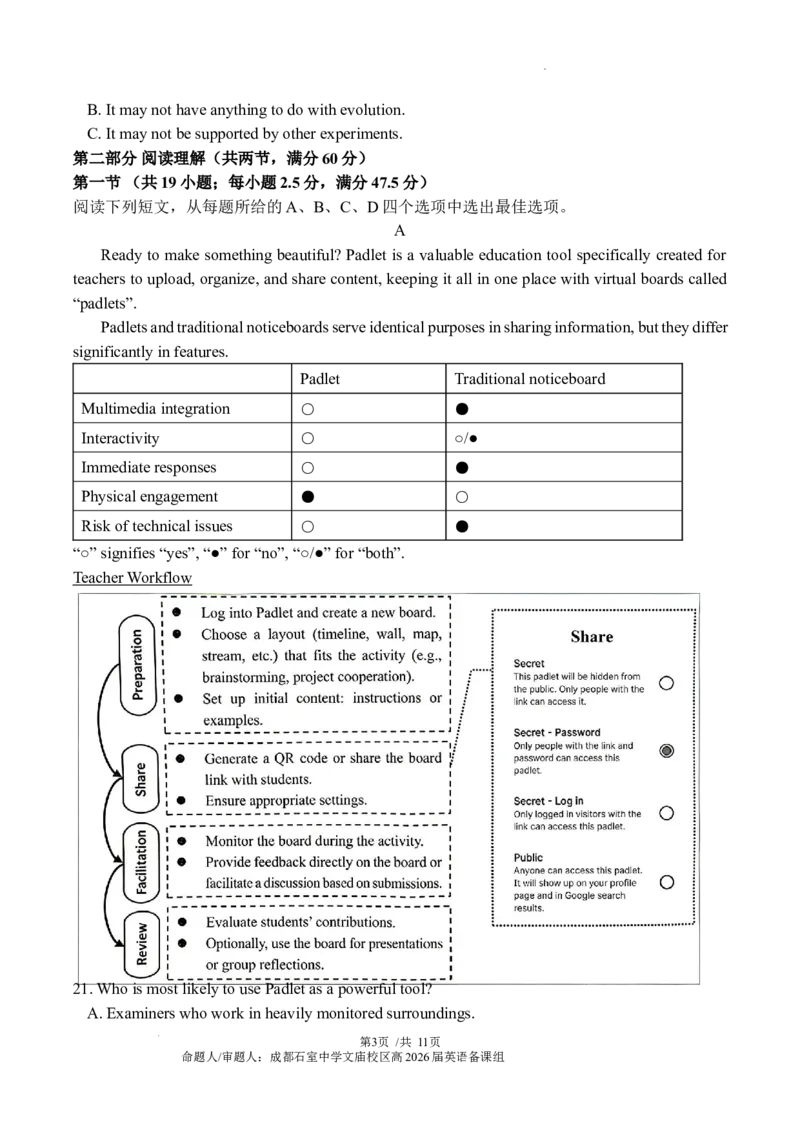
Teacher Workflow
21. Who is most likely to use Padlet as a powerful tool?
A. Examiners who work in heavily monitored surroundings.
第3页 /共 11页
命题人/审题人:成都石室中学文庙校区高2026届英语备课组
学科网(北京)股份有限公司B. Beginners whose work calls for deep, uninterrupted focus.
C. Students who prefer hands-on interaction with information.
D. Learners engaging with audio, videos and interactive tasks.
22. At the beginning of the class, several students are unable to access the Padlet. What could be the
possible cause?
A. Users are logged out when Padlet is overloaded.
B. Monitors block their access due to how contributions.
C. Students enter incorrect passwords for the link in class.
D. Evaluations are set to be invisible for privacy reasons.
23. Based on the teacher workflow, in what order do learners respond to the creation of the Padlet?
Click the “+” button or double-click on the Sign up and join the board through the
board to add a post as instructed. shared link or QR code.
① ②
Polish your submissions based on reviews. Comment on others’ posts to share ideas,
Organize entries if necessary. give feedback, or ask questions.
③ ④
A. B. C. D.
B
②①④③ ①②④③ ②①③④ ①②③④
At my first lesson in Chinese calligraphy, my teacher told me plainly: “Now I will teach you how
to write your name. And to make it beautiful.” I felt my breath catch. I was curious.
Growing up in Singapore, I had an unusual relationship with my Chinese name. My parents are
ethnically Chinese, so they asked fortune tellers to decide my name, aiming for maximum luck. As a
result, I ended up with a nonsense and embarrassing name: Chen Yiwen, meaning, roughly, “old”,
“barley (薏米)” and “warm”.
When I arrived in America for college at 18, I put on an American accent and abandoned my
Chinese name. When I moved to Hong Kong in 2021, after 14 years in the States, I decided to learn
calligraphy. Why not get back in touch with my heritage? I thought.
In calligraphy, the idea is to copy the old masters’ techniques, thereby refining your own. Every
week, though, my teacher would give uncomfortably on-the-nose assessments of my person. “You
need to be braver,” he once observed. “Have confidence. Try to produce a bold stroke(笔画).” For
years, I had prided myself on presenting an image of confidence, but my writing betrayed me.
I was trying to make sense of this practice. You must visualize the word as it is to be written and
leave a trace of yourself in it. As a bodily practice, calligraphy could go beyond its own cultural
restrictions. Could it help me go beyond mine? My teacher once said to me, “When you look at the
word, you see the body. Though a word on the page is two-dimensional, it contains multitudes,
conveying the force you’ve applied, the energy of your grip, the arch of your spine.” I had been learning
calligraphy to get in touch with my cultural roots, but what I was really seeking was a return to myself.
Now I have sensed that the pleasure out of calligraphy allows me to know myself more fully.
During a recent lesson, my teacher pointed at the word I had just finished, telling me: “This word
is much better. I can see the choices you made, your calculations, your flow. Trust yourself. This word
第4页 /共 11页
命题人/审题人:成都石室中学文庙校区高2026届英语备课组
学科网(北京)股份有限公司is yours.” He might as well have said, “This word is you.”
24. What did the author initially think of her name “Chen Yiwen”?
A. It was lucky so she gladly accepted it.
B. She understood the intention but disliked it.
C. She felt proud of its symbolic meaning.
D. Its strange pronunciation made her embarrassed.
25. Why did the author decide to learn calligraphy?
A. To pick up a new hobby.
B. To fit in with local community.
C. To gain insights into a new culture.
D. To reconnect with her origin.
26. What does the author learn about calligraphy from the teacher’s words?
A. It facilitates understanding oneself.
B. It comes from creative energy.
C. It reflects the creator’s spirits.
D. It depends on continuous practice.
27. What does the author intend to tell us?
A. We are the sum of what we create. B. Find beauty from your inner self.
C. Appreciate what our culture offers. D. A great teacher leads you to truth.
C
As we enter a period of profound economic uncertainty, presaged (预示) by recent high-profile
layoffs and a culture of “quiet quitting”, thinking about the future of work might well seem a daunting 令(
人生畏的) prospect.
Indeed, an ever-increasing digital skills gap threatens to stop businesses adopting the game-
changing technologies that will help to power growth in the months and years ahead. For instance,
with each exciting new technology comes a growing concern about whether we have a digitally savvy 精(
明的) workforce ready to take advantage of it. After all, keeping the workforce up to speed with the
latest advances is a key element of the digital transformation process, which will prove essential if we
hope to improve business productivity and efficiency alongside our efforts to achieve sustained
growth.
Likewise, at the World Economic Forum’s annual meeting in Davos, the cybersecurity skills gap
was named as one particular area of concern. There’s good reason for this focus: if businesses can’t
protect themselves against external threats, they risk going backwards. And that’s before they even
start thinking about achieving growth. This is why we need to address the digital skills gap urgently.
Well, we should start by changing the narrative to help us recruit and retain from a more diverse
pool of talent, giving businesses a far better chance of finding the up-to-date digital skills they need.
And, when it comes to engaging and empowering the current workforce, learning and development
opportunities will be key, helping employees to improve their skills for the benefit of both themselves
第5页 /共 11页
命题人/审题人:成都石室中学文庙校区高2026届英语备课组
学科网(北京)股份有限公司and their employers.
To make this all happen, leaders and employers must demonstrate a commitment to teaching their
workforces digital skills by setting clear expectations and providing all the resources required. One
approach, for example, would be to focus on the potential in the existing talent pool by identifying
those already skilled in digital capabilities and supporting them to upskill their colleagues. Creating a
culture of learning, with an emphasis on personal growth, can be an impressive motivator in the
workplace.
Of course, it’s all well and good saying that digital skills are vital, but a workforce with purely
hard skills will not future-proof a business. There’s a need for soft skills that support the broader goal,
so as not to neglect the other competencies required in a digital transformation: communication, critical
thinking, creative design skills, and leadership. To exploit the technology to its full potential, such
qualities are equally important.
Fundamentally, getting the interaction right between humans and technology will be paramount if
businesses are to succeed. As a result, human skills must not be underestimated. Every business will
need a range of people with a variety of skills — not only those well-versed in math, engineering, and
science, but also those with creative minds and leadership qualities.
28. What is the writer’s main concern in the digital transformation process?
A. The threats from technology.
B. The shortage of experienced workers.
C. The culture of quiet quitting.
D. The challenge of upskilling workforces.
29. What can be learnt from paragraph 4 and 5?
A. Employers should develop a learning culture inside their workforces.
B. High requirements of recruitment ensure a sound workforce.
C. Replacing current workforces with digital talents is the key.
D. Business leaders should focus on the training of the existing talent pool.
30. What does the underlined word “paramount” in the last paragraph probably mean?
A. Challenging. B. Inspiring.
C. Crucial. D. Beneficial.
31. What might be the writing purpose of the passage?
A. To advocate the necessity of improving digital skills.
B. To stress the importance of combining hard skills with soft skills.
C. To draw people’s attention to the ever-increasing digital skills gap.
D. To warn humans of the potential problems with technology.
D
Have you ever noticed people around you who always seem to be “creating drama”? John always
turns minor workplace disagreements into intense conflicts, describing them as if they were plot twists
in a horror movie. Emily on social media carefully selects every photo to present her life as a series of
第6页 /共 11页
命题人/审题人:成都石室中学文庙校区高2026届英语备课组
学科网(北京)股份有限公司idealized moments, each post framed as an essential scene in her personal story. Or consider Mark,
who often expects special treatment in group settings and reacts with visible disappointment when he
isn’t given priority. In doing so, they often struggle to genuinely understand or empathize with the
experiences of those around them. Such behavior is characteristic of what is commonly referred to as
“main character syndrome (综合征).”
What causes this syndrome? Cultural and media influences, such as movies, books and TV shows
centered on a single character, shape people’s perception of their own life roles. Social media platforms
like Instagram, Facebook and TikTok further facilitate this tendency by rewarding self-presentation
and attention-seeking behaviors. Additionally, personalities like narcissistic (自恋的) tendencies or
emotional struggles such as insecurity and low self-esteem, as well as self-focused family upbringing,
can increase the likelihood of developing such a mindset.
This mindset is not entirely negative, as framing oneself as life’s leading role can develop a strong
sense of purpose and motivation, encouraging individuals to pursue their goals with greater confidence
and determination. However, its potential downsides often outweigh these benefits: It breeds more
than enough self-centeredness, weakens interpersonal empathy, and ruins genuine relationships by
reducing others to mere “supporting roles” rather than equals in mutual interactions.
Since main character syndrome is not a formally recognized psychological disorder, there is no
targeted medical treatment for it. Nevertheless, practical approaches can effectively address its
underlying issues: Cognitive behavioral therapy (CBT) helps individuals adjust self-centered
behaviors and address interpersonal relationships; empathy training enhances the ability to understand
and appreciate others’ feelings; mindfulness practices promote a more grounded and less self-focused
perspective; and social skills workshops develop collaborative and empathetic interpersonal
relationships. Together, these practices cultivate balanced self-awareness and fuel meaningful personal
growth.
32. How does the author illustrate the term “main character syndrome”?
A. By giving examples. B. By defining a concept.
C. By quoting an expert. D. By providing statistics.
33. Who is most likely to have the main character syndrome?
A. Students absorbed in social media.
B. Teenagers modelling roles in the movies.
C. People struggling with physical disabilities.
D. Children prioritized by overprotective parents.
34. What is the author’s attitude toward the main character syndrome?
A. Unclear. B. Critical. C. Favorable. D. Dismissive.
35. What can be a suitable title for the passage?
A. Star of Your Own Story?
B. To Focus on Yourself or Others?
C. Acting in the Way You Wish?
第7页 /共 11页
命题人/审题人:成都石室中学文庙校区高2026届英语备课组
学科网(北京)股份有限公司D. Right to Be the Main Character?
第二节(共5小题; 每小题2.5分,满分12.5分)
根据短文内容,从短文后的选项中选出能填入空白处的最佳选项,选项中有两项为多余
选项。请将答案写在答题卷上。
Voice notes are a highly divisive medium of communication. There are those, like me, who enjoy
both leaving and listening to them; and then there are those who dislike them and feel very strongly
about that. 36 A poll found that 62% of Americans have sent voice notes, and about 30%
communicate this way on a regular basis. But even the voice note lovers among us have our limits. All
of us know a voice note bore. And it is time to establish some ground rules.
The first rule: only ever leave voice notes for someone that you are confident likes you. 37
It is also somewhat self-indulgent (我行我素).While a spot of self-indulgence can be healthy, it is
unreasonable to expect someone who dislikes you to indulge you.
Never give complicated instructions in a voice note. 38 If you end up leaving a long voice
note that contains a mixture of key information and other bits, follow it up with a text that gives the
other person the important stuff, so they’re not forced to listen straight away.
39 Leaving a voice note that is under 10 seconds long—unless you are funny or the other
person likes you—is annoying. Type it out instead.
Follow the other person’s cues. If they are responding to your eight-minute specials with one-
minute voice messages, take the hint. Also, if your message is longer than about four minutes, you
should be open to the possibility that the other person is going to take a long time to listen and respond.
If your message is upwards of 10 minutes, they might never listen to it. 40 .
All you need do, really, is remember to use a bit of common sense. Modern innovations need not
negate good old-fashioned manners.
A. Be at peace with that.
B. Be responsive and informative.
C. You need not keep your messages too short.
D. It seems the haters are losing the battle, though.
E. A voice note is a demand on someone else’s time.
F. It suggests limiting voice notes to less than two minutes.
G. These should be typed out so the other person can refer back.
第三部分 语言运用(共两节,满分30分)
第一节 完形填空(共15小题,每小题1分,满分15分)
George White, 77, may look like an ordinary grandfather at a family reunion—until you learn he
calls 200 people his “children.” “They’re not biologically my kids, but 41 they surely are,” White
told the local news outlet.
That is how 42 he became and still is to the students who 43 his school bus, a job he held
第8页 /共 11页
命题人/审题人:成都石室中学文庙校区高2026届英语备课组
学科网(北京)股份有限公司for 27 years before he retired. Yet, driving a bus was never his 44 plan. In 1990, he fell off a roof
while working outdoors. After that, he intended to 45 a job closer to the ground. However, he said
no job has ever 46 him higher. “It’s the children,” White said. “And being in a position where you
can love kids every single day is a 47 position to be in.”
The positive feeling was 48 by so many of the kids on his bus over the years. One of his former
students, Kaitlyn Hare, cited that he just made everybody feel safe, loved and cared for. It is a 49 so
strong that even though George retired years ago, former students 50 recently for one last ride.
“They’re finding their 51 that they had 20 years ago,” White said. “And now even their children
are sitting on their laps. And that kind of feeling is a wonderful thing.”
What was White’s secret to developing this 52 ? “He only had two 53 on the bus,” another
former student, Louis Castello, said. “Show everyone love, and show respect.” It’s a lesson many of
them now 54 with them.
“I’m convinced that when you love and respect people, that’s what you’re going to get back.”
White said. That is how one man’s unexpected path became 200 lives’ 55 .
41. A. personally B. emotionally C. mentally D. socially
42. A. exposed B. committed C. attached D. accustomed
43. A. drove B. missed C. repaired D. rode
44. A. realistic B. original C. alternative D. previous
45. A. offer B. perform C. seek D. quit
46. A. held B. pushed C. promoted D. lifted
47. A. lovely B. tricky C. suitable D. challenging
48. A. returned B. inspired C. judged D. hidden
49. A. symbol B. character C. bond D. tone
50. A. graduated B. gathered C. communicated D. developed
51. A. seats B. wallets C. puzzles D. jobs
52. A. strategy B. skill C. affection D. curiosity
53. A. bans B. options C. records D. rules
54. A. turn to B. carry through C. keep up D. search for
55. A. career B. dream C. position D. compass
第二节 语法填空(共10小题,每小题1.5分,满分15分)
A Journey Back to Each Other
Inspired by my daughter’s tales of backpacking adventures and my desire to hang out with my
youngest son outside the house, I booked two tickets to Shanghai for the September school holidays,
surprising us both. We, 5 6 (arm) with a budget, some travel insurance, and a rough plan built
around some last-minute internet searches, headed to the airport.
We arrived in Shanghai, sleepy and excited, at 5: 30 a.m. Despite the early start, the air was
already hot and soupy, 57 my son used as an excuse to head straight for a convenience store and
第9页 /共 11页
命题人/审题人:成都石室中学文庙校区高2026届英语备课组
学科网(北京)股份有限公司buy one of the many drinks he 58 (remember) from all those years before. There is something
very freeing about arriving in a place where you have no plans. And we didn’t.
I discovered that he could find his way 59 remembering landmarks. Within a day he’d
become 60 navigator, and I was the lost one, following behind. As tourists, we were exposed to
everything together, giving us back a connection we don’t always have in our daily lives.
He was the one who said we should hire bikes. He was the one who showed me how to speed up
and led me through the streets downtown, laughing 61 I screamed in delight. He dragged me
shopping for jeans in stores and made me catch buses 62 (take) us in the wrong direction
entirely. He was just as likely as I was 63 (know) what train to catch, or find the right street to
turn down, or stand in awe at the foot of a giant temple, or queue for hours for a steaming bowl of
Xiaolongbao.
I saw him differently in Shanghai. Travelling meant we were more like 64 (equal) —
partners in adventure. And instead of missing the child version of him, I saw the adult he 65
(become).
第四部分 写作 (共两节,满分40分)
第一节 (满分15分)
假定你是李华,你班的英语报要增设一个栏目。外教 Jenny 提出“Fun at my school”和
“Guess who I am”两个选项供大家选择。请给Jenny写一封邮件,内容包括:
(1) 你的选择;
(2) 说明理由。
注意:
(1) 写作词数应为80个左右;
(2) 请按如下格式在答题卡的相应位置作答。
Dear Jenny,
I really like the idea of adding a new column to our English newspaper.
Yours,
Li Hua
第二节(满分25分)
阅读下面材料,根据其内容和所给段落开头语续写两段,使之构成一篇完整的短文。
This was only Amy’s first year at SunRay Tech, yet she already felt like an old hand.
She read market reports on the subway, ate salad at her desk, and even practised her presentation
while brushing her hair. Her small apartment, a thousand miles from home, witnessed all her efforts:
notes, charts and presentation drafts covered the living-room table.
“Amy, you’re on fire!” her manager laughed one Monday. The words kept Amy smiling all
第10页 /共 11页
命题人/审题人:成都石室中学文庙校区高2026届英语备课组
学科网(北京)股份有限公司afternoon. Then a company e-mail arrived:
Amy, congratulations! You are this year’s Outstanding New Employee. Please give an eight-minute
speech at the company’s annual meeting on Sunday morning.
Amy’s heart jumped. She read the message again and again. That night she sat at her desk and
wrote about the coffee that grew cold, the code that finally worked at 2 a.m., and the pride she felt
when her first project helped the team win a new client.
Yet, from time to time, a faint guilt brushed her heart. She remembered her mother’s soft voice in
their last video call: “Don’t work too hard, sweetheart. You’re already great. Come home for a rest.”
Each time Amy whispered to herself, “Next month, Mum — on your birthday.”
She spent the next evenings perfecting every word and gesture. On Saturday evening she felt
ready. Then the phone rang. It was Dad.
“Amy, tomorrow’s your mum’s fiftieth birthday. We’re planning a simple lunch. When are you
coming home?”
Mum’s birthday! How could I forget? Shame washed over Amy. She opened her mouth, but no
words came out. The meeting, the carefully prepared speech and her colleagues’ proud smiles all
suddenly felt heavy in her chest.
“Dad, the company’s annual meeting is also tomorrow... I was supposed to give a speech as the
Outstanding New Employee...” Her voice was tight with conflict.
“Oh, congratulations, sweetie. I understand — it’s a big day. Your mum will be so proud...”
Amy remained frozen for a moment, not knowing how the call ended. Then her eye fell on her
family photo on the desk, with her parents on either side.
注意:
1. 续写词数应为150左右;
2. 请按如下格式在答题卡的相应位置作答。
Seeing the happy smiles on their faces, she knew what she had to do.
With a light heart, Amy booked the earliest flight home.
第11页 /共 11页
命题人/审题人:成都石室中学文庙校区高2026届英语备课组
学科网(北京)股份有限公司