文档文本内容
六级200词带背1-学术
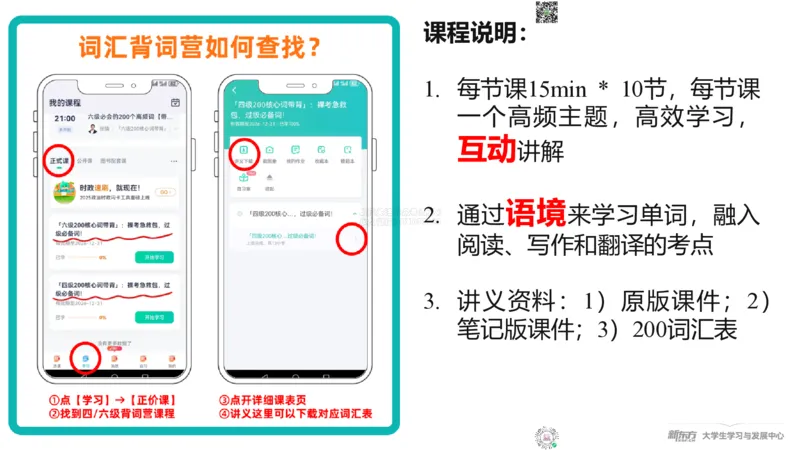
主讲教师:张 镇课程说明:
1. 每节课15min * 10节,每节课
一个高频主题,高效学习,
互动
讲解
语境
2. 通过 来学习单词,融入
阅读、写作和翻译的考点
3. 讲义资料:1)原版课件;2)
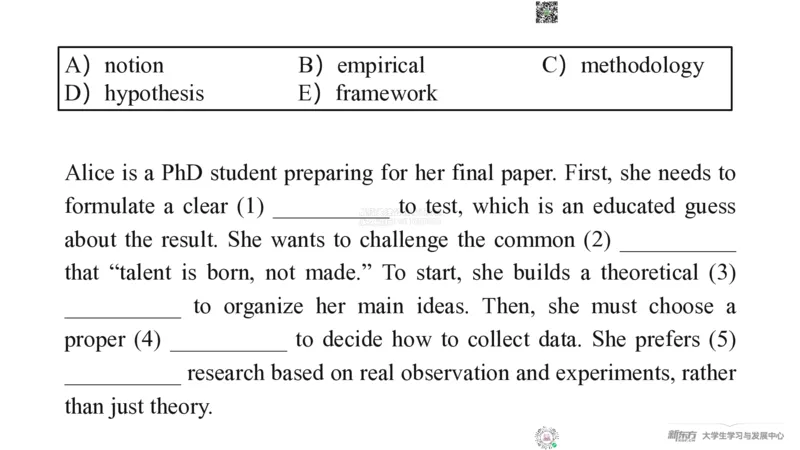
笔记版课件;3)200词汇表A)notion B)empirical C)methodology
D)hypothesis E)framework
Alice is a PhD student preparing for her final paper. First, she needs to
formulate a clear (1) __________ to test, which is an educated guess
about the result. She wants to challenge the common (2) __________
that “talent is born, not made.” To start, she builds a theoretical (3)
__________ to organize her main ideas. Then, she must choose a
proper (4) __________ to decide how to collect data. She prefers (5)
__________ research based on real observation and experiments, rather
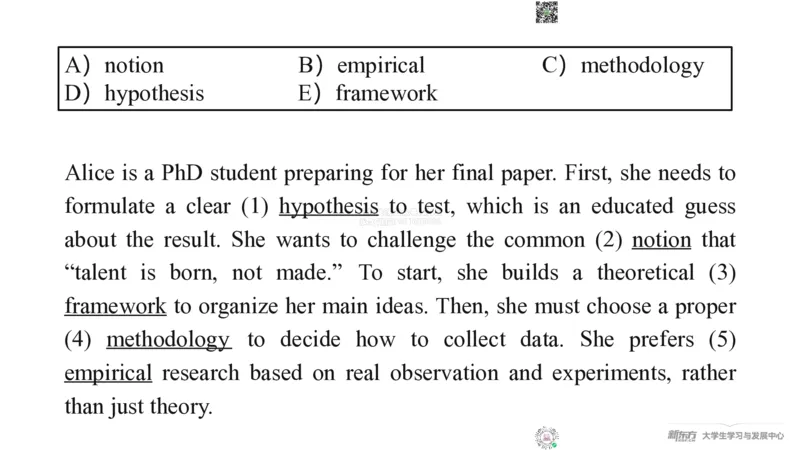
than just theory.A)notion B)empirical C)methodology
D)hypothesis E)framework
Alice is a PhD student preparing for her final paper. First, she needs to
formulate a clear (1) hypothesis to test, which is an educated guess
about the result. She wants to challenge the common (2) notion that
“talent is born, not made.” To start, she builds a theoretical (3)
framework to organize her main ideas. Then, she must choose a proper
(4) methodology to decide how to collect data. She prefers (5)
empirical research based on real observation and experiments, rather
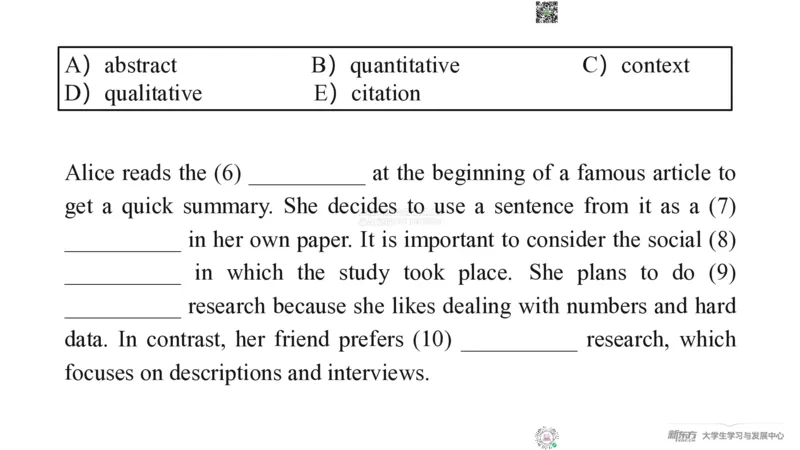
than just theory.A)abstract B)quantitative C)context
D)qualitative E)citation
Alice reads the (6) __________ at the beginning of a famous article to
get a quick summary. She decides to use a sentence from it as a (7)
__________ in her own paper. It is important to consider the social (8)
__________ in which the study took place. She plans to do (9)
__________ research because she likes dealing with numbers and hard
data. In contrast, her friend prefers (10) __________ research, which
focuses on descriptions and interviews.A)abstract B)quantitative C)context
D)qualitative E)citation
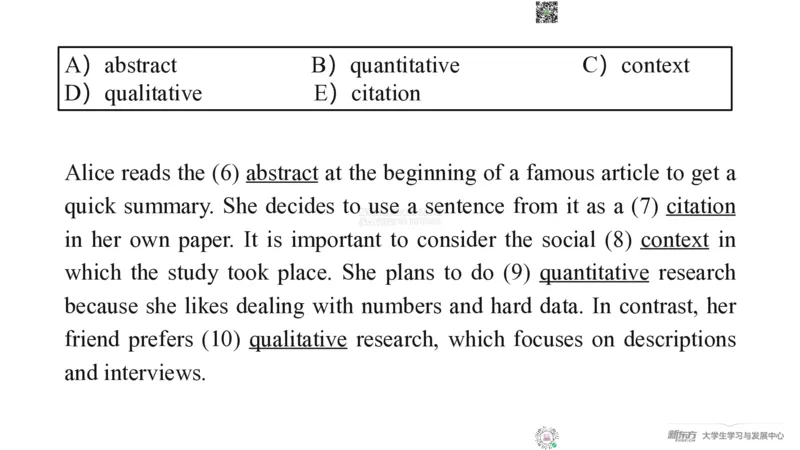
Alice reads the (6) abstract at the beginning of a famous article to get a
quick summary. She decides to use a sentence from it as a (7) citation
in her own paper. It is important to consider the social (8) context in
which the study took place. She plans to do (9) quantitative research
because she likes dealing with numbers and hard data. In contrast, her
friend prefers (10) qualitative research, which focuses on descriptions
and interviews.A)indicator B)reliability C)variable
D)parameter E)validity
Alice identifies one key (11) __________, such as age, that might
change during the test. She looks for a measurable (12) __________ of
success, like exam scores. She also sets a strict (13) __________ to
define the boundaries of her study group. She needs to check the (14)
__________ of her test to ensure it measures what it is supposed to
measure. She also checks the (15) __________ to make sure the results
are consistent every time.A)indicator B)reliability C)variable
D)parameter E)validity
Alice identifies one key (11) variable, such as age, that might change
during the test. She looks for a measurable (12) indicator of success,
like exam scores. She also sets a strict (13) parameter to define the
boundaries of her study group. She needs to check the (14) validity of
her test to ensure it measures what it is supposed to measure. She also
checks the (15) reliability to make sure the results are consistent every
time.A)dimension B)statistic C)interpret
D)deduction E)inference
In the data, she finds a surprising (16) __________, a single number
that changes everything. This adds a new (17) __________ to the
problem that she hadn‘t thought of before. She uses logic and (18)
__________ to move from general rules to specific conclusions. Based
on the evidence, she makes a reasonable (19) __________ about the
cause. Finally, she tries to (20) __________ the meaning of the data in
her conclusion.A)dimension B)statistic C)interpret
D)deduction E)inference
In the data, she finds a surprising (16) statistic, a single number that
changes everything. This adds a new (17) dimension to the problem
that she hadn’t thought of before. She uses logic and (18) deduction to
move from general rules to specific conclusions. Based on the evidence,
she makes a reasonable (19) inference about the cause. Finally, she
tries to (20) interpret the meaning of the data in her conclusion.Thanks