Unit 5 What a Delicious Meal !
课时 3 Section A (3a-3d) 分层作业
核心知识速记
01 基础达标 03 拓展培优
02 能力提升 04 思维进阶
词汇
1.mess /mes/ n.脏乱;凌乱
2.pretty /'priti/adj. 漂亮的;美丽的 ; adv.相当;十分;非常
3.Christmas/'krisməs/n.圣诞节
4.pancake /'pankerk/n.烙饼;薄饼
5.dream/dri:m/n.梦想;梦; v.(dreamt /dremt/或dreamed) 做梦;梦见;梦想
6.university/jiu.nV3:sati/n.(综合性)大学;高等学府
句型
感叹句:What an amazing smell (it is)!
What luck(we have)!
What a mess(it is)!
How delicious the dish looks!
How clever you are!
How wonderful life is!
一、单词默写。
1.____________ n.脏乱;凌乱
2.____________adj. 漂亮的;美丽的 ; adv.相当;十分;非常
3.____________n.圣诞节
4.____________n.烙饼;薄饼
5.____________n.梦想;梦; v.(____________或____________) 做梦;梦见;梦想
6.____________n.(综合性)大学;高等学府
二、词组默写。1.去划船__________________
三、用 how 、what或 what a(n)填空
1. interesting book you are reading!
2 good advice you gave me!
3. hard work it is!
4. heavily it is raining!
5. delicious the food you made is!
四 、完形填空
“Nancy, try cooking for us today,” my mother called. “But I don’t know how to 1 ,” I said. “Today your
father and I will 2 you to cook,” said my mother. I didn’t know 3 it would go, but I agreed.
I saw my mother cook rice before, so I did it easily. 4 when I planned to cook vegetables, I didn’t know
how to do it. My father asked me to 5 one cabbage and make other ingredients 6 . “Now put some garlic (大
蒜) into the pot. Then, 7 some turmeric (姜黄根粉) and put the cabbage. Don’t 8 to add some salt,” my
father said. He stood next to me and told me what I should do. 9 finishing the cabbage, I cooked beef soup.
10 , I finished cooking the meal almost two hours later. I 11 the food to my parents. They ate it and said it
was 12 . At last, it was 13 turn to eat the food. However, I thought it was terrible.
From that day on, I learnt to cook. Although my first cooking was so terrible, it taught me a great 14 . I
started respecting (尊重) the meals my parents cooked for me, as I learnt that it was not 15 to cook meals.
1.A.wash B.cook C.sing D.drive
2.A.choose B.encourage C.expect D.teach
3.A.what B.how C.which D.when
4.A.Because B.So C.But D.If
5.A.add to B.cut up C.pour into D.take away
6.A.ready B.funny C.lucky D.healthy
7.A.fall B.cover C.pick D.add
8.A.agree B.plan C.leave D.forget
9.A.Through B.After C.From D.Before
10.A.Quickly B.Loudly C.Finally D.Quietly
11.A.served B.turned C.filled D.shared
12.A.comfortable B.fresh C.hard D.wonderful
13.A.my B.his C.our D.their14.A.program B.reason C.hobby D.lesson
15.A.difficult B.easy C.similar D.common
五、任务型阅读
阅读下面短文,完成短文后的问题。
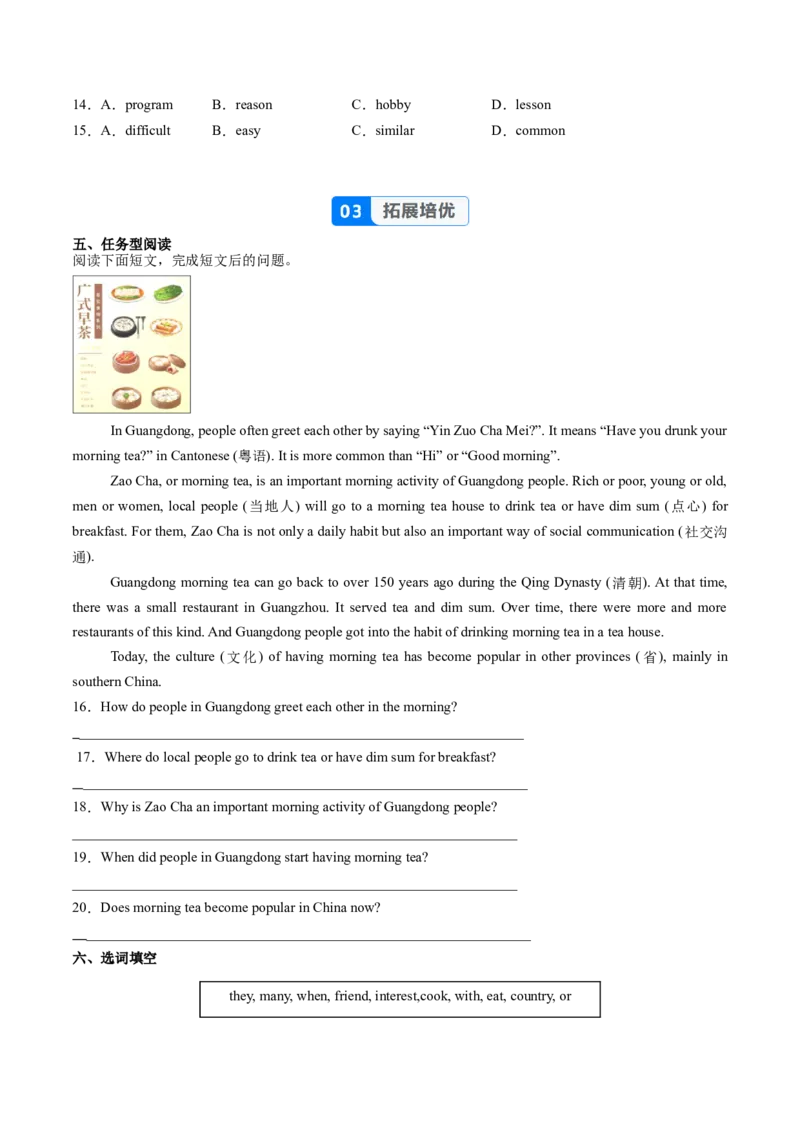
In Guangdong, people often greet each other by saying “Yin Zuo Cha Mei?”. It means “Have you drunk your
morning tea?” in Cantonese (粤语). It is more common than “Hi” or “Good morning”.
Zao Cha, or morning tea, is an important morning activity of Guangdong people. Rich or poor, young or old,
men or women, local people (当地人) will go to a morning tea house to drink tea or have dim sum (点心) for
breakfast. For them, Zao Cha is not only a daily habit but also an important way of social communication (社交沟
通).
Guangdong morning tea can go back to over 150 years ago during the Qing Dynasty (清朝). At that time,
there was a small restaurant in Guangzhou. It served tea and dim sum. Over time, there were more and more
restaurants of this kind. And Guangdong people got into the habit of drinking morning tea in a tea house.
Today, the culture (文化) of having morning tea has become popular in other provinces (省), mainly in
southern China.
16.How do people in Guangdong greet each other in the morning?
_______________________________________________________________
17.Where do local people go to drink tea or have dim sum for breakfast?
_______________________________________________________________
18.Why is Zao Cha an important morning activity of Guangdong people?
_______________________________________________________________
19.When did people in Guangdong start having morning tea?
_______________________________________________________________
20.Does morning tea become popular in China now?
_______________________________________________________________
六、选词填空
they, many, when, friend, interest,cook, with, eat, country, orHot pot is a kind of traditional food in China. It has a long history of 21 than 1,700 years. You can eat it
at home 22 in a restaurant. It’s great for you to spend time with 23 sitting around the hot pot. You can
24 , chat and have fun together.
25 food in the hot pot is very easy. You can put different foods into the hot pot, like meat and
vegetables. 26 it is ready, you can take the food out of the pot into the bowl. After that, you can eat it 27
all kinds of sauces (酱汁).
Many Chinese like eating hot pot in winter to make 28 warm. But some also enjoy eating it in summer.
People in Sichuan are very 29 in spicy (辣的) hot pot because eating spicy food is good for their health.
Today, hot pot is also popular among people from other 30 . They come to China to try the wonderful
food.
七、阅读理解
A
Whether yellow, red or white, the onion is a vegetable that you may not know well. The list of its uses in
cooking is endless. People have used onions to add flavor (味道) to their foods for thousands of years. Besides
onions’ great taste, they are very good for you. They have special chemicals that improve your ability to fight off
illness and you have fewer chances of getting ill.
No matter how good onions are for you, it is difficult to cut an onion without your eyes filling with tears!
When you cut an onion, irritating chemicals inside the onion will get into the air. They touch your whole eyes and
cause pain. Your eyes make tears to wash away the chemicals and protect your eyes.
Luckily, cooks and scientists have discovered some ways to keep you from crying when you cut up onions.
●Cut the onion under running water. The water will wash away the chemicals before they can reach your
eyes.
●Use a fan to blow air over the onion as you cut it. The air will blow the chemicals away from your eyes.
●Put the onion in a fridge for an hour before cutting. This helps make the chemicals in the onion move
slowly, so they may not ever reach your eyes.
If you try out these good ideas and still cry while cutting onions, don’t worry. Scientists think that if you cut
more onions, your body will become more resilient to the onion’s chemicals. So the tears will not last long. If you
think about how healthy onions are, you might even call those tears “happy tears”.
31.Why can onions help you fight off illness?
A.Because they have different colours. B.Because they have many uses in cooking.
C.Because they have a great taste. D.Because they have special chemicals.
32.Why do your eyes make tears when you cut onions?A.To improve physical condition. B.To stop common diseases.
C.To wash away irritating chemicals. D.To cause terrible pain.
33.What can you do to stop crying according to the text?
① Cut the onion under running water. ② Use a fan to blow air over the onion while cutting.
③ Cover the onion with a piece of cloth as you cut it. ④ Put the onion in a fridge for an hour before cutting.
A.①②③ B.①②④ C.①③④ D.②③④
34.What does the underlined word “resilient” in the last paragraph mean?
A.Tired. B.Weak. C.Sad. D.Strong.
35.In which part of a magazine can you probably read the text?
A.Life and health. B.Language and culture.
C.The business world. D.National news.
B
Should you eat to live or live to eat? This is a question asked by a French playwright Moliere in his work The
Miser. Eating is necessary, and our bodies need energy, and dining with friends or loved ones is a wonderful
experience. However, some of us often find oneself reserving a table for one in a restaurant. But is dining alone
really that bad? Maybe not.
We all have foods we like and dislike. Maybe it’s a piece of smelly cheese or fish. We sometimes hold back
on things that may cause others to cover the noses. When dining alone, we can eat whatever we like, with the added
good that we might eat more healthily. Often, if you want a salad and your partner wants some less healthy food,
you end up ordering the same. And if you don’t get the same, you might end up with “food envy (忌妒)” as
someone enjoys a pizza while you’re left holding the vegetables.
Have you ever spent too long discussing with people which restaurant to eat in or when to meet? If dining
alone, you can make the choice depending on your own desires and take your food in at exactly the time you’re
hungry! And why does it have to be a restaurant? You could eat in a park, garden or even your bed—the point is,
the choice is yours! That lonely time also means it’s a time to turn off. According to the psychologist Sherrie Bourg
Carter, staying alone can relax your brain and help you concentrate more.
36.Why is Moliere referred to in Paragraph One?
A.To lead in the main topic. B.To attract the readers' interest.
C.To show his wonderful writing. D.To describe the famous writer's opinion.
37.Your partner wants some less healthy food. You are likely to ______.
A.eat more healthily B.cover your nose with hands
C.take the same order D.end up with unhappiness
38.What is the main idea of Paragraph Three?
A.Dining alone can save time and relax ourselves. B.Debating where to eat is a waste of time.
C.Staying alone can improve our concentration. D.Making your own choice is important.
39.How does the author possibly feel about eating alone?A.Unwise. B.Popular. C.Boring. D.Acceptable.