Unit 12 Life is full of the unexpected.
重要知识点清单
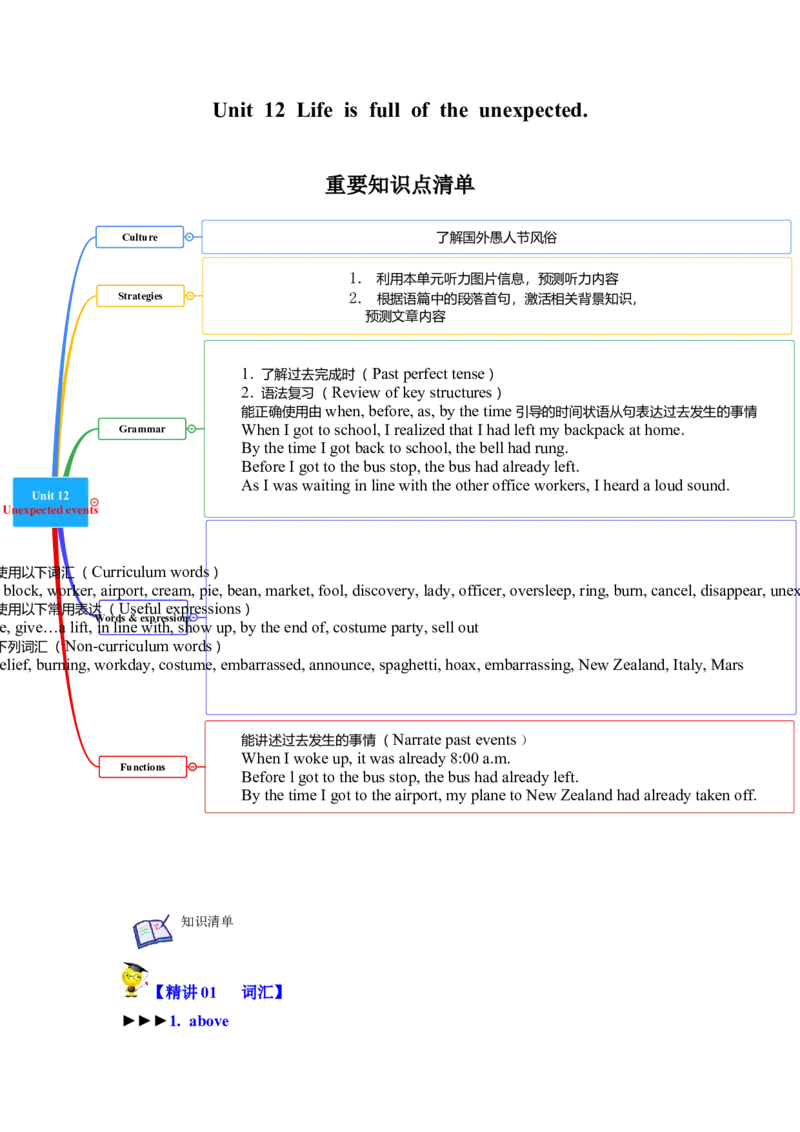
Culture 了解国外愚人节风俗
1. 利用本单元听力图片信息,预测听力内容
Strategies 2. 根据语篇中的段落首句,激活相关背景知识,
预测文章内容
1. 了解过去完成时(Past perfect tense)
2. 语法复习(Review of key structures)
能正确使用由when, before, as, by the time引导的时间状语从句表达过去发生的事情
Grammar When I got to school, I realized that I had left my backpack at home.
By the time I got back to school, the bell had rung.
Before I got to the bus stop, the bus had already left.
As I was waiting in line with the other office workers, I heard a loud sound.
Unit 12
Unexpected events
1. 能正确使用以下词汇(Curriculum words)
backpack, block, worker, airport, cream, pie, bean, market, fool, discovery, lady, officer, oversleep, ring, burn, cancel, disappear, unexpected, alive, believable, above, till, west
2. 能正确使用以下常用表达(Useful expressions)
Words & expressions
by the time, give…a lift, in line with, show up, by the end of, costume party, sell out
3. 能认读下列词汇(Non-curriculum words)
stare, disbelief, burning, workday, costume, embarrassed, announce, spaghetti, hoax, embarrassing, New Zealand, Italy, Mars
能讲述过去发生的事情(Narrate past events)
When I woke up, it was already 8:00 a.m.
Functions
Before l got to the bus stop, the bus had already left.
By the time I got to the airport, my plane to New Zealand had already taken off.
知识清单
【精讲01 词汇】
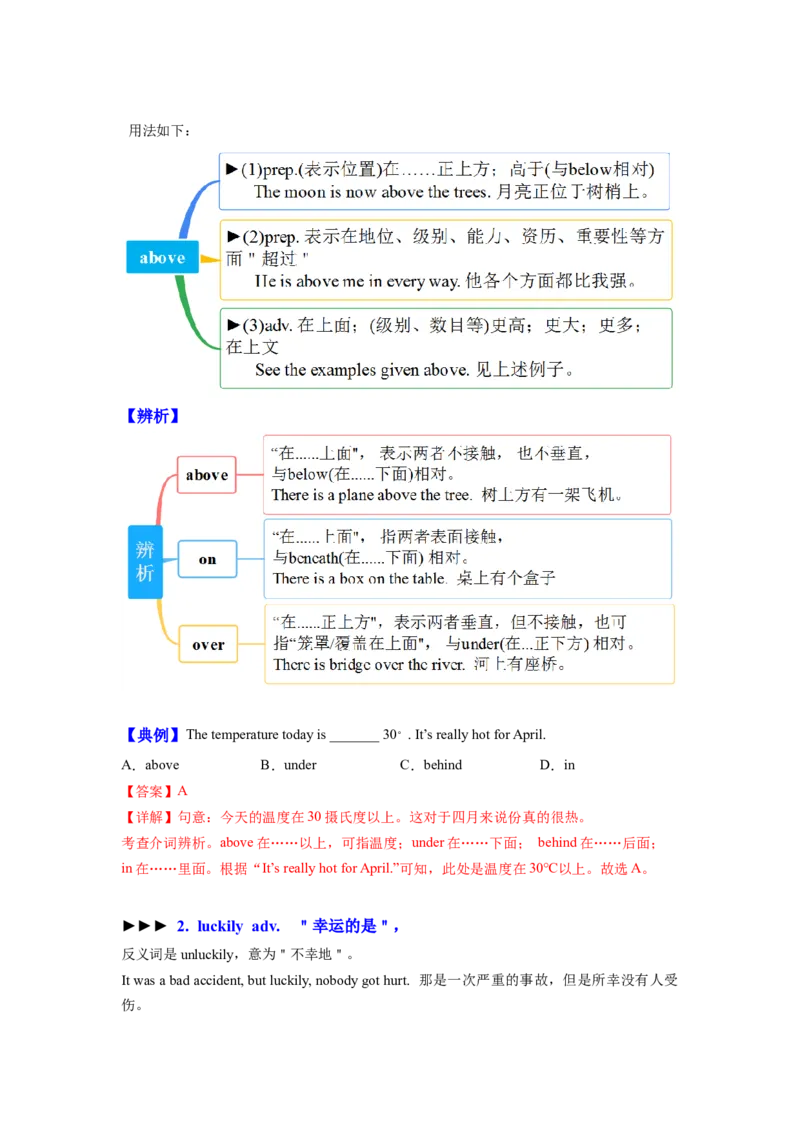
►►►1. above用法如下:
【辨析】
【典例】The temperature today is _______ 30。. It’s really hot for April.
A.above B.under C.behind D.in
【答案】A
【详解】句意:今天的温度在30摄氏度以上。这对于四月来说份真的很热。
考查介词辨析。above在……以上,可指温度;under在……下面; behind在……后面;
in在……里面。根据“It’s really hot for April.”可知,此处是温度在30℃以上。故选A。
►►► 2. luckily adv. "幸运的是",
反义词是unluckily,意为"不幸地"。
It was a bad accident, but luckily, nobody got hurt. 那是一次严重的事故,但是所幸没有人受
伤。Unluckily, I missed the last bus. 不幸的是,我错过了最后一班公交车。
【拓展】
(1) lucky adj."幸运的",既可以作表语,也可以作定语,unlucky"不幸的"。
Some people think thirteen is an unlucky number.有些人认为十三是个不幸运的数字。
(2) luck n."运气"。
good luck表示"好运",用于祝福某人。
bad luck表示"真糟糕,运气不好"。
Good luck to you. 祝你好运。
►►► 3.miss
miss作及物动词,意为“错过; 未赶上".
后接名词、代词或动词-ing形式, miss doing sth.意为“错过做某事",
例:We missed the bus. 我们没赶上公共汽车。
I missed taking part in the sports meeting. 我错过参加那次运动会了。
►►► 4. as
as是连词,意为“当……时候”,引导时间状语从句,强调两个动作同时发生;或某事发
生的过程中另一件事发生;或某事一发生,另一件事立即发生。例如:
We walked into the garden as the music stopped. 音乐声一停,我们就走进了花园。
【拓展】
as的用法颇多,现将所学的其他用法归纳如下:
(1) as作连词:
1) “像……一样、如……”,常用于比较状语从句或方式状语从句。例如:
I can’t run as fast as I used to. 我跑得不如过去那样快。
You must do everything as I do. 你必须按照我做的那样去做每件事。
2) “因为,既然”,引导原因状语从句。例如:
As we are both tired, let’s stop to have a rest.
既然我们都累了,让我们停下来休息会吧。
3) “正如,照……方法”,常引导非限制性定语从句。例如:
As we all know, the earth travels around the sun. 众所周知,地球绕着太阳转。
(2) as作介词,意为“好像;作为、当作”。例如:
I work in Beijing as a guider 我在北京当导游。
【典例】As I ________ in line, I heard a loud noise from that building which is two blocks away.
A.wait B.waited C.was waiting D.waiting
【答案】C
【详解】句意:当我正在排队时,我听到两个街区外的那栋大楼里传来很大的噪音。考查时间状语从句。听到噪音的动作发生的时候,排队的动作正在进行,heard是一般过去
时,因此从句用过去进行时。故选C。
►►► 5. stare
stare at意为“凝视",为固定短语。
例: What are you staring at? 你在看什么?
I stared at the paper in front of me. 我盯着面前的那张纸。
例:We stared at her in disbelief. 我们疑惑地盯着她。
【典例】Don’t stare others in this way. It’s impolite!
A.of B.with C.at D.for
【答案】C
【详解】句意:不要用这种方式盯着别人看。那是不礼貌的。
考查介词辨析。of……的;with和……一起;at在具体时刻或小地点;for为了,因为。该
空与空前的stare为固定搭配,stare at…意为“盯着看,凝视”。故选C。
►►► 6. disbelief
disbelief不可数名词,意为“不相信;怀疑",
常用短语in disbelief,意为“怀疑地;难以置信地”通常在句中作状语。
He listened in disbelief to that surprising story.
他满腹怀疑地听着那个令人惊奇的故事。
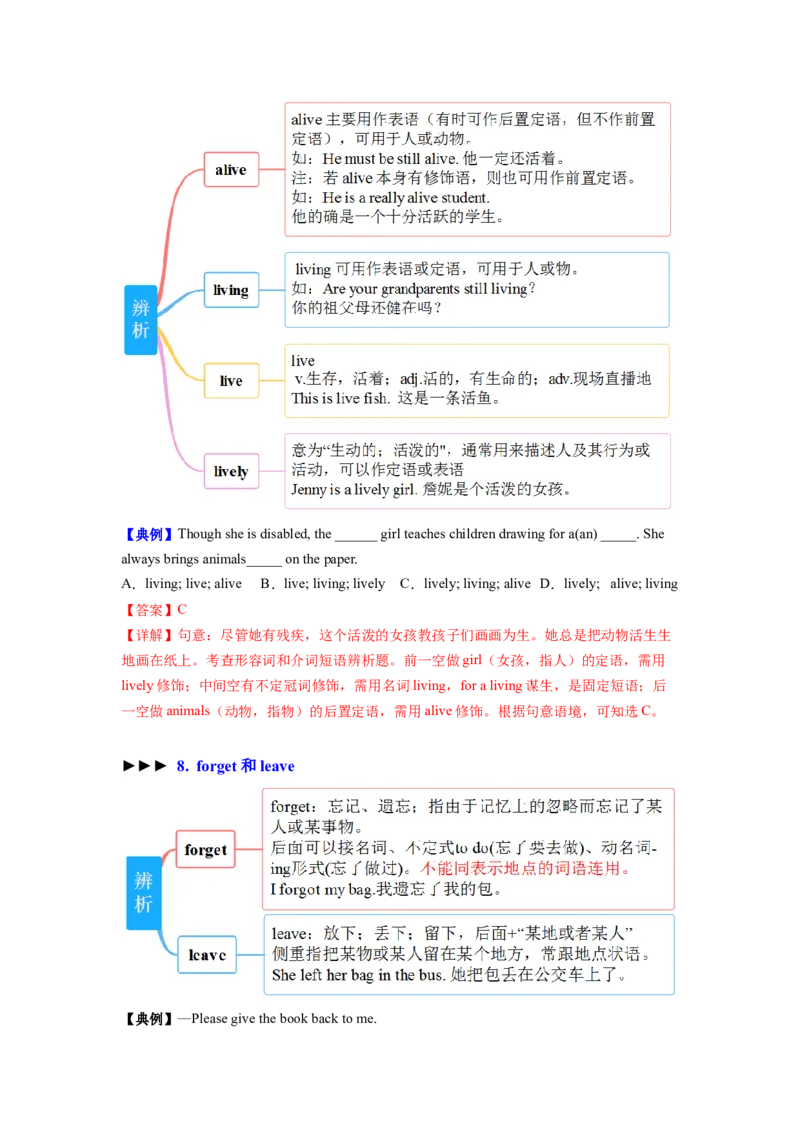
►►► 7. alive
alive是形容词,意为"活着的;有生气的"。反义词是 dead,多用于人或动植物,只作表
语。
He wanted to keep the fish alive. 他想让鱼活着。
【辨析】alive,live,living,lively【典例】Though she is disabled, the ______ girl teaches children drawing for a(an) _____. She
always brings animals_____ on the paper.
A.living; live; alive B.live; living; lively C.lively; living; alive D.lively; alive; living
【答案】C
【详解】句意:尽管她有残疾,这个活泼的女孩教孩子们画画为生。她总是把动物活生生
地画在纸上。考查形容词和介词短语辨析题。前一空做girl(女孩,指人)的定语,需用
lively修饰;中间空有不定冠词修饰,需用名词living,for a living谋生,是固定短语;后
一空做animals(动物,指物)的后置定语,需用alive修饰。根据句意语境,可知选C。
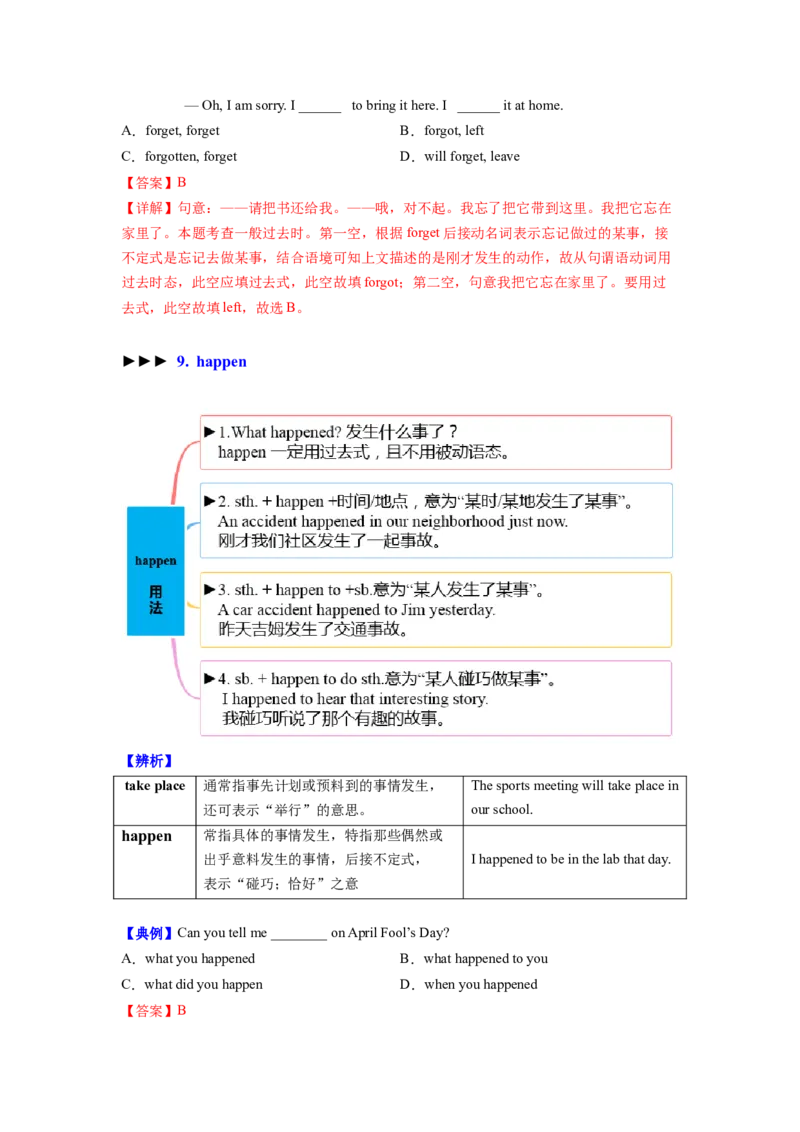
►►► 8. forget和leave
【典例】—Please give the book back to me.— Oh, I am sorry. I ______ to bring it here. I ______ it at home.
A.forget, forget B.forgot, left
C.forgotten, forget D.will forget, leave
【答案】B
【详解】句意:——请把书还给我。——哦,对不起。我忘了把它带到这里。我把它忘在
家里了。本题考查一般过去时。第一空,根据forget后接动名词表示忘记做过的某事,接
不定式是忘记去做某事,结合语境可知上文描述的是刚才发生的动作,故从句谓语动词用
过去时态,此空应填过去式,此空故填forgot;第二空,句意我把它忘在家里了。要用过
去式,此空故填left,故选B。
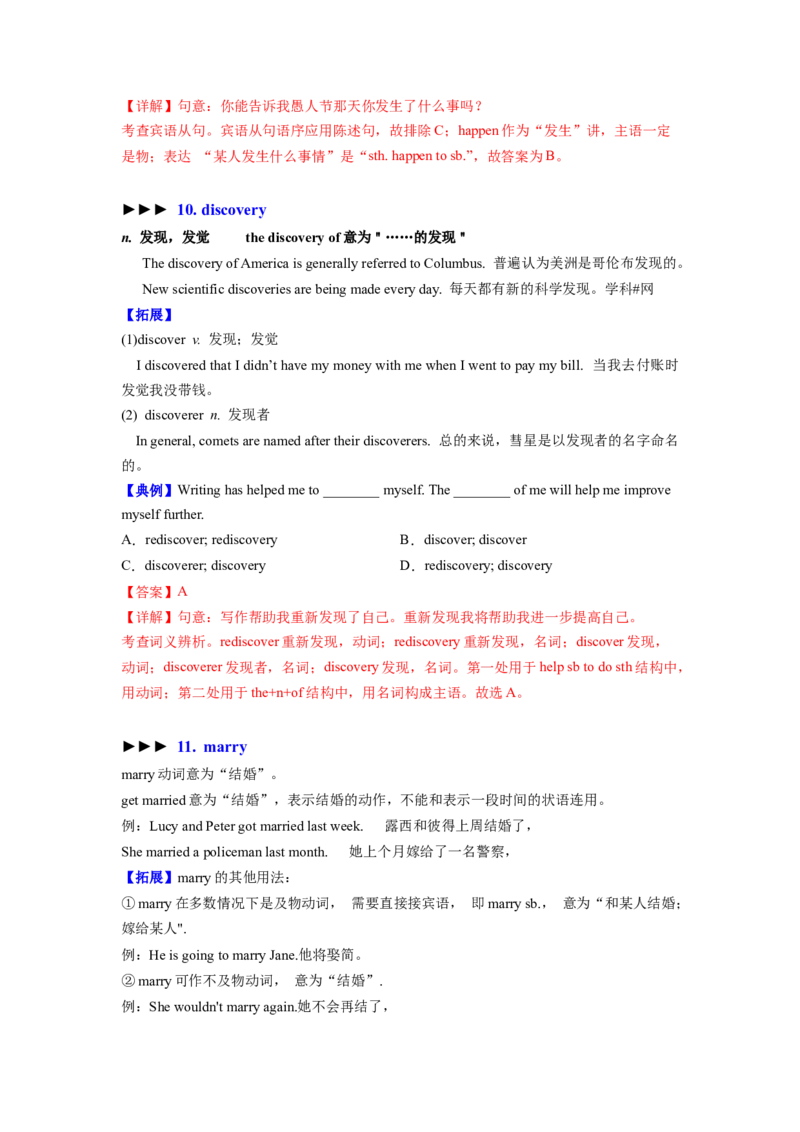
►►► 9. happen
【辨析】
take place 通常指事先计划或预料到的事情发生, The sports meeting will take place in
还可表示“举行”的意思。 our school.
happen 常指具体的事情发生,特指那些偶然或
出乎意料发生的事情,后接不定式, I happened to be in the lab that day.
表示“碰巧;恰好”之意
【典例】Can you tell me ________ on April Fool’s Day?
A.what you happened B.what happened to you
C.what did you happen D.when you happened
【答案】B【详解】句意:你能告诉我愚人节那天你发生了什么事吗?
考查宾语从句。宾语从句语序应用陈述句,故排除C;happen作为“发生”讲,主语一定
是物;表达 “某人发生什么事情”是“sth. happen to sb.”,故答案为B。
►►► 10. discovery
n. 发现,发觉 the discovery of意为"……的发现"
The discovery of America is generally referred to Columbus. 普遍认为美洲是哥伦布发现的。
New scientific discoveries are being made every day. 每天都有新的科学发现。学科#网
【拓展】
(1)discover v. 发现;发觉
I discovered that I didn’t have my money with me when I went to pay my bill. 当我去付账时
发觉我没带钱。
(2) discoverer n. 发现者
In general, comets are named after their discoverers. 总的来说,彗星是以发现者的名字命名
的。
【典例】Writing has helped me to ________ myself. The ________ of me will help me improve
myself further.
A.rediscover; rediscovery B.discover; discover
C.discoverer; discovery D.rediscovery; discovery
【答案】A
【详解】句意:写作帮助我重新发现了自己。重新发现我将帮助我进一步提高自己。
考查词义辨析。rediscover重新发现,动词;rediscovery重新发现,名词;discover发现,
动词;discoverer发现者,名词;discovery发现,名词。第一处用于help sb to do sth结构中,
用动词;第二处用于the+n+of结构中,用名词构成主语。故选A。
►►► 11. marry
marry动词意为“结婚”。
get married意为“结婚”,表示结婚的动作,不能和表示一段时间的状语连用。
例:Lucy and Peter got married last week. 露西和彼得上周结婚了,
She married a policeman last month. 她上个月嫁给了一名警察,
【拓展】marry的其他用法:
①marry在多数情况下是及物动词, 需要直接接宾语, 即marry sb., 意为“和某人结婚;
嫁给某人".
例:He is going to marry Jane.他将娶简。
②marry可作不及物动词, 意为“结婚”.
例:She wouldn't marry again.她不会再结了,③be married(ts.) (不能用with sb.) 表示已婚的状态, 可以和表示一段时间的
状语连用。
例:She has been married to him for five years.她已经嫁给他5年了,
【典例】— How long __________ they __________?
— Sorry, I don’t know. But I know that Peter is going to __________ a nurse next month.
A.did; marry; marry to B.did; get marry; marry with
C.have; got married; marry D.have; been married; marry
【答案】D
【详解】句意:——他们结婚多久了?——对不起,我不知道。但是我知道皮特下个月将
会娶一名护士。
考查动词时态。marry做动词,表示“结婚”,marry sb.表示“嫁/娶某人”;题干第二个
空格指的是皮特先生将要娶一名护士,此处用“be going to+动词原形”表示“将来时”,
故此处应填原形marry。其次how long表示多长时间,常和现在完成时态连用,且谓语动
词应用延续性动词,marry本身是短暂性动词,其对应的延续性动词是be married。故选
D。
►►► 12. fool
fool用作可数名词,意为“蠢人;傻瓜”,复数形式为fools,
常用短语:make fool of...意为“取笑......,捉弄......".
例:I felt such a fool when I realized my mistake.
当我意识到自己的错误时,我才感觉自己真是一个傻瓜。
Are you trying to make fool of me?你想患弄我吗?
fool用作动词,意为“愚弄,欺哄"。
例:Don't be fooled by the salesman. 不要被这个推销员欺骗了。
fool的形容词为foolish,意为“患蠢的,荒谬的"。
例:I was foolish enough to believe what he said.我太愚蠢了,竟然相信他说的话,
【辨析】
foolish “蠢", 着重指缺乏智慧或判断力
silly “傻", 着重指头脑简单、不懂事, 有单纯糊涂的意味
stupid “笨", 着重指生理迟钝, 反应迟钝
例:She was foolish enough to trust him. 她蠢到竟然相信他。
I feel silly in this dress. 穿这件衣服让我显得呆头呆脑。
How could you be so stupid? 你怎么这么笨?
【典例】— The story “Yan Er Dao Ling” is about a thief, right?
— Oh, yes. The thief was foolish and he covered his ears to steal (偷) the bell.
A.not brave B.not right C.not clever【答案】C
【详解】句意:——故事《掩耳盗铃》讲的是关于一个小偷,对吗?——哦,是的。那个
小偷是愚蠢的并且他捂上自己的耳朵盗铃。
考查形容词辨析。brave勇敢的;right正确的;clever聪明的。句中划线单词foolish“愚蠢
的”,即不聪明的。故选C。
【精讲02 短语】
►►►1. by the time “到……时间为止”,
强调时间的截止,引导时间状语从句。By the time+过去的时间,主句一般用过去完成时,
表示在从句谓语动作前已经完成。如:
By the time I got there, the bus had already left. 不晚于我到那里时,公共汽车已经开走了。
(2)当时间状语为by the end of last month/year/week时,主句也用过去完成时。如:
By the end of last month we had learned 20 English songs.
到上一个月我们已经学习了20首英语歌曲。
【典例】________ the end of last term, most students in our school had learnt two foreign
languages.
A.With B.By C.From D.Since
【答案】B
【详解】句意:到上学期末,我们学校的大多数学生都学了两门外语。
考查介词辨析。With和;By到……为止;From从;Since自从。根据“the end of last term”
结合时态是过去完成时可知,此处是固定短语by the end of“到……结束时”,故选B。
►►►2. give sb.a lift "捎某人一程"
相当于give sb. a ride。
They gave me a lift on the way home. =They gave me a ride on the way home.
回家的路上他们捎了我一程。
【典例】—You look worried.
—Yes, I’ll be late, could you give me a ________ in your car?
A.seat B.hand C.lift D.choice
【答案】C
【详解】句意:——你看起来着急。——是的,我要迟到了。你可以让我搭便车吗?
考查短语辨析。give sb. a seat让座位;give sb. a hand帮忙;give sb. a lift让某人坐便车;
give sb. a choice给某人一个选择。我要迟到了,你可让我坐便车吗?故选C。
►►►3. end up “结束,告终",
后面常接名词、代词或动词-ing形式,表示“最终成为;最终处于".其后加介词with构成短语end up with中,表示“以......结束/告终",此时up可以省略。
例:If he keeps drinking so much,hell end up ill.
如果他继续喝这么多酒,总有一天会生病的,
I ended up doing all the work myself. 结果所有的工作都是我一个人干了.
The party ended up with a song. 晚会以一首歌曲结束,
【拓展】
end up as...最后成为......
end up like...最后像......一样
例:He worked very hard and ended up as a famous scientist.
他非常努力,最终成了一位著名的科学家。
Try to keep healthy. I don't want you to end up like that.
努力保持健康,我不想你最后落得那样的情况。
【典例】When we practice speaking English,we often end up ________in Chinese.
A.to speak B.speaking C.speak D.spoke
【答案】B
【详解】句意:当我们练习说英语时,我们通常以汉语结束。
A. to speak说,动词不定式;B. speaking说,现在分词; C. speak说,原形;D. spoke说,
过去式。短语end up doing sth.表示结束做某事。根据题意,故选B。
►►►4. be about to do sth. 表示"打算做某事"。
be about to do sth. 表示"打算做某事"。
I am about to go shopping this weekend. 我这个周末打算去购物。
when表示叙述前面所没有提到过的信息。它总是对所描述的事件予以引人注目的强调,意
为"这时,突然"。
They were about to leave when it began to snow. 他们打算离开,突然开始下雪。
【辨析】be about to do与be going to do注意:be about to do不可和tomorrow等表示将来的副词连用。
►►►5. so...that
意思是“如此……以至于……”,中间用形容词或者副词,
so修饰词形容词或副词,形容词后一般没有名词,that的后面是表示结果的状语从句。
而同义短语such...that的中间有名词,such修饰此名词。例如:
Our teacher is so kind that all of us like him. 我们的老师是如此好心以至于我们都喜欢他。
He runs so fast that nobody in my class can catch up with him.
他跑得那么快,我们班没有人能追上他。
It is such an interesting film that all of us like it.
它是一部如此有兴趣的电影以至于我们都喜欢它。
He had such long arms that he could almost touch his knees.
他的胳膊很长,几乎就能够到他的膝盖。
【注意】如果名词前的形容词是表示数量的few、little、many、much仍要用so修饰。例如:
There are so many people in the room that we could not get in.
房间里那么多的人,我们都进不去。
【拓展】
so that意思是“以便于、为了”,引导表示目的的状语从句。例如:
We got up early this morning so that we can catch the first bus.
我们今天早上起床很早是为了能赶上第一班公共汽车。
【典例】—Where is your father?
—In the bedroom. He is ________ tired ________ he goes to bed early.
A.too; to B.so; that C.such; that D.so; but
【答案】B
【详解】句意:——你父亲在哪里?——在卧室。他太累了,很早就上床睡觉了。
考查结果状语从句。too...to...太……而不能……;so...that...如此……以致于……;
such...that...如此……以致于……。根据“He is...tired...he goes to bed early.”可知,表示“太
累了,以至于很早就上床睡觉了”,tired是形容词,故用so...that...引导结果状语从句。故
选B。
►►►6. run away from
意为“从......逃脱;回避;逃避";run away意为“逃跑;逃脱”.
例:It's best not to runaway from your problems. 最好不要逃避你的问题。
The teenager ran away after being punished.
那个青少年受到惩罚之后就逃跑了。
【常见短语】
run across偶然碰见run after追赶;追捕;跟踪 run into撞上;遇到
run for竞选 run out of用尽; 用完
【典例】When the policemen walked ______ the house, the thief (小偷) wanted to run
________.
A.into; away B.into; along C.onto; off D.onto; away
【答案】A
【详解】句意:当警察走进这个房子时,这个小偷想逃跑。
考查动词短语。walk into为固定搭配,意为“走进”;run away为固定搭配,意为“逃
跑”。故选A。
【精讲03 句子】
►►► 1.Life is full of the unexpected. 生活充满了出乎意料的事。
(1)unexpected adj. 出乎意料的;始料不及的
the unexpected"意外的事情;出乎意料的事"。英语中,有些形容词与定冠词 the连用,
表示一类人或事物,在句子中起集体名词的作用。
the homeless 无家可归者 the disabled 残疾人 the poor 穷人 the rich 富人
The old should be taken good care of by the government. 政府应该好好照顾老年人。
It will not be unexpected if Tom comes late again, because he is always like this.
如果汤姆又迟到了,一点也不意外,因为他一向如此。
(2) be full of意为“充满”,相当于be filled with。如:
The glass is full of water.=The glass is filled with water. 杯子里装满了水。
The classroom is full of different boys and girls. 教室里挤满了不同的男孩女孩。
【典例】The best gift in the world may be not expensive, but must _______ love.
A.be full of B.be afraid of
C.be busy with D.be worried about
【答案】A
【详解】句意:世界上最好的礼物可能不贵,但必须充满爱。
考查形容词短语辨析。be full of充满;be afraid of害怕;be busy with忙于;be worried
about担心。根据前句“The best gift in the world may be not expensive,”语境和but的提示可
知,应是礼物不一定要贵但是一定要充满爱。故选A。
►►► 2. By the time people realized that the story was a hoax,…
当人们意识到这个故事是一个骗局时,…
句中that引导的是宾语从句,作动词realized的宾语。
I realize that it’s very necessary for us to learn English well.我意识到对我们来说学好英语非常有必要。
By the time we got to the bookstore, all the books had been sold out.
当我们到达书店的时候,所有的书都卖完了。
【典例】The tickets for The Wandering Earth ________ well, and they will ________ soon.
A.are sold; sell out B.are sold; sold out C.sell; be sold out D.sell; sold out
【答案】C
【详解】句意:《流浪地球》的门票很畅销,它们很快被卖光了。
考查被动语态。sell售卖,无被动语态,故第一空填sell。sell out卖光,主语they与动词短
语sell out之间是被动关系,故第二空应填过去分词,故选C。
【精讲04 语法】过去完成时
►►►1.过去完成时的概念
过去完成时表示在过去某一时间或动作之前已经发生或完成了的动作,即“过去的过
去( past-in-the-past )”。
----|-------------------------- |-------------------------------|---------------------------->
那时以前 那时 现在
Mr Black told me that he had seen the movie three times.
布莱克先生告诉我这部电影他已经看过三遍了。
►►►2.过去完成时的构成和句式
►►►3.过去完成时的用法
过去完成时是一个相对的时态,表示的是“过去的过去”,只有和过去某一时间或某
一动作相比较时才使用它。它需要与一个表示过去的时间状语连用,不能离开过去时间而独立存在。
多与 already, yet, still , just, before, never 等时间副词及 by , before ,
until 等引导的短语或从句连用。如:
He told me that he had written a new book. (had written 发生在 told 之前 )
When I woke up, it had stopped raining.
Before she came to China, Grace had taught English in a middle school for about five years.
Peter had collected more than 300 Chinese stamps by the time he was ten.
【典例】—What happened to you on April Fool’s Day?
—I was the only one at school on Saturday, I realized that I _______ by my classmates.
A.am fooled B.had fooled C.had been fooled
【答案】C
【详解】句意:——愚人节你怎么了?——星期六我是学校里唯一的一个学生,我意识到
我被同学们愚弄了。
考查被动语态。根据“by my classmates”可知,此处用被动语态的结构,排除B选项。根
据realized以及“主过从必过”原则可知,此处要用某个过去时的被动语态,故选C。
►►►4.过去完成时的判断依据
►►►2.过去完成时与现在完成时的区别
过去完成时与现在完成时的主要区别是时间的参照点不同:
过去完成时的时间参照点是某个"过去的"时间;
现在完成时的时间参照点是"现在"。因此现在完成时中的很多规则,也适用于过去完成时。
When I got to the cinema, the film had been on for five minutes.
当我到达电影院时,电影已演了五分钟了。 (got是一个过去的"时间点",电影"开
始"在我"到达"之前,是"过去的过去"。因为for five minutes为延续一段的时间状语,
应用可延续的系表结构be on的过去完成时形式。)
【提示】
过去完成时是一个相对的时态,表示的是"过去的过去",只有在和过去某时或某动
作相比较时才用到它,因此当原句中若找不到一个"过去的时间"作为参照点时,是不能
用过去完成时的。
He got to the railway station and suddenly realized that he had forgotten to bring his ticket. 他到
了火车站后忽然意识到他竟忘记带车票了。("忘记"这一动作在"意识到"这一动作之
前。)
【典例】Emily and her parents ________ each other for weeks by yesterday afternoon.
A.didn’t see B.haven’t seen C.hadn’t seen D.wouldn’t see
【答案】C
【详解】句意:到昨天下午为止,艾米丽和她的父母已经好几个星期没有见面了。
考查动词时态。根据句意和句中的时间状语by yesterday afternoon“到昨天下午为止”可知,
谓语动词的动作表示过去之前的事情,应用过去完成时,其结构为had+动词的过去分词。
故选C。
【精讲05 写作】
本单元主要谈论过去的事情或经历。写作时一般直接交代时间、地点、人物、事件等,
然后详细叙述事情发生的原因、经过和结果。要求能够正确使用一般过去时和过去完成时
合理运用顺叙、倒叙和插叙等记叙方法,条理清楚。
【话题写作】
【框架结构】【典例分析】 材料作文
假如你是Kate,今天发生了一些不开心的事,请你根据提示以“An unlucky day”为题,
写一篇80词左右的短文。
要点:1.因为闹钟没有响,早上起床晚了;
2.没赶上校车,不得不步行去上学;
3.到校后,老师让交家庭作业时,才发现作业落在了家里;
4.文章结尾进行总结:糟糕的一天。
An unlucky day
_______________________________________________________________________________
_______________________________________________________________________________
_______________________________________________________________________________
_______________________________________________________________________________
_______________________________________________________________________________
_______________________________________________________________________________
_______________________________________________________________________________
_______________________________________________________________________________
_______________________________________________________________________________
【答案】例文
An unlucky day
I got up late this morning because my alarm clock didn't go off. When I woke up, it was 7:
10. So I washed my face quickly and ran to the bus stop without breakfast. By the time I gotthere,the school bus had already gone. I missed it. So I had to walk to school. Finally, when I got
to school, it was already 9:10. I was late for class. When the teacher asked for my homework, I
found I had left it at home. What a bad day it was!
【详解】
1.题干解读:本篇材料作文要求以Kate的身份,用第一人称的方式讲述不开心的一天;讲
述过去的事情,用一般过去时;书写时要注意用全所给材料,文句通顺,内容完整。
2.点评:本例文按时间顺序got up late this morning…7:10….By the time I got there,…when
I got to school…When the teacher asked for my homework讲述今天发生过不愉快的事情,文
字表达清楚,内容完整连贯。
3.高分亮点:
短语:get up late;wash my face quickly ;run to the bus stop without breakfast;be late for
class.;ask for;leave it at home
句型:原因状语从句I got up late this morning because my alarm clock didn't go off.;
时间状语从句By the time I got there, the school bus had already gone;
宾语从句When the teacher asked for my homework, I found I had left it at home;
感叹句What a bad day it was!
【点睛】本篇是材料作文,书写前要认真阅读题干,了解题干的要求,叙述发生过的事情
用一般过去式时;书写时要围绕题干提示的要点,按时间顺序、有条理地讲述自己不幸的
一天。