文档文本内容
Unit 3 Could you please tell me where the restrooms
are?
Section A(2a-2d)
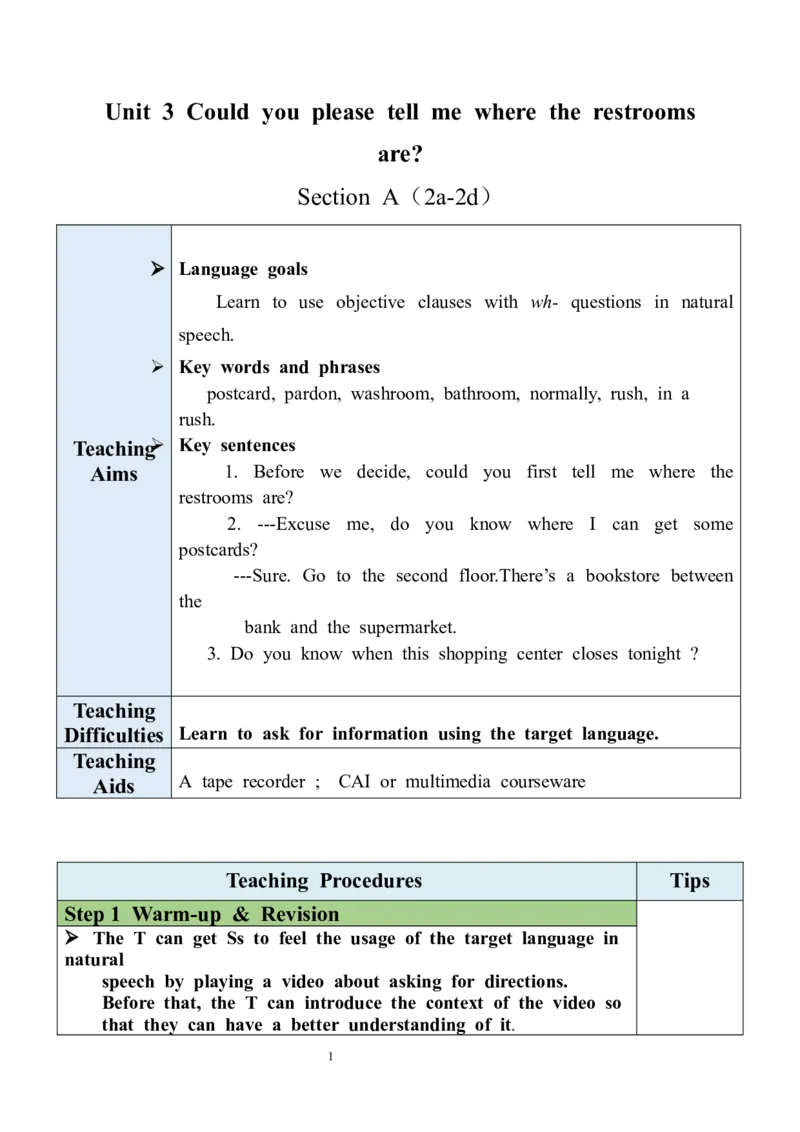
Language goals
Learn to use objective clauses with wh- questions in natural
speech.
Key words and phrases
postcard, pardon, washroom, bathroom, normally, rush, in a
rush.
Teaching Key sentences
Aims 1. Before we decide, could you first tell me where the
restrooms are?
2. ---Excuse me, do you know where I can get some
postcards?
---Sure. Go to the second floor.There’s a bookstore between
the
bank and the supermarket.
3. Do you know when this shopping center closes tonight ?
Teaching
Difficulties Learn to ask for information using the target language.
Teaching
Aids A tape recorder ; CAI or multimedia courseware
Teaching Procedures Tips
Step 1 Warm-up & Revision
The T can get Ss to feel the usage of the target language in
natural
speech by playing a video about asking for directions.
Before that, the T can introduce the context of the video so
that they can have a better understanding of it.
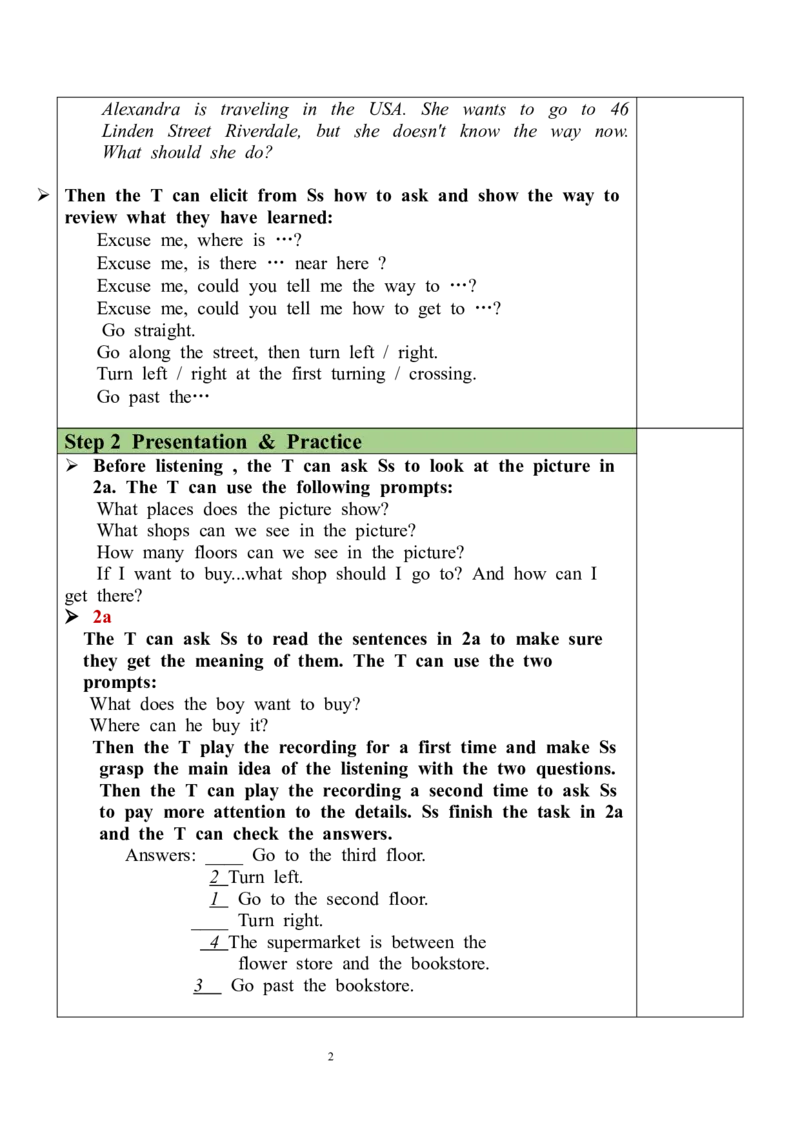
1Alexandra is traveling in the USA. She wants to go to 46
Linden Street Riverdale, but she doesn't know the way now.
What should she do?
Then the T can elicit from Ss how to ask and show the way to
review what they have learned:
Excuse me, where is …?
Excuse me, is there … near here ?
Excuse me, could you tell me the way to …?
Excuse me, could you tell me how to get to …?
Go straight.
Go along the street, then turn left / right.
Turn left / right at the first turning / crossing.
Go past the…
Step 2 Presentation & Practice
Before listening , the T can ask Ss to look at the picture in
2a. The T can use the following prompts:
What places does the picture show?
What shops can we see in the picture?
How many floors can we see in the picture?
If I want to buy...what shop should I go to? And how can I
get there?
2a
The T can ask Ss to read the sentences in 2a to make sure
they get the meaning of them. The T can use the two
prompts:
What does the boy want to buy?
Where can he buy it?
Then the T play the recording for a first time and make Ss
grasp the main idea of the listening with the two questions.
Then the T can play the recording a second time to ask Ss
to pay more attention to the details. Ss finish the task in 2a
and the T can check the answers.
Answers: ____ Go to the third floor.
2 Turn left.
1 Go to the second floor.
____ Turn right.
4 The supermarket is between the
flower store and the bookstore.
3 Go past the bookstore.
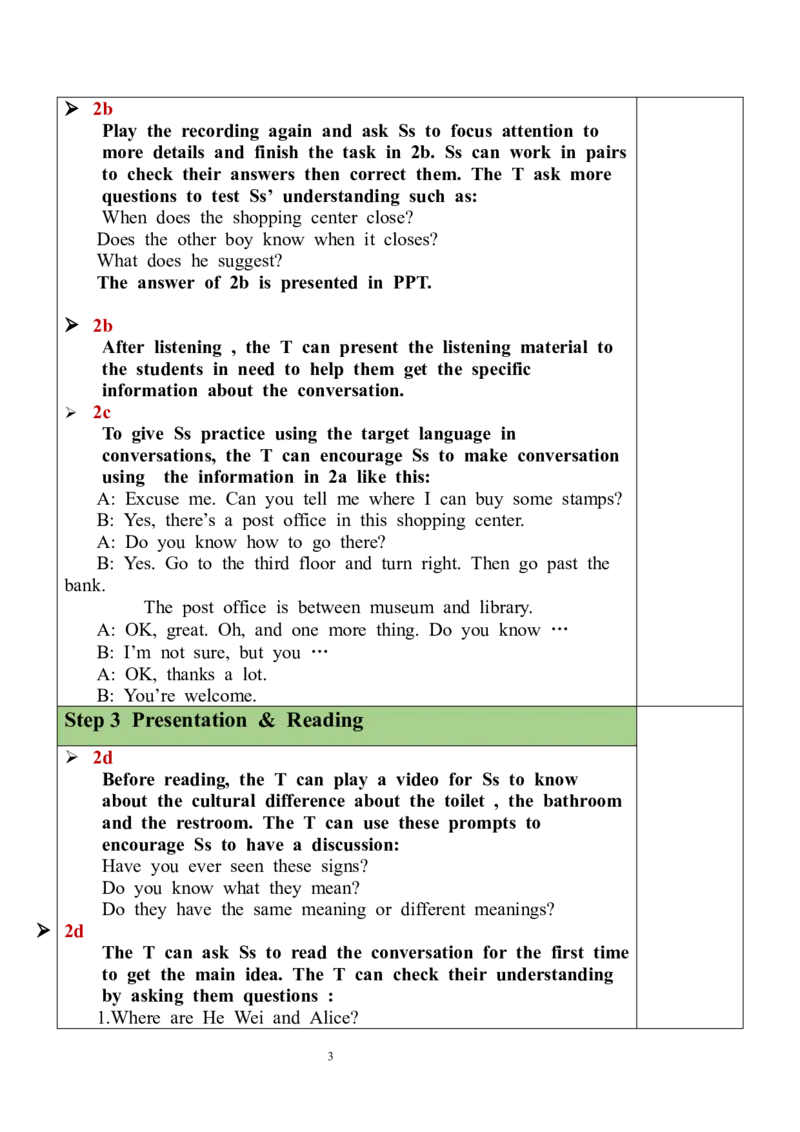
2 2b
Play the recording again and ask Ss to focus attention to
more details and finish the task in 2b. Ss can work in pairs
to check their answers then correct them. The T ask more
questions to test Ss’ understanding such as:
When does the shopping center close?
Does the other boy know when it closes?
What does he suggest?
The answer of 2b is presented in PPT.
2b
After listening , the T can present the listening material to
the students in need to help them get the specific
information about the conversation.
2c
To give Ss practice using the target language in
conversations, the T can encourage Ss to make conversation
using the information in 2a like this:
A: Excuse me. Can you tell me where I can buy some stamps?
B: Yes, there’s a post office in this shopping center.
A: Do you know how to go there?
B: Yes. Go to the third floor and turn right. Then go past the
bank.
The post office is between museum and library.
A: OK, great. Oh, and one more thing. Do you know …
B: I’m not sure, but you …
A: OK, thanks a lot.
B: You’re welcome.
Step 3 Presentation & Reading
2d
Before reading, the T can play a video for Ss to know
about the cultural difference about the toilet , the bathroom
and the restroom. The T can use these prompts to
encourage Ss to have a discussion:
Have you ever seen these signs?
Do you know what they mean?
Do they have the same meaning or different meanings?
2d
The T can ask Ss to read the conversation for the first time
to get the main idea. The T can check their understanding
by asking them questions :
1.Where are He Wei and Alice?
32. What different parts does Fun Times Park have?
3.Alice used a word that He Wei didn’t fully understand at the
beginning.What was that word?
4.How did Alice help He Wei to understand her?
2d
The T can check Ss’ answers and focus Ss’ attention to the
key words and sentence patterns in the conversation:
2d
Then the T can play the recording of the conversation and
make Ss read after it. Pa attention to the pronunciation and
intonation.
2d
The T can play the video of the conversation and then
invite some Ss to role-play the conversation as open pairs.
Step 4 Language points learning
go past = pass 意为“经过;路过”。其中 past为介词,意为 The
“从……旁边过去”。 language
rush作动词,意为“仓促;急促”。常用短语: points are
rush to do sth. 意为“赶紧/抢着做某事”; for
rush to…意为“冲/奔向……”。 reference
only.
rush用作名词,意为“匆忙;繁忙”。
in a rush“匆忙地”
rush hour“(交通)高峰期;拥挤时刻”
pardon作感叹词,常用于表示没有听清楚或不理解对方所说的内
容,请求对方再重复一遍,语气比较委婉,读时用升调;也可用于表
示歉意。“Pardon?”相当于“I beg your pardon?”或“Pardon
me?”。
pardon还可作及物动词,意为“原谅”。
pardon sb. for ( doing) sth. 原谅某人(做)某事。
Step 5 Summary & Homework
4 Summary The T can encourage Ss to summarize the key points
of this class to help Ss consolidate the knowledge. The
Homework: homework
Preview the passage in 3a. can vary
Do the exercises in students’ book. with the
specific
conditions.
In this period, there are more new words and expressions. The T should
provide more practice in listening and speaking and encourage Ss to be
Teaching more involved.The teacher should get them to learn the main structure-
Reflection objective clause with wh- word and get the students to practice it in
listening and speaking. In the reading part, Ss can experience more practice
in using the target language in natural speech.
5