文档文本内容
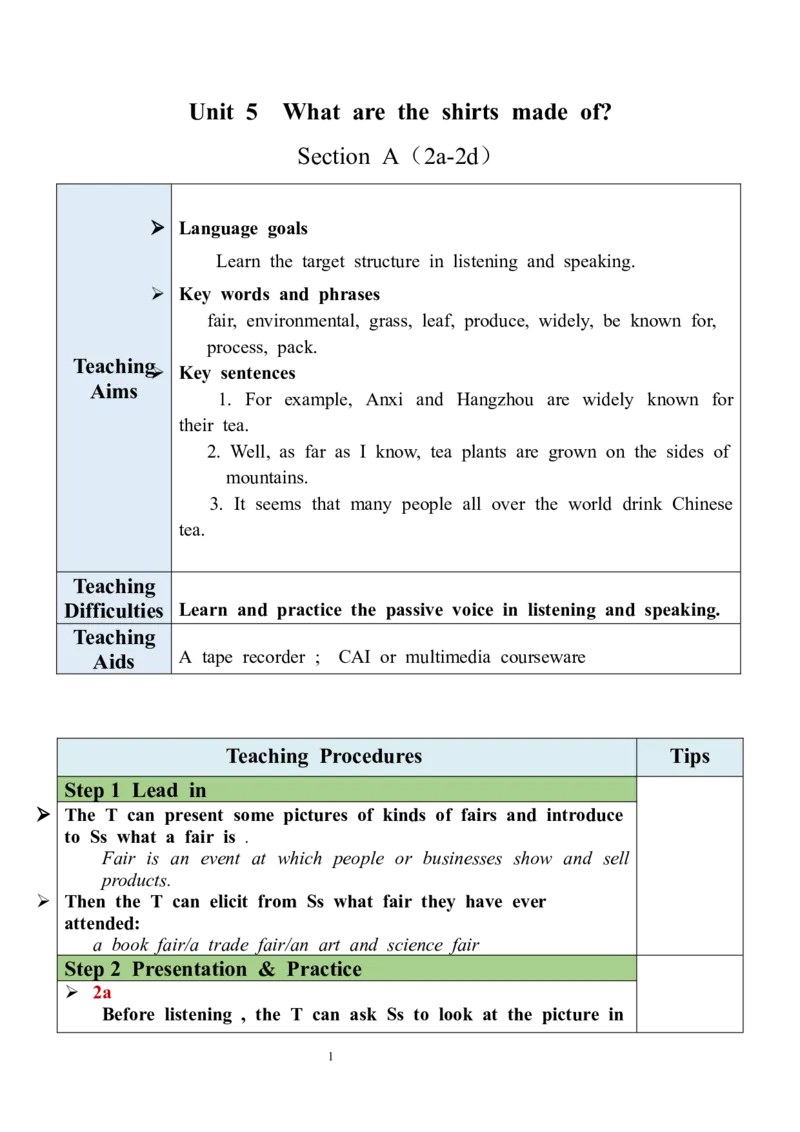
Unit 5 What are the shirts made of?
Section A(2a-2d)
Language goals
Learn the target structure in listening and speaking.
Key words and phrases
fair, environmental, grass, leaf, produce, widely, be known for,
process, pack.
Teaching
Key sentences
Aims
1. For example, Anxi and Hangzhou are widely known for
their tea.
2. Well, as far as I know, tea plants are grown on the sides of
mountains.
3. It seems that many people all over the world drink Chinese
tea.
Teaching
Difficulties Learn and practice the passive voice in listening and speaking.
Teaching
Aids A tape recorder ; CAI or multimedia courseware
Teaching Procedures Tips
Step 1 Lead in
The T can present some pictures of kinds of fairs and introduce
to Ss what a fair is .
Fair is an event at which people or businesses show and sell
products.
Then the T can elicit from Ss what fair they have ever
attended:
a book fair/a trade fair/an art and science fair
Step 2 Presentation & Practice
2a
Before listening , the T can ask Ss to look at the picture in
12a and talk about it. The T can use the following prompts:
What’s this in the picture?
Where do you think we can see it in our daily life?
The T can ask Ss to read the expressions in 2a to make
sure they get the meaning of them and the requirement of
the task.
2a
The activity is to provide Ss with practice in listening for
the main topic of a conversation. At the beginning, the T
may emphasize to Ss that they are to check only the main
topic , not check everything that is mentioned.
Then the T play the recording for the first time and make
Ss grasp the main idea of the listening and check the main
topic.
Answer: the art and science fair
2b
Ask Ss to read the four questions to get the meaning in 2b.
Then the T should teach Ss how to identify and capture the
required information from the recording quickly and
accurately and listen to some details selectively. For high
level Ss, the T can encourage them to take notes about some
details mentioned. Then the T may stop at the key point
while playing the recording so that Ss have time to write
answers. Ss can be asked to check their answers in pairs by
making conversations.
Answers: 1.Outside the science museum.
2.No. Their school i spaying for it.
3. Used wood and glass.
4. Grass, leaves and flowers.
2b
Play the recording again and ask Ss to focus attention to
more details in the conversation. The T ask more questions
to test Ss’ understanding such as:
Do we have a notice board in our school?
What does “notice board” mean?
Can you say “fair” in another way?
Do you know some other meaning of “fair”?
Who were the works made by? Were they made by scientists,
university students or middle school students?
2b
After listening , the T can present the listening material to
the students in need to help them get the specific
information about the conversation.
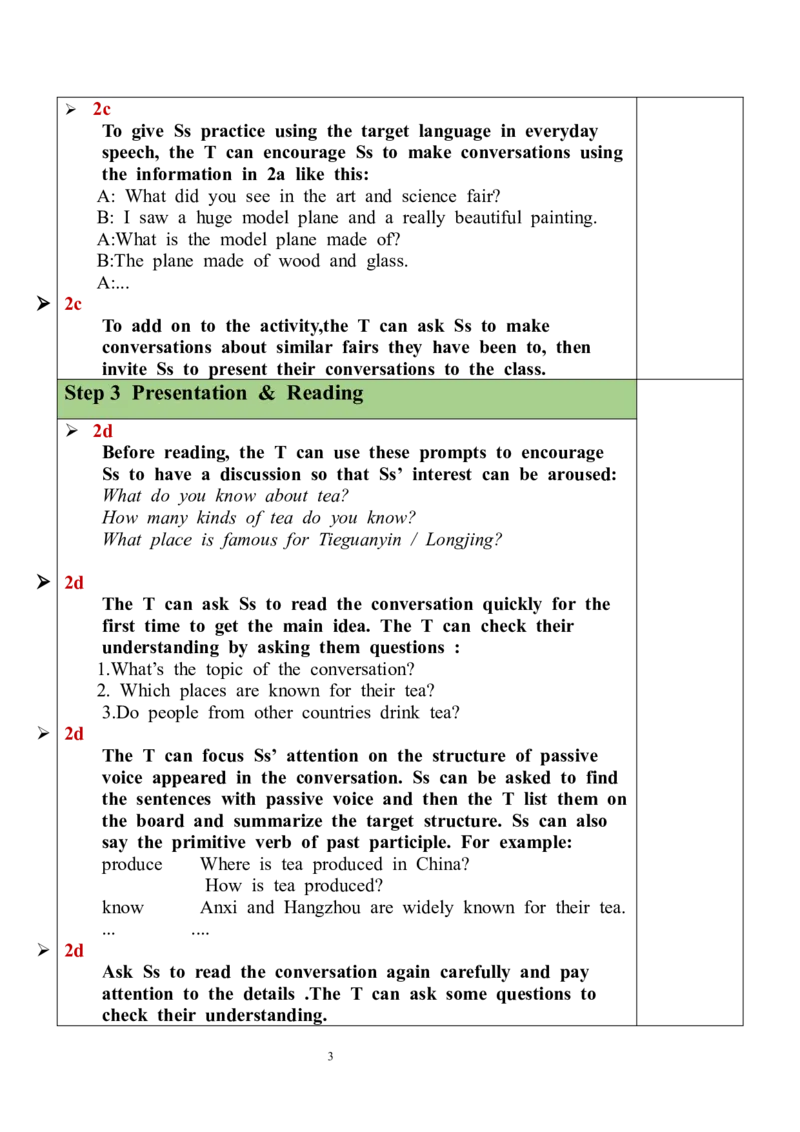
2 2c
To give Ss practice using the target language in everyday
speech, the T can encourage Ss to make conversations using
the information in 2a like this:
A: What did you see in the art and science fair?
B: I saw a huge model plane and a really beautiful painting.
A:What is the model plane made of?
B:The plane made of wood and glass.
A:...
2c
To add on to the activity,the T can ask Ss to make
conversations about similar fairs they have been to, then
invite Ss to present their conversations to the class.
Step 3 Presentation & Reading
2d
Before reading, the T can use these prompts to encourage
Ss to have a discussion so that Ss’ interest can be aroused:
What do you know about tea?
How many kinds of tea do you know?
What place is famous for Tieguanyin / Longjing?
2d
The T can ask Ss to read the conversation quickly for the
first time to get the main idea. The T can check their
understanding by asking them questions :
1.What’s the topic of the conversation?
2. Which places are known for their tea?
3.Do people from other countries drink tea?
2d
The T can focus Ss’ attention on the structure of passive
voice appeared in the conversation. Ss can be asked to find
the sentences with passive voice and then the T list them on
the board and summarize the target structure. Ss can also
say the primitive verb of past participle. For example:
produce Where is tea produced in China?
How is tea produced?
know Anxi and Hangzhou are widely known for their tea.
... ....
2d
Ask Ss to read the conversation again carefully and pay
attention to the details .The T can ask some questions to
check their understanding.
31. Which city is well-known for its tea?
2. Where is tea grown?
3. How are tea leaves picked?
4. What needs to be done after tea leaves are processed?
5. Why is tea drunk all over the world?
2d
The T can play the recording of the conversation and make
Ss read after it. Pay attention to the pronunciation and
intonation.
Then the T can play the video of the conversation and then
invite some Ss to role-play the conversation as open pairs.
Step 4 Language points learning
fair n. 展览会;交易会 The
fair作形容词 意为“公平的;公正的”, 常用结构: language
be fair to sb. 对某人是公平的 points are
反义词为unfair 意为“不公平的;不公正的” for
reference
fair作形容词 还可意为“白皙的;浅色的”
only.
be famous for 意为“因……而出名”,后接原因(通常是名词)
be famous as意为“作为……而出名”,后接表示身份、地位等
的名词。
be famous to意为“为……所熟知”,后接表示人的名词。
produce v. 生产;制造;出产
produce 本身也可作名词,意为“产品; (尤指)农产品”。为不
可数名词。区别于product。
①product是produce的名词形式,意为“产品;成果”,是可数
名词。
②production也为produce的名词形式,意味“生产;产量”,是不
可数名词。
widely adv. 广泛地;普遍地 由“wide(adj. 宽的)+ly(副词后
缀)”构成。 相关词汇:
width n. 宽度;广度 widen v.(使)变宽; (使)扩大
as far as I know 据我所知
结构类似的短语有:as far as I can see 依我看
As far as I can remember 据我所记得 as far as I can tell 据我所知
Step 5 Summary & Homework
Summary The T can encourage Ss to summarize the key points The
of this class to help Ss consolidate the knowledge. homework
Homework: can vary
Preview the passage in 3a. with the
Do the exercises in students’ book. specific
4conditions.
Passive voice is difficult for Chinese students. They either forget the verb
“be” or miss the “ed” after the verb, especially the past participle of
Teaching irregular verbs, which is easier for students to forget. Sometimes even if
Reflection they understand the meaning of the passive voice, they have little sense
of application. Therefore, teachers must create different contexts for
practice.
5