文档文本内容
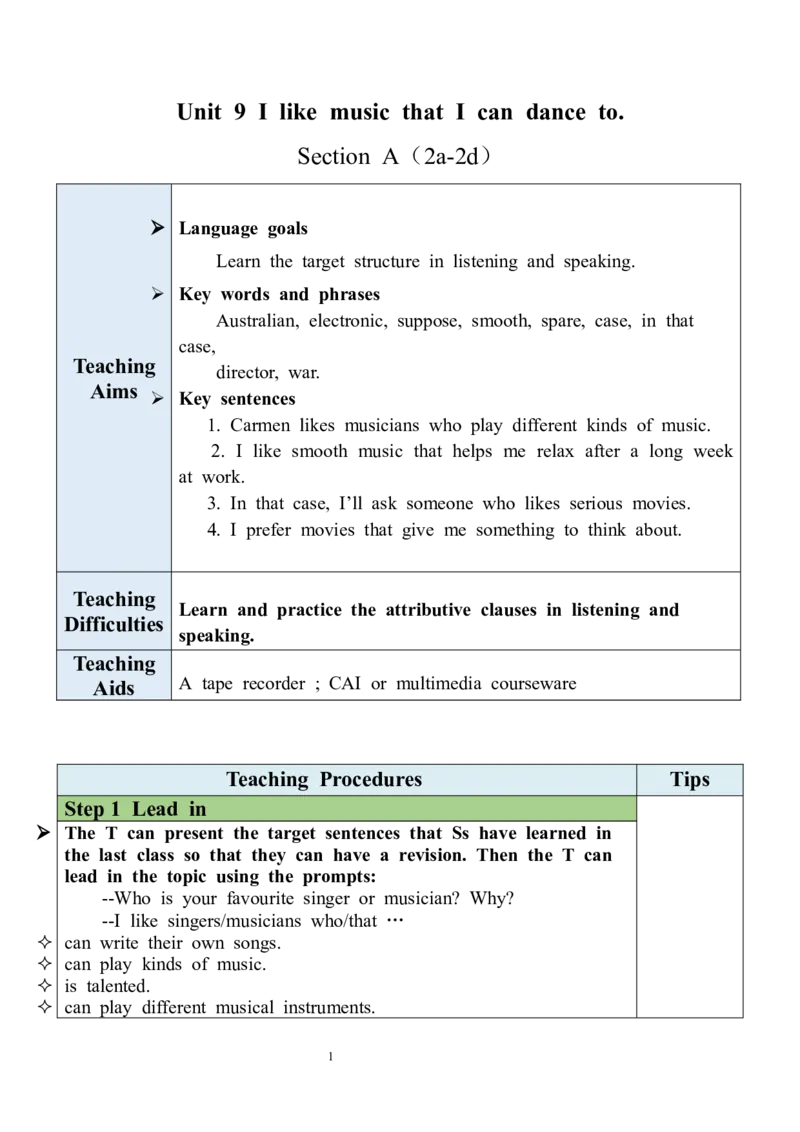
Unit 9 I like music that I can dance to.
Section A(2a-2d)
Language goals
Learn the target structure in listening and speaking.
Key words and phrases
Australian, electronic, suppose, smooth, spare, case, in that
case,
Teaching
director, war.
Aims
Key sentences
1. Carmen likes musicians who play different kinds of music.
2. I like smooth music that helps me relax after a long week
at work.
3. In that case, I’ll ask someone who likes serious movies.
4. I prefer movies that give me something to think about.
Teaching
Learn and practice the attributive clauses in listening and
Difficulties
speaking.
Teaching
Aids A tape recorder ; CAI or multimedia courseware
Teaching Procedures Tips
Step 1 Lead in
The T can present the target sentences that Ss have learned in
the last class so that they can have a revision. Then the T can
lead in the topic using the prompts:
--Who is your favourite singer or musician? Why?
--I like singers/musicians who/that …
can write their own songs.
can play kinds of music.
is talented.
can play different musical instruments.
1 ...
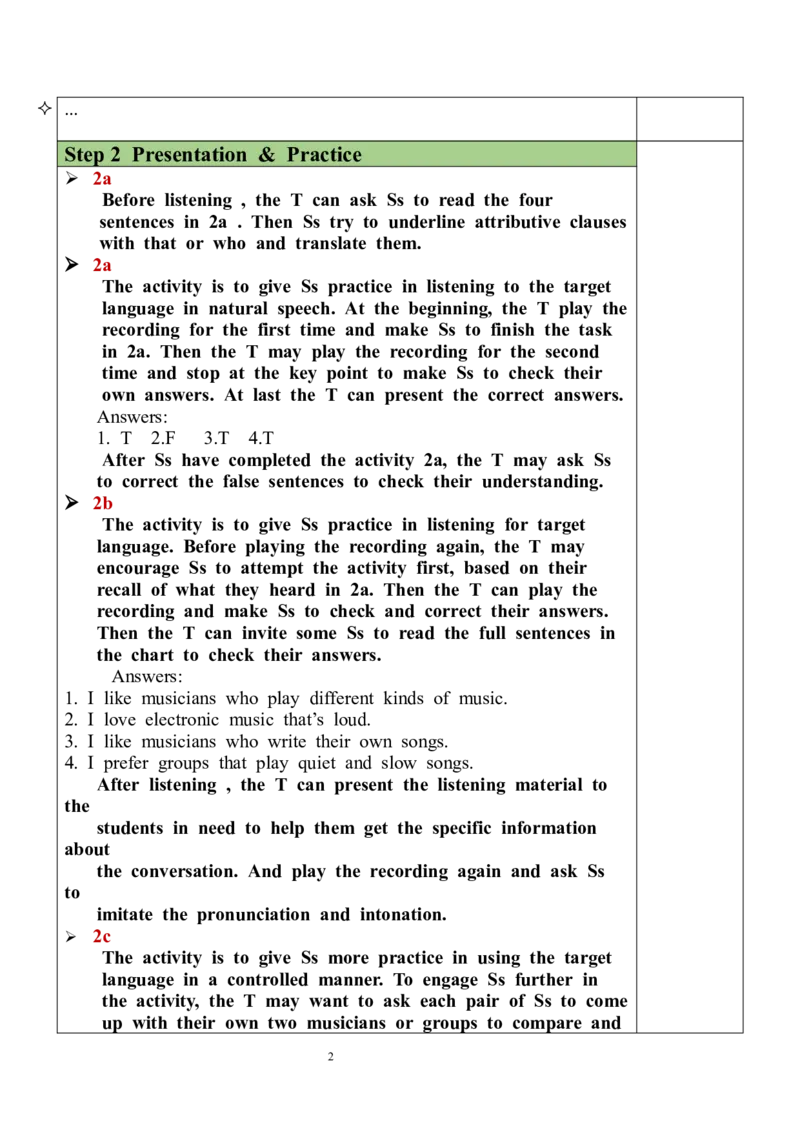
Step 2 Presentation & Practice
2a
Before listening , the T can ask Ss to read the four
sentences in 2a . Then Ss try to underline attributive clauses
with that or who and translate them.
2a
The activity is to give Ss practice in listening to the target
language in natural speech. At the beginning, the T play the
recording for the first time and make Ss to finish the task
in 2a. Then the T may play the recording for the second
time and stop at the key point to make Ss to check their
own answers. At last the T can present the correct answers.
Answers:
1. T 2.F 3.T 4.T
After Ss have completed the activity 2a, the T may ask Ss
to correct the false sentences to check their understanding.
2b
The activity is to give Ss practice in listening for target
language. Before playing the recording again, the T may
encourage Ss to attempt the activity first, based on their
recall of what they heard in 2a. Then the T can play the
recording and make Ss to check and correct their answers.
Then the T can invite some Ss to read the full sentences in
the chart to check their answers.
Answers:
1. I like musicians who play different kinds of music.
2. I love electronic music that’s loud.
3. I like musicians who write their own songs.
4. I prefer groups that play quiet and slow songs.
After listening , the T can present the listening material to
the
students in need to help them get the specific information
about
the conversation. And play the recording again and ask Ss
to
imitate the pronunciation and intonation.
2c
The activity is to give Ss more practice in using the target
language in a controlled manner. To engage Ss further in
the activity, the T may want to ask each pair of Ss to come
up with their own two musicians or groups to compare and
2contrast. Invite a few pairs to share their conversations with
the class.
Step 3 Presentation & Reading
2d
Before reading, the T can use these prompts to encourage
Ss to have a discussion about the following questions so that
Ss’ interest can be aroused:
What do you usually do on weekends?
Do you prefer to enjoy music or watch movies?
What kind of music(movie) do you prefer? Why?
2d
The T can ask Ss to read the conversation carefully. The T
can check their understanding by asking them questions :
1. What is Scott going to do this weekend?
2. What about Jill?
2d
The T can focus Ss’ attention on the structure of attributive
clauses appeared in the conversation and other key word
groups. Ss can be asked to make sentences using the key
structure and phrases.Then the T can make Ss read the
conversation in chorus to check their pronunciation and
intonation. At last the T can invite some Ss to role-play the
conversation as open pairs.
Optional Approach:
After Ss have role-played the the conversation, the T may
want to extend the activity by asking Ss to identify the kinds
of music and movies mentioned in the conversation and
asking Ss to underline these parts of the conversation
(smooth music that helps me relax, movies that are funny,
serious movies, movies that give me something to think about).
Then ask Ss to substitute the parts they underlined earlier
with ideas of their own. Invite some pairs to read aloud
their new versions of the conversation to the class.
Step 4 Language Points
suppose v. 推断;料想
suppose +(that)从句 表示“猜测/认为……”。 The
suppose 还常用于被动结构 be supposed to do sth.,意为“应该做 language
某事”,be supposed to 相当于 should。 points are
3 spare adj. 空闲的;不用的 v. 抽出;留出 for
作形容词,意为“空闲的;不用的”,通常用在名词前作定语。常用 reference
短语:in one’s spare time 在某人的空闲时间。 only.
spare还可以作及物动词,意为“抽出;留出”, 多指抽出时间、
空间等。常用结构有:spare…for sb./ sth. “为某人/某事抽出/留
出……”
Step 5 Summary & Homework
Summary The T can encourage Ss to summarize the key points The
of this class to help Ss consolidate the knowledge. homework
Homework: can vary
Preview the passage in 3a. with the
Do the exercises in students’ book. specific
conditions.
In this period, there are more new words and expressions. The T should
provide more practice in listening and speaking and encourage Ss to be
Teaching more involved.The teacher should get them to learn the main structure-
Reflection attributive clauses and get the students to practice it in listening and
speaking. In the reading part, Ss can experience more practice in using the
target language in natural speech.
4