文档文本内容
Unit 9 I like music that I can dance to.
Section A(1a-1c)
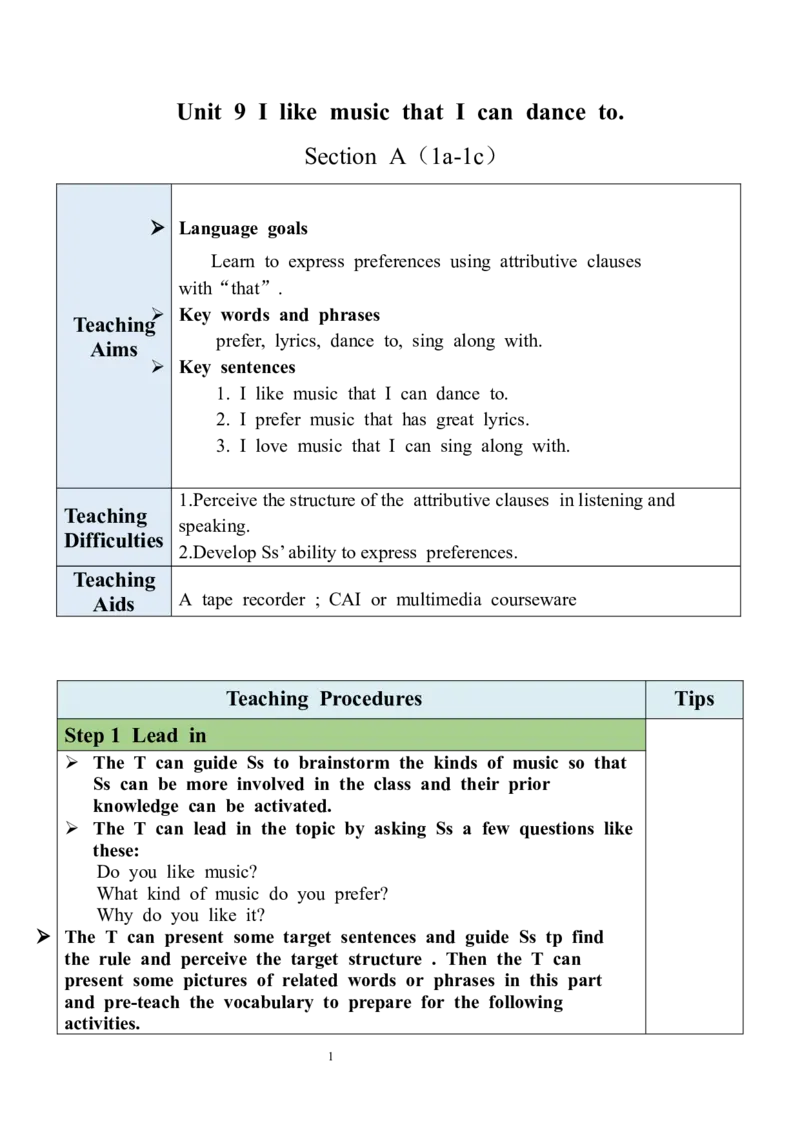
Language goals
Learn to express preferences using attributive clauses
with“that”.
Key words and phrases
Teaching
prefer, lyrics, dance to, sing along with.
Aims
Key sentences
1. I like music that I can dance to.
2. I prefer music that has great lyrics.
3. I love music that I can sing along with.
1.Perceive the structure of the attributive clauses in listening and
Teaching
speaking.
Difficulties
2.Develop Ss’ ability to express preferences.
Teaching
Aids A tape recorder ; CAI or multimedia courseware
Teaching Procedures Tips
Step 1 Lead in
The T can guide Ss to brainstorm the kinds of music so that
Ss can be more involved in the class and their prior
knowledge can be activated.
The T can lead in the topic by asking Ss a few questions like
these:
Do you like music?
What kind of music do you prefer?
Why do you like it?
The T can present some target sentences and guide Ss tp find
the rule and perceive the target structure . Then the T can
present some pictures of related words or phrases in this part
and pre-teach the vocabulary to prepare for the following
activities.
1I like folk music. Because it makes me feel relaxed.
I like music that can make me feel relaxed.
I like pop music. Because I can sing along with it.
I like music that I can sing along with.
...
Step 2 Presentation & Practice
1a
To set the scene for activity 1a, the T may want to draw Ss’
attention to the picture, encourage them to focus on what the
people are saying and to speculate on what these people
might have been doing based on what is in the picture. Then
the T can invite Ss to share with the class the sentences they
have written.
Suggested answers:
...is relaxing.
...has a strong beat.
...is sentimental.
...is traditional.
...is modern.
...is associated with my culture.
1b
Before listening, the T should make sure that Ss understand
the requirement of the task and the meaning of these
sentences in 1b.
While listening, the T can play the recording without stop
for the first time and Ss finish the task in 1b. This step
aims to develop Ss’ skills of grasping the target information.
Then the T can play a second time to check Ss’ answers.
This time, the T can stop at the key point and check Ss’
answers by asking them to say the full sentences.
Answers:
Tony— music that has great lyrics, music that I can sing along
with
Betty— music that I can dance to, music that I can sing along
with
1b
While listening, the T may play the recording a third time and
ask Ss to repeat the key sentences. The T may also ask some
questions to consolidate Ss’ understanding of the dialog:
Does Betty like the Cool Kids? Why?
What does Tony think of the Cool Kids?
2What kind of music does Tony prefer?
What’s Tony’s favorite band?
Then the T can play the video about 1b and have Ss try to
imitate the
pronunciation and intonation of the dialog.
After listening, the T can conduct a post-listening discussion by
using
these prompts:
Do you know of any music with great lyrics? What are the lyrics
about?
Do you have a favourite band? Why do you like this band?
1c
The T can invite Ss to role-play the conversation in 1c. Then
the Ss
can work in pairs to make conversations using the target
structure. During this step, the T should pay attention to the
fluency of Ss’ speaking instead of the accuracy. Just offer
help to the Ss in need and don’t over correct their small
mistakes so that Ss can speak as much as possible. Before
conducting this activity, the T may focus on some useful
words for talking about music, movies and books.
Step 3 Language points learning
prefer v. 更喜欢 相当 like...better,其过去式和过去分词均为 The
preferred,现在分词为preferring。常见用法有: language
① prefer sth. 更喜欢某物 points are
② prefer to do sth. 更喜欢做某事 for
reference
③ prefer+(doing) A + to (doing) B 比起(做)B事更喜欢(做)A事
only.
④ prefer to do sth.+rather than do sth.
along with 随着;和……一起 作“和……一起”讲时,相当于
together with。
注意:
当主语后面紧跟由with, along with, together with等引出的短语
时,谓语动词的数要与主语保持一致。
dance to 随着……跳舞
其中to为介词, 意为“按照;随着”
Step 4 Summary & Homework
Summary The T can encourage Ss to summarize the key points The
3of this class to help Ss consolidate the knowledge. homework
Homework: can vary
Preview the conversation in 2d. with the
Do the exercises in students’ book. specific
conditions
.
This is the first period of the unit.During this period, teachers interact
with students through high-density questions according to the topic
picture in 1a, which is helpful for students to learn new vocabulary,
and also help students review the language content they have learned.
Teaching
When checking the answers, teachers need not rush to judge right or
Reflection
wrong. They should let students speak actively. At this stage, it is
OK to understand sentences without explaining for the time being so
that students can accumulate more perceptual knowledge in the stage
of grammar perception.
4