文档文本内容
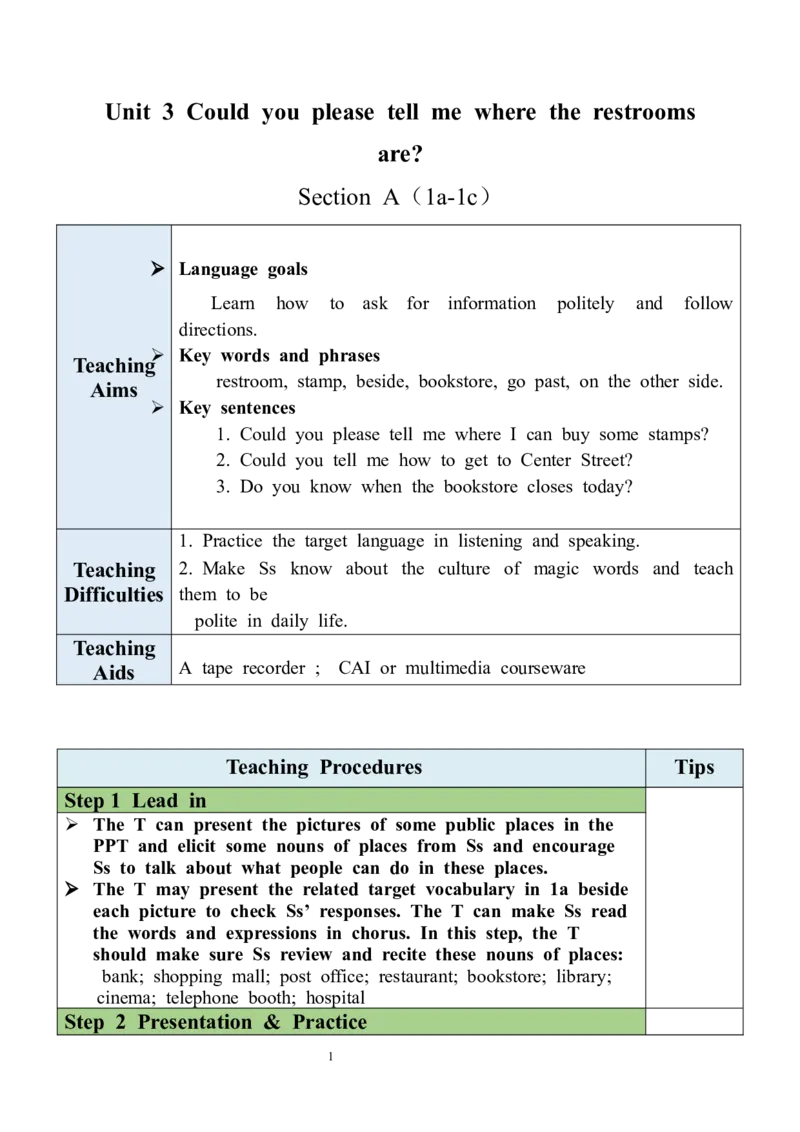
Unit 3 Could you please tell me where the restrooms
are?
Section A(1a-1c)
Language goals
Learn how to ask for information politely and follow
directions.
Key words and phrases
Teaching
restroom, stamp, beside, bookstore, go past, on the other side.
Aims
Key sentences
1. Could you please tell me where I can buy some stamps?
2. Could you tell me how to get to Center Street?
3. Do you know when the bookstore closes today?
1. Practice the target language in listening and speaking.
Teaching 2. Make Ss know about the culture of magic words and teach
Difficulties them to be
polite in daily life.
Teaching
Aids A tape recorder ; CAI or multimedia courseware
Teaching Procedures Tips
Step 1 Lead in
The T can present the pictures of some public places in the
PPT and elicit some nouns of places from Ss and encourage
Ss to talk about what people can do in these places.
The T may present the related target vocabulary in 1a beside
each picture to check Ss’ responses. The T can make Ss read
the words and expressions in chorus. In this step, the T
should make sure Ss review and recite these nouns of places:
bank; shopping mall; post office; restaurant; bookstore; library;
cinema; telephone booth; hospital
Step 2 Presentation & Practice
1 1a
The T can make Ss talk about the picture in 1a. The T may use
these prompts:
What places do you see in the picture?
(Answers: post office,library,restaurant,bank,bookstore,department store
)
What are names of the two streets?
(Answers:Main and Center)
What are the people doing?
(Answer: The two girls are asking the two boys for
information )
1a
The T can make Ss read the expressions in chorus and then do
the exercises in 1a . The T can check answers by making
conversations with Ss or asking them do this in pairs like this:
T: Where can we get some money?
S1: We can get some money at a bank.
S2: Where can we get some magazines?
S3: We can get them at a post office.
Suggested answers:
b get some money d/f get some information about the
town
c/f get some magazines f buy a newspaper
a have dinner e buy some stamps
f get a dictionary c get a pair of shoes
1b
Before listening, the T may guide Ss to review the
prepositions of position by describing the positions of these
places in the picture in 1a to prepare for the following
listening. For example:
T: Where is the bank?
S: It’s between the restaurant and the bookstore.
T: Which street is it on?
S: It’s on Main Street..
1b
While listening, the T can play the recording for the first
time and Ss finish the task in 1b. Then the T can present
the correct answers in the PPT.
Answers:
1. buy some stamps 2.post office 3.Center Street
4.get a dictionary 5.bookstore 6.Main Street
2 1b
While listening, the T may play the recording a second time
and uses these prompts to have a brief discussion:
What does the girl want to buy?
(answer : Some stamps.)
When does the bookstore close today?
(answer : 7:00P.M..)
1b
After listening, the T can play the video of the 1b and help Ss
recognize the target language in natural speech. Then the T
can provide Ss with the opportunity for further practice in
using target language by getting Ss to substitute any of the
answers for the speech bubbles with other possible answers. For
example:
S1: Excuse me, could you tell me where I can ge t a pai r o f
shoes?
S2: Yes, there’s a department store on Main Street .
1c
The T can invite Ss to role-play the conversation in 1c. Then
the Ss
can work in pairs to make conversations . During this step,
the T should pay attention to the fluency of Ss’ speaking
instead of the accuracy. Just offer help to the Ss in need and
don’t over correct their small mistakes.
Note: In this period, the T needn’t highlight the grammar
structure. Ss just need to understand the meanings of
sentences and practice use them in the conversations. The T
needn’t analyze the structure to Ss.
Step 4 Language points learning
表示委婉请求及请求允许做某事的句型 The
Could you please do sth.? language
Would/Will you please do sth.? points are
Would you like to do sth.? for
May/Can/Could I do sth.? reference
肯定回答常用:Sure./Of course./ No problem./ I’d love to.等。 only.
否定回答常用:Sorry, I’d love/like to, but I…/
Sorry, I’m afraid …等。
3 常见的问路句型
Excuse me. Could/Can you tell me the way to…?
Excuse me. Could/Can you tell me how I can get to…?
Excuse me. Could/Can you tell me how to get to…?
Excuse me. Could/Can you tell me where…is/are?
Excuse me. Do you know where/how…?
Excuse me. Which is the way to…, please?
Excuse me. Where is …, please?
Excuse me. Is there a/an…near here?
Step 5 Summary & Homework
Summary The T can encourage Ss to summarize the key points The
of this class to help Ss consolidate the knowledge. homework
Homework: can vary
Preview the conversation in 2d. with the
Do the exercises in students’ book. specific
conditions
.
This is the first period of the unit.Students should learn how to ask for
information in polite ways in this unit. The class starts with places in a city
Teaching and things that people do in these places.Then the teacher should help
Reflection them come to oral practice about asking the way and asking for
information.At this step we usually don't tell them the structure.Our focus is
on language listening and speaking.
4