文档文本内容
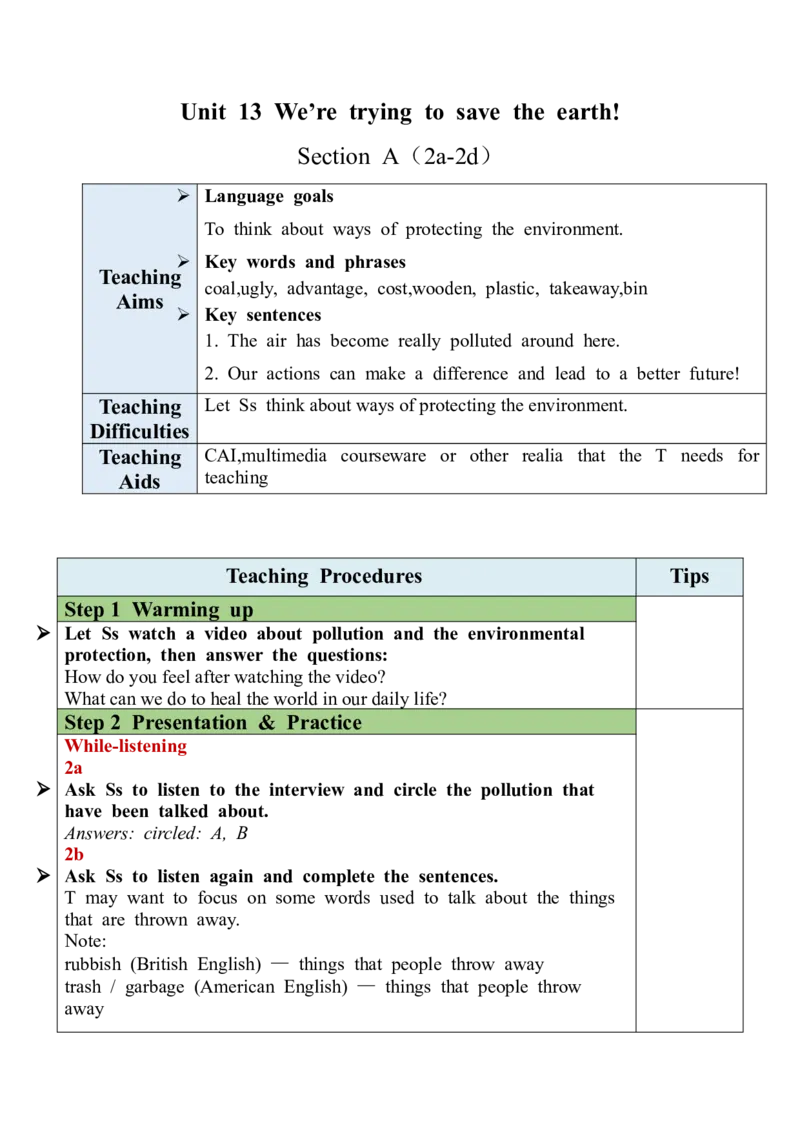
Unit 13 We’re trying to save the earth!
Section A(2a-2d)
Language goals
To think about ways of protecting the environment.
Key words and phrases
Teaching
coal,ugly, advantage, cost,wooden, plastic, takeaway,bin
Aims
Key sentences
1. The air has become really polluted around here.
2. Our actions can make a difference and lead to a better future!
Teaching Let Ss think about ways of protecting the environment.
Difficulties
Teaching CAI,multimedia courseware or other realia that the T needs for
Aids teaching
Teaching Procedures Tips
Step 1 Warming up
Let Ss watch a video about pollution and the environmental
protection, then answer the questions:
How do you feel after watching the video?
What can we do to heal the world in our daily life?
Step 2 Presentation & Practice
While-listening
2a
Ask Ss to listen to the interview and circle the pollution that
have been talked about.
Answers: circled: A, B
2b
Ask Ss to listen again and complete the sentences.
T may want to focus on some words used to talk about the things
that are thrown away.
Note:
rubbish (British English) — things that people throw away
trash / garbage (American English) — things that people throw
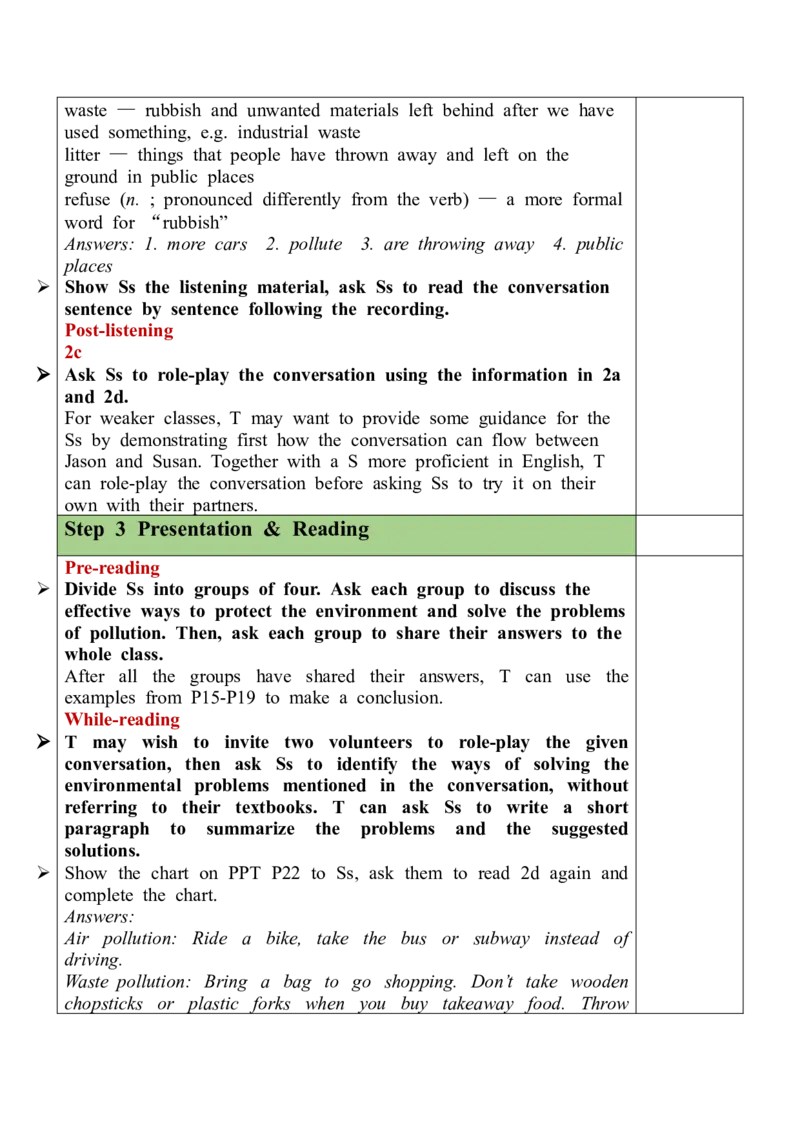
awaywaste — rubbish and unwanted materials left behind after we have
used something, e.g. industrial waste
litter — things that people have thrown away and left on the
ground in public places
refuse (n. ; pronounced differently from the verb) — a more formal
word for “rubbish”
Answers: 1. more cars 2. pollute 3. are throwing away 4. public
places
Show Ss the listening material, ask Ss to read the conversation
sentence by sentence following the recording.
Post-listening
2c
Ask Ss to role-play the conversation using the information in 2a
and 2d.
For weaker classes, T may want to provide some guidance for the
Ss by demonstrating first how the conversation can flow between
Jason and Susan. Together with a S more proficient in English, T
can role-play the conversation before asking Ss to try it on their
own with their partners.
Step 3 Presentation & Reading
Pre-reading
Divide Ss into groups of four. Ask each group to discuss the
effective ways to protect the environment and solve the problems
of pollution. Then, ask each group to share their answers to the
whole class.
After all the groups have shared their answers, T can use the
examples from P15-P19 to make a conclusion.
While-reading
T may wish to invite two volunteers to role-play the given
conversation, then ask Ss to identify the ways of solving the
environmental problems mentioned in the conversation, without
referring to their textbooks. T can ask Ss to write a short
paragraph to summarize the problems and the suggested
solutions.
Show the chart on PPT P22 to Ss, ask them to read 2d again and
complete the chart.
Answers:
Air pollution: Ride a bike, take the bus or subway instead of
driving.
Waste pollution: Bring a bag to go shopping. Don’t take wooden
chopsticks or plastic forks when you buy takeaway food. Throwrubbish in the bins.
Think-Pair-Share
Step 1: Ask Ss to think about the questions: What did you learn
from the conversation? What other things can we do to protect our
environment?
Step 2: Ask Ss to find their shoulder partners.
Step 3: Ask Ss to share their answers with their partners.
Step 4 Language points learning
advantage作名词,其反义词为disadvantage“缺点;不利条件”。take
advantage of... 意为“利用……”。
cost在此处作动词,其过去式和过去分词均为cost。
cost, spend, take与pay的区别:
cost的主语是物,宾语是金钱,sth. cost(s) (sb.) some money指“某
物花费(某人)多少钱”;
spend的主语是人,宾语是时间或金钱,sb. spend(s) some time/
money on sth.指“某人花费时间/金钱在某事/物上”,sb. spend(s)
some time/ money doing sth.指“某人花费时间/金钱做某事”;
take常用it作形式主语,宾语是时间,it takes sb. some time to do
sth.指“做某事花费某人多长时间”;
pay主语是人,宾语是金钱,sb. pay(s) some money for sth.指“某
人为某物付费”。
Step 5 Exercises& Homework
Exercises
Do exercises from PPT P28-P29.
Homework
Preview the passage in 3a.
Do the exercises in students’ book.
This is the second period of the unit. In the unit we talk about pollution
and environmental protection. So it is important to get the students to learn
words and phrases about the topics in this unit. We will review some
structures and tenses and get the students to practice them in listening and
Teaching
Reflection speaking. They are “should+do; used to+do; have / has+done; be+
done; be + doing”. The topic is an important content in our life and
students should learn to use the words and structures to talk about and write
about it. So much practice should be done in the period and in later periods.