文档文本内容
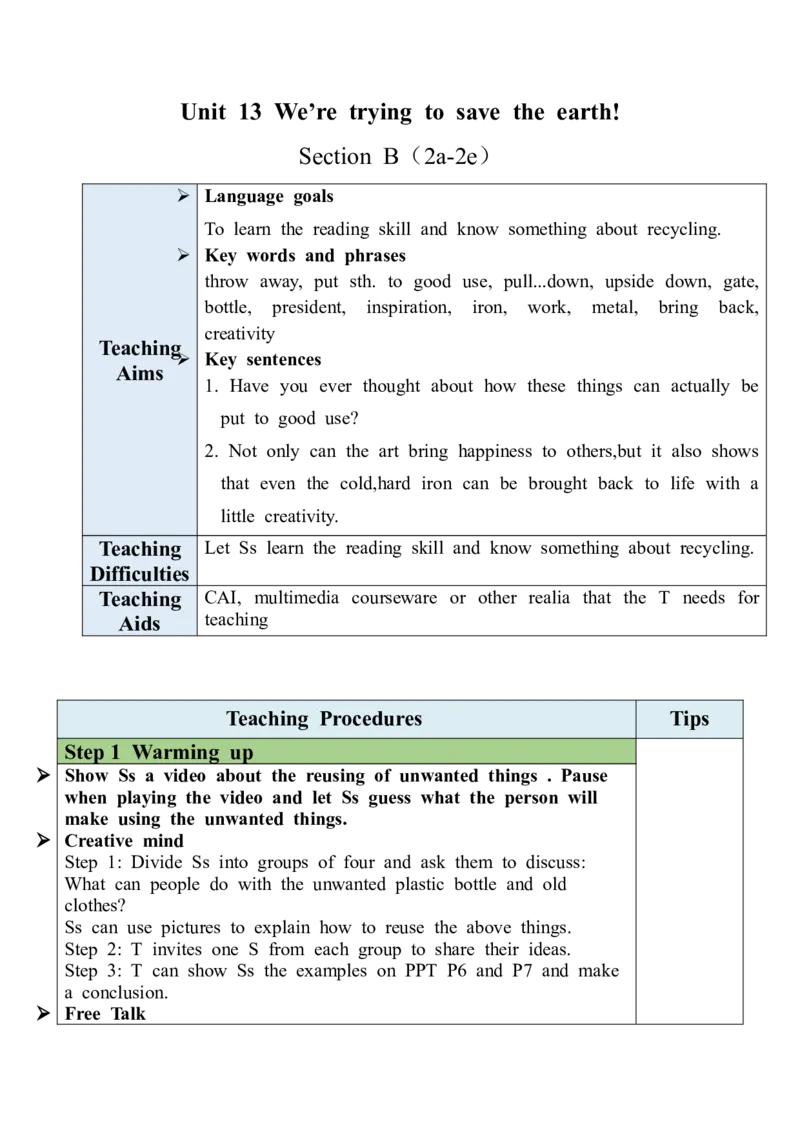
Unit 13 We’re trying to save the earth!
Section B(2a-2e)
Language goals
To learn the reading skill and know something about recycling.
Key words and phrases
throw away, put sth. to good use, pull...down, upside down, gate,
bottle, president, inspiration, iron, work, metal, bring back,
creativity
Teaching
Key sentences
Aims
1. Have you ever thought about how these things can actually be
put to good use?
2. Not only can the art bring happiness to others,but it also shows
that even the cold,hard iron can be brought back to life with a
little creativity.
Teaching Let Ss learn the reading skill and know something about recycling.
Difficulties
Teaching CAI, multimedia courseware or other realia that the T needs for
Aids teaching
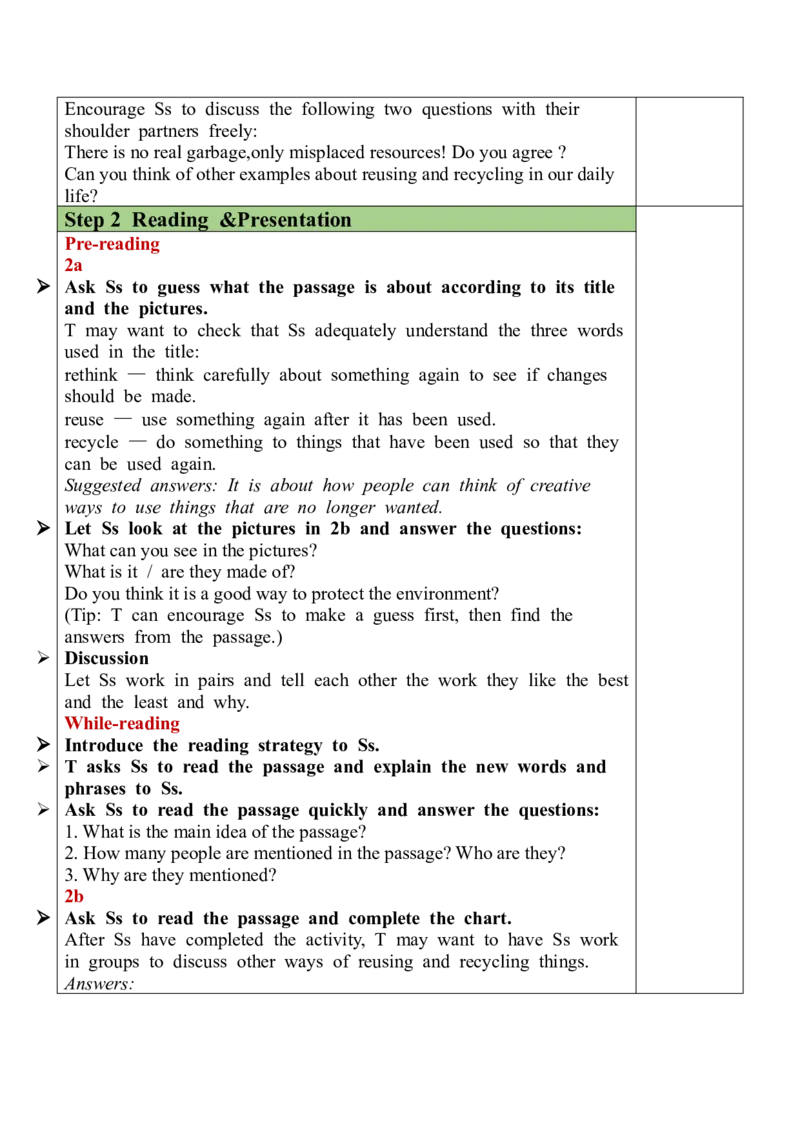
Teaching Procedures Tips
Step 1 Warming up
Show Ss a video about the reusing of unwanted things . Pause
when playing the video and let Ss guess what the person will
make using the unwanted things.
Creative mind
Step 1: Divide Ss into groups of four and ask them to discuss:
What can people do with the unwanted plastic bottle and old
clothes?
Ss can use pictures to explain how to reuse the above things.
Step 2: T invites one S from each group to share their ideas.
Step 3: T can show Ss the examples on PPT P6 and P7 and make
a conclusion.
Free TalkEncourage Ss to discuss the following two questions with their
shoulder partners freely:
There is no real garbage,only misplaced resources! Do you agree ?
Can you think of other examples about reusing and recycling in our daily
life?
Step 2 Reading &Presentation
Pre-reading
2a
Ask Ss to guess what the passage is about according to its title
and the pictures.
T may want to check that Ss adequately understand the three words
used in the title:
rethink — think carefully about something again to see if changes
should be made.
reuse — use something again after it has been used.
recycle — do something to things that have been used so that they
can be used again.
Suggested answers: It is about how people can think of creative
ways to use things that are no longer wanted.
Let Ss look at the pictures in 2b and answer the questions:
What can you see in the pictures?
What is it / are they made of?
Do you think it is a good way to protect the environment?
(Tip: T can encourage Ss to make a guess first, then find the
answers from the passage.)
Discussion
Let Ss work in pairs and tell each other the work they like the best
and the least and why.
While-reading
Introduce the reading strategy to Ss.
T asks Ss to read the passage and explain the new words and
phrases to Ss.
Ask Ss to read the passage quickly and answer the questions:
1. What is the main idea of the passage?
2. How many people are mentioned in the passage? Who are they?
3. Why are they mentioned?
2b
Ask Ss to read the passage and complete the chart.
After Ss have completed the activity, T may want to have Ss work
in groups to discuss other ways of reusing and recycling things.
Answers:2c
Ask Ss to fill in the blanks using the phrases in the box.
T may want to check that Ss understand the given phrases before
asking them to complete the activity.
pull down — knock down and destroy
put to good use — use something for a purpose
build ... out of — make something (especially a building) with
certain materials
set up — start a company
known for — famous because of something
not only ... but also — link two parts of sentence to show that the
second part is in addition to the first part
Answers: 1. pulled down 2. put to good use 3. built, out of 4.
set up 5. known for 6. not only, but also
2d
Get Ss to focus on prefixes and suffixes and let them underline
the words in the passage based on the words in the box.
T may want to introduce the terms “prefix” and “suffix” after Ss
have completed this activity.
Note:
Prefix: a group or letters added to the beginning of a word to
change the meaning of the word.
Suffix: a group of letter added to the end of a word to change the
part of speech.
Answers: think - rethink special - especially use - reuse, useful
recent - recently usual -unusual environment - environmental
recycle - recycling important - importance build - building
protect - protection create - creative, creativity inspire -
inspiration
Post-reading
2a Ask Ss to work in groups of four and make a list of things that
need to be done to save the environment. T needs to encourage
Ss to express their opinions about ways of protecting the
environment.
After the groups have compiled their lists, T may want to add on
to the activity by have a class discussion. Invite groups to present
their views and agree / disagree with other group’s views.
Suggested answers:
Things which can be done by people every day:
Take your own bags when you go shopping
Spend less time in the shower
Turn off the lights when you leave a room
Take public transport rather than drive
Avoid using air conditioners
Things which have to be done by governments and organizations:
Educate the public
Ensure that factories get rid of waste in a responsible way
Preserve the forests
Preserve endangered species
Not allow activities that seriously endanger the environment
Step 3 Language points learning
a most unusual woman是“a most+adj.+n.”结构,其中most是副词,
意为“极其;非常”,相当于very, 用来修饰它后面的形容词,而不
是最高级的标志。
Step 4 Exercises,Summary& Homework
Exercises
Complete the exercises from PPT P33-P35.
Homework
Read and recite the passage in 2b.
Do the exercises in students’ book.
In the reading period, students accept a large amount of information
besides they learn new words and expressions and structures. So today
they will learn how to help save the earth. What can we do and what do the
Teaching government and organizations have to do to protect the environment?It is a
Reflection good time to train the students' ability of reading quickly and efficiently.
While reading, students learn the main and the most important ideas
as quickly as they can. They can also learn something about prefixes
and suffixes.