文档文本内容
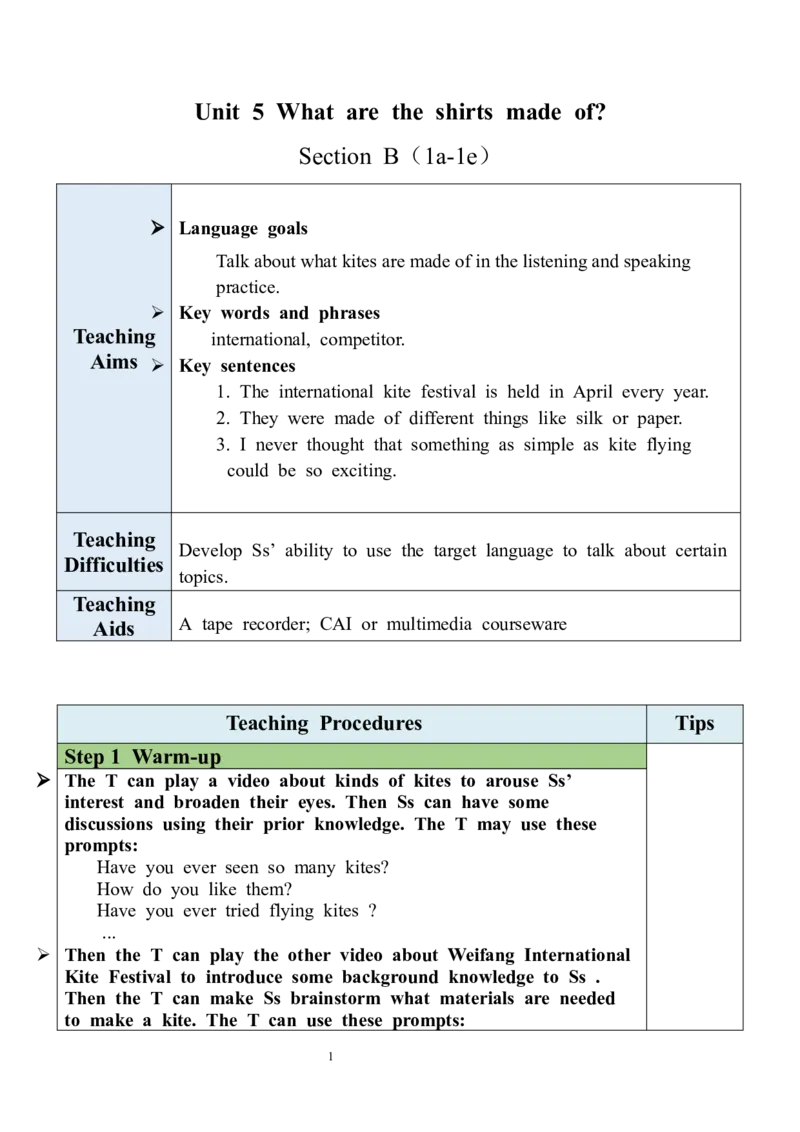
Unit 5 What are the shirts made of?
Section B(1a-1e)
Language goals
Talk about what kites are made of in the listening and speaking
practice.
Key words and phrases
Teaching international, competitor.
Aims
Key sentences
1. The international kite festival is held in April every year.
2. They were made of different things like silk or paper.
3. I never thought that something as simple as kite flying
could be so exciting.
Teaching
Develop Ss’ ability to use the target language to talk about certain
Difficulties
topics.
Teaching
Aids A tape recorder; CAI or multimedia courseware
Teaching Procedures Tips
Step 1 Warm-up
The T can play a video about kinds of kites to arouse Ss’
interest and broaden their eyes. Then Ss can have some
discussions using their prior knowledge. The T may use these
prompts:
Have you ever seen so many kites?
How do you like them?
Have you ever tried flying kites ?
...
Then the T can play the other video about Weifang International
Kite Festival to introduce some background knowledge to Ss .
Then the T can make Ss brainstorm what materials are needed
to make a kite. The T can use these prompts:
1Have you ever made a kite?
What materials or tools do we need to make a kite?
Then the T can list the materials and tools on the board so
that Ss
can have a review of these words and phrases.
Step 2 Presentation & Practice
1a
This activity is to review the target language for talking
about what things are made of. If feasible, the T may bring
one or two kites to class and have Ss identify the materials
used to make those kites. Alternatively, the T may ask Ss
prior to this lesson to bring any kites they might have for
this lesson.
1a
Ss look at the pictures in 1a and the T can ask some
questions such as “Are they bees? Are they flies? Is this a
butterfly? ” to help Ss to review the learned words. Ss finish
the task in 1a and share their answers by making
conversations using the target language structure in pairs.
Suggested answers: paper, silk, nylon, wood/bamboo
1b
Before-listening, the T can ask Ss to look through the context
in 1b to predict. The T may use these prompts:
If Laura wants to know what Zheng Yun did on his vacation,
she may ask Zhang Yun:
What did you do …?
What happened …?
What took place …?
If Laura wants to know what Zheng Yun thinks about Weifang,
she may ask Zheng Yun:
How is …?
How do you find … ?
How do you like … ?
1b
The T can play the recording and Ss finish the task in 1b.
Then the T can invite some Ss to share answers by asking
the following questions and then the T can make feedback.
What is Laura trying to find out more about?
Does Zheng Yun tell Laura about a kite festival or how to
make a
2kite?
Why did you choose that answer?
Answers: 1.A 2.A
1b
After Ss have completed activity 1b, the T may want to ask
Ss to listen to the recording again and identify the
superlatives used to describe the kites. (best/highest)
1c
This activity is to give Ss practice in listening for specific
information. The T can ask Ss to look through the sentences
in 1c before playing the recording .Ss finish the task in 1c
and the T can nominate Ss to share their answers .
Answers:
1. Z 2.L 3.Z 4.L 5.L
1d
This activity is to give Ss further practice in listening for
specific information. Before playing the recording again, the T
can have Ss work in pairs to predict answers in 1d so that
they can be more focused when listening. Then the T present
the correct answers.
Answers:
1.kites 2.April 3.all over the world
4.competitions 5.silk or paper; drawings.
1e
To provide Ss with speaking practice using the target
language, the T can invite Ss to role-play the conversations
between Laura and Zheng Yun. Or make them work in
closed pairs. The T can observe the Ss’ performance and
provide support when necessary.
Other options:
The T may have Ss work in pairs to make a conversation
about other festivals they have been to, then invite a few
pairs to role-play their conversations for the class.
Step 4 Language points learning
international adj. 国际的 The
international作形容词,由“ inter-(前缀)+ nation(n. 国家;民 language
族) + -al(形容词后缀)”构成。 points are
(1)前缀inter-表示“……之间,相互”。 for
reference
inter- + net(n. 网络)Internet(n. 互联网)
only.
(2)后缀-al常加在名词之后,构成形容词,表示“与.....有关的”。
3nature(n. 自然)去e + -al natural(adj. 自然的)
competitor n. 参赛者;竞争者
(1)compete作动词,意为“竞争”。
Some companies are competing against each other for the market.
(2)competition作名词,意为“比赛,竞争”。
He took part in several chess competitions last year.
Step 5 Summary & Homework
The
Summary The T can encourage Ss to summarize the key points homework
of this class to help Ss consolidate the knowledge. can vary
Homework: with the
Preview the passage in Section B 2b. specific
Do the exercises in students’ book. conditions
.
In this period,the students should expand the topic.They have a lot to
say about their favorite topic-flying kites.The students can practice the
conversation in listening and speaking.Before listening the teacher gets
Teaching
Reflection them to prepare new words on the topic and review the material words and
the passive voice.After listening , they practice orally to make
conversations.
4