文档文本内容
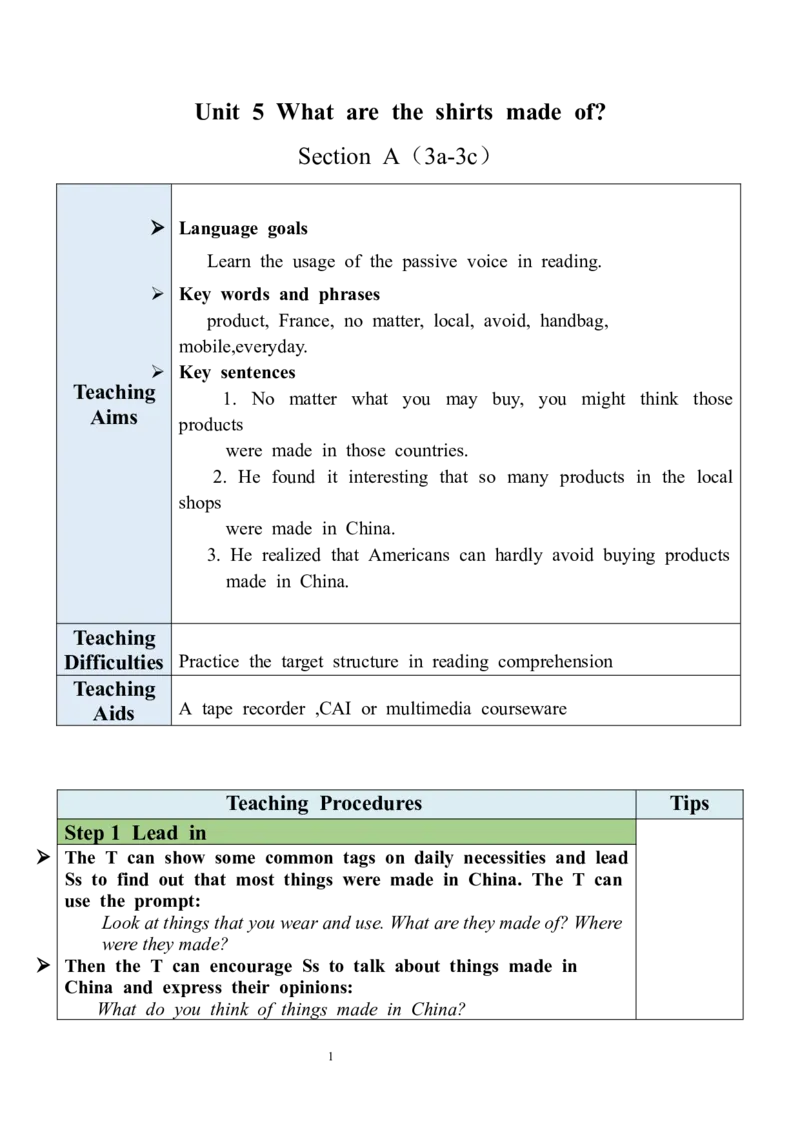
Unit 5 What are the shirts made of?
Section A(3a-3c)
Language goals
Learn the usage of the passive voice in reading.
Key words and phrases
product, France, no matter, local, avoid, handbag,
mobile,everyday.
Key sentences
Teaching
1. No matter what you may buy, you might think those
Aims
products
were made in those countries.
2. He found it interesting that so many products in the local
shops
were made in China.
3. He realized that Americans can hardly avoid buying products
made in China.
Teaching
Difficulties Practice the target structure in reading comprehension
Teaching
Aids A tape recorder ,CAI or multimedia courseware
Teaching Procedures Tips
Step 1 Lead in
The T can show some common tags on daily necessities and lead
Ss to find out that most things were made in China. The T can
use the prompt:
Look at things that you wear and use. What are they made of? Where
were they made?
Then the T can encourage Ss to talk about things made in
China and express their opinions:
What do you think of things made in China?
1 The T can set a scene and and ask Ss to brainstorm some local
products in different countries so that Ss’ can be more involved
in the class and prepare well for the following reading task.
If you go abroad for vacation, what local products will you buy
?
In Japan/France/Switzerland, I will buy...
Then the T can tell Ss that most of these products are
made in China.Things made in China have been all over the
world.
The T can play a video about a blogger’s one-day experience in
America of avoiding using things made in China. After watching
the video, the Ss can exchange their feelings.
Step 2 Presentation & Reading
Before-reading
The T can ask Ss to talk about the title and the picture in 3a
and have a discussion. The T can use these prompts:
1. Where is the tourist?
2. Does he want to buy Chinese products or American
products?
3. Is it easy for him to buy American products? Why?
3a While-reading
The T make Ss read the passage quickly and find the key
information to finish the task in 3a. Then the T can invite
some Ss to share answers with the class.
Answers:
1.He wanted to buy a toy car and a pair of basketball shoes.
2. Most of the shoes and toys that he found were made in
China.
3b While-reading
The activity is to encourage Ss to read for details and to
express their opinions in response to what they have read.
The T can ask Ss to read the questions first. Ss read the
passage again carefully and finish the task in 3b. Then the
T can invite some Ss to share answers with the class.
Answers:
1. San Francisco.
2. He discovered that so many products in the local shops were
made in China.
3. Because he wanted to buy a pair of basketball shoes made
in America.
24. He realized that Americans can hardly avoid buying products
made in China.
Suggested answer:
5. I think Chinese people are great; they can make many things
and sell them to places around the world. It shows that China
is a great and strong country. I feel proud as a Chinese.
3b
The T can extend the activity by conducting a class
discussion based on question 5. Encourage Ss to express their
opinions about so many foreign brands having their products
made in China and how they feel about it and why they feel
about it.
At last, the T can summarize the passage with Ss by asking
the following questions:
1. Which is the most important key word in the title?(difficult)
2. Why do you think so?(The passage is about how difficult Kang
Jian’s search for products made in America was.)
3c
The T can point out to Ss that the aim of this activity is to
enhance their understanding of the use of pronouns. Being
able to understand how pronouns are used is an important
skill for reading and writing. Since a pronoun usually refers
to something that has already been mentioned, to
understand what a pronoun stands for , we should look at
the earlier part of the sentence or the sentence that comes
before. Ss can first find the sentence with the target
pronoun and try analyzing the elements of the sentence and
master the usage of these pronouns.
Answers:
those(products):cameras, beautiful clothes, watches
those(countries):Japan, France, Switzerland
it:so many products in the local shops were made in China
they: most of the toys
Step 3 Language points learning
search n.&v. 搜索,搜查 用作名词时,常用短语 in search of,意 The
为“寻找”,后接寻找的人或物。 language
points are
no matter 无论;不论 与 what, who, when, where, how for
等疑问词连用,引导让步状语从句 reference
only.
avoid v. 避免;回避 常用搭配:
①avoid sb./sth. 躲避某人/ 某事
3② avoid doing sth. 避免做某事
Step 5 Summary & Homework
Summary The T can encourage Ss to summarize the key points The
of this class to help Ss consolidate the knowledge. homework
Homework: can vary
Read and recite the passage in 3a. with the
Do the exercises in students’ book. specific
conditions.
During the teaching process, teachers had better not translate every
sentence into Chinese or explain it in Chinese, but to understand students'
mastery of information through asking questions at all levels, guide students
Teaching to pay attention to some words, phrases or sentence patterns through asking
Reflection questions, and "force" students to answer questions with some words,
phrases and sentence patterns through asking questions, so as to enable
students to perceive the target language and use the target language, and
cultivate students' ability to use the target language.
4