文档文本内容
Unit 5 What are the shirts made of ?
Section A(Grammar Focus-4c)
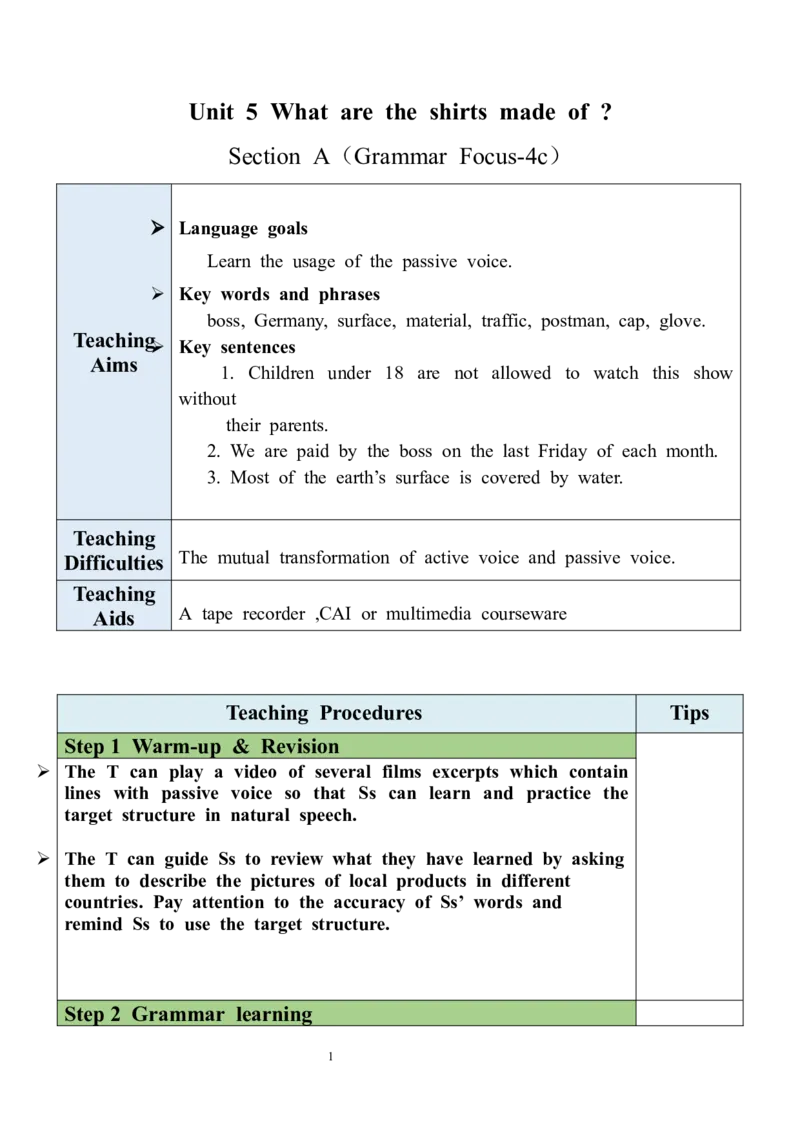
Language goals
Learn the usage of the passive voice.
Key words and phrases
boss, Germany, surface, material, traffic, postman, cap, glove.
Teaching
Key sentences
Aims
1. Children under 18 are not allowed to watch this show
without
their parents.
2. We are paid by the boss on the last Friday of each month.
3. Most of the earth’s surface is covered by water.
Teaching
The mutual transformation of active voice and passive voice.
Difficulties
Teaching
Aids A tape recorder ,CAI or multimedia courseware
Teaching Procedures Tips
Step 1 Warm-up & Revision
The T can play a video of several films excerpts which contain
lines with passive voice so that Ss can learn and practice the
target structure in natural speech.
The T can guide Ss to review what they have learned by asking
them to describe the pictures of local products in different
countries. Pay attention to the accuracy of Ss’ words and
remind Ss to use the target structure.
Step 2 Grammar learning
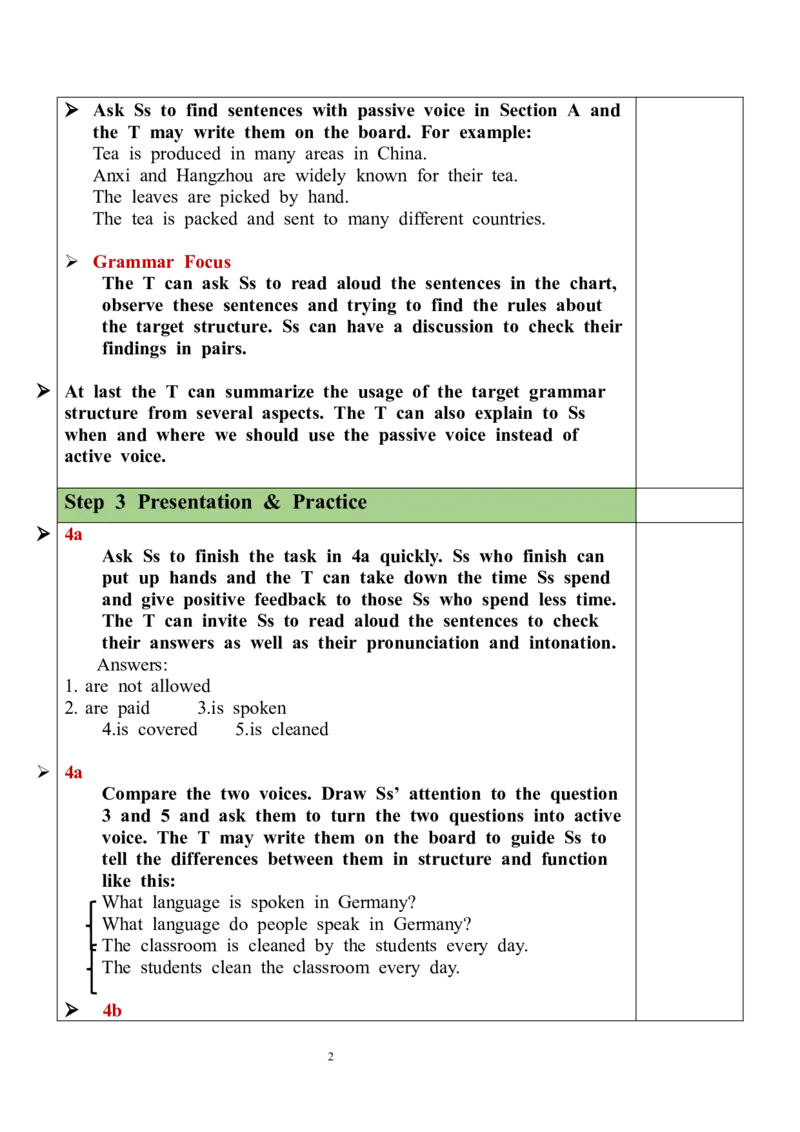
1 Ask Ss to find sentences with passive voice in Section A and
the T may write them on the board. For example:
Tea is produced in many areas in China.
Anxi and Hangzhou are widely known for their tea.
The leaves are picked by hand.
The tea is packed and sent to many different countries.
Grammar Focus
The T can ask Ss to read aloud the sentences in the chart,
observe these sentences and trying to find the rules about
the target structure. Ss can have a discussion to check their
findings in pairs.
At last the T can summarize the usage of the target grammar
structure from several aspects. The T can also explain to Ss
when and where we should use the passive voice instead of
active voice.
Step 3 Presentation & Practice
4a
Ask Ss to finish the task in 4a quickly. Ss who finish can
put up hands and the T can take down the time Ss spend
and give positive feedback to those Ss who spend less time.
The T can invite Ss to read aloud the sentences to check
their answers as well as their pronunciation and intonation.
Answers:
1. are not allowed
2. are paid 3.is spoken
4.is covered 5.is cleaned
4a
Compare the two voices. Draw Ss’ attention to the question
3 and 5 and ask them to turn the two questions into active
voice. The T may write them on the board to guide Ss to
tell the differences between them in structure and function
like this:
What language is spoken in Germany?
What language do people speak in Germany?
The classroom is cleaned by the students every day.
The students clean the classroom every day.
4b
2Ss finish the task in 4b and then communicate with their
partners.
Then the T can invite some Ss to share their answers in class
and the T can make assessments.
Answers:
2.The best materials are used to make dresses by this shop.
3.Many traffic accidents are caused by careless driving.
4.Letters and postcards are brought to people's homes by the
postman.
5. This silver plate is not used very often by our family.
4c
The activity is to reinforce the target language for talking
about what things are made of and where they were made.
The T may prompt Ss to name the things they are wearing
and the things they have on their desks and in their
schoolbags. Write these words on the board. Have Ss work
in pairs to make similar conversations using the things they
have just named. The T can then invite a few pairs to role-
play their alternative conversations.
Step 4 Summary & Homework
Summary The T can encourage Ss to summarize the key points The
of this class to help Ss consolidate the knowledge. homework
Homework: can vary
Preview the new words and phrases in Section B(1a-1e). with the
Do the exercises in students’ book. specific
conditions.
Grammar focus arranges the general present tense usage of the passive
voice in this unit, including declarative sentences, general questions, special
questions and answers. The activity 4a highlights the structure of the
passive voice. Activity 4b is to turn the active voice into the passive
Teaching voice. It aims to break through the difficult points and let students
Reflection compare the different structures and functions of the two voices. Activity
4c reproduce the language knowledge learned in this unit in the form of
dialogue. Let students consolidate the language through reading and oral
practice. While teaching, teachers should also focus Ss’ attention to
the past participle of irregular verbs involved in the structure.
3