Unit 3 Could you please tell me where the restrooms
are?
Section B(3a-Self Check)
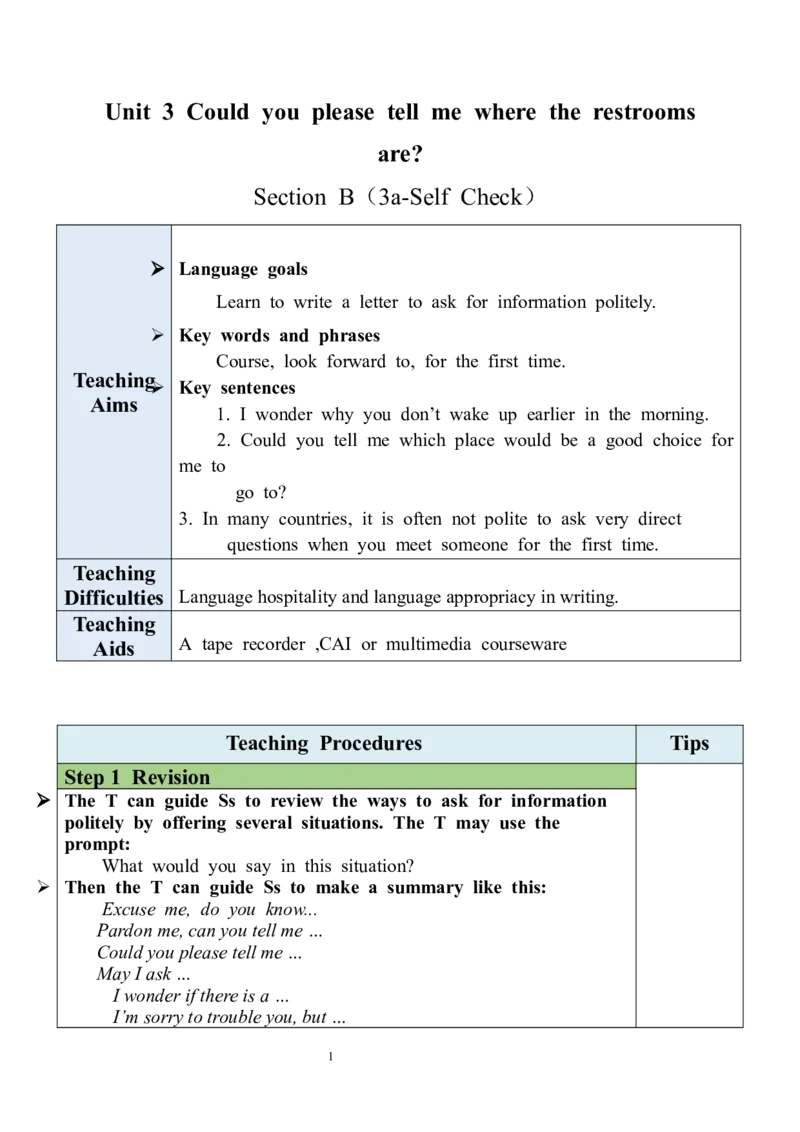
Language goals
Learn to write a letter to ask for information politely.
Key words and phrases
Course, look forward to, for the first time.
Teaching
Key sentences
Aims
1. I wonder why you don’t wake up earlier in the morning.
2. Could you tell me which place would be a good choice for
me to
go to?
3. In many countries, it is often not polite to ask very direct
questions when you meet someone for the first time.
Teaching
Difficulties Language hospitality and language appropriacy in writing.
Teaching
Aids A tape recorder ,CAI or multimedia courseware
Teaching Procedures Tips
Step 1 Revision
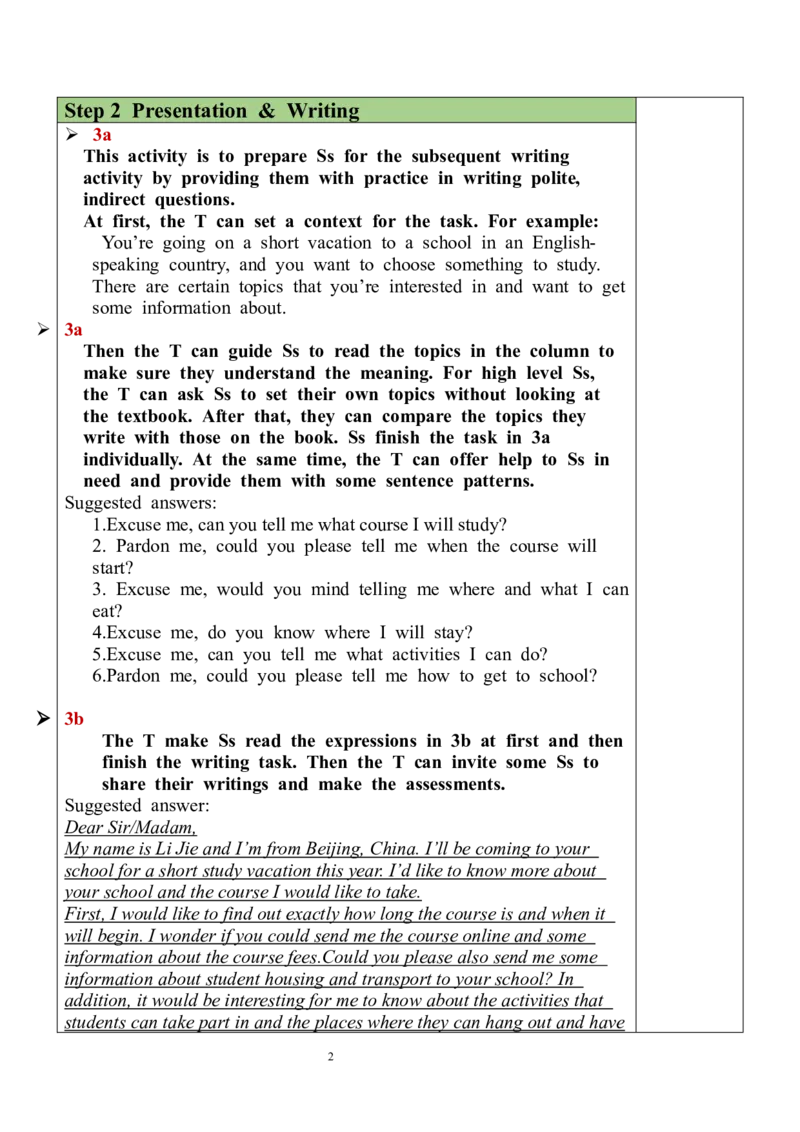
The T can guide Ss to review the ways to ask for information
politely by offering several situations. The T may use the
prompt:
What would you say in this situation?
Then the T can guide Ss to make a summary like this:
Excuse me, do you know...
Pardon me, can you tell me …
Could you please tell me …
May I ask …
I wonder if there is a …
I’m sorry to trouble you, but …
1Step 2 Presentation & Writing
3a
This activity is to prepare Ss for the subsequent writing
activity by providing them with practice in writing polite,
indirect questions.
At first, the T can set a context for the task. For example:
You’re going on a short vacation to a school in an English-
speaking country, and you want to choose something to study.
There are certain topics that you’re interested in and want to get
some information about.
3a
Then the T can guide Ss to read the topics in the column to
make sure they understand the meaning. For high level Ss,
the T can ask Ss to set their own topics without looking at
the textbook. After that, they can compare the topics they
write with those on the book. Ss finish the task in 3a
individually. At the same time, the T can offer help to Ss in
need and provide them with some sentence patterns.
Suggested answers:
1.Excuse me, can you tell me what course I will study?
2. Pardon me, could you please tell me when the course will
start?
3. Excuse me, would you mind telling me where and what I can
eat?
4.Excuse me, do you know where I will stay?
5.Excuse me, can you tell me what activities I can do?
6.Pardon me, could you please tell me how to get to school?
3b
The T make Ss read the expressions in 3b at first and then
finish the writing task. Then the T can invite some Ss to
share their writings and make the assessments.
Suggested answer:
Dear Sir/Madam,
My name is Li Jie and I’m from Beijing, China. I’ll be coming to your
school for a short study vacation this year. I’d like to know more about
your school and the course I would like to take.
First, I would like to find out exactly how long the course is and when it
will begin. I wonder if you could send me the course online and some
information about the course fees.Could you please also send me some
information about student housing and transport to your school? In
addition, it would be interesting for me to know about the activities that
students can take part in and the places where they can hang out and have
2their meals after school.
I would like to thank you for your help and I’m looking forward to your
reply.
Yours faithfully,
Li Jie
Step 3 Self Check
1
This part is to check Ss’ understanding to the key
expressions and functions of this unit. It can also practice
the Ss’ comprehensive skills . The T can ask Ss to read
these words first and make sure all of them can understand
these expressions. Then Ss can be asked to finish the task on
their own. At last, the T present the correct answer.
Answers:
1.corner 2.rush, plan 3.suggest 4.polite, direct
2
The T can ask Ss to read the expressions and make sure
they understand them and then finish the task individually.
Then Ss can work in pairs and role-play their conversations
to check if their answers are right.
Suggested answers:
2.Q: Do you know where I can get some stamps?
A:You can get them at the post office on Green Street.
3.Q:Could you tell me what time the shopping center opens?
A:It opens at 10:00 a.m..
4. Q:May I ask how to get to the Japanese restaurant?
A:Just go along Main Street and turn right on Lake street.
Step 4 Language points learning
look forward to 意为“期待;期盼” 其中的to为介词,其后接 The
名词、代词、动名词(动词-ing)作宾语。 language
reply用作名词,意为“答复”,相当于answer,表示“……的答 points are
复”时,reply与answer都需要与to连用。 for
reference
reply用作不及物动词,意为“回答,回复”,
only.
reply to sb./sth.表示“对某人/某事作 出回答”。用作及物动词,
其后可接宾语从句。
answer作及物动词,其后可直接跟名词或代词作宾语。
Step 5 Summary & Homework
3 Summary The T can encourage Ss to summarize the key points
of this class to help Ss consolidate the knowledge. The
Homework: homework
Preview Unit 4 Section A (1A-1C). can vary
Do the exercises in students’ book. with the
specific
conditions.
In the writing task chain, textbook activities aim to guide students to ask
questions through topics, then design the writing with questions as clues,
and then write. This is a writing conception strategy commonly used in
writing. When we encounter problems that need to be solved, we will put
forward a series of relevant problems in the context of the environment at
that time, and then sort out our ideas, find out the answers to these problems
Teaching
one by one, and implement them. When we need to seek solutions to these
Reflection
problems and consult relevant information, or enter the solutions to these
problems one by one in the form of text, we will have writing needs and
start writing. Therefore, in the teaching process of these two exercises,
teachers should highlight the three links of "situation setting", "question
asking" and "looking for answers" as much as possible, so that students can
understand and try to use the writing conception skill and strategy.
4