文档文本内容
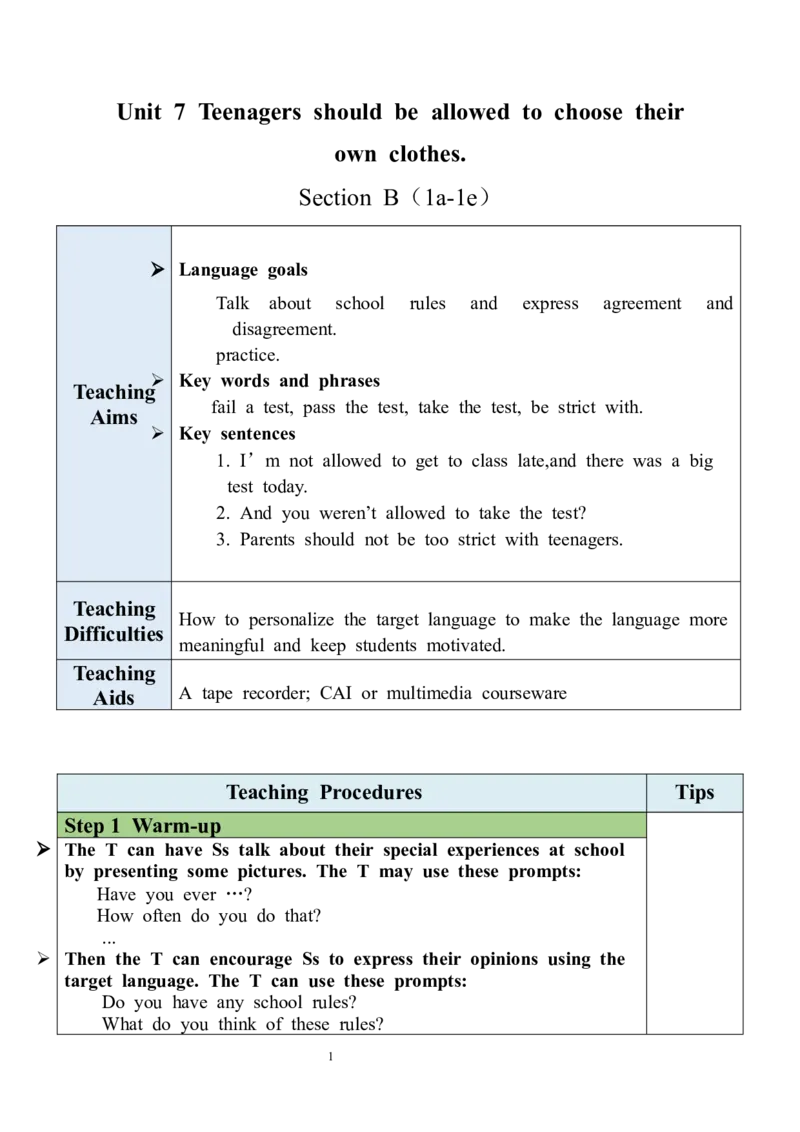
Unit 7 Teenagers should be allowed to choose their
own clothes.
Section B(1a-1e)
Language goals
Talk about school rules and express agreement and
disagreement.
practice.
Key words and phrases
Teaching
fail a test, pass the test, take the test, be strict with.
Aims
Key sentences
1. I’m not allowed to get to class late,and there was a big
test today.
2. And you weren’t allowed to take the test?
3. Parents should not be too strict with teenagers.
Teaching
How to personalize the target language to make the language more
Difficulties
meaningful and keep students motivated.
Teaching
Aids A tape recorder; CAI or multimedia courseware
Teaching Procedures Tips
Step 1 Warm-up
The T can have Ss talk about their special experiences at school
by presenting some pictures. The T may use these prompts:
Have you ever …?
How often do you do that?
...
Then the T can encourage Ss to express their opinions using the
target language. The T can use these prompts:
Do you have any school rules?
What do you think of these rules?
1What do you think teenagers should be allowed to do at school?
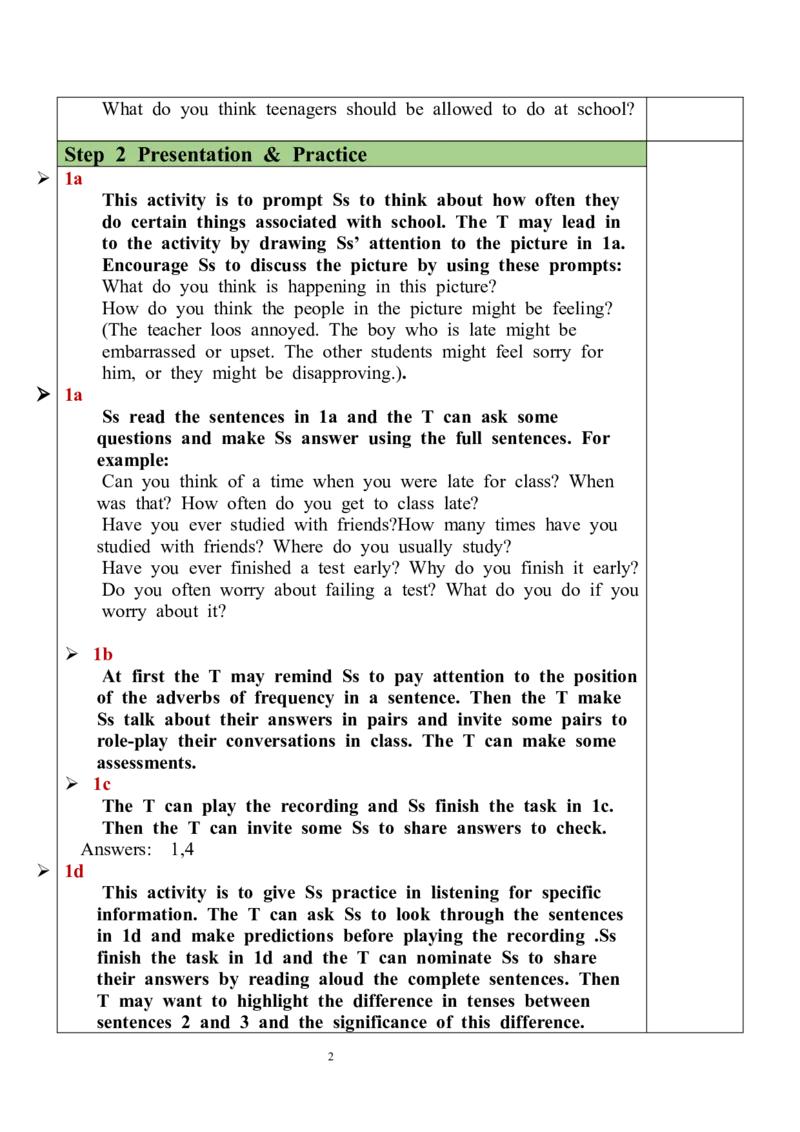
Step 2 Presentation & Practice
1a
This activity is to prompt Ss to think about how often they
do certain things associated with school. The T may lead in
to the activity by drawing Ss’ attention to the picture in 1a.
Encourage Ss to discuss the picture by using these prompts:
What do you think is happening in this picture?
How do you think the people in the picture might be feeling?
(The teacher loos annoyed. The boy who is late might be
embarrassed or upset. The other students might feel sorry for
him, or they might be disapproving.).
1a
Ss read the sentences in 1a and the T can ask some
questions and make Ss answer using the full sentences. For
example:
Can you think of a time when you were late for class? When
was that? How often do you get to class late?
Have you ever studied with friends?How many times have you
studied with friends? Where do you usually study?
Have you ever finished a test early? Why do you finish it early?
Do you often worry about failing a test? What do you do if you
worry about it?
1b
At first the T may remind Ss to pay attention to the position
of the adverbs of frequency in a sentence. Then the T make
Ss talk about their answers in pairs and invite some pairs to
role-play their conversations in class. The T can make some
assessments.
1c
The T can play the recording and Ss finish the task in 1c.
Then the T can invite some Ss to share answers to check.
Answers: 1,4
1d
This activity is to give Ss practice in listening for specific
information. The T can ask Ss to look through the sentences
in 1d and make predictions before playing the recording .Ss
finish the task in 1d and the T can nominate Ss to share
their answers by reading aloud the complete sentences. Then
T may want to highlight the difference in tenses between
sentences 2 and 3 and the significance of this difference.
2Answers:
1. c 2.e 3.a 4.b 5.d
Then the T can play the recording again and stop at the key
point to draw Ss’ attention to some key sentences so that Ss
can have a better understanding of the listening material.
The T can even invite some high level Ss to repeat the
sentences after listening to practice their oral ability.
1e
The activity is to provide Ss with speaking practice using the
target language. Before asking Ss to to start on the activity,
the T may want to review phrases used to express opinions
and to agree and disagree. E.g. I think/ I don’t think/ I agree/
I disagree/I don’t know about that/ I’m not sure but...
Then the T can divide Ss into groups of four or five to
discuss the questions in 1e. The T can use the following
prompts to help Ss to discuss:
1. Peter should be allowed to take the test later.
Do you think Peter should be allowed to take the test later?
Why do you think he should?
Why do you think he should not?
Is it fair or unfair for the other students if he takes the test later?
Will more students come to class late if he gets to take the test later?
2. Students need strict rules.
Why do students need strict rules?
Do you think a school has to have rules?
What will happen if there are no rules at school?
Does a rule tell you what is right and what is wrong?
3.Parents should not be too strict with teenagers.
Are your parents too strict with you?
Is it good or bad for you?
Do you like the rules? Why? Why not?
Step 3 Summary & Homework
3 Summary The T can encourage Ss to summarize the key points The
of this class to help Ss consolidate the knowledge. homework
Homework: can vary
Preview the passage in Section B 2b. with the
Do the exercises in students’ book. specific
conditions
.
The design of activities before listening(Activities1a and 1b) is very
important. The purpose is to activate the memory in students' brain, recall
the learned words, phrases and sentence patterns, and pave the way for
listening activities. At the same time, students' response process is also to
learn and consolidate language knowledge in application. The role of
teachers in this link is also very important. They should be good at
providing topics and mastering the rhythm and difficulty levels of the
discussion and adjusting the discussion atmosphere. We should not only
Teaching
encourage excellent students to express actively, but also pay attention to
Reflection
the students with average or weak foundation and give them the
opportunity to express, even if they are just asked to repeat the statements
of other students or express whether they agree with others. Teachers should
also purposefully pre-teach the unfamiliar words possibly appearing in
1c-1d.
In addition, the demonstration of teachers' language is extremely
important. The wording should be concise, clear and easy to understand,
which is also an important language information input.
4