文档文本内容
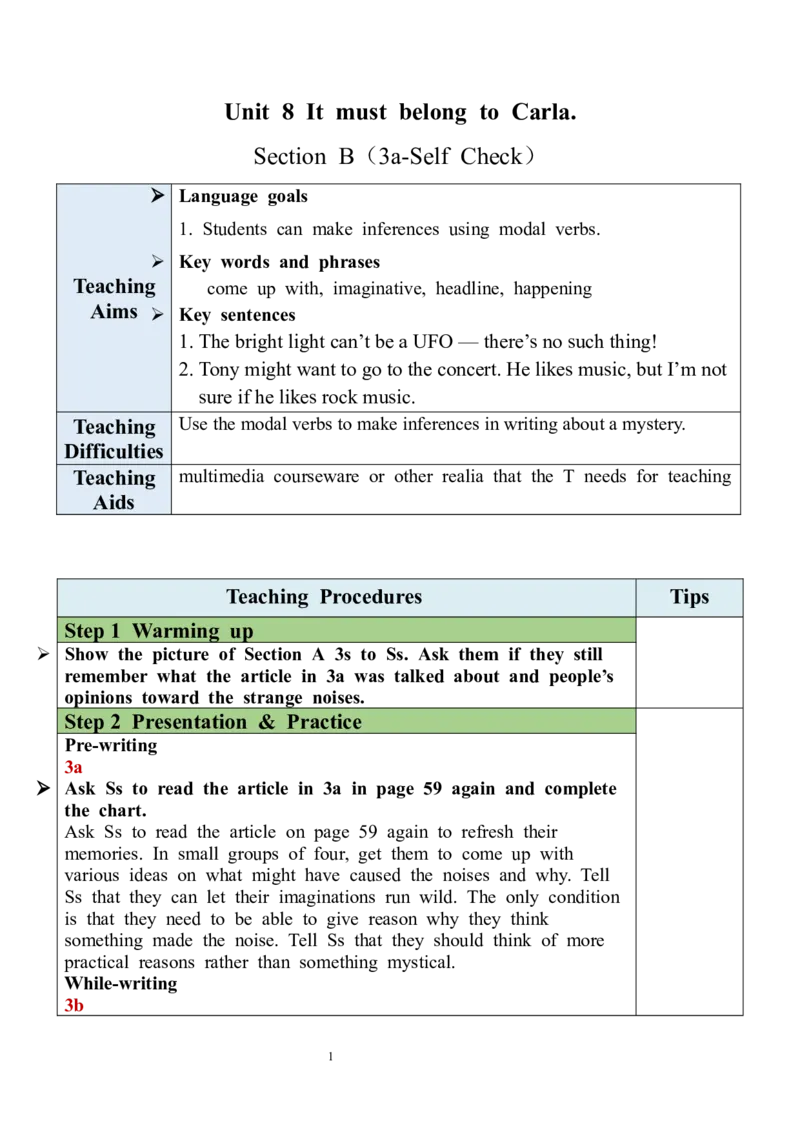
Unit 8 It must belong to Carla.
Section B(3a-Self Check)
Language goals
1. Students can make inferences using modal verbs.
Key words and phrases
Teaching come up with, imaginative, headline, happening
Aims
Key sentences
1. The bright light can’t be a UFO — there’s no such thing!
2. Tony might want to go to the concert. He likes music, but I’m not
sure if he likes rock music.
Teaching Use the modal verbs to make inferences in writing about a mystery.
Difficulties
Teaching multimedia courseware or other realia that the T needs for teaching
Aids
Teaching Procedures Tips
Step 1 Warming up
Show the picture of Section A 3s to Ss. Ask them if they still
remember what the article in 3a was talked about and people’s
opinions toward the strange noises.
Step 2 Presentation & Practice
Pre-writing
3a
Ask Ss to read the article in 3a in page 59 again and complete
the chart.
Ask Ss to read the article on page 59 again to refresh their
memories. In small groups of four, get them to come up with
various ideas on what might have caused the noises and why. Tell
Ss that they can let their imaginations run wild. The only condition
is that they need to be able to give reason why they think
something made the noise. Tell Ss that they should think of more
practical reasons rather than something mystical.
While-writing
3b
1 Ask Ss to look at the newspaper headline and finish the article
about the strange happenings.
T can allow Ss to do this activity as a group project. Ask Ss
brainstorm on how to complete the article. Once they finished
writing the article as a group, get Ss to think about how to lay out
the article as a newspaper article. If possible, T can provide each
group a large-enough sheet of paper so they can write their article
on it. Remind Ss that English newspaper articles usually follow a
column-format, and bigger news stories have an accompanying
pictures.
Post-writings
When the groups submit their articles, T can select two or three
well-written or well-designed ones to put on the classroom notice
board.
Self Check
Exercise 1
Ask Ss to fill in the blanks with must, might or can’t.
Answers: 1. can’t 2. could / might 3. must 4. might 5. can’t
Exercise 2
Ask Ss to look at the chart and write sentences.
(Tip: T should encourage Ss to write more different sentences.)
Answers: 1. It can’t be Mike’s. He doesn’t like to watch movies.
2. It can’t be Todd’s. He doesn’t eat sweet food.
3. It must be Jessica’s. She likes taking photos.
4. It can’t be Annie’s. She doesn’t like to cook.
5. It must be Mike’s. He likes to play tennis.
6. It can’t be Jessica’s. She doesn’t like to run.
Step 3 Summary & Homework
Summary
Ask Ss to do the exercises from PPT P14-15.
Homework
Preview 1a-1c in Unit 9.
Do the exercises in students’ book.
This is the period for writing practice. In this period, we help the students
to review the unit and tell them how to write the story. Before the students
write, they talk about the story so that they have enough expressions to use.
Teaching
Then they learn what are in the first, second and third part of the article.
Reflection
That is to get the students to write what they have learned in listening,
speaking and reading. Teach them how to use linking words to make their
sentences longer.
2