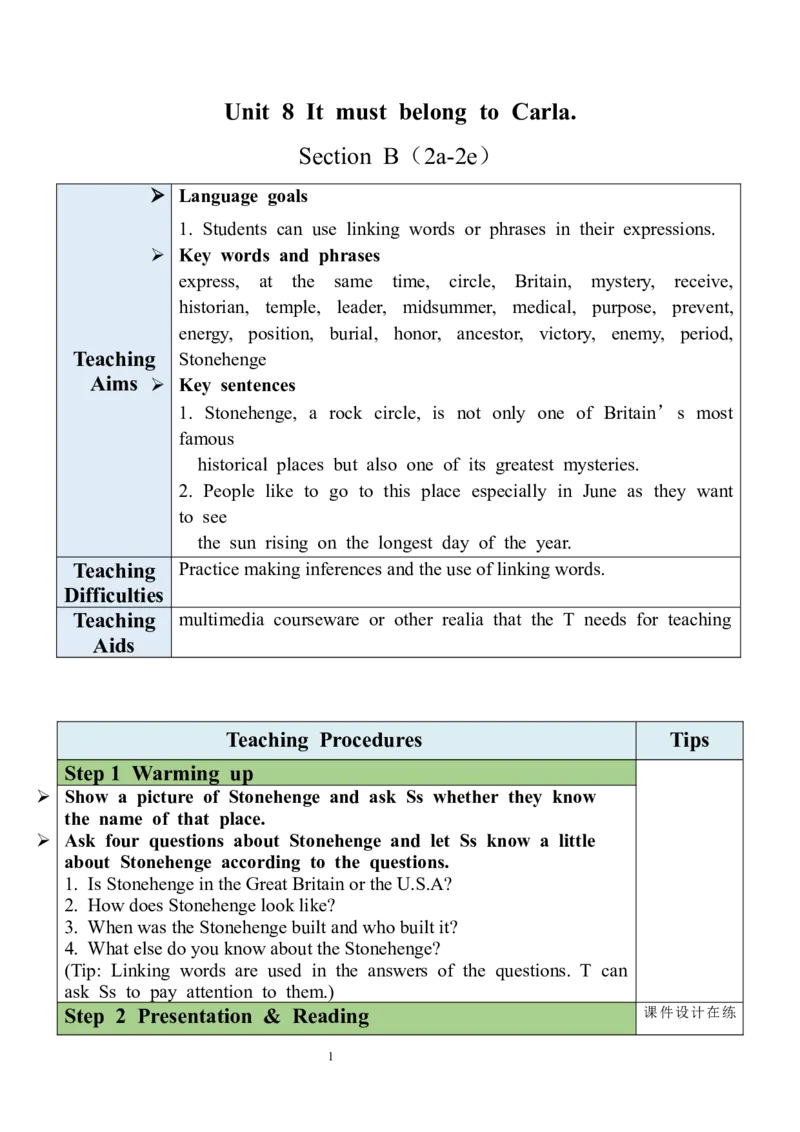
Unit 8 It must belong to Carla.
Section B(2a-2e)
Language goals
1. Students can use linking words or phrases in their expressions.
Key words and phrases
express, at the same time, circle, Britain, mystery, receive,
historian, temple, leader, midsummer, medical, purpose, prevent,
energy, position, burial, honor, ancestor, victory, enemy, period,
Teaching Stonehenge
Aims Key sentences
1. Stonehenge, a rock circle, is not only one of Britain’s most
famous
historical places but also one of its greatest mysteries.
2. People like to go to this place especially in June as they want
to see
the sun rising on the longest day of the year.
Teaching Practice making inferences and the use of linking words.
Difficulties
Teaching multimedia courseware or other realia that the T needs for teaching
Aids
Teaching Procedures Tips
Step 1 Warming up
Show a picture of Stonehenge and ask Ss whether they know
the name of that place.
Ask four questions about Stonehenge and let Ss know a little
about Stonehenge according to the questions.
1. Is Stonehenge in the Great Britain or the U.S.A?
2. How does Stonehenge look like?
3. When was the Stonehenge built and who built it?
4. What else do you know about the Stonehenge?
(Tip: Linking words are used in the answers of the questions. T can
ask Ss to pay attention to them.)
Step 2 Presentation & Reading 课件设计在练
1习顺序上做了
Pre-reading
一些调整。思
路为:介绍巨
Show the title of the article to Ss and ask them to make
石阵并呈现连
词—介绍什么
prediction about the content.
是连词并让学
生在文章中划
While-reading
出连词—学习
连词的作用并
Introduce linking words to Ss. Tell them that they need to
练习—泛读,
了解段落大意
identify and underline linking words while reading.
—寻读,抓住
文章的细节信
2a 息—读后拓展
练习—逐字逐
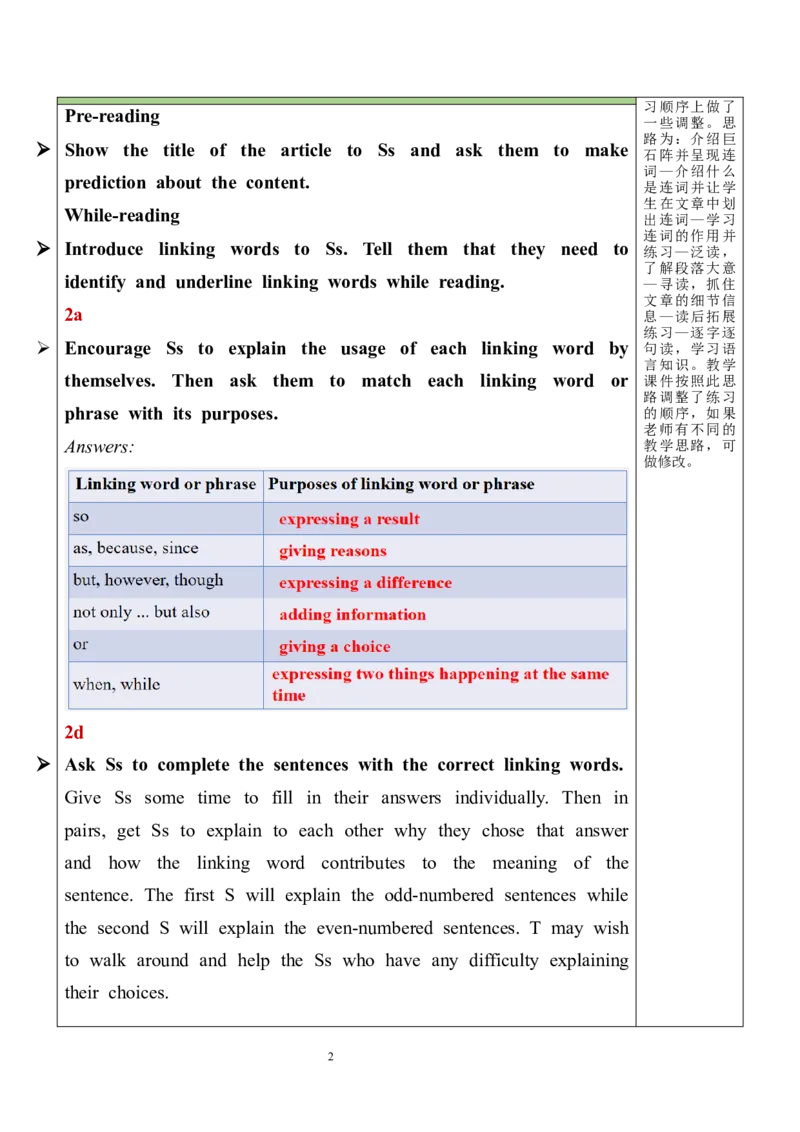
Encourage Ss to explain the usage of each linking word by 句读,学习语
言知识。教学
themselves. Then ask them to match each linking word or 课件按照此思
路调整了练习
phrase with its purposes. 的顺序,如果
老师有不同的
Answers: 教学思路,可
做修改。
2d
Ask Ss to complete the sentences with the correct linking words.
Give Ss some time to fill in their answers individually. Then in
pairs, get Ss to explain to each other why they chose that answer
and how the linking word contributes to the meaning of the
sentence. The first S will explain the odd-numbered sentences while
the second S will explain the even-numbered sentences. T may wish
to walk around and help the Ss who have any difficulty explaining
their choices.
2Answers: 1. and 2. as 3. not only, but also 4. or 5. however
T rewrites the sentences in 2b and then ask Ss to complete the
sentences using different linking words.
Answers: 1. because 2. so 3. while 4. Though
Ask Ss to read the article and summarize the main idea of each
paragraph.
Para 1: Stonehenge is not only a famous historical place, but also a
great mystery.
Para 2: Historians have different ideas about what Stonehenge was
built for.
Para 3: Different ideas about the purposes of Stonehenge.
Para 4: Who built Stonehenge, when it was built and how it was
built are still mysteries.
Ask Ss to read the rest parts of the article and answer the
questions.
Who built Stonehenge? No one really knows.
When was it built? Most historians believe it was built 5,000 years
ago.
How was it built? Nobody knows.
Show the chart on PPT P26 to Ss and ask them to find out
people’s opinions about what Stonehenge was used for.
Historians believed it was a temple where ancient leaders tried to
communicate with the gods.
Historian Paul Stoker thinks it can’t be a temple.
Another popular idea is that Stonehenge might be a kind of calendar.
Other people believe the stones have a medical purpose.
Some think it might be a burial place or a place to honor ancestors.
Other think it was built to celebrate a victory over an enemy.
32c
In groups of four, get Ss to read the article to each other. Each
S will read one paragraph. After reading, ask them to discuss
and find out the mysteries about Stonehenge and what
Stonehenge might have been used for.
Answers:
Post-reading
2e
In small groups of four, get Ss to discuss any mysteries that
they know of. Encourage each S to contribute a different
mystery. Ask them to distinguish between what they know is
fact and what is myth.
(Tip: T can use the bronze standing figure in Sanxingdui museum
and the Moai of Easter island as examples.)
Activity
Ask Ss to look up information online and write a short passage
about a mystery they know. They are encouraged to draw a
picture or download some pictures of that mystery too.
T can use prompts:
1. What mystery can you think of?
42. What do you know about it?
3. What is mysterious about it?
Step 3 Language points learning
circle 既可作动词也可作名词。作名词意为“圆圈”,作动词意为 此处只呈现部
分语言点
“圈出;盘旋”。
receive的意思是“接待;收到;接受”,它与accept的区别是:
receive指客观上收到(信件、礼物、赠品等),不涉及收到者是否愿意
接受。本身有一定的被动性。accept指收到者经过考虑而愿意接受,
通常指主观上的接受,常与表示邀请或建议的句型连用。
arrive 的意思是“到达;抵达”,它与 reach 和 get to 的区别是:
arrive
后接表示地点的名词时,需接介词 in 或 at。其中 arrive in 后接大地
方,如国家、城市等;arrive at 后接小地方,如学校、车站等。reach
是及物动词,直接接表示地点的名词。get to 后接地点名词,多用于
口语。但是当表示地点的词是副词 here, there, home等时,介词 to, in,
at都要省略。
point out的意思是“指出;指明”,point的常用短语还有 point at和
point to,二者的区别是:point at指向离说话人较近的人或事物,意
为“指着”;point to 指向离说话人较远的人或事物,意为“指
向”。
prevent 的意思是“阻止;阻挠”,其常用短语是 prevent sb. from
doing
sth 在 prevent / stop sb. from doing sth.这个结构中,from 可以省
略,
在被动语态中不能省略。而在keep sb. from doing sth.中,from在任
时候都是不能省略的。
position 是名词,意思是“位置;地方”。它作名词还可以表示“工
作
职位”,相当于job。
Step 4 Summary & Homework
Homework:
Preview 3a-Self Check in Section B.
Do the exercises in students’ book.
Teaching In this period, the most important thing is reading. It is a good time to train
5the students’ ability of reading quickly and efficiently. While reading,
students should learn to catch the main and the most important ideas as
quickly as they can. They must learn some new words and new language
Reflection items. They practice the use of linking words. They need to learn some
long sentences in the reading passage.
After reading, we do some oral practice and discuss some questions to
check how well the students learn from the passage.
6