文档文本内容
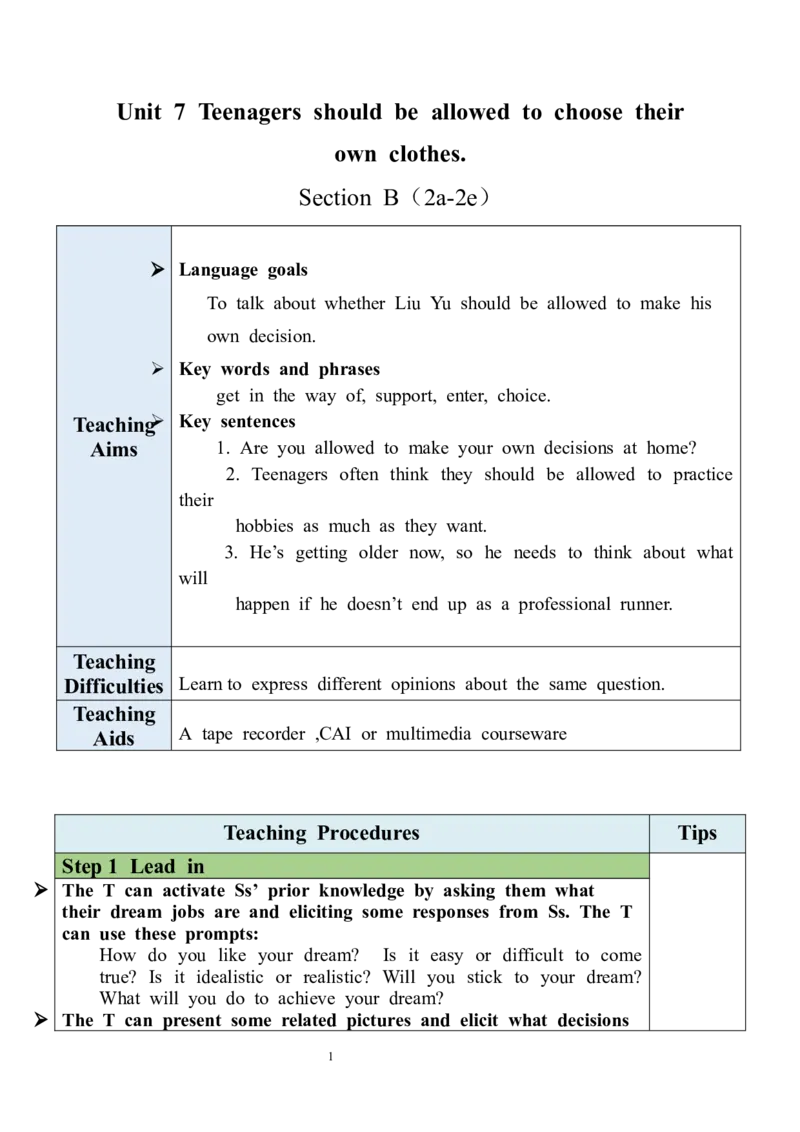
Unit 7 Teenagers should be allowed to choose their
own clothes.
Section B(2a-2e)
Language goals
To talk about whether Liu Yu should be allowed to make his
own decision.
Key words and phrases
get in the way of, support, enter, choice.
Teaching Key sentences
Aims 1. Are you allowed to make your own decisions at home?
2. Teenagers often think they should be allowed to practice
their
hobbies as much as they want.
3. He’s getting older now, so he needs to think about what
will
happen if he doesn’t end up as a professional runner.
Teaching
Difficulties Learn to express different opinions about the same question.
Teaching
Aids A tape recorder ,CAI or multimedia courseware
Teaching Procedures Tips
Step 1 Lead in
The T can activate Ss’ prior knowledge by asking them what
their dream jobs are and eliciting some responses from Ss. The T
can use these prompts:
How do you like your dream? Is it easy or difficult to come
true? Is it idealistic or realistic? Will you stick to your dream?
What will you do to achieve your dream?
The T can present some related pictures and elicit what decisions
1Ss want to make.The T can use the following prompts:
Are you allowed to make your own decisions at home?
What kinds of decisions?
What is the one decision you want to make most now?
Do you think you might be allowed to make this decision? why?
Step 2 Presentation & Reading
2a
The activity is to engage Ss in a speaking activity to prepare
them for the subsequent reading activity. Ask Ss to discuss in
groups and observe their performance and give proper feedback.
Try to get all Ss involved in the activity. Pay attention if they
use the target structure. The T may want to add on to the
activity by having Ss express their opinions on these additional
questions:
Why should you be allowed to make your own decisions at home?
When do you think someone is old enough to make his/her own
decisions?
Before reading, the T can ask Ss to look at the pictures and the
title and prompt Ss to predict by asking questions:
What do you think the passage is mainly about, according to the title?
What’s the boy in the picture doing?
What decision does he want to make?
Task 1 Skimming
The T can ask Ss to read the passage quickly and try to get
the main idea of the passage.
Task 2 &Task 3 Scanning
The T can ask Ss to read each paragraph carefully and fill in
the
blanks. Then the T can invite some Ss to share their answers.
These
tasks can help Ss get the specific details and have a better
understanding of the passage.
2b
The activity is to provide Ss with reading practice using the
target
language. The T can make Ss read the title first and answer
it. The
T can invite some Ss to explain their reasons. Then Ss can
read the
passage again and decide if they want to change their
2answers. The
T can invite the students who change answers to explain their
Reasons so that the T can check Ss’ understanding of the
passage.
2c
The activity is to provide Ss with practice in reading for details
and encourage Ss to respond to what they have learned. Ss can
read the questions first and then read the passage again to get
more details. Ss finish the task individually and then check their
answers in pairs.
Answers:
1. His hobby is running.
2. He wants to be a professional runner.
3. Because Liu Yu’s parents believe that he should study hard in the
evenings.
4. Suggested answers:
Yes, he has the potential to be a running star./ No, his parents know
best. His dream may not be realistic and he may regret it in the future
if he does not study hard now.
Besides the questions in the textbook , the T can provide more
questions to help Ss get familiar with the passage and develop
Ss' logical thinking skills. The following questions are offered for
reference:
What can get in the way of teenagers' schoolwork?(理解文中代词these)
What do their parents worry about?
What do you think makes up a child's success at school?
-How do Liu Yu’s parents feel about his dream?
Why won't they allow Liu Yu to train so much?
Is it really important to enter university?
Is it difficult to become a professional sports star?
What advice can you give to Liu Yu and his parents?
Do you have the same problem as Liu Yu'?How do you deal with it?
...
2d
The activity is to encourage the active learning of new
expressions by having Ss use these expressions in sentences of
their own. Before Ss start working on the activity, the T may
want to highlight the importance of using the sentences in the
passage as models to guide Ss’ writing. The T can make Ss find
out these phrases in the passage and read the sentences where
these phrases appear. Ss can be asked to say the meaning in
Chinese. In addition, the T may point out that several of the
expressions end up with a preposition, which means that what
3follows should be a noun, a noun phrase or a gerund. Then the
T can invite some Ss to read aloud the sentences to check their
answers.
Suggested Answers:
1. My parents worry about my school results
2. My parents have always taught me how important it is to be
honest in all situations.
3. I am serious about my part-time jobs.
4. I think it is unfair that I’m not allowed to hang out with friends.
5. I have always wanted to be a pilot.
6. My parents have nothing against makeup.
7. I need to think about what will happen if I don’t get a place in the
university of my choice.
8. I need to spend more time on practicing the piano
2e
The activity is to encourage Ss to express their opinions on a
given subject. The T may have Ss discuss the questions in
groups, and then have a class discussion and encourage some
volunteers to express their opinions. The T can also use these
prompts to help Ss:
What do you want to be?Is it your dream?Are you serious about it?
Do your parents have anything against your dream?
What do they worry about?
How much time do you spend working towards your dream?
What will happen if you fail in achieving your dream?
...
Step 3 Language points learning
get in the way of 挡...... 的路;妨碍 为固定短语,后接名词、代词 The
或动词-ing。可用be in one’s way或be in the way of...替换。 language
support 作及物动词,意为“支持”。 points are
support sb. /sth. (in... )意为“ (在......方面)支持某人/某事”。 for
reference
作动词,还可意为“养活,赡养;资助,赞助”。
only.
support还可作不可数名词,意为“支持”。
have nothing against ( doing) sth. 不反对
against 作介词,在此处意为“反对”,其反义词是for。 be
against (doing) sth.反对(做)某事。
enter作动词,在本单元意为“考上(大学或学校)”。此外,enter
还意为“进来;进去”,相当于go/ come into, 所以不再与介词into
4连用。enter作动词还有“报名参加”的意思。enter的名词形式为
entrance,意为“入口”
be serious about对.....认真 为固定短语,后接名词、代词或动词-ing
形式。其同义短语为take … seriously。
only 引导的倒装句
当only位于句首,后接副词、介词短语或状语从句时,句子要用部分
倒装结构。即:Only + 副词/介词短语/ 状语从句 +助动词/ be 动词/
情态动词+ 主语 + 其他.
Step 4 Summary & Homework The
homework
Summary The T can encourage Ss to summarize the key points can vary
of this class to help Ss consolidate the knowledge. with the
Homework: specific
Read and recite the passage in 2b. conditions
Do the exercises in students’ book. .
Asking questions centered on unit topics can activate students'
background knowledge and stimulate their interest. During the conversation,
Teaching teachers can also take the opportunity to deal with new words that will cause
Reflection difficulties in understanding, such as enter, professional, support, get in the
way. they can also review the previously learned phrases and sentence
patterns and make more input.
5