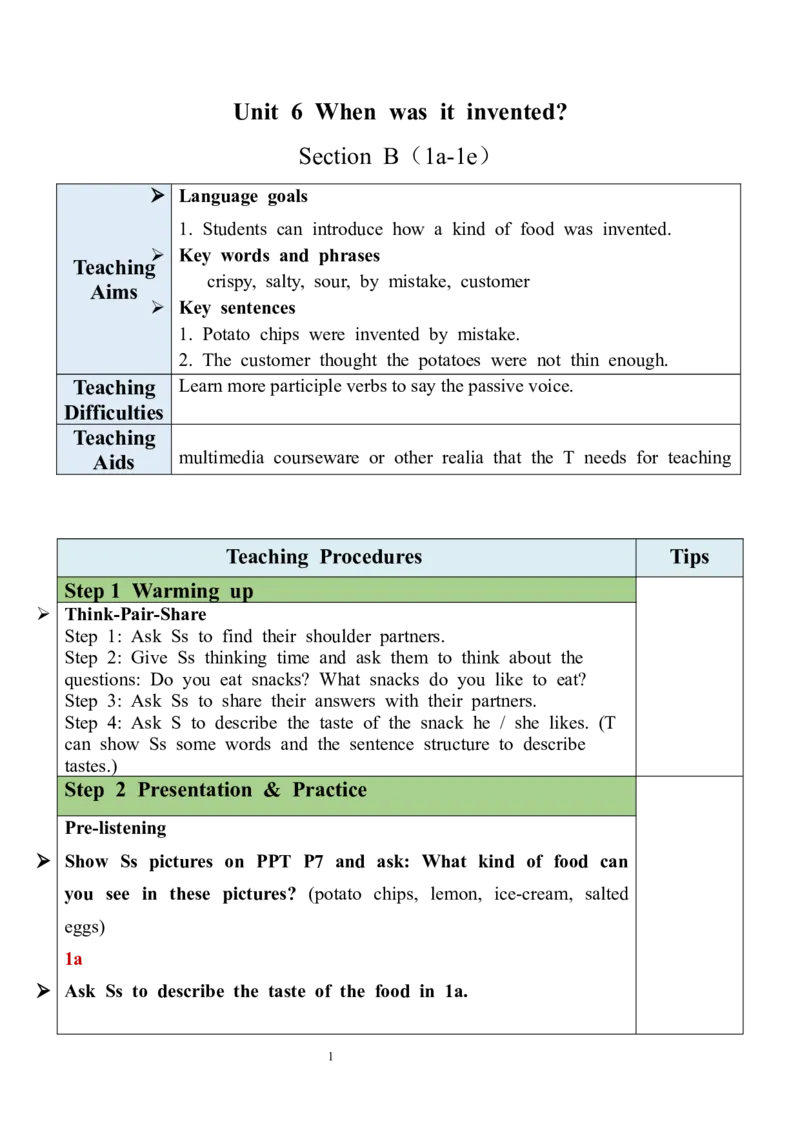
Unit 6 When was it invented?
Section B(1a-1e)
Language goals
1. Students can introduce how a kind of food was invented.
Key words and phrases
Teaching
crispy, salty, sour, by mistake, customer
Aims
Key sentences
1. Potato chips were invented by mistake.
2. The customer thought the potatoes were not thin enough.
Teaching Learn more participle verbs to say the passive voice.
Difficulties
Teaching
Aids multimedia courseware or other realia that the T needs for teaching
Teaching Procedures Tips
Step 1 Warming up
Think-Pair-Share
Step 1: Ask Ss to find their shoulder partners.
Step 2: Give Ss thinking time and ask them to think about the
questions: Do you eat snacks? What snacks do you like to eat?
Step 3: Ask Ss to share their answers with their partners.
Step 4: Ask S to describe the taste of the snack he / she likes. (T
can show Ss some words and the sentence structure to describe
tastes.)
Step 2 Presentation & Practice
Pre-listening
Show Ss pictures on PPT P7 and ask: What kind of food can
you see in these pictures? (potato chips, lemon, ice-cream, salted
eggs)
1a
Ask Ss to describe the taste of the food in 1a.
1Answers: potato chips — crispy, salty lemons — sour
ice-cream — sweet salted eggs — salty
Ask Ss to name more food associated with sweet / crispy / salty
/ sour.
(Tip: T can ask Ss to work in pairs or groups. Answers can be
varied.)
Suggested answers:
sweet — sweet potato, mooncake, tang yuan (glutinous rice ball) ,
sweet zong zi, cupcake, chocolate
crispy — spring roll, pancake, banana chips, cracker, pop corn,
corn flakes
salty — sausage, noodles, jiaozi (dumplings), wonton, pizza, Beijing
Roast Duck
sour — ketchup, pickle, yogurt, string of candied haws (tang hulu),
passion fruit, vinegar
1b
Ask Ss to write the name of a different food after each word.
Answers can be varied.
1c
Ask Ss to look at the picture and read the sentences in 1c. Ask
them to think about:
1. What are the two boys in the picture talking about?
2. Where does this story take place?
Ask Ss to close their eyes and just concentrate on the
conversation they are about to hear. By shutting out any other
stimulus or factors that may distract them, Ss should be able to
listen and remember the facts better. When the recording ends,
Ss can attempt the activity.
2(Tip: Get Ss check their answers with a partner.)
Answers: 1. T 2. F 3. T 4. F 5. F 6. T
1d
Ask Ss to fill in the blanks based on what they have heard
when their eyes were closed and they were concentrating. Do
they remember what they heard? Or can they guess the answers
based on what they know and the context around the blanks?
Once all Ss have attempted this activity, play the recording
again and ask them to check their answers.
(Tip: T can play the video before Ss complete the sentences if Ss
are not strong enough.)
Answers: were invented, 1853, thin, crispy, really salty
Post-listening
Optional Choice:
After listening, T can ask Ss to answer some questions which
may help Ss have a better understanding of the listening
material.
1. How and when were potato chips invented?
2. What was the name of the inventor? What was his job?
3. Why was it a mistake? What did the cook do with the potatoes then?
4. How can you make food crispy / salty?
5. What can we learn from the story? Do you want to be an inventor?
1e
Ask Ss to make a conversation about the invention of potato
chips.
For this conversation, get Ss to inject some exclamations into their
speech instead of just using direct questions and answers. Have
pairs of Ss experiment on how they can “ jazz” up their
3conversations. Remind them of the role-play they did in Section A,
activity 2d and how inflections, tones and feelings play a part.
Step 3 Language points learning
by mistake 为 介 词 短 语 , 意 为 “ 无 意 中 ; 错 误 地 ” , 相 当 于
accidentally。
enough 修饰名词时不需要倒装。enough 修饰形容词、副词时需要倒
装。
enough常可以和词组so ... that ...,too ... to ...转换。
in the end 的意思是“后来,最后,终于”,in the end 用一个单词表
达可以用finally,用一个短语表达可以用at last 。
Step 4 Summary & Homework
Summary
Ask Ss to do the exercises from PPT P27-28.
Homework:
Preview 2a-2e in Section B.
Do the exercises in students’ book.
When we talk about food, we should learn how to describe their taste. So
we do a brainstorming to practice the food names and their tastes. In this
period, the students should practice the passive voice in listening to the
story about how potato chips were invented. And then get them to listen
Teaching
and speak. In this way they can improve their capacity of language
Reflection
organization and oral output while listening and speaking practice. Students
must do some writing practice after they have learned the new items. So we
can give them some written work to do after they listen to the story and
learn the new words in the part.
4