文档文本内容
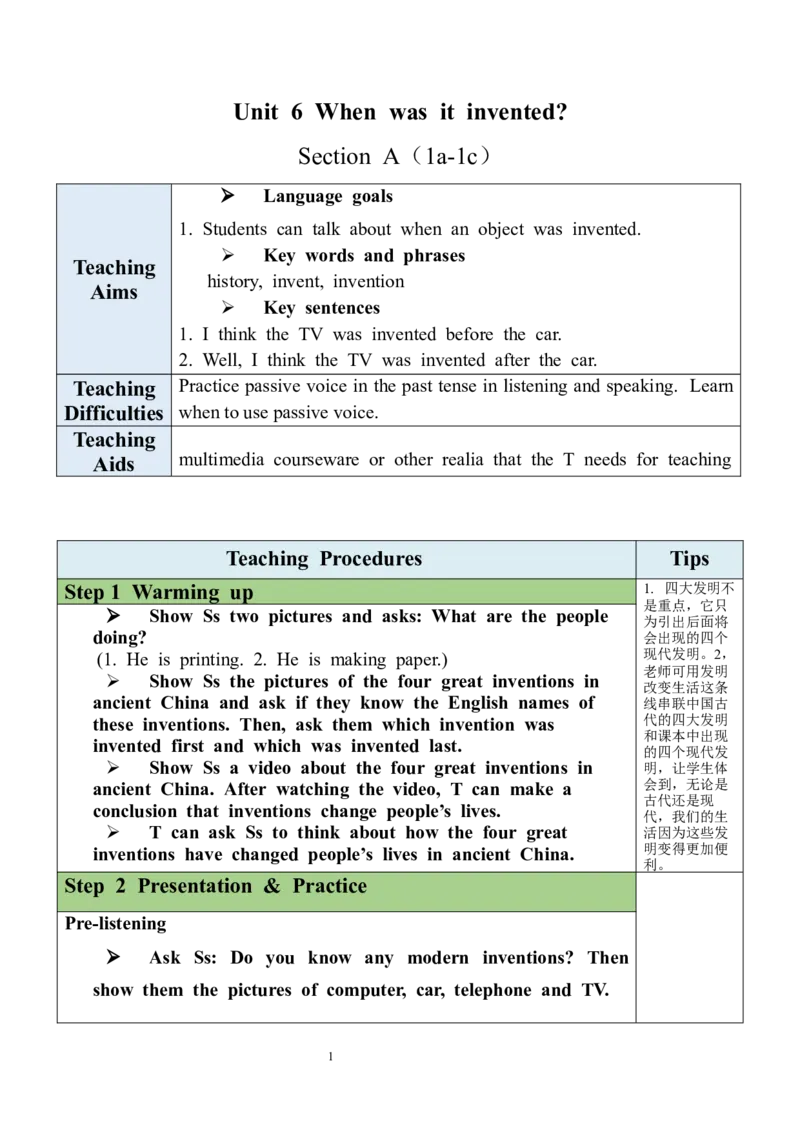
Unit 6 When was it invented?
Section A(1a-1c)
Language goals
1. Students can talk about when an object was invented.
Key words and phrases
Teaching
history, invent, invention
Aims
Key sentences
1. I think the TV was invented before the car.
2. Well, I think the TV was invented after the car.
Teaching Practice passive voice in the past tense in listening and speaking. Learn
Difficulties when to use passive voice.
Teaching
Aids multimedia courseware or other realia that the T needs for teaching
Teaching Procedures Tips
Step 1 Warming up 1. 四大发明不
是重点,它只
Show Ss two pictures and asks: What are the people
为引出后面将
doing? 会出现的四个
(1. He is printing. 2. He is making paper.) 现代发明。2,
老师可用发明
Show Ss the pictures of the four great inventions in
改变生活这条
ancient China and ask if they know the English names of 线串联中国古
these inventions. Then, ask them which invention was 代的四大发明
和课本中出现
invented first and which was invented last.
的四个现代发
Show Ss a video about the four great inventions in 明,让学生体
ancient China. After watching the video, T can make a 会到,无论是
古代还是现
conclusion that inventions change people’s lives.
代,我们的生
T can ask Ss to think about how the four great 活因为这些发
inventions have changed people’s lives in ancient China. 明变得更加便
利。
Step 2 Presentation & Practice
Pre-listening
Ask Ss: Do you know any modern inventions? Then
show them the pictures of computer, car, telephone and TV.
1Ask Ss to think and answer the questions:
1. Can you guess which one of them was invented first?
2. Which one of them was invented last?
3. Was the TV invented before the car or after the car?
(Tip: T can encourage Ss to use the passive voice when answering
the questions.)
1a
Ask Ss to open their books, look at the four pictures
in 1a and discuss which invention was invented first. Then,
number the pictures from 1 to 4.
(Tip: Ask Ss to use the sentence structures in the box on the left
when discussing.)
While-listening
Show the picture of 1b to Ss. Ask them to think about
what these people are talking about. Ask them to guess the
year in which each invention was invented.
1b
Show the video of 1b to Ss. Ask them to finish the
task in 1b.
(Answers: d 1876 a 1885 c 1927 b 1971)
Extension: Show PPT P17 to Ss and ask them to
match the inventors with their inventions.
telephone: Alexander Bell, car: Karl Benz, TV: J.L.Baird, computer:
John von Neumann
Ask Ss to listen again and answer the questions:
1. Did the older lady have a telephone?
2. Why didn’t the older lady have a TV?
3. Why didn’t the older lady have a personal computer?
24. Can you guess when the older lady was born?
Post-listening
1c
Ask Ss to work in pairs and finish the task in 1c.
(Tip: T can show more inventions to Ss. Tell Ss that more modern
inventions can be talked about in 1c.)
Show Ss pictures of different inventions (PPT P23) and
ask them to think about how these inventions have changed
people’s lives.
(Tip: T can ask Ss to choose one or two inventions and have a
group discussion.)
Step 3 Language points learning
invent v. “发明”,指经过认识和实践创造出前所未有的事物。
invention和inventor都是名词, 前者意为“发明”,后者意为“发
明家”。
invent, discover和find out的区别是:
invent主要指发明世界上原本不存在的东西
discover指发现一种世界上原本已经存在,后来才被人们认识到的东
西
find out指通过观察、调查而发现事实真相
Step 4 Summary & Homework
Summary
Ask Ss to do the exercises from PPT P27-28.
Homework:
Preview the conversation in 2d.
Do the exercises in students’ book.
This is the period for listening and speaking practice. Before listening,
students talk about the four common things and get the words ready for
Teaching
listening. Then students listen and make conversations. The most
Reflection
important thing is to learn the passive voice in the past tense and teach
students past participle forms.
34