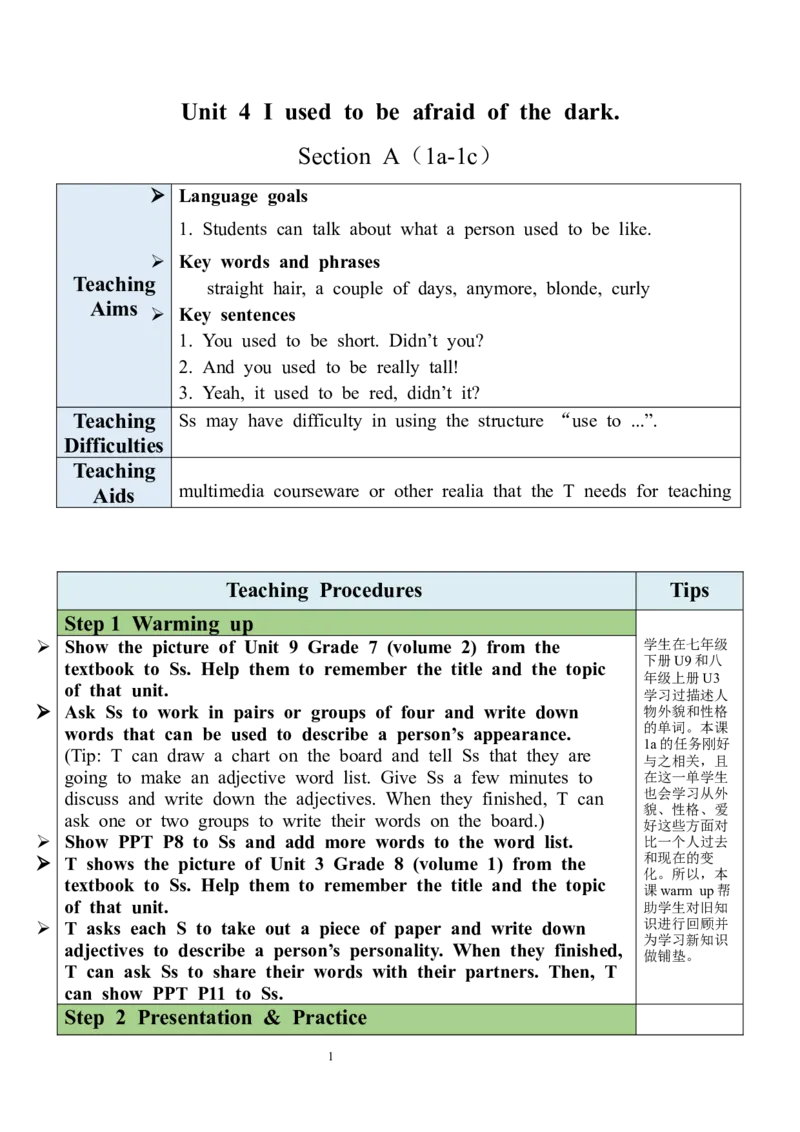
Unit 4 I used to be afraid of the dark.
Section A(1a-1c)
Language goals
1. Students can talk about what a person used to be like.
Key words and phrases
Teaching
straight hair, a couple of days, anymore, blonde, curly
Aims
Key sentences
1. You used to be short. Didn’t you?
2. And you used to be really tall!
3. Yeah, it used to be red, didn’t it?
Teaching Ss may have difficulty in using the structure “use to ...”.
Difficulties
Teaching
Aids multimedia courseware or other realia that the T needs for teaching
Teaching Procedures Tips
Step 1 Warming up
Show the picture of Unit 9 Grade 7 (volume 2) from the 学生在七年级
下册U9和八
textbook to Ss. Help them to remember the title and the topic
年级上册U3
of that unit.
学习过描述人
Ask Ss to work in pairs or groups of four and write down 物外貌和性格
words that can be used to describe a person’s appearance.
的单词。本课
1a的任务刚好
(Tip: T can draw a chart on the board and tell Ss that they are
与之相关,且
going to make an adjective word list. Give Ss a few minutes to 在这一单学生
discuss and write down the adjectives. When they finished, T can
也会学习从外
貌、性格、爱
ask one or two groups to write their words on the board.)
好这些方面对
Show PPT P8 to Ss and add more words to the word list. 比一个人过去
T shows the picture of Unit 3 Grade 8 (volume 1) from the
和现在的变
化。所以,本
textbook to Ss. Help them to remember the title and the topic
课warm up帮
of that unit. 助学生对旧知
T asks each S to take out a piece of paper and write down 识进行回顾并
为学习新知识
adjectives to describe a person’s personality. When they finished,
做铺垫。
T can ask Ss to share their words with their partners. Then, T
can show PPT P11 to Ss.
Step 2 Presentation & Practice
1Pre-listening
1a
Ask Ss to open their books and finish the task in 1a.
Suggested answers:
Appearance: tall, straight hair, short, fat, thin, long hair, curly hair,
glasses ...
Personality: outgoing, funny, quiet, shy, cheerful, lazy, hard-working,
friendly ...
Ask Ss to think of one aspect of their appearance or personality
that has changed since they became teenagers. Write them down
and tell their partners.
(Tip: Ss are required to use the sentence structure “I used to be /
have ..., but now I am / have ...”. T can explain the meaning of
“used to ...” to Ss if necessary.)
While-listening
1b
Ask Ss to look at the picture in 1a and introduce the characters
to Ss. Ask Ss to make predictions about the missing words in
1b.
Ask Ss to close their books and watch a video. Remind them to
focus on the details.
(Tip: Tell Ss they can take notes for some key information.)
Ask Ss to open their books and finish the task. Tell Ss to check
the answers with their partners before giving them the correct
answers.
Optional choice:
Play the recording of the first conversation again and ask
Ss to answer the questions.
21. What did Mario used to be like?
学生编对话前
2. What did Mario used to wear? 的小活动目的
在于帮助学生
Show PPT P18&P19 to Ss, ask them to listen to the second 理解图片,并
建立图片信息
and the third conversation again and complete the
之间的联系。
conversation orally.
Show Ss listening material if necessary.
Post-listening
1c
Ask Ss to look at the picture in 1a and make conversations
following the example.
(Tip: Before they make conversations, ask Ss to pick a partner.
Next ask each S in a pair to choose a character in the picture. The
first S will then tell their partner what has changed about the
character he/she has chosen. The partner will then ask the first S,
“Are you sure?” The answer to this must be, “Yes, because ...”
and the first S should explain his/her answer based on what they
see in the picture. They should then repeat the same exercise but
this time with the second S and his/her choice of the character in
the picture.)
Optional Choice:
Activity: Walk around in the classroom
Ask each S to prepare a small piece of paper, write down their names
and their changes in appearance and personality. Tell Ss to change
their paper with anyone they want in the class. Ask them to find a
new partner, tell their partner whose paper he/she has got. The Ss
should take turns to talk about the changes of that person. When
both of them have finished, they need to find a different partner
and repeat the activity.
3(Tip: T can encourage Ss to talk freely or make conversations
following the example in 1c.)
Step 3 Language points learning
used to的用法
used to do sth. “过去常常做某事”, 表示过去经常性或习惯性的动作
或状态,暗指现在已经不存在了,强调过去与现在的对比。
used to的其他用法:be used to do sth. 被用来做某事;be used to
doing sth. 习惯于做某事;be used for doing sth. 被用于做某事
反义疑问句
反义疑问句指的是在陈述句之后加上一个意思与之相反的简短问
句,用以向对方证实所叙述的事情的句子。
反义疑问句必须由意思相反的两部分组成,在前一部分(陈述句)
之后用逗号,后一部分(简短问句)之后用问号。
反义疑问句的否定句必须用缩略形式,同时它的主语必须用人称代
词,不能用名词。
反义疑问句有下面两类:
前一部分为肯定式,后一部分是否定式。
前一部分是否定式,后一部分是肯定式。
在使用反义疑问句时需要注意:
1. 陈述句和简短问句在人称、数和时态上必须保持一致,且简短
问句的主语必须为代词。
2. 陈述部分含有nothing, never, hardly, little等表示否定意义的词
简短问句要用肯定形式。
Step 4 Summary & Homework
4Summary
Ask Ss to do the exercises from PPT P31-32.
Homework:
Preview the conversation in 2d.
Do the exercises in students’ book.
This is the first period of the unit. We’d better review the words of appearance and
Teaching personality in the former units because in this unit they are repeated. We focus on the
Reflection main structure-used to. Students must learn the statement form, and question form.
They should practice in listening and make enough oral practice.
5