文档文本内容
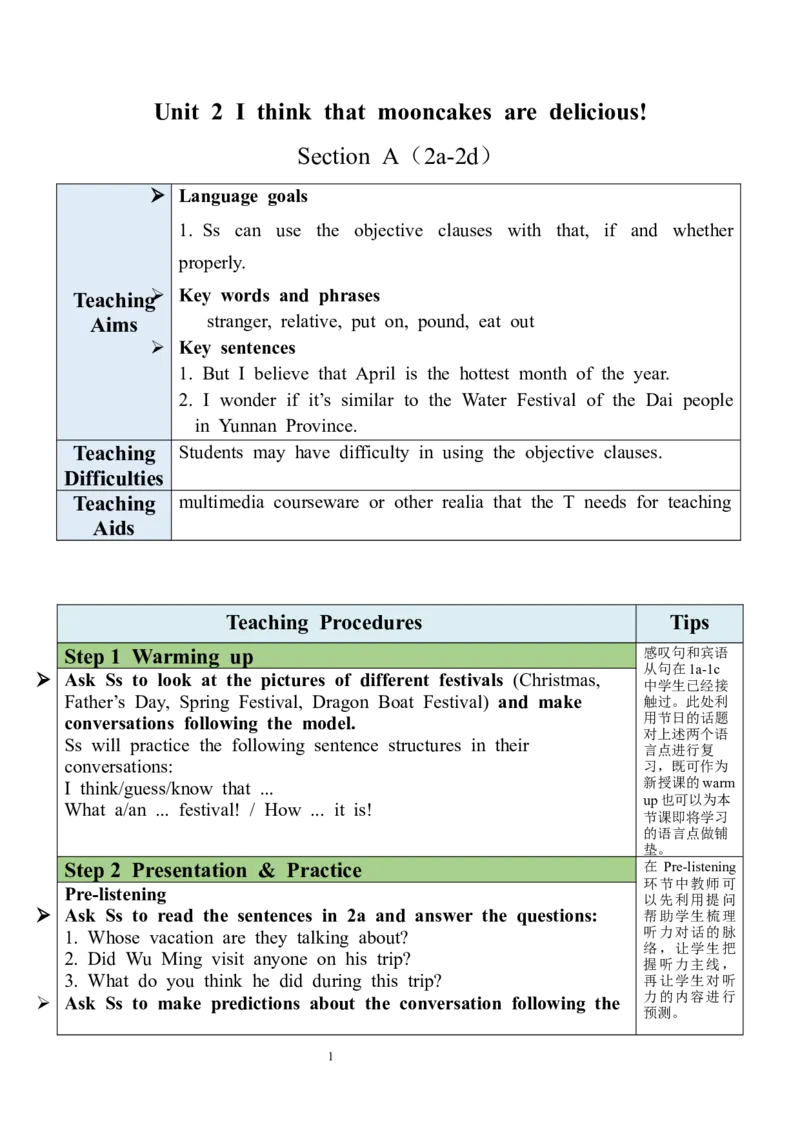
Unit 2 I think that mooncakes are delicious!
Section A(2a-2d)
Language goals
1. Ss can use the objective clauses with that, if and whether
properly.
Key words and phrases
Teaching
Aims stranger, relative, put on, pound, eat out
Key sentences
1. But I believe that April is the hottest month of the year.
2. I wonder if it’s similar to the Water Festival of the Dai people
in Yunnan Province.
Teaching Students may have difficulty in using the objective clauses.
Difficulties
Teaching multimedia courseware or other realia that the T needs for teaching
Aids
Teaching Procedures Tips
Step 1 Warming up 感叹句和宾语
从句在1a-1c
Ask Ss to look at the pictures of different festivals (Christmas,
中学生已经接
Father’s Day, Spring Festival, Dragon Boat Festival) and make 触过。此处利
conversations following the model. 用节日的话题
对上述两个语
Ss will practice the following sentence structures in their
言点进行复
conversations: 习,既可作为
I think/guess/know that ...
新授课的warm
up也可以为本
What a/an ... festival! / How ... it is!
节课即将学习
的语言点做铺
垫。
Step 2 Presentation & Practice 在 Pre-listening
环节中教师可
Pre-listening
以先利用提问
Ask Ss to read the sentences in 2a and answer the questions: 帮助学生梳理
1. Whose vacation are they talking about? 听力对话的脉
络,让学生把
2. Did Wu Ming visit anyone on his trip?
握听力主线,
3. What do you think he did during this trip? 再让学生对听
Ask Ss to make predictions about the conversation following the
力的内容进行
预测。
1example.
(Tip: Ss are encouraged to make predictions in their own words
too.)
While-listening
2a
Ask Ss to listen to the conversation and do exercises in 2a.
Answers: 1.friends 2.Hong Kong 3.relatives 4.the Dragon Boat 听力时不光要
让学生找到正
Festival
确答案,还要
2b 让学生抓住听
Ask Ss to listen to the conversation again and complete the 力线索(即细
节信息),说
chart in 2b. Ask Ss to share their answers with their partners
出是如何确定
after they have filled in their answers. 答案的。这能
The partner who receives the answers have to ask a question to 一步能训练学
生 搜 寻 ( 把
verify the answers, e.g.:
握)细节信息
1. How do you know that the downsides of eating out is putting on 的能力和语言
weight? 组织能力。
2. How do you know that the downsides of shopping is costing too
much money?
3. How do you know that the downside of having the dragon boat
races in June is the hot weather?
(Tip: The above questions are just examples. Ss are encouraged to
ask questions in their own words.)
Answers: 1.put on weight 2.spent money 3.hot weather
Show listening material to Ss and ask Ss to do the exercise in
“Read and match”.
Post-listening
2c
Ask Ss to do the exercise in 2c in pairs. T can choose some
students to role play their conversations for the whole class. PPT P15 为
If Ss choose to make their own conversations, the T can use these P14 学生自己
prompts to help Ss think about their conversations:
编写对话的引
导问题。如果
1. Where did you go on your vacation? What did you do?
学选择用2a和
2. What was the best part of your vacation? What were the 2b的内容做对
downsides? 话 可 不 用 此
页。在进行对
(Tip: The T can encourage Ss to use the objective clauses in their
话时,老师尽
conversations.) 量引导学生使
用宾语从句,
如场景合适也
可 使 用 感 叹
句。
Step 3 Presentation & Reading
Pre-reading 此处为一个简
要的文化背景
介绍。PPT 中
2 Tell Ss that they are going to read a conversation between Clara 列出简单的问
题,老师可与
and Ben. Clara is going to Chiang Mai. The T can use PPT 学生进行简答
的互动。
P16-P17 to introduce Chiang Mai briefly.
While-reading
Ask Ss to watch a video about the conversation in 2d and
answers the questions:
1. When is Clara going to Chiang Mai? Why is she going at that time?
2. Why are the Dai people mentioned in the dialogue?
3. When is the Water Festival in Thailand? And what do people always
do?
4. Why do people throw water at each other?
(Tip: The T can ask Ss to share their answers after watching the
video.)
The T can show Ss the conversation. Ask Ss to read and then
role play the conversation.
Step 4 Language points learning
Words and Phrases
In two weeks: in two weeks用到了“in+时间段”这个结构, 意为
“......之后”, 该结构常与将来时连用, 也可用于回答how soon的提
问。
比较:“in+时间段”,“after+时间段”,“for+时间段”。
In的用法:可表示“穿着”;(书写或表达用的方式)“用,
以”;“在.....期间”。
be similar to: be similar to为固定搭配, 其中similar是形容词, 意
为“相像的; 类似的”。
be similar in: 在......方面相似
throw at: throw at意为“抛向; 泼向; 洒向”。动词throw后面接所
投掷的物体, 用介词at引入泼洒的对象。
Step 5 Summary & Homework Post-reading是
一个基于2d对
话的拓展活
Post-reading
动,目的是利
Ask Ss to work in pairs and make conversations following the 用information
3instruction: gap帮助学生
建立一个更真
Suppose you are going to visit another city (or country), your friend is
实的语言使用
going to ask you some information about it. Make up a conversation with
场景。该练习
your partner! 建议在学生熟
练掌握2d对话
Summary
后进行,故放
Ask Ss to do the exercises from PPT P31-32.
在language
Homework points之后。
Preview the passage in 3a. 如果老师有不
同的教学设计
Do the exercises in students’ book.
也可移至
language points
前。
The teacher needs to encourage the students to practice the target
Teaching language in listening and speaking. With the help of language
Reflection practice, the students can learn the new pattern and the objective
clauses in a more natural way.
4