Unit 10 You’re supposed to shake hands.
Section A(1a-1c)
Language goals
1. Students can talk about customs and what they are supposed to
do.
Key words and phrases
Teaching
custom, bow, kiss, be supposed to
Aims
Key sentences
1. In your country, what are you supposed to do when you meet
someone for the first time?
2. You’re supposed to shake hands.
Teaching Use the structure “be supposed to do sth. / be expected to do sth.” to
Difficulties make suggestions.
Teaching multimedia courseware or other realia that the T needs for
Aids teaching.
Teaching Procedures Tips
Step 1 Warming up
Let Ss to think and guess: what do people say in different
countries for the first time? ( i.e. the US, France, Germany,
Spain, Italy, Japan)
Or T can ask Ss: In China when we meet someone we will say 其实P6和P8
的两个问题选
“ni hao”. How do people say “ni hao” in different countries?
用相同的国家
(Britain: Hello, France: Bonjour, Germany: Guten Tag, Spain: Hola,
是最好的,但
Italy: Ciao, Japan: kon ni chi wa) 由于有些国家
打招呼的方式
Ask Ss to think about: What do people do when they meet for
有重复,类型
the first time in the US / France / Japan / Saudi Arabia /
不够丰富,故
Thailand. 做了替换,但
尽量保留课本
(Tip: The purpose of this question is to motivate Ss find out the
中出现的国
culture differences between different countries. Ss don’t have to 家。
answer all the questions correctly.)
(the US: shake hands, France: kiss, Japan: bow, Saudi Arabia: touch
noses (between men), Thailand: bowing slightly and pressing palms
together in a prayer-like manner while saying Sawasdee)
Step 2 Presentation & Practice
Pre-listening
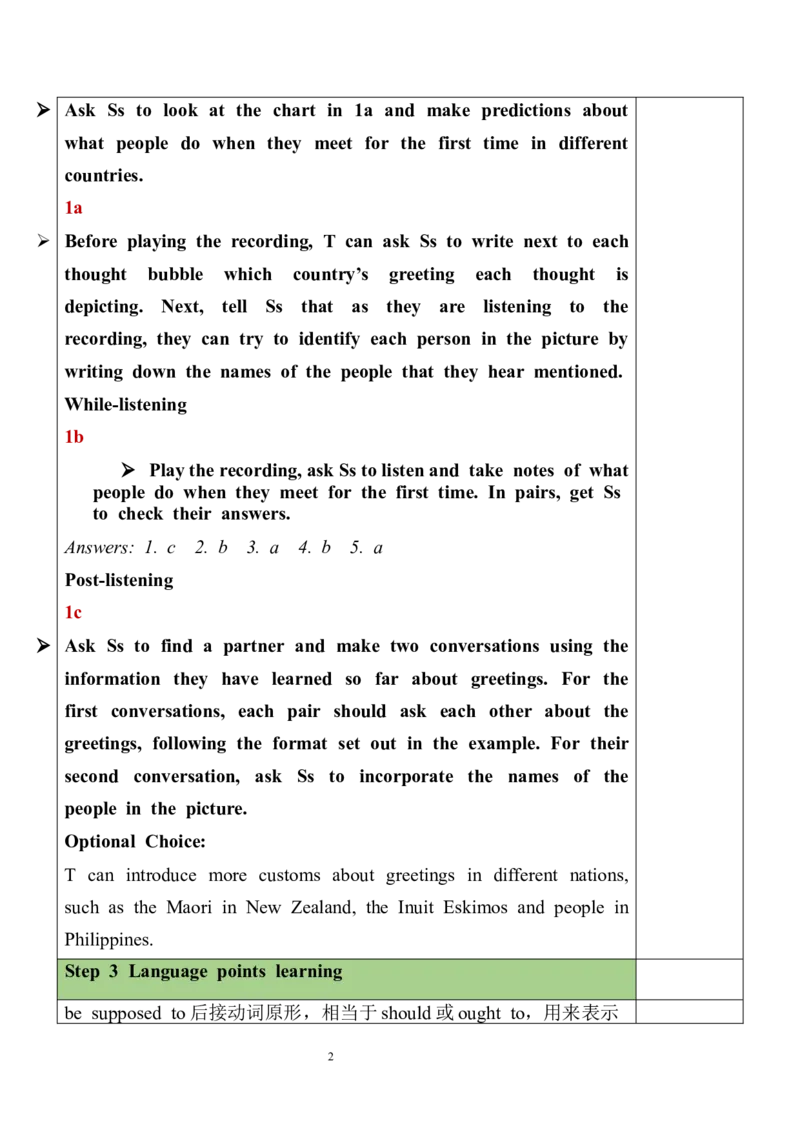
1 Ask Ss to look at the chart in 1a and make predictions about
what people do when they meet for the first time in different
countries.
1a
Before playing the recording, T can ask Ss to write next to each
thought bubble which country’s greeting each thought is
depicting. Next, tell Ss that as they are listening to the
recording, they can try to identify each person in the picture by
writing down the names of the people that they hear mentioned.
While-listening
1b
Play the recording, ask Ss to listen and take notes of what
people do when they meet for the first time. In pairs, get Ss
to check their answers.
Answers: 1. c 2. b 3. a 4. b 5. a
Post-listening
1c
Ask Ss to find a partner and make two conversations using the
information they have learned so far about greetings. For the
first conversations, each pair should ask each other about the
greetings, following the format set out in the example. For their
second conversation, ask Ss to incorporate the names of the
people in the picture.
Optional Choice:
T can introduce more customs about greetings in different nations,
such as the Maori in New Zealand, the Inuit Eskimos and people in
Philippines.
Step 3 Language points learning
be supposed to后接动词原形,相当于should或ought to,用来表示
2劝告、建议、义务、责任等。其否定形式为be not supposed to,意
为“不应该”。
suppose表示“认为, 推断”时, 其后常接宾语从句, 它的近义
为think, regard, consider。在宾语从句中其否定要前移(主句
语多为第一人称) 。当主语是“物”时, be supposed to意为“本应
该”,用来表示“某事本应该发生而没有发生”。
expect的意思是“预料; 期待”,作及物动词, 后接名词、动词不定
式或that从句。其常见搭配有:
expect sb. / sth. 等待(期待)某人 / 某物
expect (sb.) to do sth. 期望(某人)做某事
expect + that从句 预料......
be expected to do sth. 被期待做某事, 被期望做某事
Step 4 Summary & Homework
Summary
Ask Ss to do the exercises from PPT P27-28.
Homework:
Preview the conversation in 2d.
Do the exercises in students’ book.
This is the first period of the unit. So it is important to get the students to
know the main structure “be supposed to”,“be expected to”,and get the
Teaching students to practice them in listening and speaking. And we should learn
Reflection the new words and expressions in the first period of the unit. We’d better
learn them by using them in listening ,speaking and reading activities.
And we always learn them in the meaning group.
3