文档文本内容
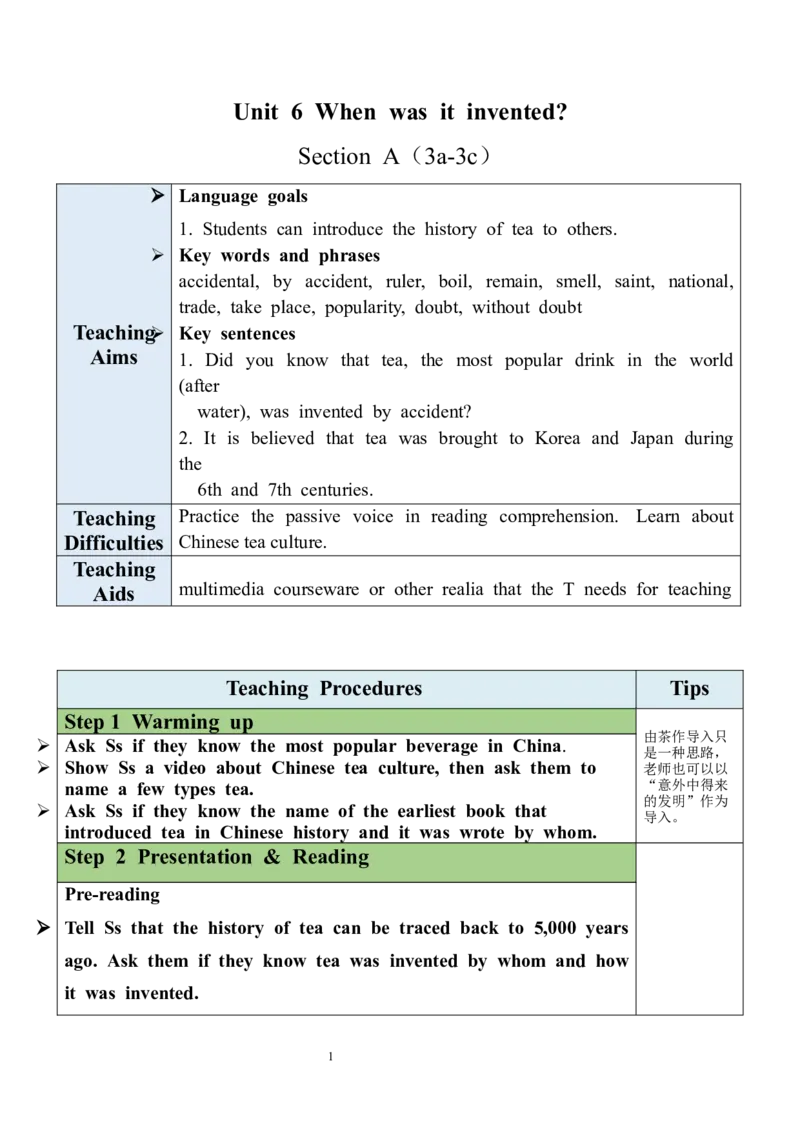
Unit 6 When was it invented?
Section A(3a-3c)
Language goals
1. Students can introduce the history of tea to others.
Key words and phrases
accidental, by accident, ruler, boil, remain, smell, saint, national,
trade, take place, popularity, doubt, without doubt
Teaching Key sentences
Aims 1. Did you know that tea, the most popular drink in the world
(after
water), was invented by accident?
2. It is believed that tea was brought to Korea and Japan during
the
6th and 7th centuries.
Teaching Practice the passive voice in reading comprehension. Learn about
Difficulties Chinese tea culture.
Teaching
Aids multimedia courseware or other realia that the T needs for teaching
Teaching Procedures Tips
Step 1 Warming up
由茶作导入只
Ask Ss if they know the most popular beverage in China.
是一种思路,
Show Ss a video about Chinese tea culture, then ask them to 老师也可以以
name a few types tea. “意外中得来
的发明”作为
Ask Ss if they know the name of the earliest book that
导入。
introduced tea in Chinese history and it was wrote by whom.
Step 2 Presentation & Reading
Pre-reading
Tell Ss that the history of tea can be traced back to 5,000 years
ago. Ask them if they know tea was invented by whom and how
it was invented.
1 Ask Ss to read the title of the passage. Give them thinking time
and ask them to discuss in pairs: What’s the meaning of “An
Accidental Invention”? Can you think of an invention which was
invented by accident?
(Tip: T can look up information on the internet and use the
invention of Popsicle and chocolate cookie as examples.)
While-reading
3a
Ask Ss to read the passage quickly and match each paragraph
with it main idea.
Answers: paragraph 1 — How tea was invented by accident
paragraph 2 — Lu Yu and his book Cha Jing
paragraph 3 — How tea spread to other countries
Optional Choice:
Show PPT P18, ask Ss to read the first paragraph and complete
the chart. (Who invented tea? When was tea invented? How was
tea invented?)
Ask Ss to read the second paragraph and answer the question:
Why was Lu Yu called the “saint of tea”?
Answer: Because he knew a lot about tea and he wrote Cha Jing
— the earliest book in Chinese history to introduce tea.
(Tip: Ss are encouraged to give different answers for the same
question.)
Ask Ss to read the third paragraph and complete the time line.
6th and 7th centuries: tea was brought to Korea and Japan
Around 1660: tea appeared in England
19th century: the tea trade from China to Western countries took
place
2 Ask Ss to answer the question: What are the influences of tea
trade between China and the western countries?
It helped to spread the popularity of tea and the tea plant to more
places around the world.
While-reading
3b
Ask Ss to read the passage again and answer the questions:
1.It was first drunk about 5000 years ago.
2.Some leaves from a tea plant fell into some boiling drinking water
over an open fire. It produced a nice smell and tasted delicious.
This is how tea was invented.
3.Lu Yu is called the saint of tea.
4.It describes how tea plants were grown and used to make tea.
5.It was brought to Korea and Japan during the 6th and 7th centuries and
to England around 1660.
Post-reading
3c
Ask Ss to complete the sentences with the correct forms of the verbs
in the box.
Answers: 1.invented 2.drunk 3.produced 4.brought 5.traded
Step 3 Language points learning
by accident “偶然; 意外地”, 相当于by chance
It is said that ... “据说......”,that后接完整的句子,其中it是形式主 此处只摘录部
分语法点
语,that从句是真正的主语。
remain是动词,意思是“保持不变;剩余”,作不及物动词时,可加
介词短语;作系动词时,后面跟形容词,意为“保持某种状态”。
remain不能用于被动语态。
smell作可数名词时意为“气味”,作不可数名词时意为“嗅觉”。
作动词时意为“发出......气味;闻到”。
one of ...的意思是“......之一”,后面接名词或代词的复数形式,该
结构作主语时,谓语动词通常用单数形式。
3take place的意思是“发生; 出现”,它易与happen混淆,二者的区
别为:
take place是不及物动词短语;常指事先安排或事发有因的事情。
happen是不及物动词;常指偶然发生的事情。
doubt既可作动词,也可作名词,在肯定句中后面常接whether引导
的从句,在否定句和疑问句中常接that从句。
Step 4 Summary & Homework
Summary
Ask Ss to do the exercises from PPT P37-40.
Homework:
Preview the grammar points in U6.
Do the exercises in students’ book.
In this period, teacher should help students learn more about the
Teaching Chinese tea culture. Students should practice the target language
Reflection through different activities. Besides, teacher should encourage students
to introduce more about tea using the passive voice.
4