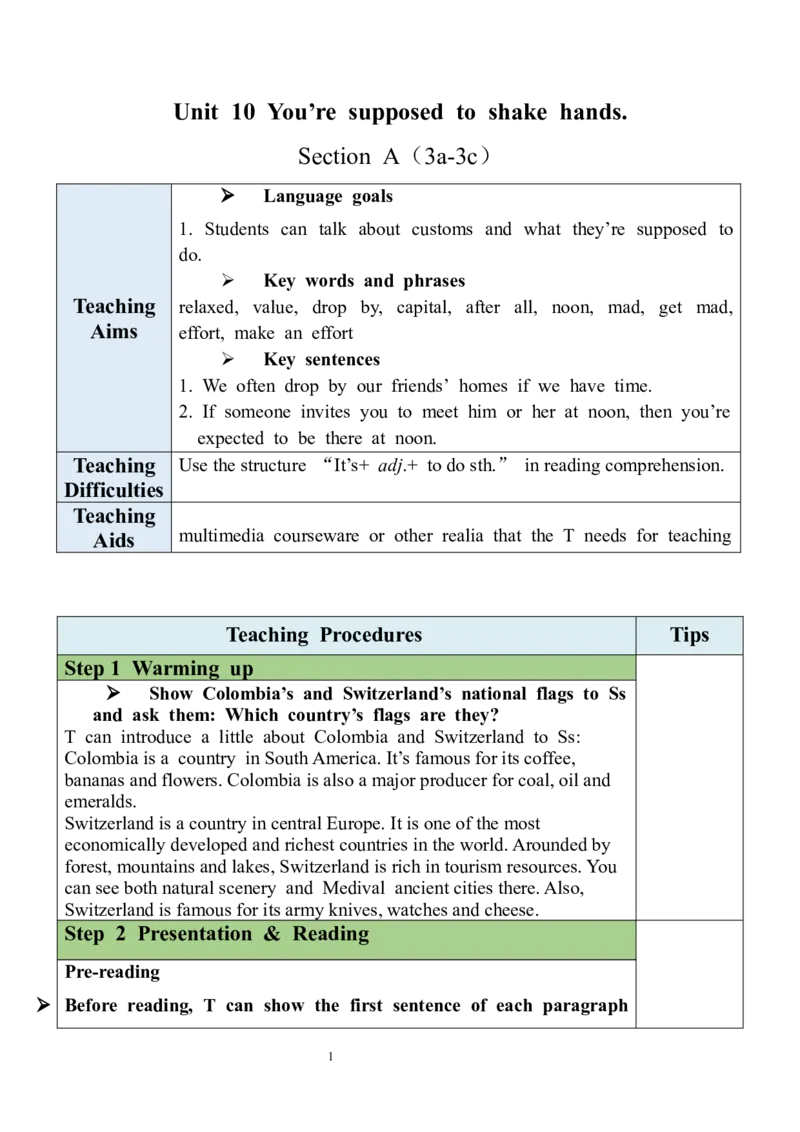
Unit 10 You’re supposed to shake hands.
Section A(3a-3c)
Language goals
1. Students can talk about customs and what they’re supposed to
do.
Key words and phrases
Teaching relaxed, value, drop by, capital, after all, noon, mad, get mad,
Aims effort, make an effort
Key sentences
1. We often drop by our friends’ homes if we have time.
2. If someone invites you to meet him or her at noon, then you’re
expected to be there at noon.
Teaching Use the structure “It’s+ adj.+ to do sth.” in reading comprehension.
Difficulties
Teaching
Aids multimedia courseware or other realia that the T needs for teaching
Teaching Procedures Tips
Step 1 Warming up
Show Colombia’s and Switzerland’s national flags to Ss
and ask them: Which country’s flags are they?
T can introduce a little about Colombia and Switzerland to Ss:
Colombia is a country in South America. It’s famous for its coffee,
bananas and flowers. Colombia is also a major producer for coal, oil and
emeralds.
Switzerland is a country in central Europe. It is one of the most
economically developed and richest countries in the world. Arounded by
forest, mountains and lakes, Switzerland is rich in tourism resources. You
can see both natural scenery and Medival ancient cities there. Also,
Switzerland is famous for its army knives, watches and cheese.
Step 2 Presentation & Reading
Pre-reading
Before reading, T can show the first sentence of each paragraph
1to Ss and ask them to think of what this passage will mainly
talk about.
While-reading
Ask for two volunteers to read each paragraph. Get the
volunteers to read “their” opinions out to the class. While they
are reading, ask the rest of the Ss to close their textbooks.
Remind the readers that they should speak clearly and loudly so
that their classmates can hear what they are saying.
3a
Ask Ss to find out in which country it is OK to be 15
minutes late for dinner.
Answer: Colombia
While-reading
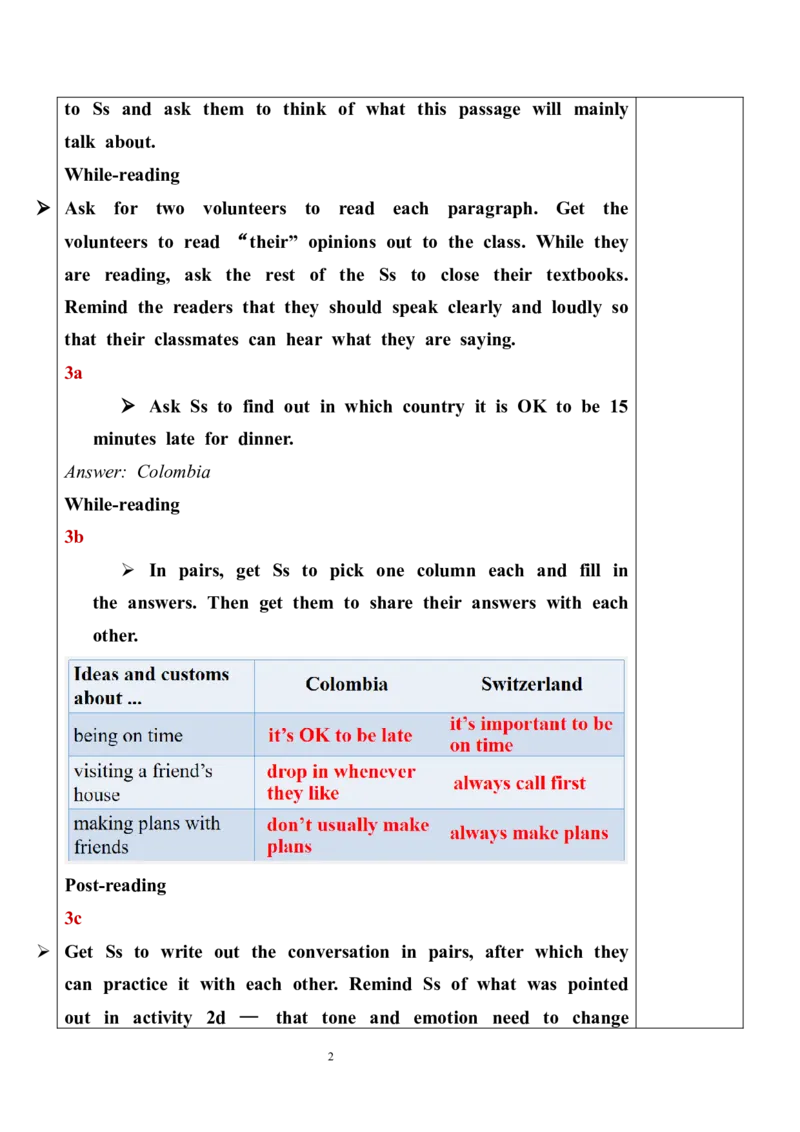
3b
In pairs, get Ss to pick one column each and fill in
the answers. Then get them to share their answers with each
other.
Post-reading
3c
Get Ss to write out the conversation in pairs, after which they
can practice it with each other. Remind Ss of what was pointed
out in activity 2d — that tone and emotion need to change
2accordingly, depending on what is being conveyed. The
instructions are clear in that Marc is angry, so this emotion
needs to come through in the vocabulary used and the emotion
in which is delivered.
Pair Work
Ask Ss to work in pairs. Tell them that Teresa plans to visit China
in summer. Ask each pair to give Teresa some information about
customs in China. (i.e. greeting, being on time, visiting a friend’s
house, making plans with friends, dressing for a party.)
Step 3 Language points learning
relaxed adj. 放松的; 自在的, 它与relaxing都是形容词,二者的区别
是: 此处呈现部分
语言点
relaxed的主语通常为人, 例如be relaxed about对……感到放松。
relaxing意为“令人放松的”,其主语通常为物。
(拓展:以-ed结尾的形容词多用来描述人, 说明人因外部原因而产
的某种情绪或感受; 以-ing结尾的形容词多用来描述事物, 说明事
物本身的特性。)
value既可作名词,也可作动词。作名词是意思是“ 价值;价格”,
作动词时意思是“重视; 珍视”。value作名词, 常用词组为be of
great value, 意为“很有价值”,等同于be very valuable。value还可
以作形容词,意思是“贵重的”。
drop by 顺便拜访,它既可单独使用,也可接表示地点的名词,此时
相当于come over to。
on time与in time的区别在于:on time表示“准时、按时”,事情
是按计划发生的, 指正好在约定的时间发生, 一般放在句末。in
time表示“及时、来得及”,指在约定的时间之前发生。
mad是形容词,意思是“很生气; 疯的”,其常用短语有:
be / get mad at / with sb. 生某人的气
be / get mad about sth. 因某事生气
drive sb. mad 使某人发狂
go mad 发疯
effort是名词,意思是“努力; 尽力”,常用短语有:
put more effort into sth. 更加努力做某事
make an effort to do sth. 努力做某事
without effort 毫不费力
其中make an effort中的an也可以根据情况换成another, every,
3one more, no等词。
something interesting意为“有趣的事情”,当something, anything,
nothing, everything等不定代词被形容词修饰时, 形容词要放在不定
代词后面。
Step 4 Summary & Homework
Summary
Ask Ss to do the exercise from PPT P40-41.
Homework:
Preview the grammar points in U10.
Do the exercises in students’ book.
In this period, we should practice the key points more in reading and
Teaching
speaking activities. The key points are practicing the structure —it is+adj.
Reflection
+ to do sth.
4