文档文本内容
Unit 10 You’re supposed to shake hands.
Section A(2a-2d)
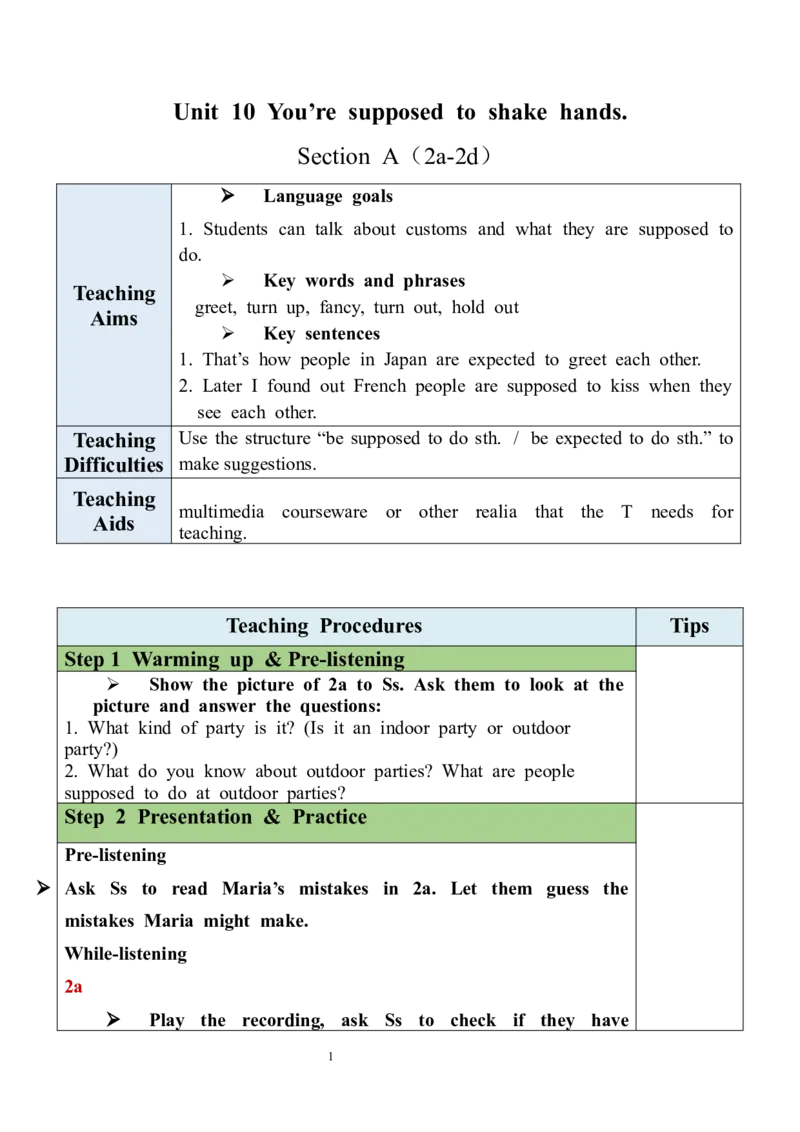
Language goals
1. Students can talk about customs and what they are supposed to
do.
Key words and phrases
Teaching
greet, turn up, fancy, turn out, hold out
Aims
Key sentences
1. That’s how people in Japan are expected to greet each other.
2. Later I found out French people are supposed to kiss when they
see each other.
Teaching Use the structure “be supposed to do sth. / be expected to do sth.” to
Difficulties make suggestions.
Teaching
multimedia courseware or other realia that the T needs for
Aids
teaching.
Teaching Procedures Tips
Step 1 Warming up & Pre-listening
Show the picture of 2a to Ss. Ask them to look at the
picture and answer the questions:
1. What kind of party is it? (Is it an indoor party or outdoor
party?)
2. What do you know about outdoor parties? What are people
supposed to do at outdoor parties?
Step 2 Presentation & Practice
Pre-listening
Ask Ss to read Maria’s mistakes in 2a. Let them guess the
mistakes Maria might make.
While-listening
2a
Play the recording, ask Ss to check if they have
1guessed correctly.
Answers: arrived late, greeted Paul’s mother the wrong way, wore
the
wrong clothes
Play the recording again and ask more detailed questions to
help Ss understand the listening material better. Remind Ss to
take notes while listening and tell them that they will use these
notes to do the exercises in 2b.
1. How many mistakes did Maria make?
2. When was she supposed to arrive? When did she arrive? Why did she
arrive late?
3. How did she greet Paul’s mom? What was she supposed to do when she
greeted Paul’s mom?
4. What did she wear at the party? What was she supposed to wear? Why?
2b
Ask Ss to fill in the blanks for this activity based on the notes
they have taken. Get them to share their answers with a
partner.
Answers: 1. arrived at 8:00 2. come later 3. shake hands 4.
wear
Post-listening
2c
Get Ss to role-play the conversation using the
information in their listening practice. Then get each pair of
Ss to switch partners with another pair and role-play the
conversation again. Next get them to go back to their
original partners and share how different the conversations
were, if at all.
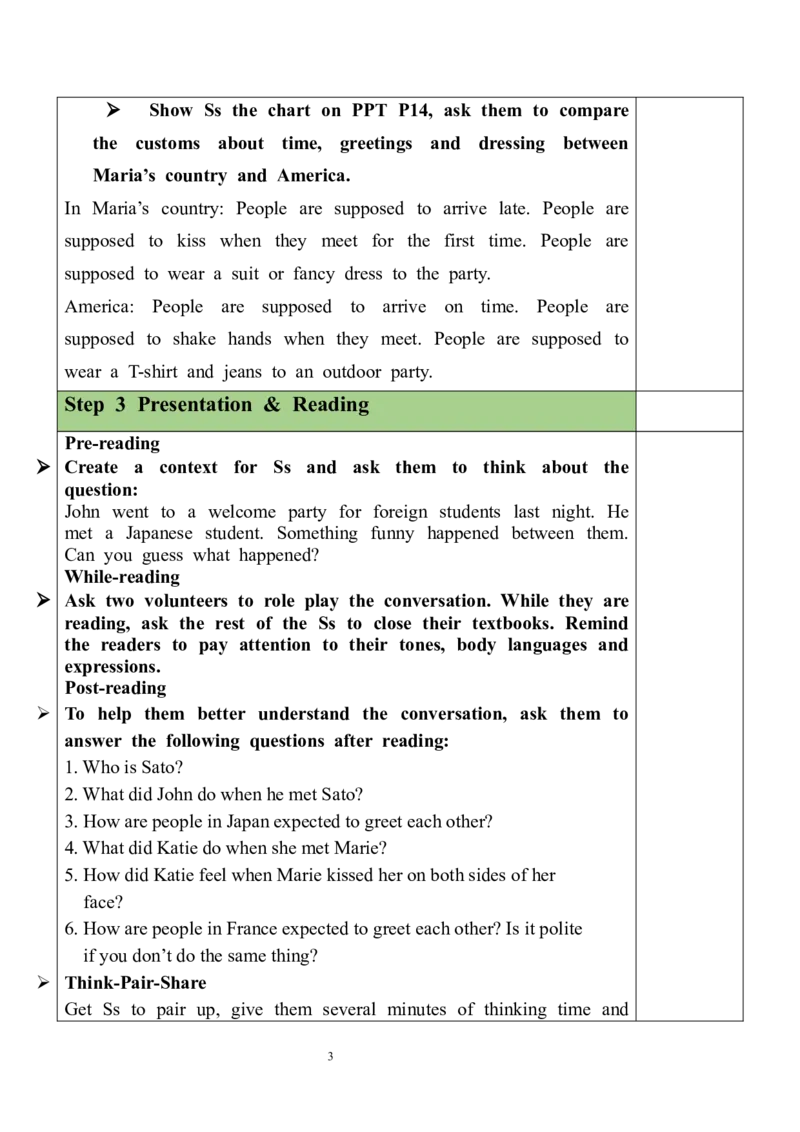
2 Show Ss the chart on PPT P14, ask them to compare
the customs about time, greetings and dressing between
Maria’s country and America.
In Maria’s country: People are supposed to arrive late. People are
supposed to kiss when they meet for the first time. People are
supposed to wear a suit or fancy dress to the party.
America: People are supposed to arrive on time. People are
supposed to shake hands when they meet. People are supposed to
wear a T-shirt and jeans to an outdoor party.
Step 3 Presentation & Reading
Pre-reading
Create a context for Ss and ask them to think about the
question:
John went to a welcome party for foreign students last night. He
met a Japanese student. Something funny happened between them.
Can you guess what happened?
While-reading
Ask two volunteers to role play the conversation. While they are
reading, ask the rest of the Ss to close their textbooks. Remind
the readers to pay attention to their tones, body languages and
expressions.
Post-reading
To help them better understand the conversation, ask them to
answer the following questions after reading:
1. Who is Sato?
2. What did John do when he met Sato?
3. How are people in Japan expected to greet each other?
4. What did Katie do when she met Marie?
5. How did Katie feel when Marie kissed her on both sides of her
face?
6. How are people in France expected to greet each other? Is it polite
if you don’t do the same thing?
Think-Pair-Share
Get Ss to pair up, give them several minutes of thinking time and
3ask them to think about the questions: What did you learn from the
conversation? What other culture differences did you know between
China and other countries? Then, let Ss to share their answers with
their partners.
Step 4 Language points learning
mistake n. 错误 / v. 误解; 误会, 其过去式为mistook,过去分词为
mistaken。其常用短语有: 此处只呈现部
分语言点
make a mistake 犯错误
by mistake 错误地
mistake ... for ... 把 ...... 错当成 ......
as soon as的意思是“一......就......”,常用来引导时间状语从句, 强
调两个动作几乎同时发生。需要注意的是当as soon as引导时间状语
从句时,若主句用一般将来时,从句则用一般现在时。若主句为祈使
句或含有情态词,从句也要用一般现在时。
find out的意思是“查明, 弄清(情况)”,find out后可接由that,
what, when或how等引导的宾语从句, 也可接名词。
find out与look for和find的区别是:
find out意为“弄清; 查明”, 指通过观察、探索或调查而得。
look for意为“寻找”, 强调找的动作和过程。
find意为“找到;发现”, 强调找的结果。
Step 5 Summary & Homework
Summary
Ask Ss to do the exercises from PPT P32-34.
Homework:
Preview the passage in 3a.
Do the exercises in students’ book.
In this lesson, it is important to get the students to know the main
structure “be supposed to”, “be expected to”, and get the students to
Teaching practice them in listening and speaking. And we should learn the new
Reflection words and expressions in the first period of the unit. We’d better learn them
by using them in listening, speaking and reading activities. And we always
learn them in the meaning group.
45