文档文本内容
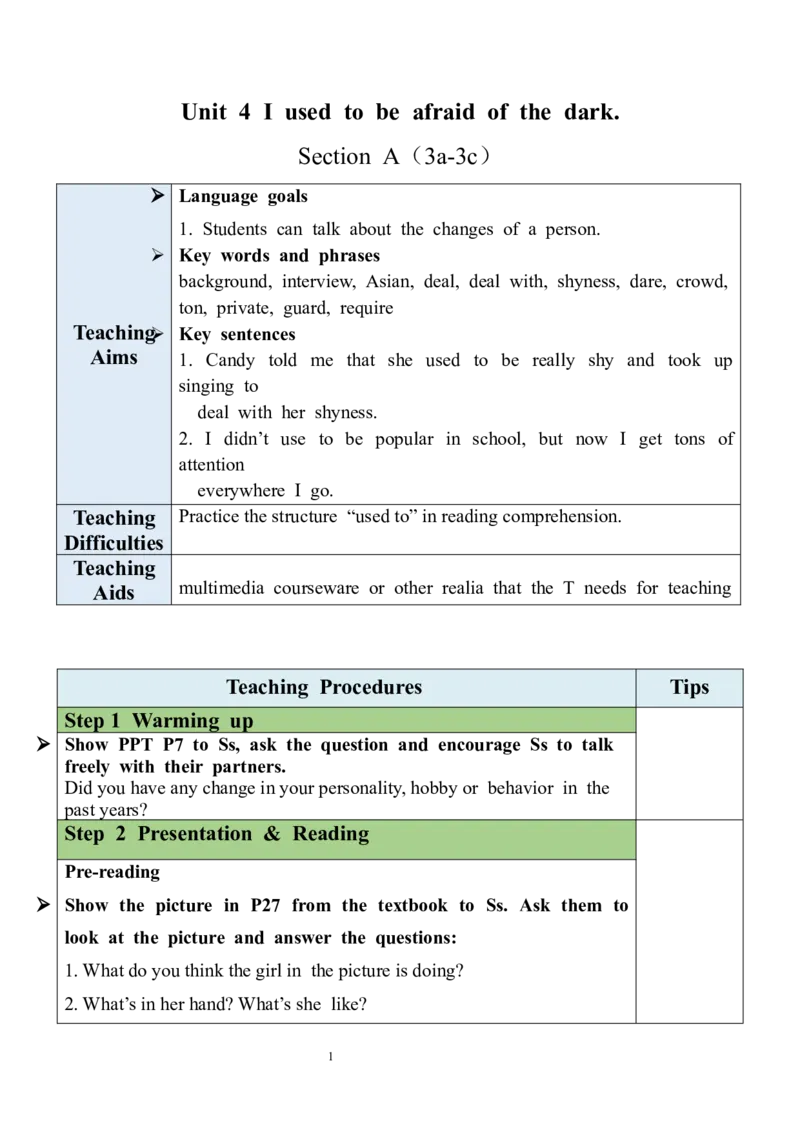
Unit 4 I used to be afraid of the dark.
Section A(3a-3c)
Language goals
1. Students can talk about the changes of a person.
Key words and phrases
background, interview, Asian, deal, deal with, shyness, dare, crowd,
ton, private, guard, require
Teaching Key sentences
Aims 1. Candy told me that she used to be really shy and took up
singing to
deal with her shyness.
2. I didn’t use to be popular in school, but now I get tons of
attention
everywhere I go.
Teaching Practice the structure “used to” in reading comprehension.
Difficulties
Teaching
Aids multimedia courseware or other realia that the T needs for teaching
Teaching Procedures Tips
Step 1 Warming up
Show PPT P7 to Ss, ask the question and encourage Ss to talk
freely with their partners.
Did you have any change in your personality, hobby or behavior in the
past years?
Step 2 Presentation & Reading
Pre-reading
Show the picture in P27 from the textbook to Ss. Ask them to
look at the picture and answer the questions:
1. What do you think the girl in the picture is doing?
2. What’s in her hand? What’s she like?
13. Is she outgoing or is she shy?
Write the title of the article on the board. Ask Ss to look at the
title and answer the questions:
1. What was the girl like in the past?
2. What kind of music does she like?
3. What do you think the reading passage is about?
文中有一些短
While-reading 语是可以通过
上下文推测出
3a 意 义 的 。 U2
Section B的阅
Ask Ss to read the article quickly and finish the task in 3a. 读 里 学 了
inferring 这 种
Answers: 2, 3, 1 阅读策略,此
处可做实操。
Ask Ss to read the article again and explain the following
phrases according to the context:
take up, hang out, fight on, make it to the top / make it
(Tip: T can ask Ss to explain how they get the meaning of the
phrases.)
Show the chart on PPT P16 to Ss. This time, ask them to read
for the details. Tell them that they need to make a comparison
of how Candy has changed in her personality, behavior, troubles
and worries.
(Tip: T can draw the same chart on the board and invite Ss to
complete the chart on the board.)
3b
Without having Ss read the passage again, ask them to fill in
the blanks in 3b. Ss can try to guess the answer based on the
construction and context of the sentence.
(Ss should make some connection between what they have read and
the sentences in the activity.)
Answers: 1.anymore 2.popular 3.hang out 4.worry about
2Optional Choice:
Ask Ss to read the second paragraph again and find out the
advantages and disadvantages of becoming famous.
(Tip: T can encourage Ss to check the answers with their partners.)
Read the third paragraph again and answer the question:
What suggestions did Candy give to those who want to become famous?
Step 3 Language points learning
interview的用法 此处只摘录教
学课件中的部
interview v. 采访;面试 n. 面试;访谈
分语法点。
interview的常用短语有:
interview sb. 采访某人
interview sb. about sth. 就某事采访某人
have an interview with sb. 采访某人
take up的用法
take up “(通常作为爱好)开始学习,开始练习”,后面可以接名词或
动名词(短语)。take up还有“占据”的意思。
dare的用法
dare v. “敢于;胆敢”,通常不用于进行时态。dare作实义动词时后
面跟动词不定式(to + v.)作宾语,有人称和数以及时态的变化。构成
疑问句和否定句时常借助助动词do。
don’t you dare 你敢,谅你不敢(用于口语,表示让人绝不要做某
事)。
how dare you 你竟敢(用于口语,表示对某人的行为或话语很气愤)
I dare say 我想;可能;大概
the road to success的用法
the road to success “通向成功的路”,其中to是介词,后面跟名词或
v.-ing形式。
the road to sth.是英语的一种固定表达方式,此处road并非指真实的
“道路”,属于修辞手法,意指“途径;通道”。它可以独立使
用,承担句子的主语、宾语等。但更多时候,the road to ...会与系动
词be及其他一些行为动词搭配,构成to be on / along the road to ...等
句式,表达出“快速地;不多久”这样的意思,汉语通常译作“很
快就要......;不久就会......”。
3Step 4 Summary & Homework
Post-reading
Ask Ss to pair up and decide who will be the interviewer and
who will be Candy. Get Ss attempt an interview using the
information only in paragraph 2. After that, they should switch
roles and attempt an interview using the information in
paragraph 3.
(Tip: Ask Ss to notice that in the article when interviewer states
one question Candy seems usually gives a very long reply. This
may not always be the case and more often than not, people tend
to give shorter answers. Tell the Ss playing the role of Candy that
they should not be giving all the answers at once. They will need
to give a little a time and allow the interviewer to ask more
questions or prompt them to say more.)
Optional Choice:
T can guide Ss to think more about “fame” by asking the
following questions:
1. In the article Candy said, “you have to be prepared to give up
your normal life. You can never imagine how difficult the road to
success is.” However, many young people in the limelight do not
realize that fame often comes at a price. How do you think about
that?
2. How do the celebrities influence young people?
Summary
Ask Ss to do the exercises from PPT P45-47.
Homework:
Preview the grammar points in U4.
Do the exercises in students’ book.
In this period,reading practice is important.We learn a lot of new words
and expressions while we are reading.The students must pay enough
Teaching attention to the new words in 3a as well as they finish the task. It is a good
Reflection idea to ask them write down the useful phrases in the reading materials.
They can learn from these models and copy them when writing their own
articles.
4