文档文本内容
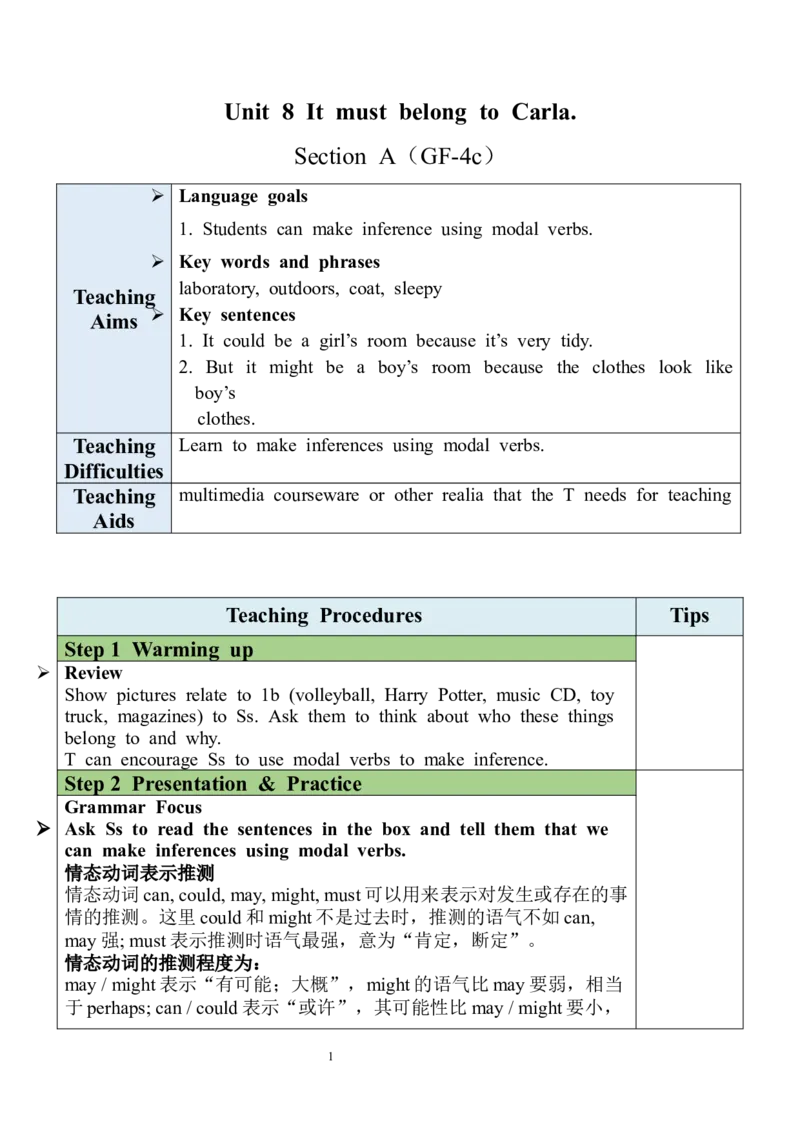
Unit 8 It must belong to Carla.
Section A(GF-4c)
Language goals
1. Students can make inference using modal verbs.
Key words and phrases
laboratory, outdoors, coat, sleepy
Teaching
Key sentences
Aims
1. It could be a girl’s room because it’s very tidy.
2. But it might be a boy’s room because the clothes look like
boy’s
clothes.
Teaching Learn to make inferences using modal verbs.
Difficulties
Teaching multimedia courseware or other realia that the T needs for teaching
Aids
Teaching Procedures Tips
Step 1 Warming up
Review
Show pictures relate to 1b (volleyball, Harry Potter, music CD, toy
truck, magazines) to Ss. Ask them to think about who these things
belong to and why.
T can encourage Ss to use modal verbs to make inference.
Step 2 Presentation & Practice
Grammar Focus
Ask Ss to read the sentences in the box and tell them that we
can make inferences using modal verbs.
情态动词表示推测
情态动词can, could, may, might, must可以用来表示对发生或存在的事
情的推测。这里could和might不是过去时,推测的语气不如can,
may强; must表示推测时语气最强,意为“肯定,断定”。
情态动词的推测程度为:
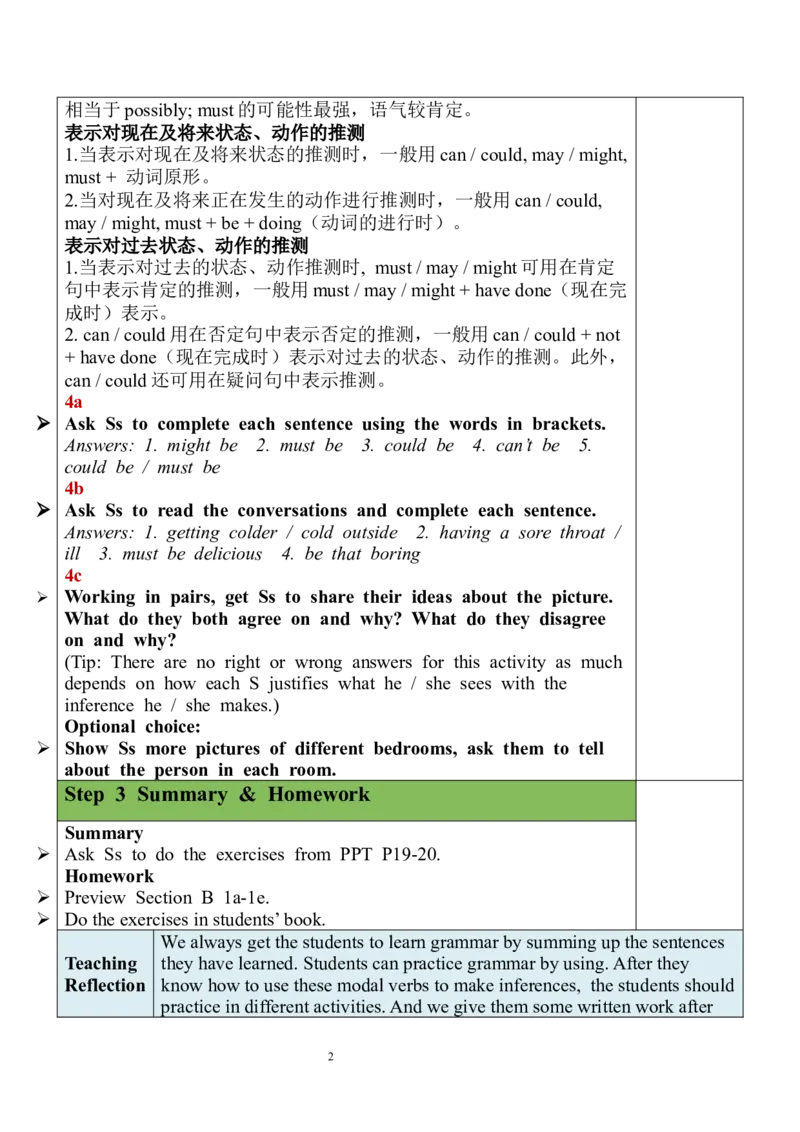
may / might表示“有可能;大概”,might的语气比may要弱,相当
于perhaps; can / could表示“或许”,其可能性比may / might要小,
1相当于possibly; must的可能性最强,语气较肯定。
表示对现在及将来状态、动作的推测
1.当表示对现在及将来状态的推测时,一般用can / could, may / might,
must + 动词原形。
2.当对现在及将来正在发生的动作进行推测时,一般用can / could,
may / might, must + be + doing(动词的进行时)。
表示对过去状态、动作的推测
1.当表示对过去的状态、动作推测时, must / may / might可用在肯定
句中表示肯定的推测,一般用must / may / might + have done(现在完
成时)表示。
2. can / could用在否定句中表示否定的推测,一般用can / could + not
+ have done(现在完成时)表示对过去的状态、动作的推测。此外,
can / could还可用在疑问句中表示推测。
4a
Ask Ss to complete each sentence using the words in brackets.
Answers: 1. might be 2. must be 3. could be 4. can’t be 5.
could be / must be
4b
Ask Ss to read the conversations and complete each sentence.
Answers: 1. getting colder / cold outside 2. having a sore throat /
ill 3. must be delicious 4. be that boring
4c
Working in pairs, get Ss to share their ideas about the picture.
What do they both agree on and why? What do they disagree
on and why?
(Tip: There are no right or wrong answers for this activity as much
depends on how each S justifies what he / she sees with the
inference he / she makes.)
Optional choice:
Show Ss more pictures of different bedrooms, ask them to tell
about the person in each room.
Step 3 Summary & Homework
Summary
Ask Ss to do the exercises from PPT P19-20.
Homework
Preview Section B 1a-1e.
Do the exercises in students’ book.
We always get the students to learn grammar by summing up the sentences
Teaching they have learned. Students can practice grammar by using. After they
Reflection know how to use these modal verbs to make inferences, the students should
practice in different activities. And we give them some written work after
2speaking and reading.
3