文档文本内容
Unit 8 Have you read Treasure Island yet?
Section A(GF-4c)
1.语言能力:了解现在分词的构成,学习现在完成时的用法。
2.文化意识:以名著为话题进行问答或对话,拓展学生知识面,培养文学素
Teaching 养。
Aims
3.思维品质:能发现同类型语篇的相似之处和不同类型语篇的结构特征。
4.学习能力:能制订明确的英语学习目标和计划,合理安排学习任务,主动预
习和复习。
Teaching 熟练掌握 already,yet在现在完成时中的用法。
Difficulties
Teaching multimedia courseware or other realia that the T needs for teaching
Aids
Teaching Procedures Tips
Step 1 Warming up
Ask the Ss to watch a video about present perfect tense!
Step 2 Presentation & Practice
Grammar Focus
Ask Ss to read the sentences in the box.
Ask the Ss the following questions:
1.How is the present perfect tense formed?
2.What adverbs are often used with the present perfect tense?
3.含现在完成时的句子如何构成一般疑问句?
Answers:1.have / has + 过去分词.
2.Already and yet.
3.将助动词have / has放在主语之前。
Grammar
现在完成时(一)
一、现在完成时的基本结构
现在完成时由“助动词have/has + 过去分词”构成,其基本句式结
1构为:
① 肯定句:主语 + have/has + 过去分词 + 其他.
I have seen this film.
② 否定句:主语 + have/has not + 过去分词 + 其他.
I have not seen this film.
③ 一般疑问句:Have/Has + 主语 + 过去分词 + 其他?
肯定回答:Yes, 主语 + have/has. 否定回答:No, 主语 +
haven't/hasn't.
—Have you seen the film? —Yes, I have. / No, I haven't.
二、过去分词的构成
1. 规则变化(与动词过去式规则一样,此类称作规则动词)
-ed的读音规则:
① 在元音或浊辅音后读[d],如tried [traɪd],lived [lɪvd]。
② 在清辅音后读[t],如worked [wɜːkt],stopped [stɒpt]。
③ 在[t][d]后读[ɪd],如mended [mendɪd],wanted [wɒntɪd]。
2. 不规则变化(此类称作不规则动词,有很多)
2三、现在完成时的用法
1. 表示过去发生或已经完成的动作对现在造成的影响或结果。常和
just(刚刚),already(已经),yet(还,仍然),ever(曾经),
never(从未),before(以前),so far(到目前为止)等连用。
— Have you had your breakfast yet?
— Yes, I have. I've just had it.
— Have you ever heard this song?
— No. I've never heard it before.
Julia has collected over 100 beautiful hair clips so far.
图示法表示
现在完成时用法1:
表示过去发生或已经完成的动作对现在造成的影响或结果。
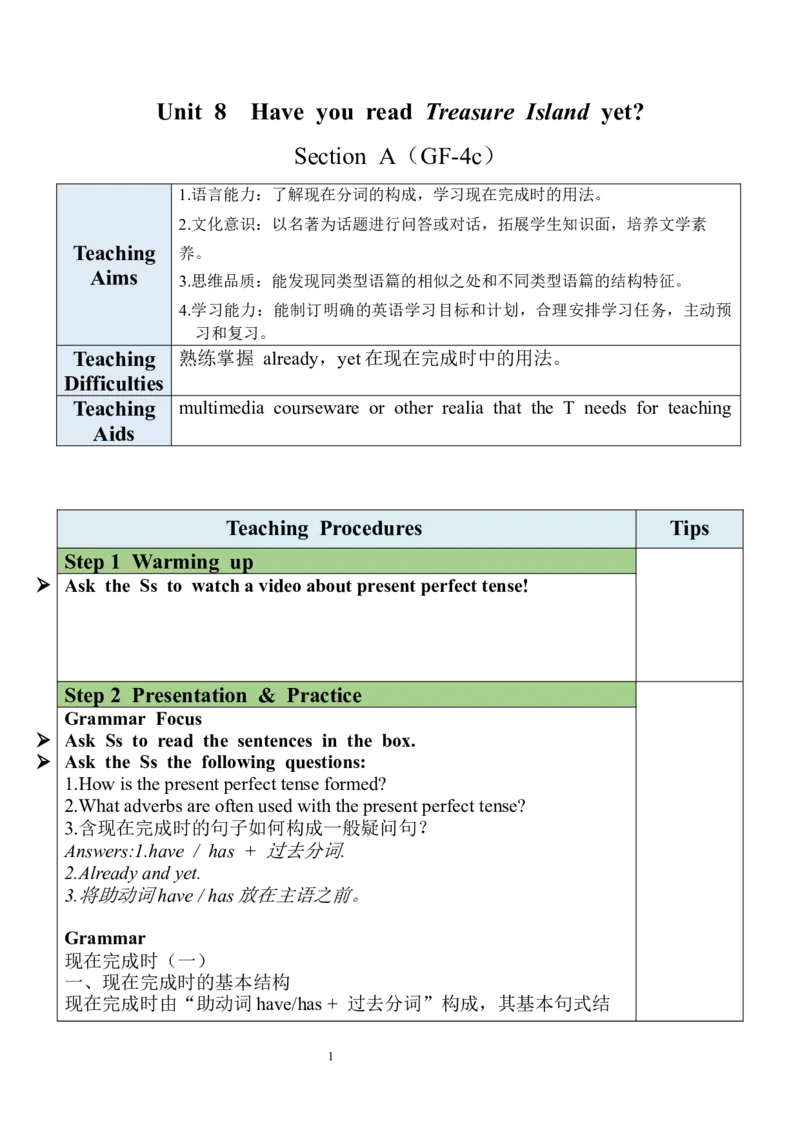
I have already had breakfast.
2. 现在完成时还可以表示过去某一时间开始并一直持续到现在的动
作或状态,常与“for + 时间段”或“since + 时间点 / 从句”连
用,这时要用延续性动词。
They have worked in this company for 30 years.
He has been in the army since 2016.
(错:He has joined the army since 2016.)
【特别提醒】如果要对for或since短语提问,疑问词用how long。
— How long have you lived in this area?
— For at least 10 years.
图示法表示
现在完成时用法2:
表示过去某一时间开始并一直持续到现在的动作或状态。
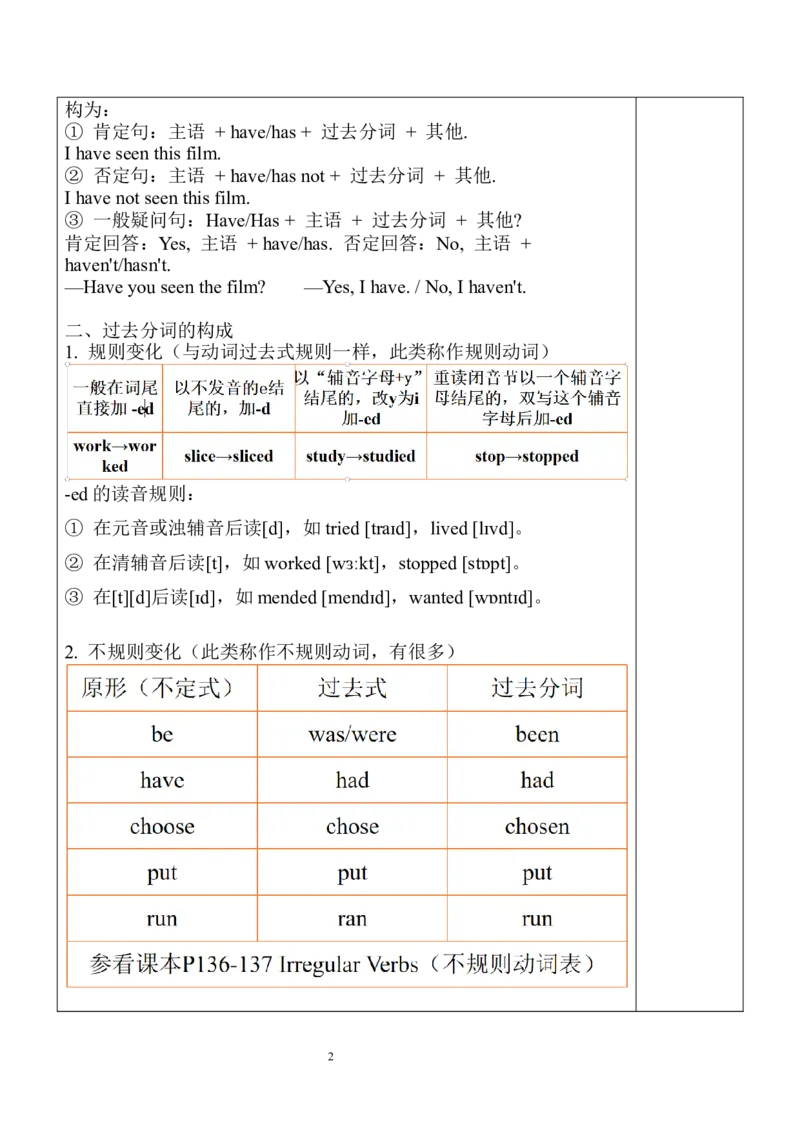
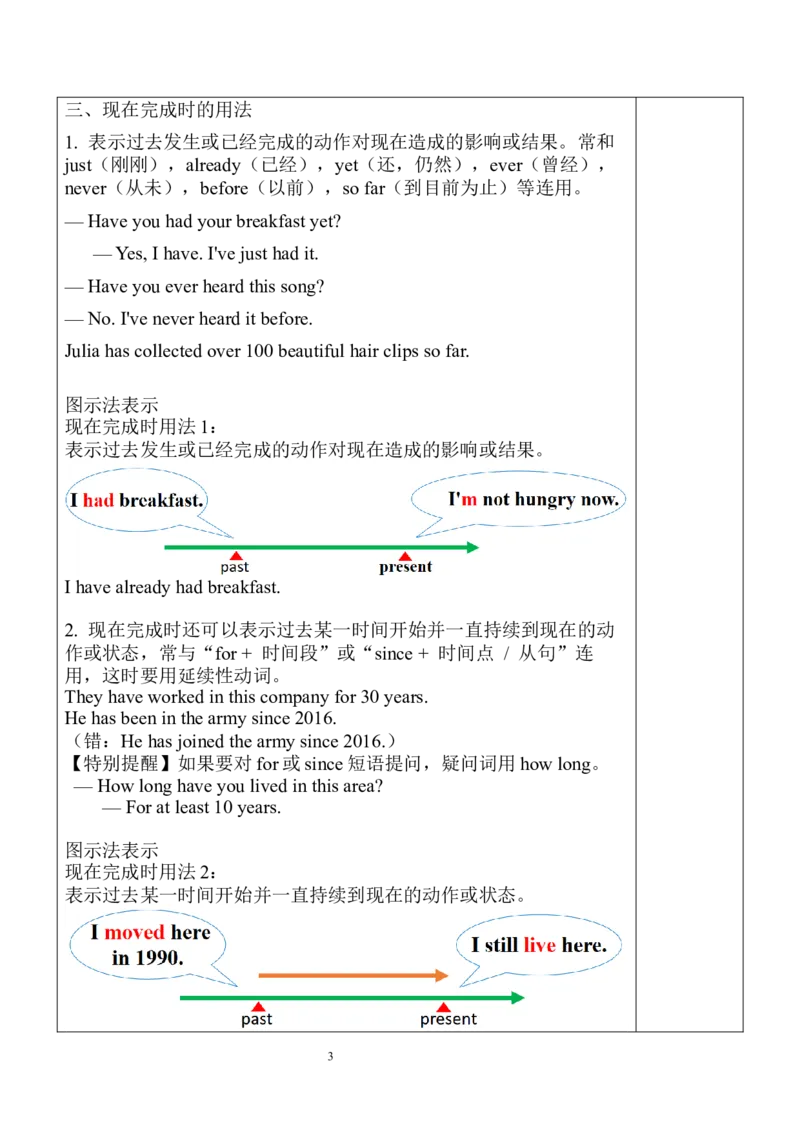
3I have lived here for 30 years.
(30年来一直生活在这里。)
四、already与yet在现在完成时中的用法解析
五、现在完成时 VS 一般过去时
1.现在完成时表示过去发生的某一动作对现在造成的影响或结果,强
调的是现在的情况,因此不能和表示过去的时间状语连用。
I have already done my homework.(不能用last night等)
I've been to Paris before.(不能用last year等)
2.一般过去时只表示过去的动作和状态,与现在无关。可以和表示过
去的时间状语连用。
I did my homework last night.
When did you go to Paris? (when一定不要和现在完成时连用)
3. 日常对话中通常两种时态配合使用,开始提到一件事做没做或发
生过时用现在完成时,说起这件事具体情形时用一般过去时。
— Have you been to Japan?
— Yes, I have. I went there last year.
— Who did you go with?
— …
Step 3 Presentation & Practice
4a
Use the words in brackets to complete the conversations.
41. A: Would you like something to drink?
B: No, thanks. ________________________. (just / drink some tea)
2. A: I heard you lost your key. _______________________? (find)
B:No, not yet.
3. A: Do you know when Tom is leaving?
B: ________________________________. (already / leave)
A: When _____________________? (leave)
B: This morning.
4. A: Is your sister going to the movies with us tonight?
B: No. ___________________________. (already / see the film)
5. A: What do your parents think about our plan?
B: I _____________________________. (not / tell them / yet)
Answers:1.I've just drunk some tea
2.Have you found it yet
3.He has already left
did he leave
4.She has already seen the film
5.have not/haven't told them yet
4b
Fill in the blanks with the correct forms of the words in brackets.
Sally ______(love) reading. In the morning, she reads the newspaper and
in the evening she reads books. She ______ already _______(read) more
than 100 different books! Her favorite kind of books is science fiction. She
is interested in science and technology and loves to imagine what the
world _________(be) like in 50 years.
She ________ (finish) reading a book about robots last week and
_________ (write) a book report about it next week for her French class.
Every time she is in the library, Sally looks at the many books she
____________(not read) yet and she can't wait to read them!
Answers:loves has read will be finished will write
hasn't read
Explain the key words and phrases.
4c
Complete the chart with information about you and a friend.
5A: What books have you already read?
B: I've already read Tom Sawyer and Harry Potter.
A: What do you think of them?
B: Well, I think Harry Potter was exciting, but Tom Sawyer
was a bit boring.
Experiences You Your friend Comments
Books I have
already read
Movies I have
already seen
Songs I have
already heard
Step 4 Summary & Homework
Summary
Ask Ss to do the exercises from PPT P24-28.
Homework
Preview the new words and phrases in Section B(1a-1d).
Do the exercises in students' book.
We always get the students to learn grammar by summing up the sentences
they have learned. Students can practice grammar by using. After they
Teaching
know how to use these present perfect tense to make sentences, the
Reflection
students should practice in different activities. And we give them some
written work after speaking and reading.
6