文档文本内容
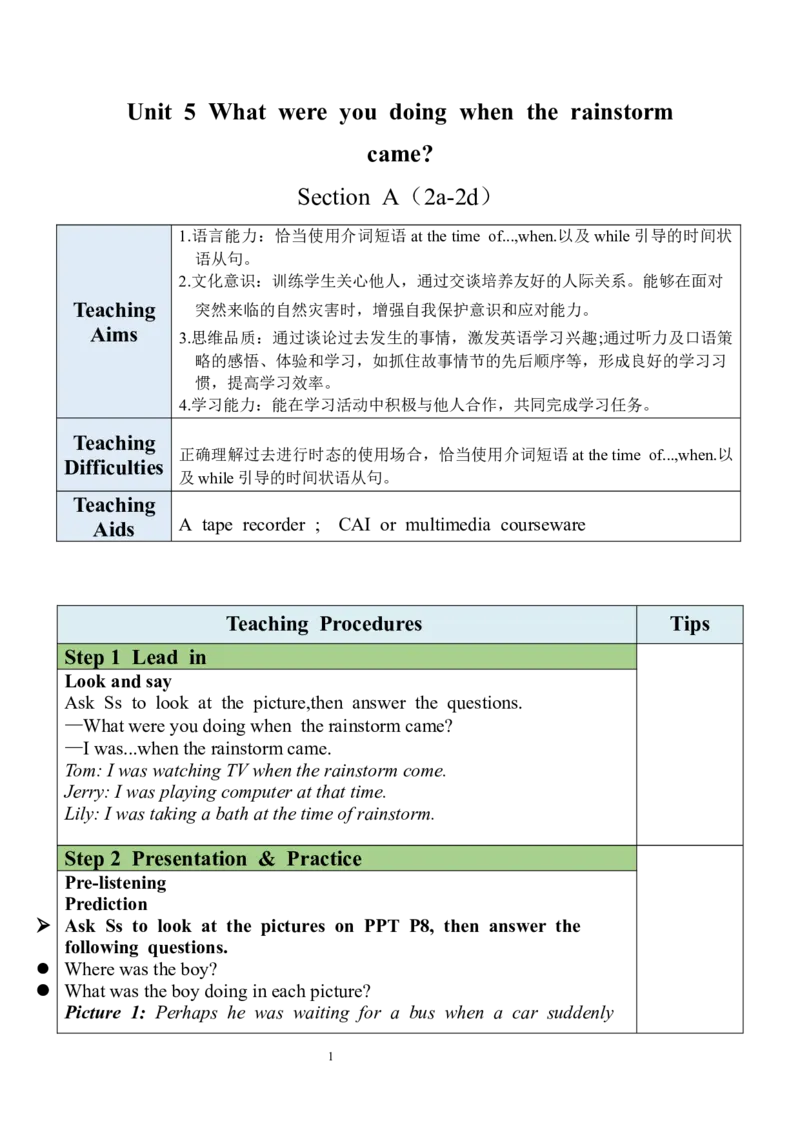
Unit 5 What were you doing when the rainstorm
came?
Section A(2a-2d)
1.语言能力:恰当使用介词短语 at the time of...,when.以及while引导的时间状
语从句。
2.文化意识:训练学生关心他人,通过交谈培养友好的人际关系。能够在面对
Teaching 突然来临的自然灾害时,增强自我保护意识和应对能力。
Aims
3.思维品质:通过谈论过去发生的事情,激发英语学习兴趣;通过听力及口语策
略的感悟、体验和学习,如抓住故事情节的先后顺序等,形成良好的学习习
惯,提高学习效率。
4.学习能力:能在学习活动中积极与他人合作,共同完成学习任务。
Teaching
正确理解过去进行时态的使用场合,恰当使用介词短语at the time of...,when.以
Difficulties
及while引导的时间状语从句。
Teaching
Aids A tape recorder ; CAI or multimedia courseware
Teaching Procedures Tips
Step 1 Lead in
Look and say
Ask Ss to look at the picture,then answer the questions.
—What were you doing when the rainstorm came?
—I was...when the rainstorm came.
Tom: I was watching TV when the rainstorm come.
Jerry: I was playing computer at that time.
Lily: I was taking a bath at the time of rainstorm.
Step 2 Presentation & Practice
Pre-listening
Prediction
Ask Ss to look at the pictures on PPT P8, then answer the
following questions.
Where was the boy?
What was the boy doing in each picture?
Picture 1: Perhaps he was waiting for a bus when a car suddenly
1came over to him.
Picture 2: He was looking at his alarm clock.
Picture 3: He was eating a meal.
Picture 4: He was standing there when it started to rain.
Picture 5: He was running after a bus.
While-listening
2a
Ask Ss to listen and number the pictures [1-5].
Answer:4 1 5 3 2
2b
Ask Ss to listen again. Then fill in the blanks in the sentences in 2a.
I _____ so busy _______ for the umbrella that I didn't see a car coming.
My alarm didn't go off so I _____ up late.
I took a hot shower and _____ some warm food.
I ___________ for the bus when it began to rain heavily.
I ____ to the bus stop but I still missed the bus.
Answers:was looking woke ate was waiting ran
Ask Ss to listen and judge the sentences True or False.
( ) 1. The boy didn't wake up until seven thirty because his alarm
didn't work.
( ) 2. He arrived at school at eight.
( ) 3. He still didn't catch the bus although he ran to the bus stop.
( ) 4. While he was waiting for the bus, it suddenly started to rain
heavily.
( )5. While he was busy looking for the umbrella in his schoolbag, a
car came and got water all over him.
Answers:1.T 2. F 3.T 4. T 5. T
Ask Ss to listen again and read.
Boy: Yesterday was a terrible day. My alarm didn't go off so I
woke up late. It was seven thirty when I woke up, and I needed to
be at school by eight! I ran to the bus stop ... but, I still missed
the bus. It was eight thirty when I got to school. My teacher was
angry and I felt bad all day. At four thirty, it was time to go
home. I was waiting for the bus when ... all of a sudden ... it
began to rain heavily.
It was like ... a really crazy rainstorm! I thought I had an
umbrella in my schoolbag, so I kept trying to look for it. I was so
busy looking for the umbrella that I didn't see a car coming. And it
got water all over me! I was waiting like that ... completely wet ...
for maybe almost an hour. Finally, the bus came and brought me
2home. I took a hot shower and ate some warm food. It felt so
good to be home!
Post-listening
2c
Ask Ss to use the information in 2a to retell the story in a
conversation between the boy and a TV reporter.
TV reporter: Tell us what happened yesterday morning.
Boy: ...
TV reporter: So, when the rainstorm suddenly came, what were you
doing?
Boy: ...
Retell the story
Tell us what happened yesterday morning.
I was late. My alarm didn't go off. It was seven thirty when I woke up. I
ran to the bus stop but I still missed the bus. When I got to school, it was
eight thirty. My teacher was angry and I felt bad.
So, when the rainstorm suddenly came, what were you doing?
I was waiting for the bus at that time. All of a sudden, it began to rain
heavily. I thought I had an umbrella. I was so busy looking for it that I
didn't see a car coming. And it got water all over me.
And then what happened? Did you get on the bus at last?
I waited for almost an hour, completely wet. Finally, I got on the bus and
came home. I took a hot shower and ate some warm food. I felt good to be
home.
Mary is asking what Linda was doing last night in the classroom.
Read the conversation in 2d and answer the questions.
What was Linda doing at seven? At eight? At nine?
Where was she at seven?At eight? At nine?
Explain the key words and phrases.
When What Where
7: 00 p.m. helping her mother in the kitchen
8: 00 p.m. taking a shower in the bathroom
9: 00 p.m. sleeping in the bedroom
Make sentences: Mary was ... in ... at ...
Mary was helping her mother in the kitchen at seven.
Mary was taking a shower in the bathroom at eight.
3 Mary was sleeping in the bedroom at nine.
Step 3 Language points
1. My alarm didn't go off so I woke up late.
go off (闹钟)发出响声 为不及物动词短语。
I have set the alarm clock to go off at 7 a.m.
【拓展延伸】go off 的其他常见含义:
①离开
He went off early this morning.
②(食物、饮料)变质;变坏
Meat goes off easily in hot weather.
③(电、灯)熄灭;(电)中断
Suddenly the lights went off.
wake up 醒来
wake up 在此处意为“醒来”,用作不及物动词短语,其后不能接宾
语。
I usually wake up at six o'clock in the morning.
【拓展延伸】wake up还可意为“叫醒”,此时为“动词+副词”型
短语,其后可接宾语。当宾语是代词时,代词要放在wake和up中
间。
The alarm clock wakes me up at seven every morning.
2. I was waiting for the bus when it began to rain heavily.
begin v. 开始
begin作动词,同义词是start。常见用法有:
begin to to sth. = begin doing sth. 开始做某事
begin with 以······开始
to begin with 首先;起初
He sat down at the desk and began/started to write.
She began/started teaching English at the age of 25.
The party began with a game.
To begin with, we have to consider the passengers' safety.
3. I called at seven and you didn't pick up.
pick up 接电话
pick up在此处相当于pick up the phone, 与answer the phone同义。
Lucy was watering the flowers in the garden, so she didn't pick up the
phone/answer the phone.
【拓展延伸】pick up的其他常见含义:
捡起;拾起 You should pick up the paper on the ground.
整理;收拾 Let's pick up the living room.
搭载;驾车去接(某人) Shall we go to the airport to pick up your
sister?
4(偶然)得到;学会 She picked up Spanish when she was living
in Mexico.
逮捕;抓捕 He was picked up by police and taken to the
station for questioning.
得(某种疾病) She seemed to pick up a terrible cold .
4. I called again at eight and you didn't answer then either.
either adv. 也
either在此作副词,用于否定句句末。
Jenny won't go and Bill won't either.
【拓展延伸】
(1) either还可作代词,意为“(两者中的)任何一个”。
You can keep either of the photos.
(2) either还可作限定词,意为“(二者之中)任一的”,修饰可数名
词单数。
You can park on either side of the street.
Either plan is better than mine.
过去进行时(Past continuous tense)
定义:表示过去在某一时刻或某一段时间内正在进行的动作或存在的
状态。
结构:主语+be(was/were)+动词的现在分词
I was cooking at 8:00 p.m. yesterday.
过去进行时的用法
①表示过去某一时刻正在进行的动作:
eg. I was drawing at that time yesterday.
②表示过去某一时间段内正在进行的动作:
eg. I was reading last night.
③表示一个动作发生时,另一个动作正在进行:
eg. When my mum came home, I was sleeping.
④表示一个动作正在进行,另一个动作突然发生:
eg. When I was walking, it rained.
⑤表示两个动作同时进行。
eg. While I was sweeping the floor, she was cooking.
时间状语标志:
①at +过去时间点
②those days
5③from ... to ... +过去时间
④when/while 引导的时间状语从句
⑤at this(that)time +过去时间
Step 4 Summary & Homework
Summary The
Ask Ss to do the exercises on PPT P34-P36. homework
Homework can vary
Preview the passage on Page 35. with the
Preview the new words and phrases. specific
Do the exercises in students’ book. conditions.
In this period, there are more new words and expressions. The T
should provide more practice in listening and speaking and encourage
Teaching Ss to be more involved. In the reading part, Ss can experience more
Reflection practice in using the target language in natural speech. In this part,
the T should teach Ss a reading strategy—the SQ4R(survey, questions,
read, record, recite, review).
6