文档文本内容
Unit 7 What’s the highest mountain in the world?
Section A(2a-2d)
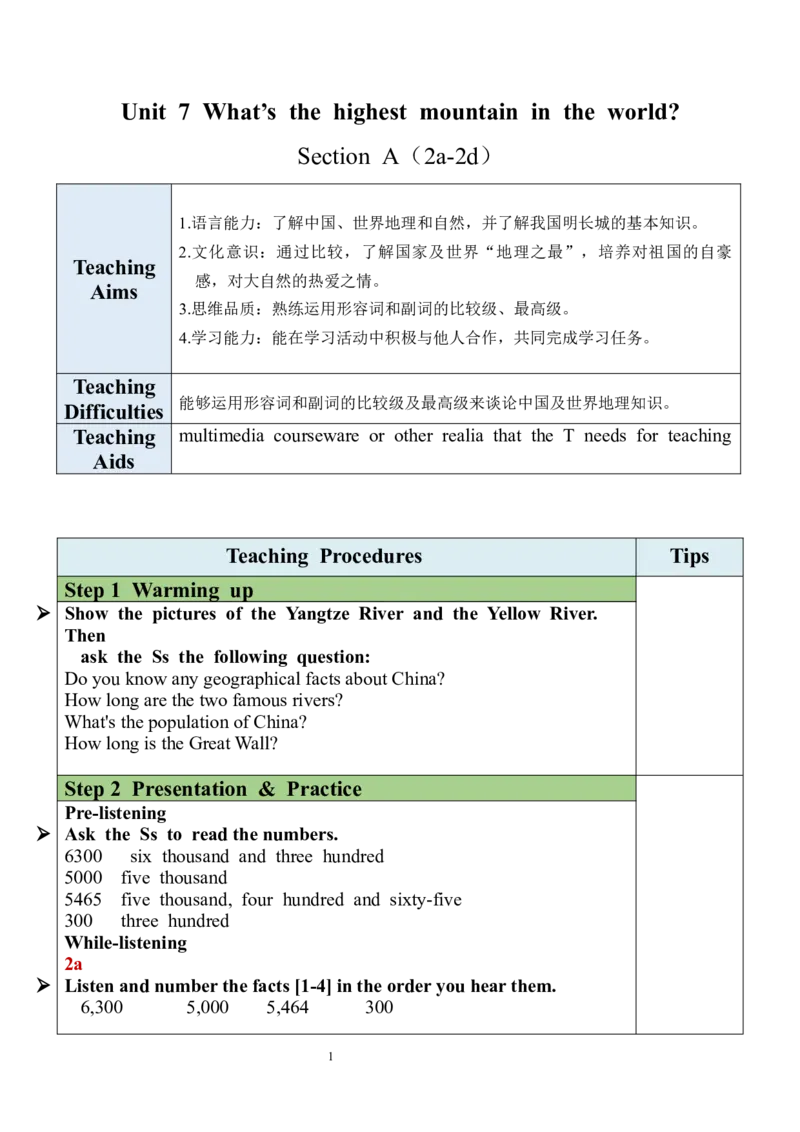
1.语言能力:了解中国、世界地理和自然,并了解我国明长城的基本知识。
2.文化意识:通过比较,了解国家及世界“地理之最”,培养对祖国的自豪
Teaching
感,对大自然的热爱之情。
Aims
3.思维品质:熟练运用形容词和副词的比较级、最高级。
4.学习能力:能在学习活动中积极与他人合作,共同完成学习任务。
Teaching
能够运用形容词和副词的比较级及最高级来谈论中国及世界地理知识。
Difficulties
Teaching multimedia courseware or other realia that the T needs for teaching
Aids
Teaching Procedures Tips
Step 1 Warming up
Show the pictures of the Yangtze River and the Yellow River.
Then
ask the Ss the following question:
Do you know any geographical facts about China?
How long are the two famous rivers?
What's the population of China?
How long is the Great Wall?
Step 2 Presentation & Practice
Pre-listening
Ask the Ss to read the numbers.
6300 six thousand and three hundred
5000 five thousand
5465 five thousand, four hundred and sixty-five
300 three hundred
While-listening
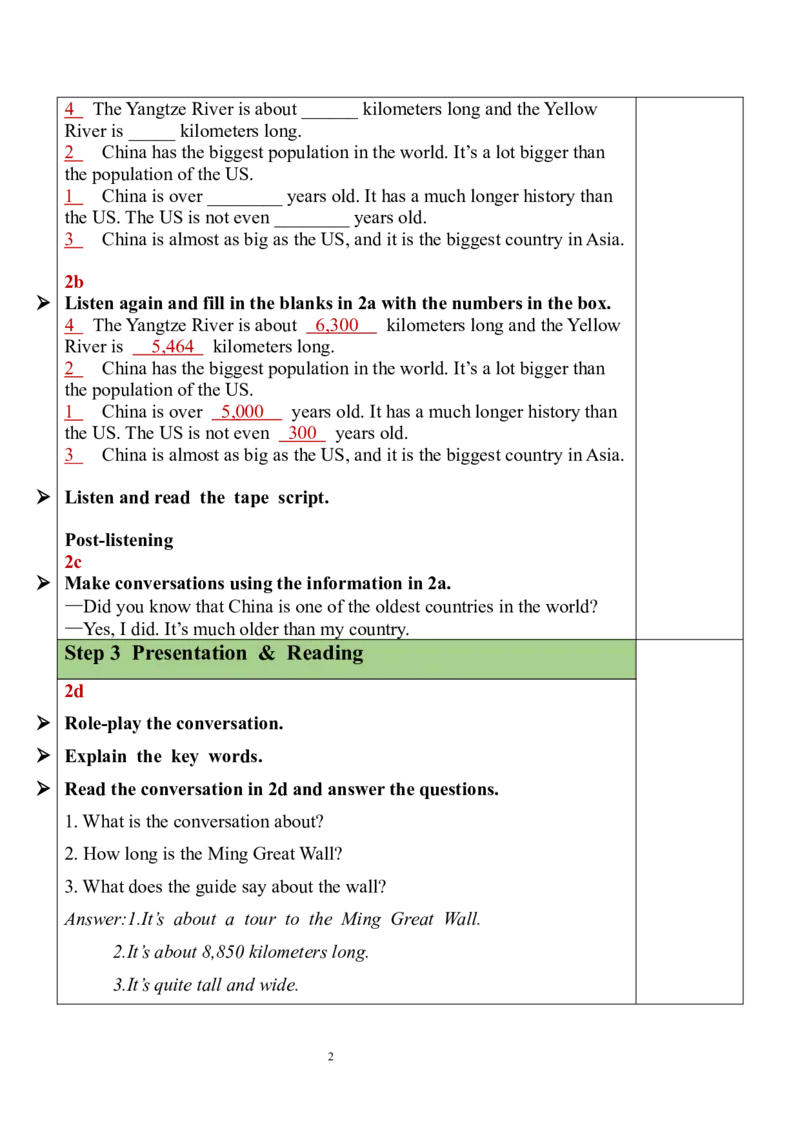
2a
Listen and number the facts [1-4] in the order you hear them.
6,300 5,000 5,464 300
14 The Yangtze River is about ______ kilometers long and the Yellow
River is _____ kilometers long.
2 China has the biggest population in the world. It’s a lot bigger than
the population of the US.
1 China is over ________ years old. It has a much longer history than
the US. The US is not even ________ years old.
3 China is almost as big as the US, and it is the biggest country in Asia.
2b
Listen again and fill in the blanks in 2a with the numbers in the box.
4 The Yangtze River is about 6,300 kilometers long and the Yellow
River is 5,46 4 kilometers long.
2 China has the biggest population in the world. It’s a lot bigger than
the population of the US.
1 China is over 5 , 0 00 years old. It has a much longer history than
the US. The US is not even 30 0 years old.
3 China is almost as big as the US, and it is the biggest country in Asia.
Listen and read the tape script.
Post-listening
2c
Make conversations using the information in 2a.
—Did you know that China is one of the oldest countries in the world?
—Yes, I did. It’s much older than my country.
Step 3 Presentation & Reading
2d
Role-play the conversation.
Explain the key words.
Read the conversation in 2d and answer the questions.
1. What is the conversation about?
2. How long is the Ming Great Wall?
3. What does the guide say about the wall?
Answer:1.It’s about a tour to the Ming Great Wall.
2.It’s about 8,850 kilometers long.
3.It’s quite tall and wide.
2It’s the longest wall in the world.
There are no man-made objects as big as this.
…
Role-play in groups of four.
Some tips:
Make eye contact.
Express interest in what other person is saying.
If you are not familiar with the subject matter, just ask questions.
Feel confident and do not hesitate to take part in a conversation.
Enjoy the conversation.
Ask the Ss to watch the video.
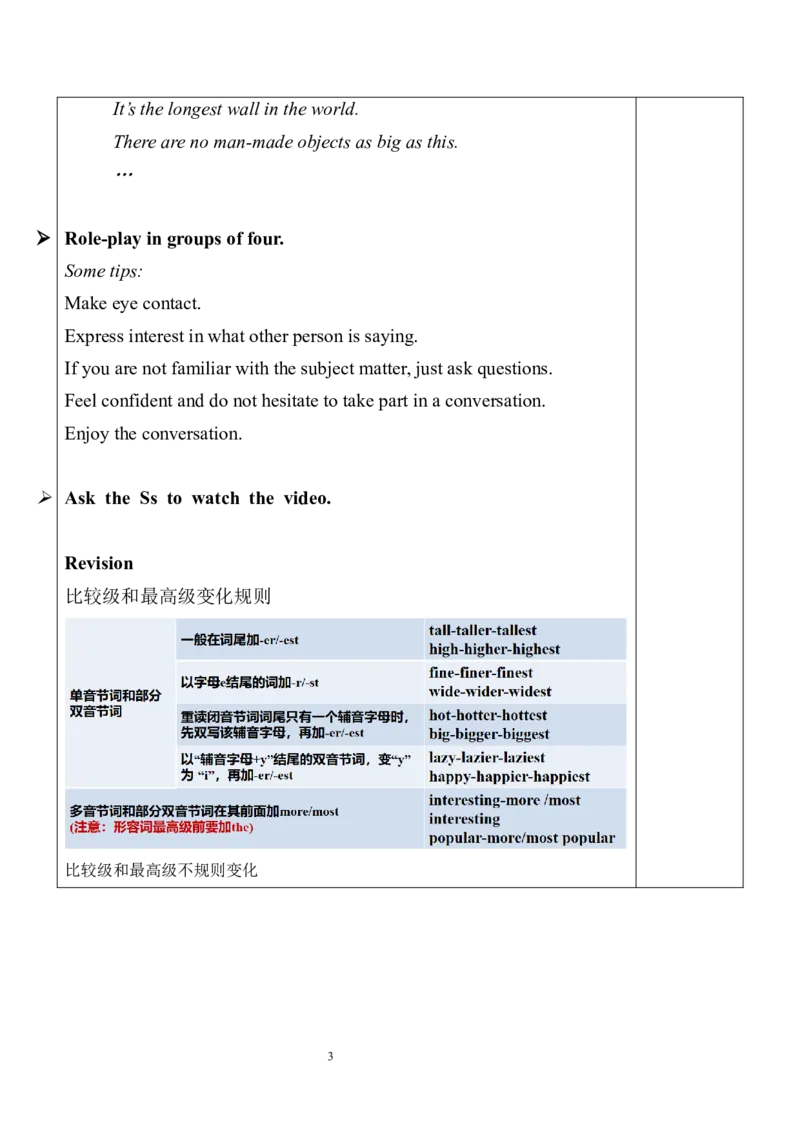
Revision
比较级和最高级变化规则
比较级和最高级不规则变化
3Step 4 Language points learning
1. China has the biggest population in the world.
① population 是集体名词,在句中作主语时,谓语动词用单数形式。
The population of the world continues to increase, but in some areas the
population is falling.
② 表示有多少人口时,用“have/has a population of + 数词”,或
“the population of … is + 数词”。
China has a population of about 1.4 billion. = The population of China is
about 1.4 billion.
③ 询问人口多少时,用“What is the population of …?”或“How large
is the population of …?”。
What/How large is the population of Henan Province?
④ 表示人口多少时,用 big/large 或 small 修饰,而不能用 many,
much 或 few 等。
India has a large population.
【注意】类似的,表示 price(价格)高低,用 high 或 low,不能
用 expensive 或 cheap;表示 temperature(温度)高低,用 high
或 low,不能用 hot 或 cold。
2. Feel free to ask me anything on today’s Great Wall tour.
tour n. & v. 旅行;旅游
tour在此处作可数名词,还可以作动词。
They went on a tour around Europe last year. ( n.)
We toured Italy for our holiday last year. ( v.)
【拓展延伸】
tour (v.) + 后缀 -ist → tourist (n.) 旅行者;观光者
The tourists (n.) toured (v.) Hong Kong for holidays. They all enjoyed
their tour (n.).
43. Wow, that’s amazing.
amazing adj. 令人大为惊奇的;令人惊喜(惊叹)的
amazing一般用于修饰事物,amazed(感到惊奇的)常用于修饰人。
be amazed at 意为“对......感到惊讶”。
The amazing magic show made me feel so amazed.
I’m amazed at his rapid progress.
【拓展延伸】类似的以 -ing(令人……),-ed(感到……)结尾的
形容词:
interesting/interested, surprising/surprised, relaxing/relaxed,
moving/moved, tiring/tired, boring/bored, exciting/excited, …
6. The main reason was to protect their part of the country.
protect v. 保护;防护
protect此处用作及物动词, protect… against/from…“保护……免
于……”。protection作不可数名词,意为“保护;防卫”。
Are we doing enough to protect the environment?
He wears a scarf to protect himself against/from the strong wind.
It’s parents’ duty to provide protection for their children.
Step 5 Summary & Homework
Summary
Ask Ss to do the exercises from PPT P28-30.
Homework
Preview the passage on Page 51.
Preview the new words and phrases.
Do the exercises in students’ book.
This is the second period of the unit. The teacher needs to
encourage the students to practice the target language in listening and
Teaching
speaking. With the help of language practice, the students can learn
Reflection
the new pattern and the comparatives and superlatives in a more
natural way.
5