Unit 3 Could you please clean your room?
Section A(GF-4c)
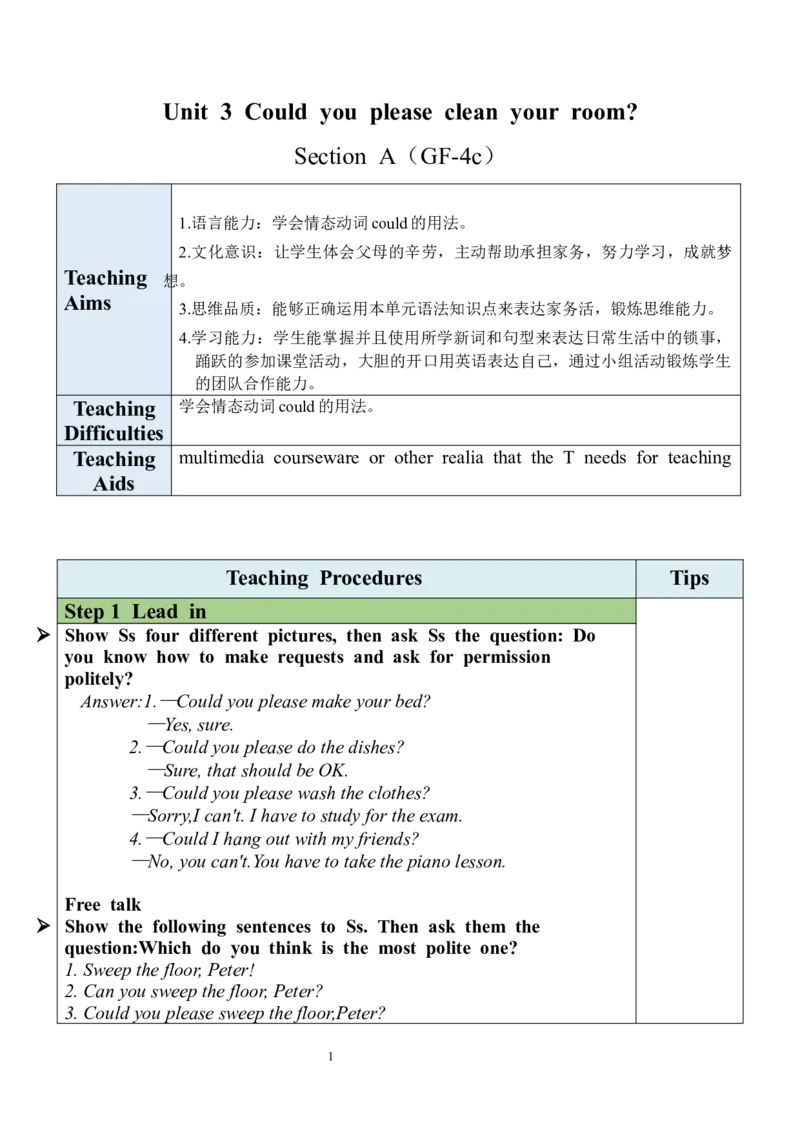
1.语言能力:学会情态动词could的用法。
2.文化意识:让学生体会父母的辛劳,主动帮助承担家务,努力学习,成就梦
Teaching
想。
Aims
3.思维品质:能够正确运用本单元语法知识点来表达家务活,锻炼思维能力。
4.学习能力:学生能掌握并且使用所学新词和句型来表达日常生活中的锁事,
踊跃的参加课堂活动,大胆的开口用英语表达自己,通过小组活动锻炼学生
的团队合作能力。
Teaching 学会情态动词could的用法。
Difficulties
Teaching multimedia courseware or other realia that the T needs for teaching
Aids
Teaching Procedures Tips
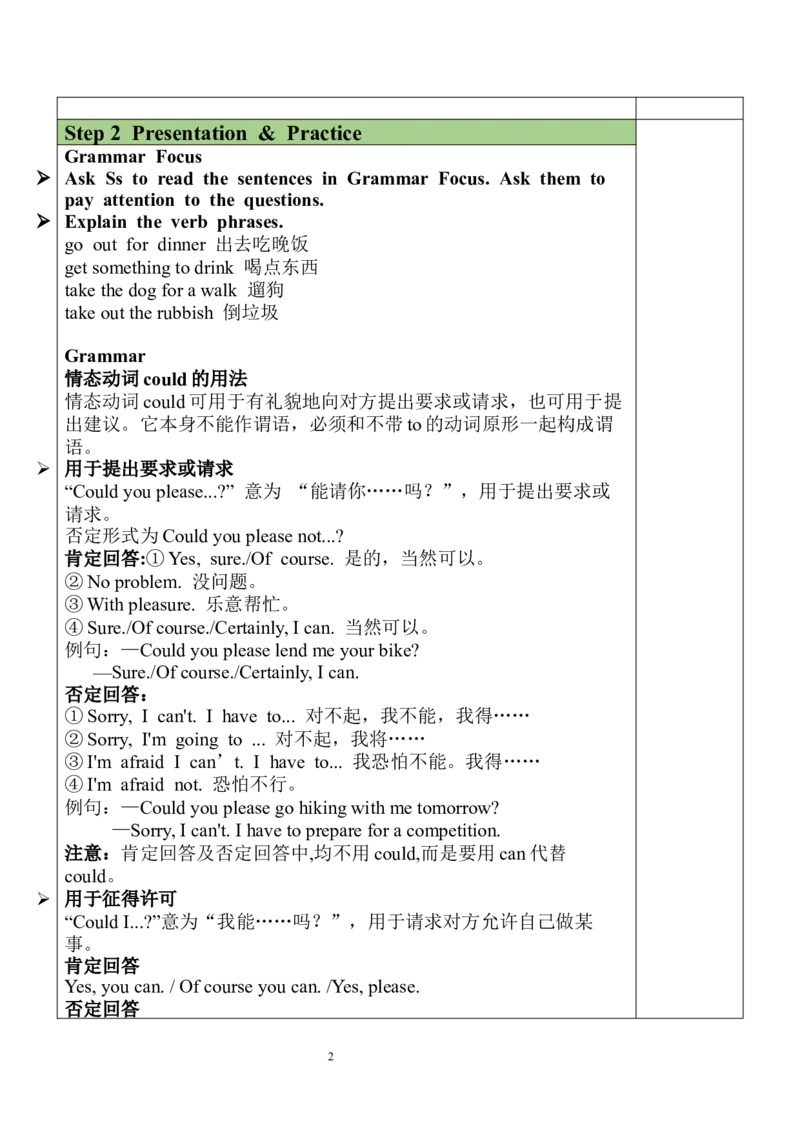
Step 1 Lead in
Show Ss four different pictures, then ask Ss the question: Do
you know how to make requests and ask for permission
politely?
Answer:1.—Could you please make your bed?
—Yes, sure.
2.—Could you please do the dishes?
—Sure, that should be OK.
3.—Could you please wash the clothes?
—Sorry,I can't. I have to study for the exam.
4.—Could I hang out with my friends?
—No, you can't.You have to take the piano lesson.
Free talk
Show the following sentences to Ss. Then ask them the
question:Which do you think is the most polite one?
1. Sweep the floor, Peter!
2. Can you sweep the floor, Peter?
3. Could you please sweep the floor,Peter?
1Step 2 Presentation & Practice
Grammar Focus
Ask Ss to read the sentences in Grammar Focus. Ask them to
pay attention to the questions.
Explain the verb phrases.
go out for dinner 出去吃晚饭
get something to drink 喝点东西
take the dog for a walk 遛狗
take out the rubbish 倒垃圾
Grammar
情态动词could的用法
情态动词could可用于有礼貌地向对方提出要求或请求,也可用于提
出建议。它本身不能作谓语,必须和不带to的动词原形一起构成谓
语。
用于提出要求或请求
“Could you please...?” 意为 “能请你……吗?”,用于提出要求或
请求。
否定形式为Could you please not...?
肯定回答:①Yes, sure./Of course. 是的,当然可以。
②No problem. 没问题。
③With pleasure. 乐意帮忙。
④Sure./Of course./Certainly, I can. 当然可以。
例句:—Could you please lend me your bike?
—Sure./Of course./Certainly, I can.
否定回答:
①Sorry, I can't. I have to... 对不起,我不能,我得……
②Sorry, I'm going to ... 对不起,我将……
③I'm afraid I can’t. I have to... 我恐怕不能。我得……
④I'm afraid not. 恐怕不行。
例句:—Could you please go hiking with me tomorrow?
—Sorry, I can't. I have to prepare for a competition.
注意:肯定回答及否定回答中,均不用could,而是要用can代替
could。
用于征得许可
“Could I...?”意为“我能……吗?”,用于请求对方允许自己做某
事。
肯定回答
Yes, you can. / Of course you can. /Yes, please.
否定回答
2Sorry, you can't. /I'm afraid you can't. /No, you mustn’t.
例句:—Could I have a look at your new watch?
—Of course you can. Here you are.
—Mum, could I go out for a while?
—I'm afraid you can't. You have to wash your clothes first.
特别提醒:
①表示请求允许(即请求别人允许自己做某事),could和can都可
以用,但could语气更委婉。
Could/Can I come in?
②对别人的请求许可的回答,一般只用can,而不用could。
—Could I use your pen?
—Of course you can.
用于表示能力
could 表示过去的能力,表示现在的能力用can。此时could是can的
过去式。
Could you speak English then?
Looking down from the plane, we could see the light on the runway.
表示推测
①后接动词原形,表示对现在或将来的推测。
You could be right, but I don’t think you are. (对现在的推测)
We could go there this summer. (对将来的推测)
②后接动词的完成式,表示对过去的推测。
Where could he have gone?
She couldn't have left so soon.
表示建议
“You could...” 表示提建议,意为“你可以……” 。
You could go to the station by subway.
You could do housework for your mother.
Presentation
4a
Ask Ss to write R for requests and P for permission.
1. ____ Could I hang out with my friends after the movie?
2. ____ Could you please pass me the salt?
3. ____ Could I borrow that book?
4. ____ Could you help me do the dishes?
5. ____ Could you lend me some money?
Answer:1.P 2. R 3.P 4.R 5.R
Explain the key phrases to Ss.
Then match each one with the correct response.
1. P-__ Could I hang out with my friends after the movie?
2. R-__ Could you please pass me the salt?
33. P-__ Could I borrow that book?
4. R-__ Could you help me do the dishes?
5. R-__ Could you lend me some money?
a. Yes, here you are.
b. Hmm. How much do you need?
c. Yes, sure. No problem. I finished reading it last night.
d. Yes, but don't come back too late.
e. No, I can't. I cut my finger and I'm trying not to get it wet.
Answer:1.d 2. a 3.c 4.e 5.b
4b
Fill in the blanks in the conversation.
A: I hate to ______ chores.
B: Well, I hate some chores too, but I like other chores.
A: Really? Great! ________ I ask you to ____ me with some chores then?
B: What do you need help with?
A: ______ you please _____ my clothes for me?
B: I don’t want to do that! It’s boring!
A: OK. Then ______ you ________ do the dishes for me?
B: Sure, no problem. But _______ we go to the movies after that?
A: Sure. I’ll finish my homework while you help me with the
dishes. Then we can go to the movies.
Answer:do Could help Could fold could please could
4c
Make a list of things your group needs to do for a camping trip. Then
discuss who will do them and complete the chart.
A: Could you please bring a tent, Liu Chang?
B: Sure. And could you please...?
C: Sorry, I can't. I have to...
Example
A: Could you please bring a tent, Liu Chang?
B: Sure. And could you please bring a camera, Mary?
C: Sorry, I can't. I have to prepare some food and drinks.
D: I'd like to bring a camera. And could I prepare some cards? We
can play a card game there.
A: That's a good idea. And I'll bring some matches and a
flashlight.
Step 3 Language points learning
41. Could I hang out with my friends after the movie?
hang out 闲逛
hang out为固定短语,此时hang的过去式和过去分词均为hung。
She is hanging out with her friends in the shopping mall.
【拓展延伸】含hang的其他常见短语:
2. Could you please pass me the salt?
pass v. 给;递;走过;通过
pass 在此处为及物动词,意为“给;递”。pass sb. sth. = pass sth.
to sb.,意为“把某物递给某人”。如果 sth. 为代词,只能用 pass
sth. to sb. 结构。
He passed me the magazine. = He passed the magazine to me.
This ball is Owen's. Please pass it to him.
【拓展延伸】 pass作动词的其他常见含义:
pass
①走过;通过 The road was so narrow that cars were unable to
pass.
②及格;合格 I was happy that I passed the exam.
③(时间) 过去;流逝 The days passed slowly.
3.①Could I borrow that book?
②Could you lend me some money?
borrow v.借;借用 lend v. 借给;借出
【易混辨析】 borrow与lend
①borrow
“借;借用”,指主语从别人处“借来”东西自己使用。
borrow sth. (from sb.)(向某人)借某物
② lend (lent, lent)“借给;借出”,指主语把自己的东西“借出”给
别人使用。lend sth. to sb.=lend sb. sth. 把某物借给某人
【拓展延伸】
keep 也可表示“借”,是延续性动词,常与表示一段时间的状语连
用。keep sth. for some time 表示“借用某物一段时间”。而 lend 与
borrow是短暂性动词,不能与表示一段时间的状语连用。
Nick borrowed a book from the library and he lent it to me. He told me
that I could keep it for a week.
【巧学妙记】
主语借出用lend,主语借入用borrow,想要保存用keep。
4. I'll finish my homework while you help me with the dishes.
while conj. 与……同时;当……的时候;而;然而
1) while 在此处作连词,引导时间状语从句,强调在从句动作发生的
同时,主句动作也在进行。
5While I was doing my homework, my father was reading a book.
2) while作连词,还可表示“而;然而”,强调两者之间的对比。
This shirt fits better while that one has a nicer style.
Step 4 Summary & Homework
Summary
Ask Ss to do the exercises from PPT P32-35.
Homework
Preview the new words and phrases in Section B(1a-1e).
Do the exercises in students’ book.
We always learn grammar when we have enough language
knowledge. When dealing with grammar, we can get the students to
conclude or sum up what they have learned in this unit and then
Teaching
learn the structure and the pattern drills. After they learn the main
Reflection
structure in the grammar focus frame, the students should practice in
different activities. And we’d better give them some written work
after speaking and reading.
6