文档文本内容
Unit 3 Could you please clean your room?
Section A(1a-1c)
1.语言能力:能用could礼貌地提出要求。
2.文化意识:培养学生分担家务的正确态度,养成良好的行为习惯和家庭责任
Teaching 感。
Aims 3.思维品质:利用主题图和1a中的短语,学习用礼貌、委婉地提出要求的句型
表达。
4.学习能力:有意识地运用知识迁移策略在在实际生活中委婉地表达请求和征
求许可。
Teaching 在实际生活中委婉地表达请求和征求许可。
Difficulties
Teaching
Aids multimedia courseware or other realia that the T needs for teaching
Teaching Procedures Tips
Step 1 Warming up
Free talk
Show some pictures about doing chores to Ss.Then ask them the
questions:
1.Do you like doing housework?
2.Do you often help your parents with housework?
3.What housework can you do?
Lead in
Do you do these chores at home? Show some pictures about doing
chores.
For example, do the dishes, clean the living room, make the
bed,wash the clothes, sweep the floor, fold the clothes,take out the
rubbish, cook the dinner,walk the dog.
Step 2 Presentation & Practice
Pre-listening
1a
Ask Ss the question:Do you do these chores at home? Discuss
1them with your partner.
1. do the dishes 2. take out the rubbish
3. fold your clothes 4. sweep the floor
5. make your bed 6. clean the living room
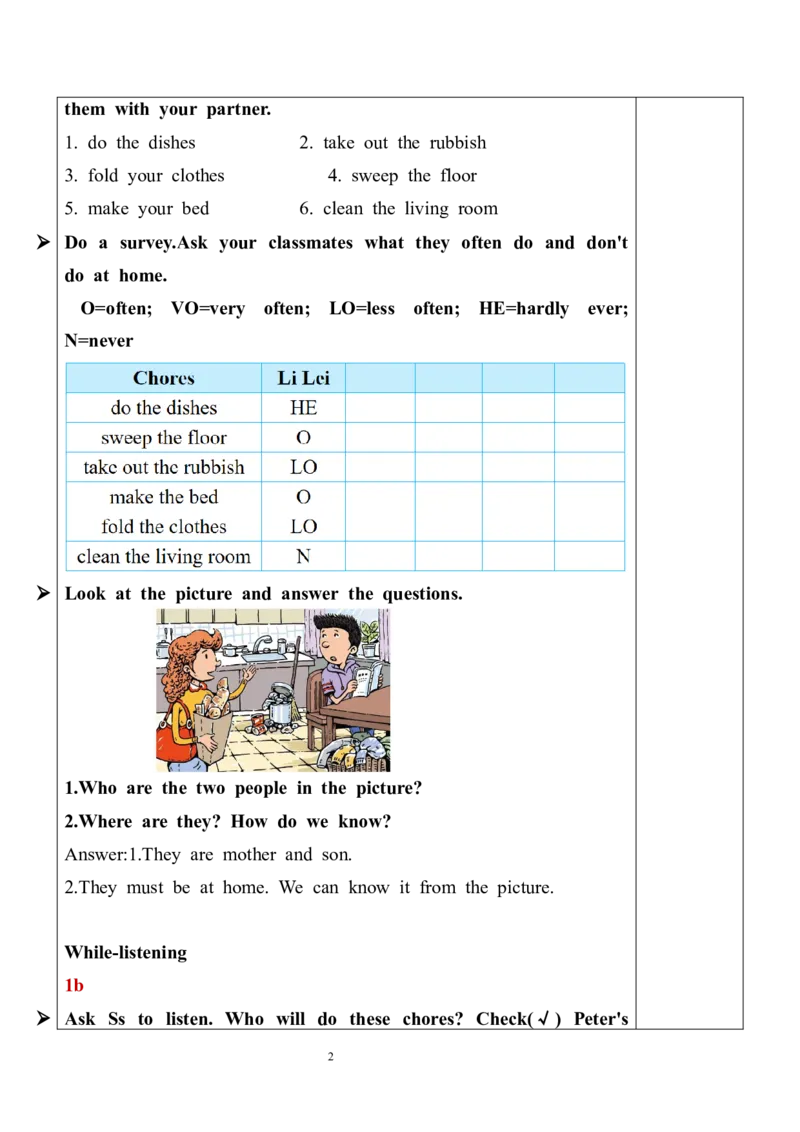
Do a survey.Ask your classmates what they often do and don't
do at home.
O=often; VO=very often; LO=less often; HE=hardly ever;
N=never
Look at the picture and answer the questions.
1.Who are the two people in the picture?
2.Where are they? How do we know?
Answer:1.They are mother and son.
2.They must be at home. We can know it from the picture.
While-listening
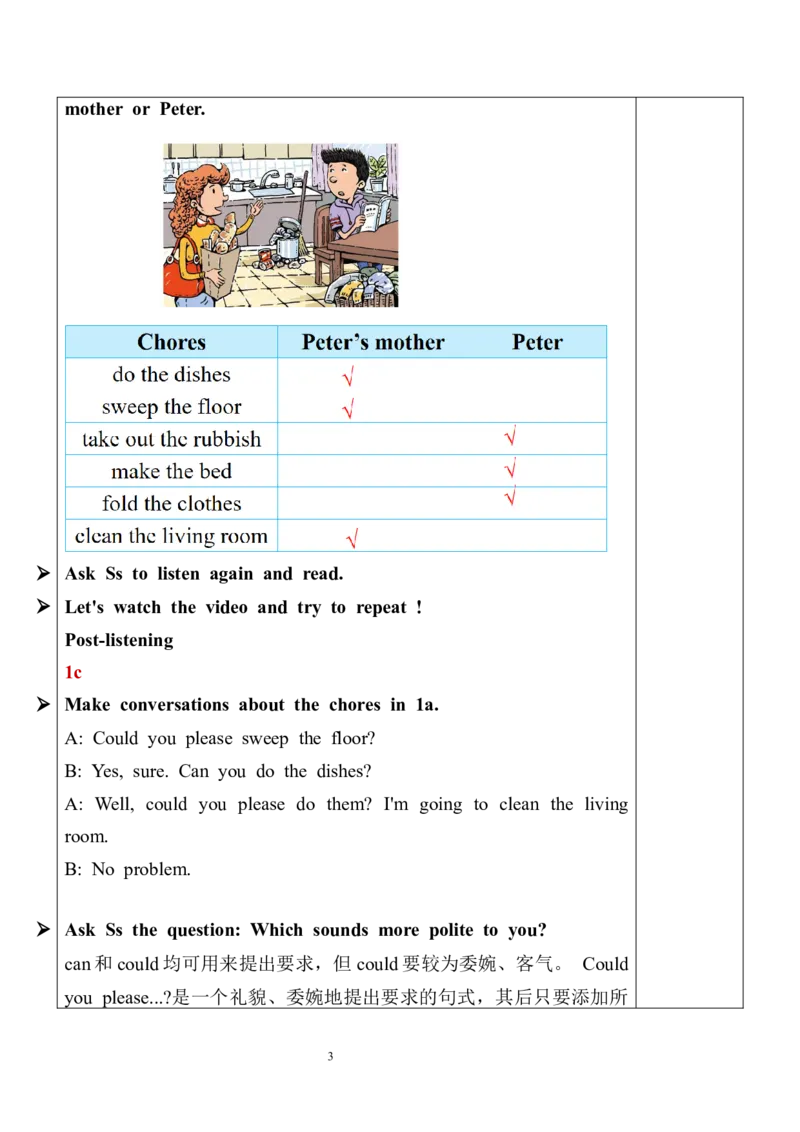
1b
Ask Ss to listen. Who will do these chores? Check(√) Peter's
2mother or Peter.
Ask Ss to listen again and read.
Let's watch the video and try to repeat !
Post-listening
1c
Make conversations about the chores in 1a.
A: Could you please sweep the floor?
B: Yes, sure. Can you do the dishes?
A: Well, could you please do them? I'm going to clean the living
room.
B: No problem.
Ask Ss the question: Which sounds more polite to you?
can和could均可用来提出要求,但 could要较为委婉、客气。 Could
you please...?是一个礼貌、委婉地提出要求的句式,其后只要添加所
3要求内容即可,please后接动词原形。
Pair work. Work in pairs, make conversations about the chores.
A: Could you please take out the rubbish?
B: Yes, sure. Can you make your bed?
A: Well, could you please do them? I'm going to buy some food in
the supermarket.
B: No problem.
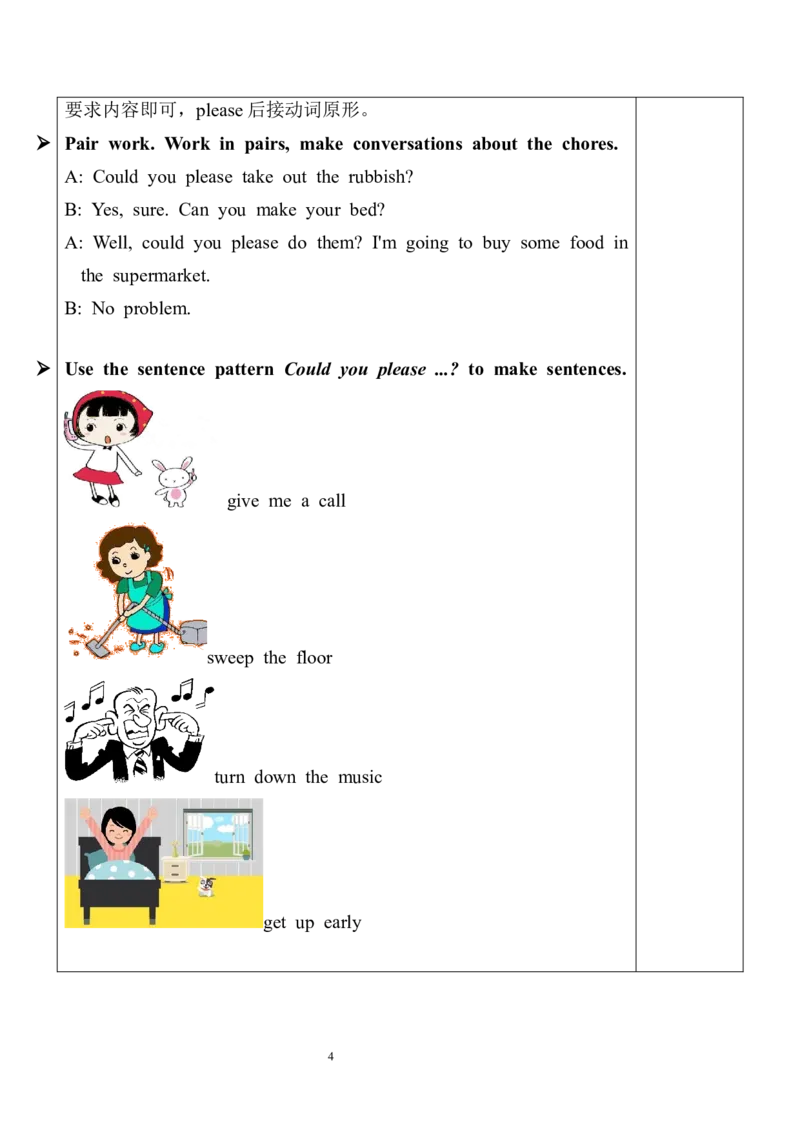
Use the sentence pattern Could you please ...? to make sentences.
give me a call
sweep the floor
turn down the music
get up early
4cook for us
open the window
What will you response(回复) if somebody says “Could you
please …”?
—Could you please clean your room?
—I’m sorry. I’ll do it right away.
—Could you please take out the rubbish?
—Yes, Sure./ Of course. / All right. / OK.
A: Could you please make the bed?
B: Sorry, I can’t. I have to do my homework.
Use the sentence pattern Could you please not ...? to make
sentences.
play soccer here
5play computer games
speak loudly
What will you response if somebody says “Could you please
not…”?
—Could you please not play football on the road?
—I’m sorry. I won’t do it again.
—Could you please not smoke here?
—I’m sorry. I’ll go out.
Step 3 Language points learning
1. Peter, could you please take out the rubbish?
1)Could you please do sth. ? 意为“请你做……好吗?” 表示委婉地
请求或建议。
肯定回答:Sure./Of course./Certainly./No problem.等。
否定回答:Sorry,I can't.(可说明理由。)
注意:回答不用could.
否定形式:Could you please not do sth.?
2) take out 带出去;取出
take out为“动词+副词”型短语。其接代词作宾语时,代词应放在
take和out之间;接名词作宾语时,名词放在take和out之间或out之
后均可。
The dog is noisy. Can you take it out?
I usually take my phone out/take out my phone when I sit down.
6【拓展延伸】 take... out of... 意为“把……从……中取出”。
I took the money out of my wallet to pay for the breakfast.
Step 4 Summary & Homework
Summary
Could you please …? Yes, I can.
do the dishes “Yes” All right.
sweep the floor Sure.
take out the rubbish No problem.
make your bed Certainly.
fold your clothes No , I can’t…
clean the living room “No” I have to …
open the door Sorry, I can’t…
I have to …
Homework
Preview the conversation in 2d.
Do the exercises in students’ book.
In this unit, students will learn how to make polite requests and ask
for permission. In the first period, the main task is to make students
Teaching
learn how to make polite requests. According to the well-designed
Reflection
tasks, we can get students to learn the target language easily. After
speaking practice, let them summarize what they have learned.
7